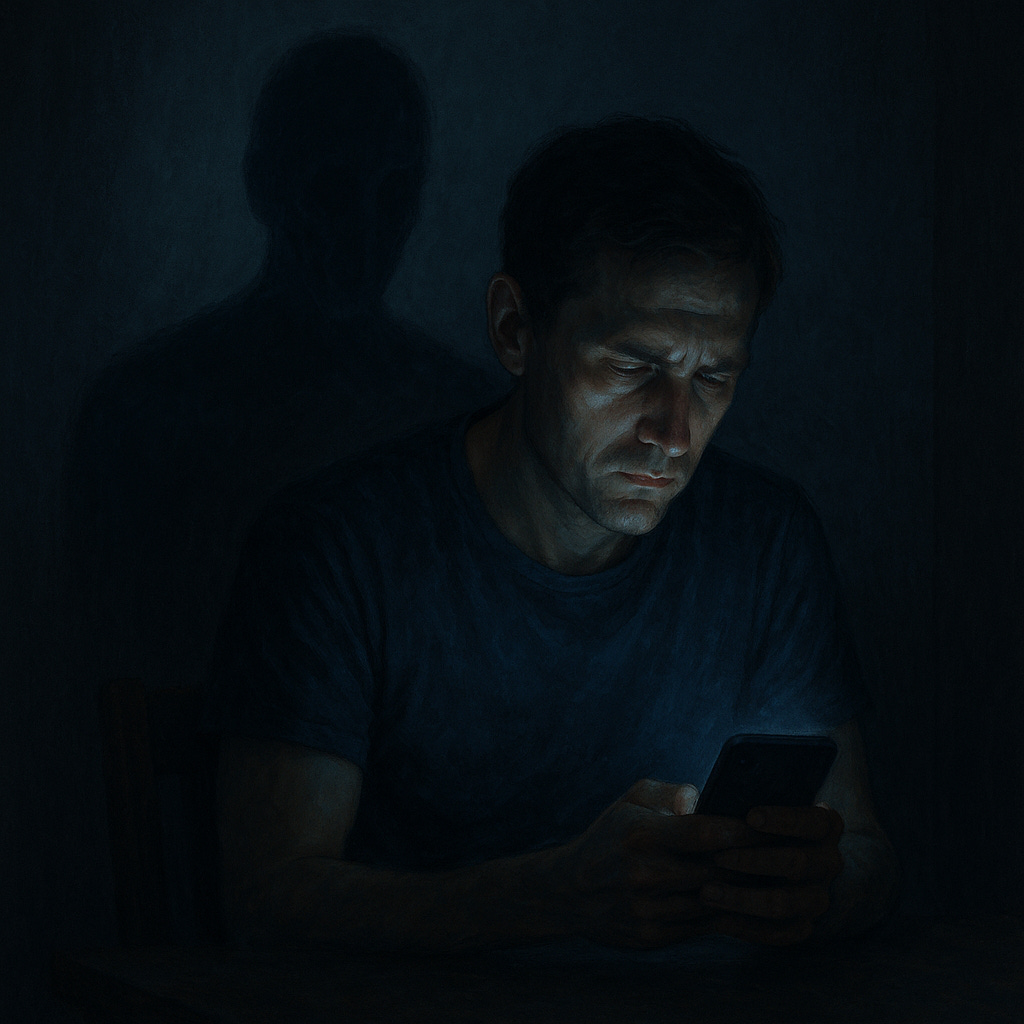
Section 1 — The Day He Lived Online
He wakes before the alarm because the phone lights his face. Face ID, then the flood: news badges, a text from his manager, two new comments on a video he watched at midnight. His thumb opens YouTube the way other people open curtains. “One simple hack to fix your sleep,” a pre-roll whispers while he’s still horizontal. He taps “Learn more,” skims a landing page with lavender gradients and graphs he doesn’t read, and buys magnesium gummies plus a productivity app’s free trial. It feels like doing something before doing anything.
In the bathroom, the mirror shows a man who slept, technically. He brushes his teeth while a short plays about “how you’ve been lied to about breakfast.” A midroll promises “clarity, finally” about finances. He files it under Later, which means he will buy it the second anxiety spikes.
Coffee, then headlines. He flicks past them. The phone suggests a creator he trusts—friendly, certain, always filming in a room that looks like victory. The creator says two things that land: you’re right to feel stressed; here’s a way out. A link sits under the video. He taps it and leaves the page open. The open page relaxes him more than the coffee.
By eight-thirty he’s at his desk. A tab labeled “lofi beats” is playing, but the other tab—the one he promised himself he wouldn’t touch until lunch—glows like a door left ajar. He reaches for it after a Slack message pings with an airy “quick question” that isn’t quick. The video chain starts with a hustle tip and slides into a supplement ad that claims to reduce “brain fog” and “modern toxicity.” He reads the bullet points and sees himself inside them. Subscribe-and-save is cheaper. He clicks.
The morning moves the way rivers erode rock—slowly and inevitably. Tasks fracture into checks and micro-rewards: an email sent, a tab opened, a sip, a swipe. He tells himself he’s multi-tasking; he’s actually multi-escaping. When a colleague posts a document and tags him twice, his chest tightens and his thumb is already on the phone, looking for the next little lift.
Late morning, a creator posts “the clip they don’t want you to see.” It’s a takedown, cleanly edited, with the exact rhythm his nervous system respects: setup, indignation, punchline, victory. In the midroll, a muscular voice recites ingredients he can’t pronounce, “backed by studies,” with a timer counting down a 20% discount. He adds it to the cart and leaves it there because leaving it there feels like self-care.
Lunch is a sandwich over the keyboard. He watches a long-form review of a small device that promises to fix posture and productivity. The reviewer has the tone of a friend who won’t steer you wrong. “Support the channel,” he says. One click later, the device is on its way and the reviewer thanks him silently in the part of his brain that mistook a transaction for fellowship.
There’s a text from the person he’s been seeing. “Tonight still on?” He types “work is crazy,” deletes it, types “can we rain check?” and sends. She replies with a thumbs-up that feels like shut-down. He sets the phone down face-down, then picks it back up because face-down makes the anxiety louder.
The two o’clock meeting is a glacier, inching and heavy. He keeps his camera off and his feed on mute, then “just for a second” opens the other tab. Shorts now: a fast-cut sequence—gym advice; a promise that AI will replace lazy people; a clip of a politician “owning” someone at a rally. He doesn’t like politics, he tells himself; he likes clarity. The clip provides it, like a sharp inhale. “Say it louder,” someone comments. He adds three fire emojis and feels, improbably, like he contributed to the nation.
By three he is tired in a way sleep won’t fix. He clicks to buy the finance mini-course he left open that morning. It’s an investment, he thinks, and the thought is soothing. Another midroll says “men don’t talk about this enough,” and he nods because he has been appreciating content like that lately—content that names a hunger he can’t. The checkout page offers a lifetime plan “for serious people.” He hovers, then declines, proud of his restraint.
Afternoon slides into the familiar skirmishes. He posts a comment correcting someone. Another person replies with contempt, and his heart rate lifts. He crafts a careful counter with links and a joke, checks for likes, refreshes, checks again. The attention of strangers buoys him for five minutes at a time.
At six he should stop. Instead, he watches a montage of “best moments” from a press briefing—sharp elbows, clean quips, theater. He thinks: Finally, someone who fights. It scratches the same itch an ad scratches: salvation, but for the body politic. He sends the clip to a group chat labeled with a joke from 2019. Three guys respond instantly. This is the most responsive any set of men in his life has ever been.
Dinner is DoorDash and a promise to himself to cook tomorrow. He eats on the couch, and the couch is a dock for his phone. The algorithm has learned his pulse. It alternates: a collapse video—markets, borders, values—then a video promising a way out—habits, supplements, side-hustles, a leader. He feels smarter with each watch and emptier between them, the way candy makes you hungrier later.
A notification from his bank pops up. He doesn’t open it. A notification from his favorite creator pops up. He opens it before thinking. The creator talks about “taking control” and “not waiting for permission” and “building your own castle,” the precise phrases that turn the volume down inside his chest. There’s a link. He clicks it, scrolls, doesn’t buy this time. He imagines buying and gets 60% of the relief anyway.
There’s a text from his mother he delays. There’s an email from his boss he flags and forgets. There’s a friend he’s been meaning to call, but he puts that promise on the same shelf as learning the guitar, cooking on Sundays, and going to bed without the phone.
By nine-thirty he is angry at people he has never met. A commentator explains why everything feels worse and who is to blame. He nods along, grateful for the architecture. He does not notice how often “they” changes definition; he likes the way it steadies the room.
By ten-thirty the feed is a slow river carrying him past more of what he already believes. A timer appears in a corner: special pricing ends in 00:14:59. He buys on instinct, somewhere between a prayer and a stretch. He sits back, exhales, and feels okay for six minutes.
He tells himself one more and then sleep. The last video is a “ten lessons I learned at 35” confessional. It’s earnest, and he wants to be earnest too. He bookmarks it to watch again and never will. He scrolls comments until the names blur and the faces in circles look like a crowd outside a stadium he can’t enter.
He plugs the phone in. Blue light fills the small room like weather. He thinks tomorrow he’ll do it differently—no phone before breakfast, a walk, he’ll call his mother, he’ll cook something, he’ll finish the big thing at work. He imagines a day like that the way he imagines a product arriving: it will fix something he cannot name.
He sleeps with the screen still warm on the nightstand. On it, a red dot waits patiently for him to wake up.
Section 2 — Follow the Money: Who the Algorithm Over-Samples
Let’s be precise. Platforms don’t have ideologies; they have objective functions. YouTube optimizes for watch-time and engagement. Google Ads optimizes for return on ad spend—show more impressions to users who click and convert. When you point a system at those goals for long enough, you don’t get a random public square. You get a statistical mirror of the people who supply the most profitable signals.
That mirror is not “the poor working class.” It is an anxious consumer class: economically comfortable enough to spend, digitally immersed enough to be reachable at all hours, and psychologically restless enough to respond to promises of relief. They are the conversion engine of the modern internet. Because they click, buy, and watch more, the system treats them as the center—and shapes the feed to keep them there.
What the system actually optimizes for
* Attention density: Content that sustains arousal and reduces drop-off (outrage, revelation, simplicity) gets promoted.
* Conversion propensity: Users who respond to offers—supplements, courses, gadgets, subscriptions—see more of them.
* Cost efficiency: Creators and advertisers who hit these notes cheaply and consistently get reinforced.
Over time this creates a selection effect. The feed is trained on the behavior of the most engaged and most convertible users, so it over-samples their tastes, fears, and rhythms. Everyone else is still present, but they’re swimming in water flavored by a cohort that the model has learned not to lose.
Who gets amplified
Call them the anxious consumer class. Common traits:
* Economically OK, emotionally unmoored. They’re not destitute; they are time-starved, comparison-soaked, and meaning-hungry.
* Attention dysregulation. Quick to click, quick to feel, quick to seek the next fix.
* Status sensitivity. Highly responsive to cues of humiliation, respect, belonging, and comeback.
* Parasocial trust. They believe the creator who “gets” them; trust transfers from video to checkout.
This cohort is not a moral category; it’s a behavioral cluster. It includes liberals and conservatives, gym people and book people, earnest improvement seekers and practiced doomers. What unites them is how they respond to the machine.
Demographic overlays (descriptive, not essentialist)
Psychographics drive the story; demographics tint it:
* United States: The highest-monetizing slice skews white, 25–54, suburban/para-urban, with disposable income and deep phone time. Not exclusively, but disproportionately.
* India: The highest-monetizing slice skews upper-caste, English-mediated, urban professional. Again, not exclusively.
* Other regions have their own overlays (Japan/Korea: national majorities under hyper-competition; Western Europe: ethnic majorities with cultural continuity anxiety). Different identities, same conversion psychology.
These skews matter because advertisers bid where money moves, and platforms learn where bids clear. The feed inside your hand is shaped by those flows.
The majority illusion
A small but hyper-reactive group can look like the center of public life if it supplies most of the measurable signals—clicks, comments, watch-time, purchases. The result is an algorithmic majority illusion: the street feels plural, but the feed feels like one loud story. That story is not necessarily the median voter; it’s the median converter.
From ads to politics (same loop, different promises)
Once you see the loop, the political tint makes sense:
* Ads sell personal restoration: energy back, focus back, control back.
* Spectacle politics sells collective restoration: dignity back, order back, country back.
Both rely on high-arousal simplicity (a villain, a fix, a deadline) and both reward performative intensity over quiet competence. It’s no accident that the memetic, always-on presidency thrived in this environment; it matches the cadence the platform pays for. The same cohort that responds to “one simple hack” also responds to “say it louder.” Different nouns, same reinforcement schedule.
Why “working-class revolt” misleads
It’s not that working-class voters don’t matter—they do. It’s that the visible center of gravity online is pulled by the people who spend the most time and money in the system. That tends to be the anxious consumer class, not the economically incapacitated. Confusing material deprivation with algorithmic centrality hides the real engine: affluence without meaning becomes attention without brakes.
The thesis, stated plainly
YouTube feels more reactionary than the street not because society is, but because the platform’s revenue function over-samples an anxious, high-conversion consumer cohort. In the U.S. that cohort is disproportionately white; in India, disproportionately upper-caste urban. Their tastes—fast clarity, high emotion, restoration narratives—become the feed’s house style. What we mistake for a population shift is often a profit-weighted echo.
Hold that mechanism, and the rest of the essay follows: the hollow center it exploits (Section 3), and a humane way to step off the ride (Section 4).
Section 3 — The Hollow Center
Boredom is not the absence of stimulation; it’s the absence of meaning. Once the day is paced by tiny highs, the lows arrive like weather, and the easiest way to name the low is disgust. It needs an object. Sometimes it picks “the left,” sometimes “the elites,” sometimes “the neighbors who don’t get it.” The object changes because the ache doesn’t. What sounds like moral clarity often begins as self-escape—anger that feels cleaner than grief, certainty that feels safer than doubt, enemies that feel simpler than the quiet question: why am I empty when I have so much?
The feed is a skilled accomplice. It knows how to turn emptiness into architecture. It offers a sequence that never fails: a clip to confirm your fear, a takedown to relieve it, a product to manage the residue. The more that cycle works, the more it becomes identity. After a while, outrage isn’t a feeling you have; it’s a place you live. You can measure residence by reflex: the headline half-read, the comment already forming, the jaw set before a thought arrives. It feels like conviction but it’s closer to a nervous system trying to keep itself together.
In that state, “disgust at the left” is often disgust at one’s own drift—at the parts of life that went unchosen because the scroll was easier than the silence. The algorithm doesn’t invent that disgust; it supplies choreography. It tells you when to clap, when to laugh, when to sneer, and the applause you get in return is bright and brief. The buzz fades, the room is quiet again, the body asks what it always asks—now what?—and the hand goes back to the phone because the phone never asks you to sit with the answer.
Even religion, when seized as costume, can become just another performance in this loop. You can cloak impatience in doctrine and call it zeal; you can baptize resentment and call it courage. But if what it produces is chronic contempt, it isn’t spiritual—no matter the symbols. That isn’t a theological judgment so much as a physiological one: the nervous system that is constantly braced cannot love. It can defend, perform, and win. It cannot soften. Spirituality worth the name lowers the guard without lowering the gaze. It makes people quieter, not smaller; kinder, not blinder. You can hear it in the voice: less edge, more air.
What passes for “authenticity” online—volume, certainty, a taste for humiliation—hooks so well because it imitates the feeling of aliveness without demanding the disciplines that sustain actual life. It is cheaper than prayer, easier than friendship, faster than service, and it lights up the same circuitry. The purchase that promises transformation, the clip that promises justice, the leader who promises restoration—each is a fast-forward button that leaves the story shorter and thinner when it stops. The comedown is predictable: a little shame, a little bitterness, the return of a shapeless fear that needs a shape. Give it a logo. Give it a party. Give it a villain.
If that sounds harsh, consider how ordinary it is. Most people in this economy of attention are decent and tired. They were not taught what to do with ache that has no name. The culture taught them to manage it with inputs. The inputs became habits, the habits became moods, the moods became politics. From there it’s a short step to seeing every call for restraint as hypocrisy, every call for care as weakness, every call for complexity as a con. It’s hard to be gentle with others when you have been hard on yourself for years and called it discipline.
There is another way to describe the hollow center that doesn’t accuse anyone: it is the place where a person should be held by rituals, stories, and neighbors, and instead they are held by a feed. The feed is tireless and clever but it does not know your name. It knows your patterns. It cannot bless; it can only trigger. It cannot forgive; it can only forget until tomorrow. And so disgust becomes the daily sacrament, a quick ceremony of self-cleansing performed against the nearest available “them,” followed by the liturgy of the checkout page, followed by sleep that never quite restores.
The test is simple and brutal: if your devotions—political, religious, cultural—make you angrier, smaller, and more certain than you were last month, they are not healing you. If they leave you a little more patient with the slow work of ordinary life, they might be the beginning of a soul. The anxious consumer class is not damned; it is dehydrated. It keeps drinking salt water because the cup is always there and the first sip feels like relief. Real water exists. It will taste like less for a while. Then it will taste like freedom.
Section 4 — Repair
He doesn’t fix his life. He changes his morning. The phone sleeps in the kitchen now. When he wakes, there is a minute of nothing—just breathing and light. It feels wrong for three days and then it feels like air. He pours water, stands by a window, and writes two lines in a notebook: what matters today, who he’ll care for. Not grand. Something like “finish the draft” and “text my sister.” The lists are short on purpose. The feeling of finishing them lands deeper than any badge a platform ever gave him.
He still watches YouTube, but not like before. No autoplay. Subscriptions instead of recommendations. He opens the app on a laptop at lunch, not on his phone in bed. He uses search. He turns off notifications and the red dots lose their power. He keeps a small list of channels that make him calmer after he closes the lid. If a video leaves him buzzing or resentful, he unsubscribes. He notices that when he chooses content, it chooses him back differently. The feed starts to soften in the way a room softens when you open a window.
Work becomes one block at a time. He tries ninety minutes on, ten off, and forgives himself when he breaks it. He sets a timer, closes chat, finishes a paragraph, gets up, walks around the block without headphones. The walk feels empty the first week and then begins to feel like resetting a compass. He eats lunch away from the keyboard twice a week. He chews. He remembers that food has a temperature. The afternoon is still heavy some days, but there is less of that strange, white noise in his head.
At night he learns to make one simple thing well—eggs, then a pot of lentils, then roast vegetables. He cooks enough to leave some for tomorrow so that tomorrow starts kinder. He makes a call while the water boils. Sometimes it’s five minutes, sometimes it’s ten. He doesn’t aim for deep; he aims for regular. The people who love him stop hearing from him only when he’s in trouble. He begins to say “I was wrong” faster. He notices how often the urge to argue online shrinks after he has washed a dish or taken out the trash.
There is a small circle that meets on Wednesdays at a library room: four people, a table, no performance. They read a short piece—wisdom from any tradition—as a way to get to the part of the week that never makes it into feeds. They talk about what actually happened in their homes and bodies. He says out loud that he is tired and a little scared. No one fixes him. They nod. Someone offers to go for a walk on Saturday. The desire to explain everything fades when you have a place to say one true sentence.
He prays, though he doesn’t call it that. Ten minutes of quiet before dinner, eyes open. He sits, lets thoughts pass, and when he remembers, he breathes out slowly. He notices that the anger that used to arrive like a thunderclap now arrives like weather he can see from a distance. On days when the quiet is too hard, he reads a page or two from a book that asks him to be patient and useful. He writes down the one line that lands. He puts it on the fridge. His apartment slowly fills with sentences that tell him who he wants to be when the screen is off.
He still buys things, but not as anesthesia. He waits twenty-four hours on anything over a small amount. Most carts evaporate by morning. The ones that remain are tools he actually use—shoes he will walk in, a pan, a lamp. The subscription box that promised a new self every month gets canceled. The bank notification gets opened. He makes a simple budget on a single sheet—rent, food, savings, the rest—and the sheet stays on the desk. The numbers are not perfect. They are a mirror that doesn’t lie.
Politics changes shape. He swaps clips for summaries, outrage for context. He keeps a short list of sources, reads once a day, and that is enough. He sends one email to a local group about a small task he can actually do. He shows up for two hours on a weekend to sort boxes or knock on doors or take notes. The satisfaction is quiet and lasts longer than a share. He notices how different people feel when you are close enough to see their shoes. His opinions don’t flatten; they cool. He still cares about the country. He just doesn’t need the rush to prove it.
None of this is straight. Some nights the old current pulls him under and he scrolls until midnight and buys the thing he promised not to buy. He doesn’t call it failure. He calls it information. The next day looks like the better days again. The loops that used to run him now run less often and with less force. The gap between stimulus and response, which used to be a crack, becomes a step.
After a month, the same man from Section 1 wakes up and doesn’t reach for the glow. He steps into a morning that belongs to him. He works and finishes something that had sat half-done for weeks. He answers his mother. He meets the Wednesday circle and listens more than he talks. He watches two videos he chose and closes the laptop without the tug. He eats food he cooked. He goes to bed before his body turns brittle. The feed on his phone is different because he is different. He has taught the machine, gently, who he is willing to be.
Nothing dramatic has happened. There is no new identity to post. But the quiet is thicker. The days have edges. He is less angry at strangers, which frees up a kind of strength he didn’t know was buried under the habit of being upset. He is not cured. He is practicing. The practice leaves a trace that people around him can feel, even if they can’t name it: fewer apologies after sharp words, a steadier tone, a decent kindness that doesn’t need to be seen to count. He sleeps, and the red dot in the other room waits alone.
Epilogue — The Rest of Us
If you read this and felt a sting of recognition, that’s not an indictment; it’s a map. The man in the first chapter isn’t a villain. He’s an average modern, which is to say a person whose nervous system was drafted into a job it never applied for: supplying a stream of profitable signals to machines. Some do it louder, some do it prettier, some do it with better lighting, but the current is the same. It moves through offices and subways and living rooms, through left and right and none-of-the-above. It moves through decent people who were trained to measure their days by pings instead of promises kept.
The platforms will not save us from the platforms. They are very good at what they were built to do. They can be pressured, litigated, regulated; they can be made less predatory and more transparent; they can be asked to add friction where they’ve engineered the world smooth. All of that matters and should be done. But even if tomorrow’s feeds were gentler, the ache that made the old ones addictive would still need somewhere to go. The problem beneath the problem is older than code: human restlessness without a story big enough to hold it.
There is no hero class waiting offstage to hand us that story. The anxious consumers are not “those people.” In another hour, on another day, they are us. We’ve all refreshed a page hoping it would refresh us. We’ve all confused intensity for truth, performance for love, certainty for courage. We have all, at some point, chosen the clean burn of contempt over the slower work of care and called it realism. The fix is not a purge of the weak-willed; it’s a gentling of the will itself, practiced daily, locally, with and for imperfect neighbors.
You can feel a culture by what it quietly honors. Ours has paid outsize dividends to spectacle and speed. The bill arrives as thinning attention, brittle politics, and a private loneliness loud enough to drown out the street. It doesn’t have to stay that way. We can raise the status of quiet competence—the nurse who is kind on hour eleven, the mechanic who won’t upcharge, the teacher who calls a kid’s name the way doors are opened. We can praise the friend who shows up without a take, the colleague who finishes the unglamorous task, the neighbor who knocks once a month and asks if anything needs fixing. Attention is a commons. What we celebrate, we seed.
None of this requires sainthood. It asks for small fidelities repeated until they accrue. Keep the phone in another room at night. Read one honest page. Cook one simple meal. Walk without headphones until you can hear your own breath. Pick one place to serve that isn’t optimized for your image. Speak once a week to someone who knew you before you had a “presence.” Vote, not as an exorcism, but as a maintenance routine. Let your opinions cool before you carry them into the room. Refuse the adrenaline discount: the idea that being charged up makes your judgment cheaper and your soul more expensive.
If you have power in the making of the world—engineer, designer, lawyer, investor—use it to add friction where harm accelerates. Defaults teach. So do limits. So do labels that tell the truth about what a product is doing to a mind. If you lead a room, make it a place where deep work is possible and where people don’t have to perform hunger to be fed. If you lead a family, make boredom survivable; it is a training ground for attention, which is a training ground for love.
The man from the first chapter still exists. He will always exist, because the conditions that made him are not going away. But he can be surrounded by people who catch him before the cliff of midnight; by infrastructures that don’t price his weakness for profit; by circles that expect goodness from him and are patient when he misses. If enough of us make those circles and those infrastructures, the feed will change—not because the code discovered a conscience, but because we did and taught it how to recognize one.
Walk outside. The street is stubbornly ordinary in the best way: someone tugging a dog that won’t, a kid wobbling on a bike, an old man measuring the day by the length of shade on the sidewalk. No one there is optimized. No one is trending. The world has not become what the worst corner of your recommendations imply; it has become what attention makes of it, one person at a time, choosing where to place their gaze and, by placing it, what to grow.
The phone will keep lighting up. It is very good at waiting. Let it wait longer. Learn your neighbor’s name again. Practice one true kindness you don’t post. Let your convictions be strong and your tone be slow. Keep the practices that gave the man in Section 4 a shape to live inside. This is not a withdrawal from the world; it is a re-entry. If we do it together, the street will start to feel like the world again—and the world, for once, will feel like it belongs to adults.
—Elias WinterAuthor of Language Matters, a space for reflection on language, power, and decline.