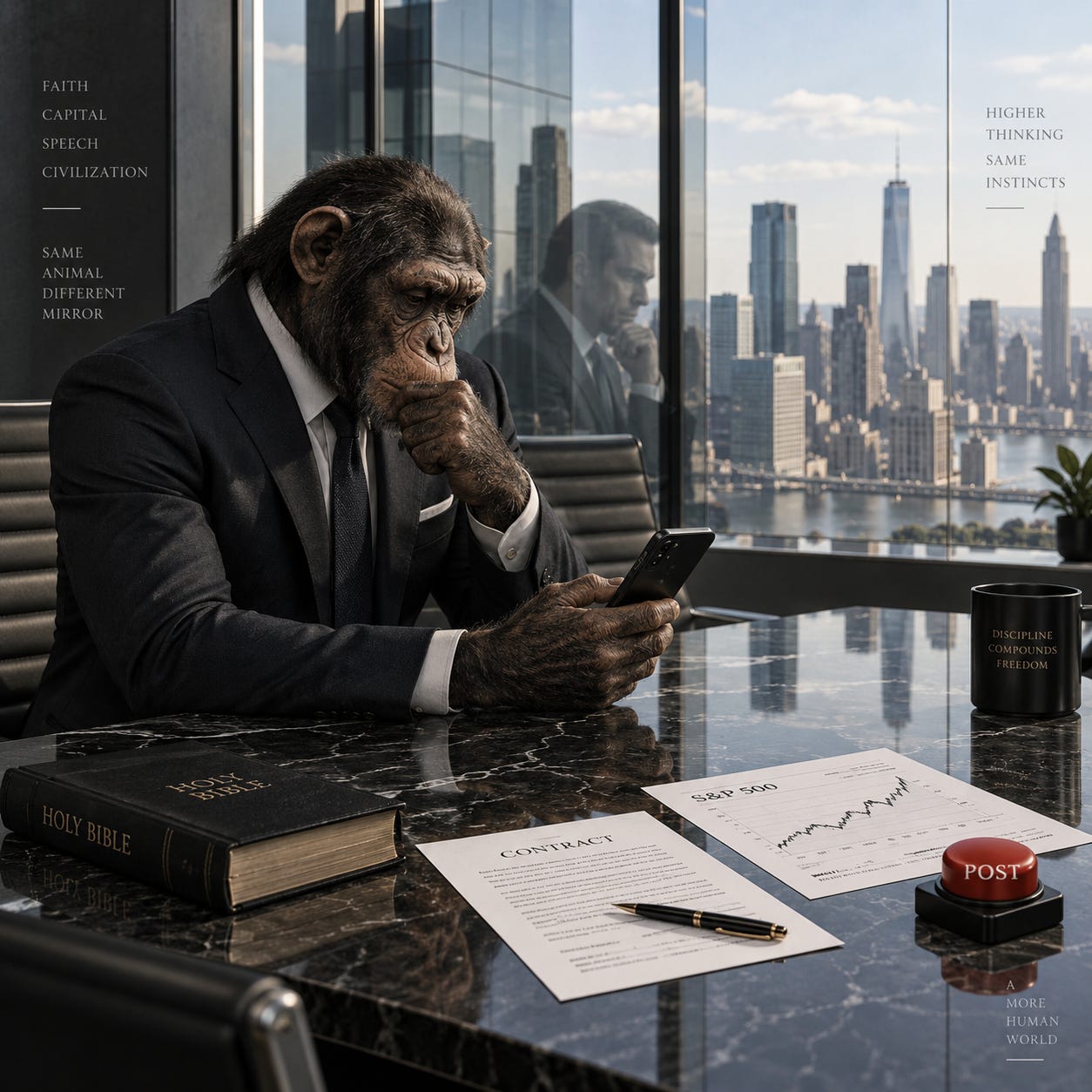
The argument began, as many serious arguments do, with parking.
A man in a black SUV had stopped halfway across the entrance to a grocery store lot, apparently because the normal rules of geometry no longer applied to him. There were cars behind him. There were cars trying to get out. There was a woman with a stroller attempting to cross. The man remained where he was, blinking at his phone.
I watched myself become Attila the Hun.
Not externally. Externally, I was excellent. I waited. I sighed. I looked meaningfully through my windshield. Internally I had already dissolved his estate, exiled his descendants, and drafted legislation preventing people like him from operating machinery larger than a toaster.
This transformation took perhaps eleven seconds.
And I thought: civilization is remarkable.
Not because the violent impulse disappeared. It had not disappeared at all. The animal was doing very well. The animal had excellent cardiovascular function. The animal had opinions.
Civilization was the thin structure standing between the animal and the black SUV.
I did not drag the driver from his vehicle. I did not challenge him to single combat. I did not summon my cousins. I did not appeal to the honor of my tribe. I sat in my climate-controlled car and muttered something about idiots.
This should not be underestimated.
We tend to imagine civilization as marble, literature, constitutional government, orchestras, sewer systems, universities, law, architecture, and perhaps French cheese. These are all nice. But underneath them is something more primitive.
Civilization is the control of violence.
Human beings are animals. Animals have appetites. Animals compete. Animals fear. Animals become territorial. Animals experience humiliation. Animals want sex, status, food, recognition, revenge, and sometimes the parking space.
Civilization does not remove those instincts. It trains them. It delays them. It redirects them. It builds procedures around them.
Instead of killing your neighbor, you sue him. Instead of raiding the neighboring village, you place tariffs on it. Instead of executing the man who insulted your family, you stop speaking to him and quietly hope his business fails.
Progress comes in stages.
The point is that civilization does not require human beings to become angels. It requires animals to accept limits.
And that immediately creates a question far more difficult than law:
Why should they?
I. Why Should I Not Punch Him?
A red light can stop a car. A policeman can stop a fight. A court can stop revenge. But no civilization can place a policeman inside every human nervous system.
Most social order is voluntary.
You accept losing an election. You wait in line. You pay taxes for schools your children do not attend. You refrain from setting fire to the home of a bureaucrat whose decision ruined your afternoon. You accept that some people will have more than you. You accept that some will have less. You tolerate speech that makes your skin itch. You watch your country spend money on people you will never meet.
You restrain yourself because somewhere beneath law is a story explaining why restraint is worth the trouble.
That story changes. Sometimes it is God. Sometimes the nation. Sometimes the republic. Sometimes the revolution. Sometimes the king. Sometimes progress. Sometimes human dignity. Sometimes the story is simply: these are our people.
Meaning, in this sense, is not luxury.
A society does not require everybody to be extremely comfortable. It requires enough people to believe that remaining inside the group is preferable to tearing the group apart.
Comfort helps. Meaning helps more.
A man will endure considerable hardship if he believes the hardship belongs to a story.
Parents do this constantly. They lose sleep, money, freedom, hair, and occasionally sanity because there is a child at the center of the sacrifice. The sacrifice has meaning.
Soldiers tolerate horrors civilians cannot imagine because they believe something larger stands behind them. Religious people fast. Immigrants work impossible jobs. Families care for old people who have forgotten their names. Civilization depends upon millions of such acts, most of which never receive a TED Talk.
Albert Camus understood this in The Plague. The city does not survive because everybody develops an elegant theory of morality. People show up. They carry stretchers. They keep records. They bury the dead. They do unpleasant things because somebody must.
Civilization is less heroic than we like to imagine. It is maintenance. It is Tuesday. It is somebody fixing a pipe. It is somebody answering the phone. It is somebody cleaning the wound. It is a man deciding not to punch another man in a parking lot.
But sacrifice without a story feels like extraction.
And this is where the modern trouble begins.
A common “we” that costs nothing is usually marketing.
A real “we” makes demands. It says: pay something. Forgive something. Wait for something. Lose something. Serve someone. Restrain yourself. Accept that another person has standing even when that person is inconvenient.
If nobody can explain why, eventually the animal asks a reasonable question:
Why exactly am I doing this?
II. The Enemy Is Much More Convenient
Building a common “we” is difficult. Finding a common enemy is easy.
This may be one of the oldest political discoveries in human history, right after fire and lying.
A society organized around a positive purpose has to answer complicated questions. What are we building? What do we owe one another? What counts as fairness? Who sacrifices? Who decides? What happens when we disagree?
This is exhausting.
A society organized around an enemy requires only one sentence:
Those b******s are doing this to us.
Instant meaning. Instant belonging. Instant innocence.
The enemy is the spiritual energy drink of political life. No preparation required. No introspection. No refrigeration. Open the can and within minutes you know who you are.
I am one of the good people because I oppose the bad people.
This is psychologically magnificent.
The human mind loves external explanations for internal disturbance. If I am angry, somebody made me angry. If I am humiliated, somebody humiliated me. If my society is deteriorating, somebody destroyed it. If my life disappoints me, perhaps somewhere there is an immigrant, banker, feminist, capitalist, socialist, Zionist, Muslim, Christian, atheist, globalist, nationalist, professor, billionaire, welfare recipient, coastal elite, rural idiot, bureaucrat, or person with the wrong lawn sign who can explain everything.
The list is remarkably customizable.
This is not to say external injustice is imaginary.
People are genuinely exploited. Governments genuinely lie. Corporations genuinely manipulate. Countries invade other countries. Families damage children. Bosses behave badly. Institutions fail.
The point is not that injury is unreal. The point is that injury can become a total theory of the self.
And once that happens, victimhood performs a very useful psychological service. It protects innocence.
Self-introspection says: what happened to me may have been wrong. Now what is happening inside me?
Self-victimization says: what is happening inside me is entirely explained by what they did.
The difference is enormous.
Introspection complicates innocence. Victimhood preserves it.
The first is spiritually expensive. The second is politically efficient.
Arthur Miller understood this in The Crucible. Accusation does not merely punish outsiders. It purifies insiders. Once the village learns that evil belongs to specific people, moral complexity becomes unnecessary. The accused carry the darkness. The accusers carry righteousness.
This arrangement is very convenient until everyone is dead.
Dostoevsky saw the same danger from another angle.
Raskolnikov in Crime and Punishment creates a moral theory allowing exceptional men to step across ordinary boundaries. He does not think of himself as a murderer. He has philosophy.
This is important.
Human beings …