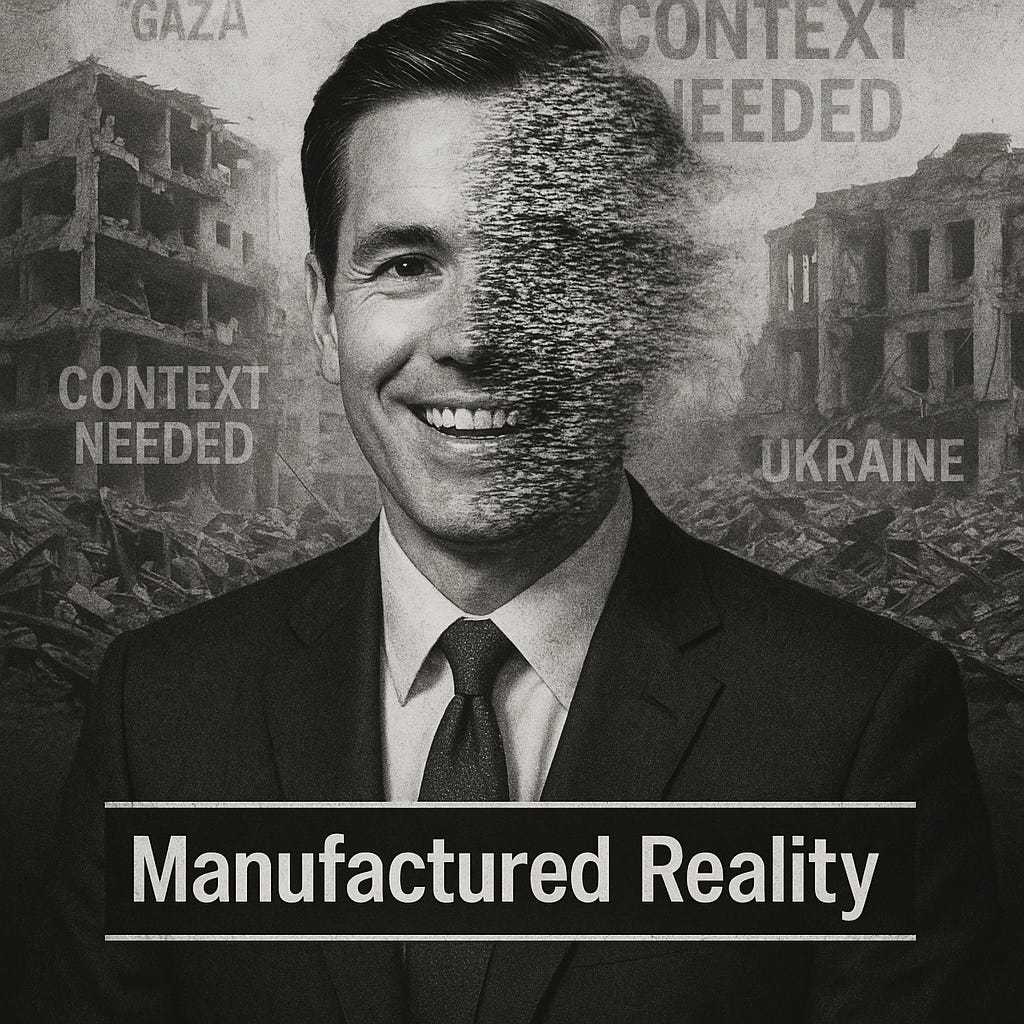
I. The Wire as Nervous System
There is no “news.” There is only signal. And the signal flows through a narrow funnel.
We live in a civilization that calls itself free while feeding almost exclusively on a cloned stream of perception. The average person, when scrolling the homepage of The Guardian, CNN, or Le Monde, imagines they are witnessing a diversity of thought. In reality, they are being fed the same content—pre-framed, pre-captioned, and often pre-cleansed—by a handful of centralized wire services.
Reuters. Associated Press. Agence France-Presse. These are not neutral newsrooms. They are the central nervous system of narrative empire.
They do not merely transmit facts—they define the boundaries of the real. They decide whose death is visible, whose terror is credible, and whose grief deserves a caption.
The image of a child pulled from rubble in Gaza or Ukraine is not chosen by your local paper—it is chosen by a single editor at AFP, distributed globally, and republished without scrutiny. The word “militant” may appear, but you will not meet the dead. The phrase “airstrike” may fill a headline, but you will not be told by whom, or why, or what remains of the father who stood nearby.
The system launders perspective into fact. The narrative becomes architecture.
II. Bernays and the Priesthood of Perception
The machine did not emerge by accident. It was built.
Edward Bernays—the nephew of Freud and the architect of public relations—understood that democracy was not a dialogue but a theater. He called it a “necessary manipulation.” He believed the masses could not be trusted with raw truth. They had to be guided, massaged, sold a version of reality clean enough to swallow.
He helped sell World War I by branding it a crusade for democracy. He sold cigarettes as feminism. He sold bacon as breakfast. He sold lies wrapped in the illusion of liberation.
But his greatest trick was this: he taught the elite that their manipulation was moral.
Modern journalism—its tone, its detachment, its obsessive framing—was not corrupted from without. It was instructed from within. Bernays did not merely distort truth. He convinced the world that truth was unsafe without him.
III. Cold War Theater: The Cultural Front
The Cold War was never just about nukes. It was about narrative dominance.
The CIA funneled money into magazines, museums, concerts, and conferences. It propped up philosophers. It funded modern art. It orchestrated the aesthetic of “freedom” through abstraction, jazz, and moral selectivity.
They called it The Congress for Cultural Freedom. But what it really was—what it remains—is an epistemic occupation. A war for the frame.
Even today, the residue remains: Western violence is “defensive,” dissent is “extremist,” and truth is that which aligns with official narrative.
This was not a bug. It was the purpose of the machine.
IV. Iraq and the Crime of Language
In 2003, the empire staged a war—and the media directed it.
Weapons of mass destruction became scripture. Journalists became embeds. The invasion of a sovereign nation was called “shock and awe,” and the dead were reduced to “collateral.”
When a statue fell in Baghdad, it was choreographed like theater. A handful of onlookers. A cleared square. A photo made for headlines and textbooks.
The camera framed liberation. The rubble, the rape, the ruin—left unspoken.
No one was held accountable. Not the generals. Not the editors. Not the polished anchors who swallowed the talking points and smiled at the lens.
The lie was not buried. It was aired live.
V. The Algorithm: Ministry of Truth 2.0
The old gatekeepers were named. The new ones are lines of code.
Search engines, feeds, filters, safety teams—these are not neutral systems. They are moral engines masquerading as convenience. They amplify, suppress, and disappear—not by decree, but by design.
You are not censored. You are buried.
A thread about a hospital bombing may be labeled “context needed.” A video of a massacre may vanish into “community standards.” The truth, if it survives, is allowed no reach. No preview. No trend.
This is not Orwell. It is something colder. Smoother. A censorship that never raises its voice.
VI. Language as Occupation
Every empire occupies land. But first, it occupies words.
A journalist does not say “massacre”—he says “clash.” A bomb does not kill—it “neutralizes.” The child is not murdered—he is “collateral.”
The language is passive. The grammar is strategic. The voice is dead.
This is not about bias. It is about domination. It is about shaping the moral imagination of a population until they forget how to speak plainly.
Until they forget how to feel.
VII. Who Narrates the World?
The question is not “What happened?”
The question is: Who gets to name what happened?
The real power today is not held by tanks or ballots—it is held by the narrative class. The editors. The engineers. The fact-checkers who sanctify alignment. The anchors who smile while describing a “targeted operation.”
They do not wear uniforms. They do not shout. But they decide what you are allowed to see, and how you are allowed to feel about it.
This is not conspiracy. This is empire.
Its weapon is not the gun. It is the caption.
Its victory is not in victory. It is in forgetting.
Final Words
To speak clearly in such a world is an act of rebellion. To name things honestly is to refuse the spell.
Say “occupation” when they say “dispute.” Say “massacre” when they say “strike.” Say “truth” when they offer only framing.
Because the greatest crime of empire is not just what it does.
It is what it teaches you not to see.
—Elias WinterAuthor of Language Matters, a space for reflection on language, power, and decline.