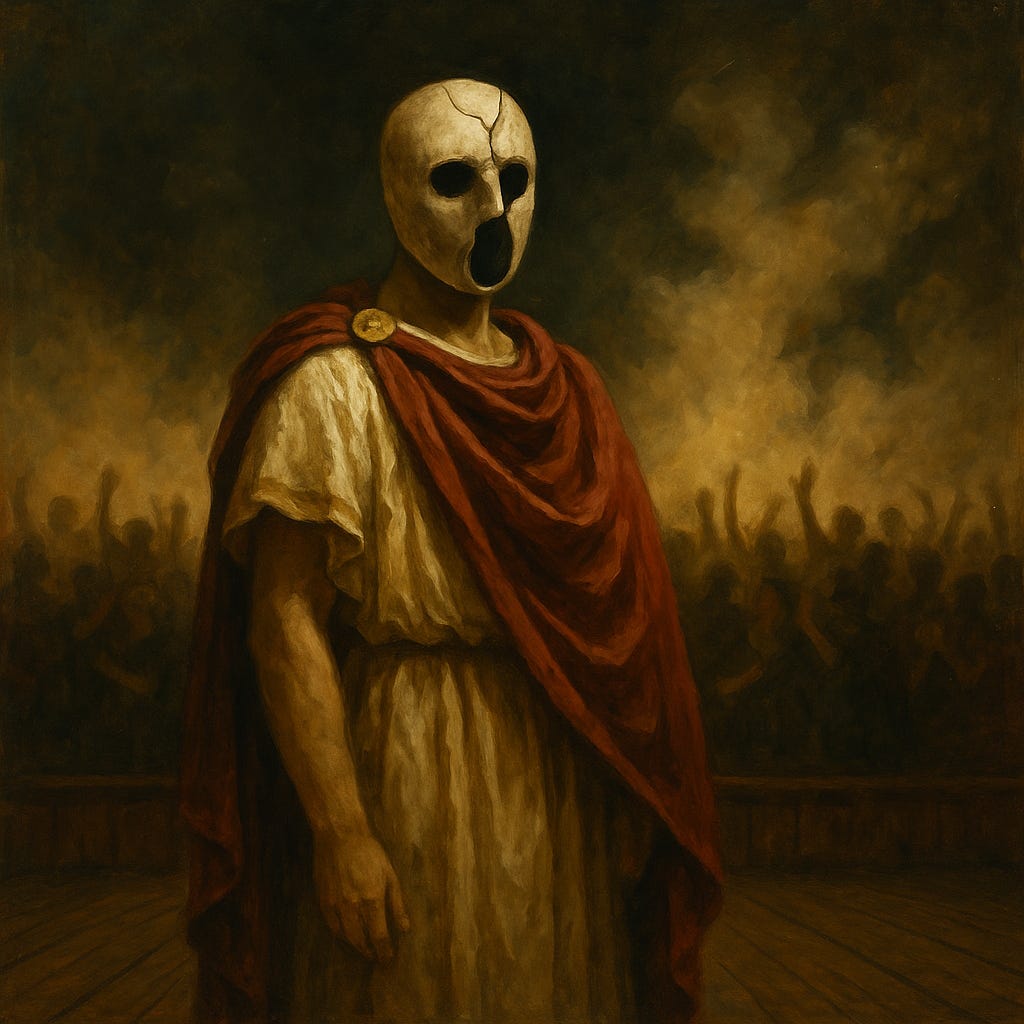
Every empire believes itself to be eternal. It builds in stone what others built in clay, it binds its laws to heaven as though marble were not just quarried rock but destiny itself. And yet, beneath the weight of monuments and the vanity of permanence, the structure trembles. It trembles not because the walls are weak, but because the spirit that sustains them has already begun to hollow.
Rome in the first century was such an empire: unrivaled in territory, unmatched in wealth, drenched in the blood of victories so decisive that even memory could not exhaust them. It was the Rome of legions stationed at the ends of the known world, Rome of aqueducts and forums, Rome of a Senate that still spoke the language of freedom even as its power shrank into ceremony. Outwardly, it was secure. Inwardly, it was already in decline.
The decline did not begin with famine, or plague, or invasion. It began in the theater.
An emperor ascended who wanted not merely to rule but to be seen. To be admired, applauded, adored. To him, governance was not the management of armies or the stewardship of laws; it was performance. His reign was not administration but spectacle. And if the empire was to be governed at all, it would be governed through the stage: through appearances, rumors, gestures, and the choreography of fear.
This was not weakness in the ordinary sense. Rome remained strong in armies and revenues, in marble and firepower. But strength can coexist with fragility, and the form of fragility that corrodes empires first is always the same: the substitution of appearance for substance, spectacle for trust, applause for authority. When power becomes theater, the stage devours the state.
It is tempting, in hindsight, to dismiss this as decadence: a mad emperor, a city on fire, a dynasty collapsing under its own corruption. But decadence is not a synonym for decline; it is its disguise. Decadence is the mask a civilization wears as it forgets its own wounds. Rome did not fall because marble cracked—it fell because memory did. Because its people, lulled by games and rumors and the intoxication of performance, no longer remembered what rule had been for, nor what power had once demanded.
And so, as flames licked through the city, as suspicion consumed the Senate, as scapegoats were dragged into the arena, Rome discovered that an empire can be vast, wealthy, armed to the teeth, and yet already ash. Ash carried in the breath of its people, ash disguised as applause.
This is not the story of Rome’s fall, which would take centuries more. It is the story of how an empire can burn while still standing, how collapse begins not with invasion but with forgetting. It is the story of an emperor who mistook the roar of a crowd for the voice of history.
It is the story of power as art, and art as ruin.
Chapter 1: The Theater of the Emperor
He was sixteen when the empire fell into his hands. Too young, too untested, too malleable for the weight of rule. But Rome had already grown accustomed to youth on the throne. The empire preferred pliability, an heir who could be guided by tutors, restrained by generals, and managed by the Senate. A boy could be molded into a man, a ruler into an emperor.
What they did not anticipate was that the boy would insist on being something else entirely. Not ruler, not soldier, not even legislator. He wanted to be an artist.
In his eyes, the purple cloak of the emperor was not a burden but a costume, the palace not a seat of governance but a stage. He studied his gestures in the mirror, rehearsed lines for effect, tuned his voice as though command itself were music. Where others saw duty, he saw performance; where others demanded authority, he sought applause.
The Senate looked on in disdain. To them, art belonged to slaves and foreigners. To act upon the stage was shameful; to sing before strangers was vulgar. Roman dignity rested upon restraint, upon the illusion of disdain for spectacle even as they consumed it. And here was their emperor, draped in silk, plucking the strings of a lyre, bowing to applause.
Yet the people loved him. They filled the theaters, they shouted his name, they welcomed the sight of their ruler descending from the heights of power into the intimacy of performance. For the crowd, it was not a humiliation but a thrill: the emperor belonged to them. Not aloof, not untouchable, but sweating under the lights as they did, hungry for the same sound that moved their own hearts—the roar of approval.
This was the secret: spectacle bound ruler and ruled more tightly than law. Laws could be broken, ignored, reinterpreted. Spectacle was immediate, binding, visceral. The empire was learning that applause could replace loyalty, that performance could stand in for governance.
And yet the applause carried with it a curse. Applause is never satisfied. It demands novelty, excess, escalation. A song one night requires a poem the next, a recitation today leads to a public dance tomorrow. What begins as a performance becomes a hunger, and the hunger consumes. The emperor was no longer free to govern; he was captive to the stage he had built for himself.
To the Senate, this was disgrace. To the generals, it was weakness. To the people, it was intoxicating. But to the empire, it was fatal. For once governance becomes theater, every decision is weighed not for its wisdom but for its dramatic effect. Every act of state is measured by its reception, every policy by its applause. And a ruler who governs for applause will burn everything—institutions, traditions, even cities themselves—so long as the crowd keeps cheering.
The boy-emperor became the artist-emperor. And Rome itself, whether it knew it or not, became his audience.
Chapter 2: The Guilt of Proximity
Every empire fears its own shadows. Power that rests upon appearances must guard against those who might pierce the illusion, and in such a climate suspicion becomes its own currency. Under Nero, suspicion was everywhere.
The whispers began in corridors, in gardens, in hushed exchanges between senators who still dreamed of the Republic. The emperor’s theatrics amused the people, but to Rome’s elite they reeked of decadence, of an erosion not just of dignity but of power itself. If the ruler was an actor, then what became of those who had once been sovereign? To them, the empire was being staged as a play, and they were reduced to unwilling extras.
Plots formed, as they always do, not from strength but from desperation. Senators muttered of restoring honor, generals hinted of loyalty to ideals older than the boy on the throne. It was inevitable that one such scheme—the Pisonian conspiracy—would be exposed. And once exposed, it became more than a plot; it became a floodgate.
For in an empire ruled by paranoia, guilt is not confined to the guilty. To be near the accused was itself accusation. To have shared a meal, a word, a silence with a conspirator was to be implicated. The circle widened: friends of friends, relatives of cousins, poets who had written verses now re-read as subversive. The web of suspicion tightened not because the emperor feared a single plot, but because performance demands an audience, and the easiest way to control an audience is to terrify it.
The arrests multiplied. Torture yielded names, names yielded more names. The empire discovered a grim efficiency: proximity itself could condemn. Under such conditions, no one was innocent, because innocence itself was proximity to power.
And so Rome became a city where silence was survival. To speak was to risk misinterpretation; to refrain from speaking was to risk association. Citizens walked like shadows, cautious of whom they greeted, careful of which homes they entered, fearful of which memories might be summoned against them. In this climate, truth no longer mattered. Accusation was enough.
The emperor did not need to know who truly conspired against him. He only needed the theater of discovery, the spectacle of punishment, the fear that kept applause flowing. Terror is its own performance, and in Rome it filled the stage as surely as music or flame.
Thus the empire learned a darker lesson: power is preserved not only by loyalty but by the fear of guilt by proximity. And when proximity is itself a crime, everyone lives under sentence.
Chapter 3: The Flood of Accusations
What begins as suspicion soon becomes system. Once proximity is criminal, accusation becomes the empire’s true currency. It flows more easily than coin, more destructively than fire, and once unleashed, it cannot be contained.
In Nero’s Rome, the accusation was not merely a tool of justice—it was an instrument of advancement. To denounce a neighbor was to display loyalty. To unmask a colleague was to prove vigilance. Informants multiplied, some official, many not, until truth itself drowned beneath the weight of testimony. A rumor whispered in the Forum could carry a man to his death before he ever knew he had been accused.
This was the economy of fear: denunciation paid in survival. Citizens accused to shield themselves, to deflect suspicion, to prove their obedience to the throne. The emperor did not need to orchestrate every charge; the culture of accusation became self-sustaining, a machine that devoured trust and spat out terror.
The Senate, once the guardian of debate, found its chamber echoing with rehearsed condemnations. Poets learned to lace their verses with flattery, lest their silences be misread. Friends ceased to confide in one another, for words could be recited, twisted, weaponized. Rome was no longer a republic of laws nor even an empire of decrees—it was a stage managed by accusations, with the emperor as its unwillingly indispensable audience.
And yet, accusations are addictive. The more they circulated, the more they were needed. Each execution demanded another. Each spectacle of punishment required new victims to sustain the illusion of vigilance. To halt the flow would have been to admit that the threat was never as vast as claimed, that the empire had been condemning itself out of fear of shadows. Better, then, to continue. Better to sacrifice the few for the silence of the many.
The crowd learned to cheer these spectacles as it cheered the games. The accused became entertainment, their downfall another act in the endless play of empire. The theater of survival merged seamlessly with the theater of art: one day an emperor singing, the next day an accused senator dragged to his death, both consumed by the same hunger for applause.
So the accusations poured in, unstoppable as a flood. Truth was irrelevant. What mattered was volume. A thousand accusations could not all be false, it was said, and so the empire drowned in its own excess.
And in that flood, the line between guilt and innocence dissolved. There were only the accusers and the accused—and each citizen understood how easily one could become the other.
Chapter 4: The Fire and the Blame
It began in the night, as so many endings do. A spark in the wooden stalls of the Circus Maximus, a flame carried by wind through narrow streets, dry timbers, and crowded insulae. Rome had burned before, but never like this. The fire raged for days, leaping from hill to hill, consuming temples and homes alike, turning marble black and bronze molten. The city that had believed itself eternal suddenly looked mortal.
The people whispered what they always whisper: that the gods were angry, that fate had turned, that some hidden hand had guided the flame. In the silence between screams, a rumor spread: that it was not an accident at all—that the emperor himself had ordered the city burned.
Why? To clear space for his grand design, a palace of impossible scale, gardens where whole neighborhoods once stood. The accusation clung to him, perhaps unfairly, but power built on spectacle has no defense against suspicion. An emperor who had made himself an actor could not escape the suspicion that he had scripted the fire as well.
The truth no longer mattered. What mattered was the perception, and perception demanded a counter-performance. To survive, the emperor needed not only to rebuild the city but to redirect its fury. And so a scapegoat was chosen.
The Christians were a strange sect—small, scattered, despised. They refused the gods, defied custom, rejected the empire’s rituals. Their stubbornness made them convenient enemies. The emperor declared them guilty of arson, guilty of sacrilege, guilty of bringing divine wrath upon the city.
The punishments were spectacular, as they were meant to be. Christians torn by dogs, burned alive to light imperial gardens, crucified in rows for the public to watch. The city that had been reduced to ash was entertained by new flames, this time sanctioned, this time theatrical. The empire turned its terror into ceremony, its fear into ritual slaughter.
The people cheered. Not because they believed in the Christians’ guilt, but because blame was a balm. To watch others suffer was to forget their own suffering, if only for an evening. Scapegoating was not merely a diversion; it was a form of governance. By directing the crowd’s rage outward, the emperor preserved his place on the stage.
But scapegoats are never enough. The fire had revealed more than destruction; it had revealed fragility. An empire that could lose its capital to flame was an empire already trembling. No scapegoat could conceal the truth forever: that Rome, like its emperor, had mistaken applause for strength, and that the applause could not drown out the sound of cracking foundations.
The fire destroyed much, but it revealed more. It showed that the empire’s greatest weakness was not its enemies, nor its accidents, but its need to preserve the performance at any cost.
Chapter 5: Bread, Circuses, and Forgetting
The city smoldered, blackened columns jutting like broken teeth against the sky, whole districts flattened to ash. Rebuilding would take years, but survival demanded something quicker than stone. And so the emperor reached for what Rome always reached for in crisis: spectacle.
The formula was older than him. Bread and circuses. Feed the people, distract them, and their anger dissolves. It had worked for centuries. Hunger makes citizens restless; satisfaction makes them docile. But food alone cannot erase the memory of flame. For that, the people required distraction—saturation of the senses, immersion in noise and color until memory itself faded.
So the games multiplied. Gladiators fought in greater numbers, the blood of men becoming a kind of civic glue. Exotic beasts were imported, slain before cheering crowds who marveled at the empire’s reach. Chariot races stretched late into the night, crowds roaring as if their cries could drown out the memory of burning homes. Music, theater, poetry—all flourished, not as art, but as anesthesia.
The emperor himself became the star attraction. His voice filled the amphitheaters, his songs carried on the wind. He performed as though Rome itself depended on the sound of his notes, and in a sense it did. For as long as the people were entertained, they forgot. They forgot the fire, the executions, the conspiracies, the terror. Forgetting was the empire’s most reliable survival strategy.
But forgetting carries its own cost. To forget is also to unlearn, to lose the memory of what power was meant to be. The Romans had once boasted of virtus, of dignity, of restraint, of laws that bound even emperors. Now they remembered only the immediacy of pleasure and the narcotic of spectacle. What they forgot was their own role as citizens.
In that forgetting, power shifted irrevocably. The emperor no longer needed to justify his rule by competence or policy. He needed only to keep the games abundant and the bread flowing. Governance was no longer the administration of empire but the management of distraction.
And yet even distraction is fragile. Spectacle soothes, but it also numbs. Each game required more blood, each performance more extravagance, each festival more excess. The people, once pacified, became addicts to their own forgetting. The empire fed this hunger, not realizing it was feeding a sickness.
An empire that forgets is an empire already dying. For memory is what binds a people together—memory of struggle, of sacrifice, of law, of what they had once believed themselves to be. Rome surrendered that memory for the price of applause, and the applause was always hungry for more.
Thus the city rebuilt not on stone but on distraction. Its ruins were masked with festivals, its losses concealed beneath music, its wounds cauterized by noise. Rome had chosen to forget itself, and in forgetting, it hastened its own unraveling.
Chapter 6: The Collapse of Trust
Spectacle can buy time, but it cannot purchase loyalty. Bread may pacify hunger, games may drown memory, but trust—once broken—cannot be rebuilt with noise.
Nero discovered this truth slowly, almost imperceptibly, like a man applauded one night and jeered the next. The Senate, humiliated by years of subservience, began to seethe in silence. Once an emperor’s decrees had to be negotiated; now they were performed. Each senator understood that his dignity had been reduced to theater, his vote a stage prop in the emperor’s endless play.
The generals fared little better. Rome’s legions were the true backbone of empire, loyal when respected, brutal when betrayed. Soldiers admired strength, decisiveness, discipline. They watched their emperor sing in Greek theaters, draped in robes foreign to Roman austerity, and they despised him. For them, power was not song but command. Rumors spread through the camps that the emperor was unfit to lead, that the armies deserved a ruler who marched with them rather than performed for the mob.
Even the people, who once cheered his every song, began to tire. Applause can be fervent, but it is never eternal. What once thrilled them now wearied them. Bread grew scarce again, games less abundant, taxes heavier. The distractions no longer distracted. And when suffering returns, memory returns with it. The fire was remembered. The scapegoats were remembered. The executions were remembered. The emperor, once adored, became once again the subject of rumor and resentment.
The machinery of accusation turned inward. Those who had once denounced others now feared being denounced themselves. Informants lost credibility, trials lost spectacle, the theater of paranoia collapsed under its own repetition. Fear, once so effective, dulled into exhaustion.
Power, in the end, is trust disguised as strength. When trust disintegrates, strength is revealed for what it is: brittle, temporary, desperate. Nero learned this as his allies abandoned him, as the Senate declared him an enemy of the state, as generals raised banners against him. He who had sought applause above all else found only silence.
The collapse did not come with foreign invasion. It came from within: a Senate that would no longer tolerate humiliation, legions that would no longer follow, a people who would no longer be entertained. An empire does not fall when it loses battles. It falls when it loses belief in itself.
And so the emperor who mistook governance for art discovered that even art cannot survive when the audience walks away.
Epilogue: The Silence After Applause
He fled the city that had once roared for him. The emperor who had filled Rome’s theaters with his voice now crept through back alleys in disguise, deserted by guards, abandoned by senators, mocked by those who had once cheered. Power, which had seemed so absolute, vanished overnight. Applause cannot be hoarded; it dissolves the moment it is not renewed.
Hunted by decree, declared a public enemy, he wandered outside the city until only a handful remained with him. The man who had commanded legions and filled amphitheaters stood reduced to a fugitive, trembling at the thought of capture. Rome no longer feared him. Rome no longer believed him. The crowd had moved on to other dramas.
In the final moment, surrounded in a villa, he hesitated. Death required courage that performance had never demanded. He faltered, begged another to strike the fatal blow, then, at last, forced the dagger into his own throat. His last words were not of empire, not of Rome, not of God or law. They were of art. Qualis artifex pereo—“What an artist dies in me.”
It was a confession and a miscalculation at once. He was not wrong: his reign had been a work of art, but art transfigured into ruin. He had made of governance a theater, of fear a stage, of empire a performance. And performances, by nature, end.
The empire staggered on. Civil war followed, then new dynasties, then centuries more of dominion. Rome did not fall with Nero; it survived him. But something in it had already cracked, something trust could never restore. The emperor had shown the people that rule itself could be a spectacle, that power could be hollowed out and yet still appear intact. Once revealed, that knowledge could not be forgotten.
What remained was silence—the silence after applause, when the stage is empty, the torches extinguished, the crowd dispersed. It is the silence in which an empire asks itself what it has witnessed, and whether it was ever real.
That silence haunted Rome long after Nero’s death. And it haunts every empire that mistakes performance for permanence, every power that believes applause can outlast truth. For silence always returns, and when it does, it speaks more loudly than any cheer.
—Elias WinterAuthor of Language Matters, a space for reflection on language, power, and decline.
Thanks for reading Language Matters! Subscribe for free to receive new posts and support my work.