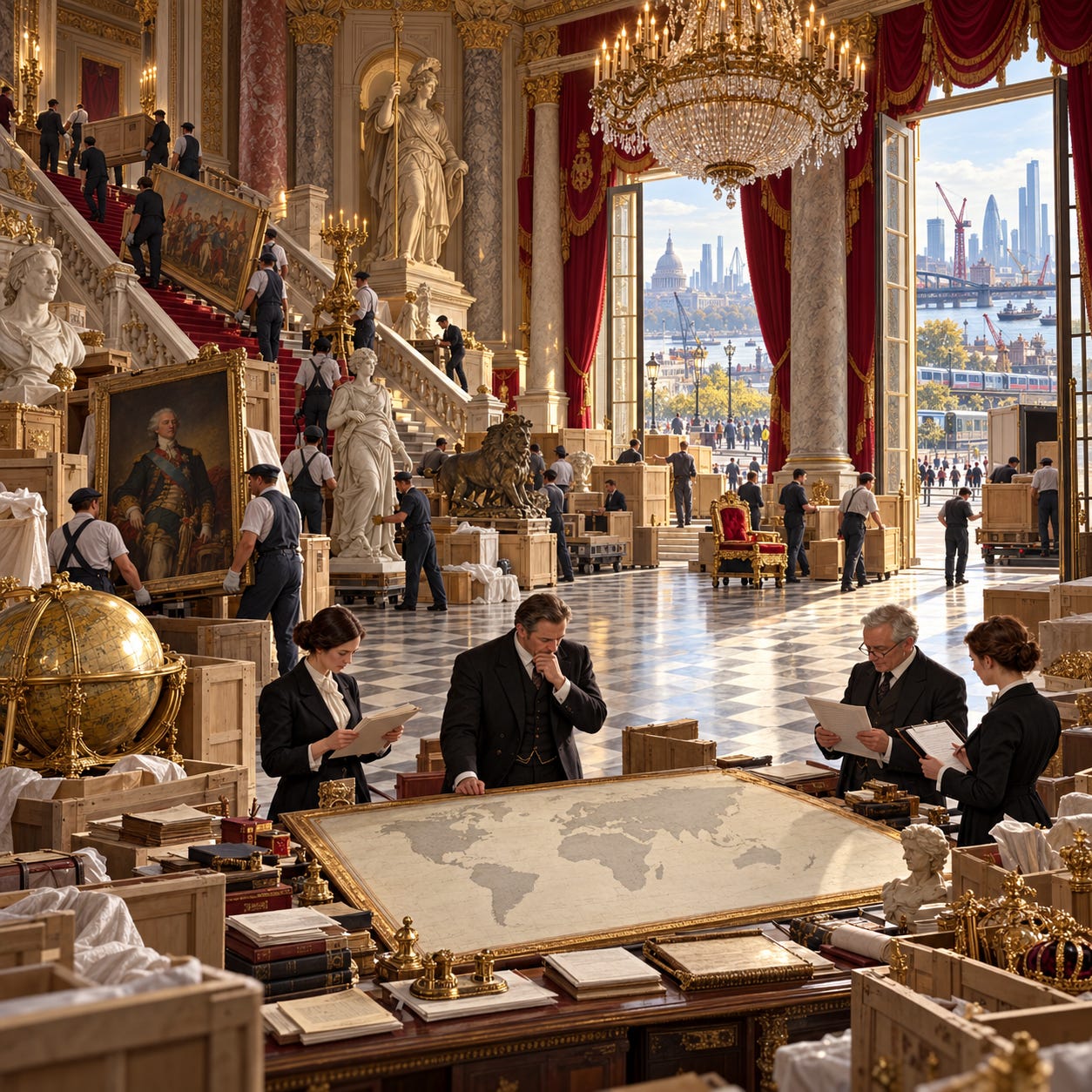
There is an awkward conversation the West has been avoiding for some time. It concerns a rather unfortunate development: the empire is ending, the colonies are no longer interested in being colonies, and the inhabitants of the imperial center are beginning to discover that maintaining an extraordinarily comfortable civilization becomes considerably more complicated when the rest of the world stops contributing to the arrangement against its will. Naturally, instead of discussing this predicament, we have decided to argue about gender-neutral bathrooms, campus drama and which books deserve a shelf in our school libraries. It is a remarkably efficient system. We can discuss absolutely everything except the thing that explains much of what we are discussing.
Perhaps we should begin with an impolite word: empire. I know. It is terribly old-fashioned. It conjures images of British gentlemen with impressive mustaches, standing over maps of Africa while deciding which rivers belonged to His Majesty. We prefer more sophisticated language now. We have international leadership, strategic partnerships, security commitments, and the rules-based international order. The old colonizer stole things. The Americans established partnerships. The vocabulary has improved considerably, even if the people on the receiving end have occasionally struggled to appreciate the distinction.
Europe’s rise to global dominance was a peculiar historical achievement, born partly from its inability to stop fighting itself. Geography fragmented the continent into competing kingdoms, churches, principalities, and ambitious aristocrats who spent centuries finding theological justifications for murdering one another. This produced an extraordinary concentration of military competition. But something remarkable emerged from the violence. Rival states competed for commerce, knowledge, military technology, and talented people. A scientist persecuted by one monarch could sometimes find refuge under another. Ideas crossed borders, even when armies could not. Scientific inquiry, commerce, and eventually the Enlightenment helped transform a continent of warring monarchies into societies capable of producing remarkable intellectual and political institutions. Europe made genuine contributions to civilization. Its scientific achievements, constitutional traditions, and eventual development of democracy were extraordinary. It would be absurd to deny them.
Unfortunately, Europe also developed the ships and weapons necessary to make other people’s contributions available for European consumption.
Colonialism was theft conducted with an impressive amount of administrative paperwork. Land was conquered, resources appropriated, labor coerced, and entire economies reorganized to serve distant capitals. Military superiority enabled extraction on a scale that substantially enriched imperial powers. The wealth generated through industrialization, science, technology, and productive labor developed within a world in which European states also enjoyed enormous advantages from their colonial possessions. To hear some accounts of British economic history, one might imagine that Britain became wealthy through punctuality, tea, and an exceptional national commitment to working hard, while India happened to become poor through a regrettable shortage of entrepreneurial enthusiasm.
As wealth accumulated and European societies developed, ordinary people began demanding a share of the prosperity. Workers organized, education expanded, democratic institutions grew, and citizens acquired rights their ancestors could scarcely have imagined. These were genuine achievements, frequently won against the resistance of ruling elites. They deserve recognition. Yet the extraordinary contradiction remains: while Europeans increasingly demanded liberty for themselves, their governments continued denying it to populations abroad. Democracy expanded at home while imperial domination continued overseas. The European citizen was becoming a political subject entitled to rights. The colonial subject was still awaiting a suitable administrative classification.
Then something deeply inconvenient happened. The rest of the world began catching up.
Colonized populations rebelled. Independence movements succeeded. Industrial knowledge spread. Countries once regarded as suppliers of raw materials developed scientific institutions, military capabilities, and political ambitions of their own. The United States inherited much of the imperial position previously occupied by Britain and other European powers, although its dominance operated through a different combination of military bases, finance, corporations, alliances, and international institutions. For decades, it occupied the extraordinary position of exercising power across the globe while generally refusing to call itself an empire.
Now the arrangement is becoming more difficult to maintain. China has become an industrial and technological power. Other states have acquired the military capacity to impose serious costs on foreign intervention. Countries once accustomed to taking instructions from Western capitals have begun discovering the pleasures of having opinions.
This is what I mean by imperial decline. The empire can no longer extract, dictate, intervene, and command at the same cost. Its privileges are being contested. And because those privileges contributed to Western prosperity, their erosion creates the prospect of relative economic decline and painful adjustments in Western living standards.
An empire losing its privileges is a historical development. Unfortunately, some among us have developed a remarkable talent for interpreting every inconvenience through the Book of Revelation.
A country that once expected the world to accommodate its preferences encounters resistance, and suddenly the Four Horsemen have appeared outside Costco. Groceries become more expensive, and civilization is finished. China develops an advanced technology, and the Antichrist has entered Beijing. There is something almost touching about a civilization so accustomed to global superiority that it mistakes the possibility of becoming ordinary for the end of creation.
Many of us know societies considerably poorer than the United States. We have seen people with fewer possessions, lower incomes, and far less material security who nevertheless possessed friendship, laughter, dignity, and the capacity for happiness. Poverty is not romantic. But human happiness does not begin at the American level of consumption, nor does civilization end when everyone can no longer afford three automobiles and a refrigerator large enough to accommodate a minor agricultural harvest.
Imperial decline can be managed. A society can remain decent, educated, productive, and humane while losing its position of global dominance. The difficulty is that the political arrangements appropriate for an empire are not necessarily appropriate for a country that must increasingly live from its own productive capabilities.
And this is where socialism enters the picture.
The political economy of a declining empire forces a question that imperial prosperity helped postpone: how will the wealth of society be distributed when external advantages diminish and domestic economic pressures intensify?
My expectation is that America will move toward socialism, or at least a much more socialized distribution of economic resources. I see this as a response to changing material conditions. When prosperity becomes harder to sustain and ordinary people face declining living standards, the concentration of extraordinary wealth in the hands of a small minority becomes increasingly politically combustible.
European countries developed extensive welfare states through labor struggles, democratic movements, and economic transformations. America will have to confront the same fundamental question: whether the state exists to protect the accumulated advantages of its wealthiest…