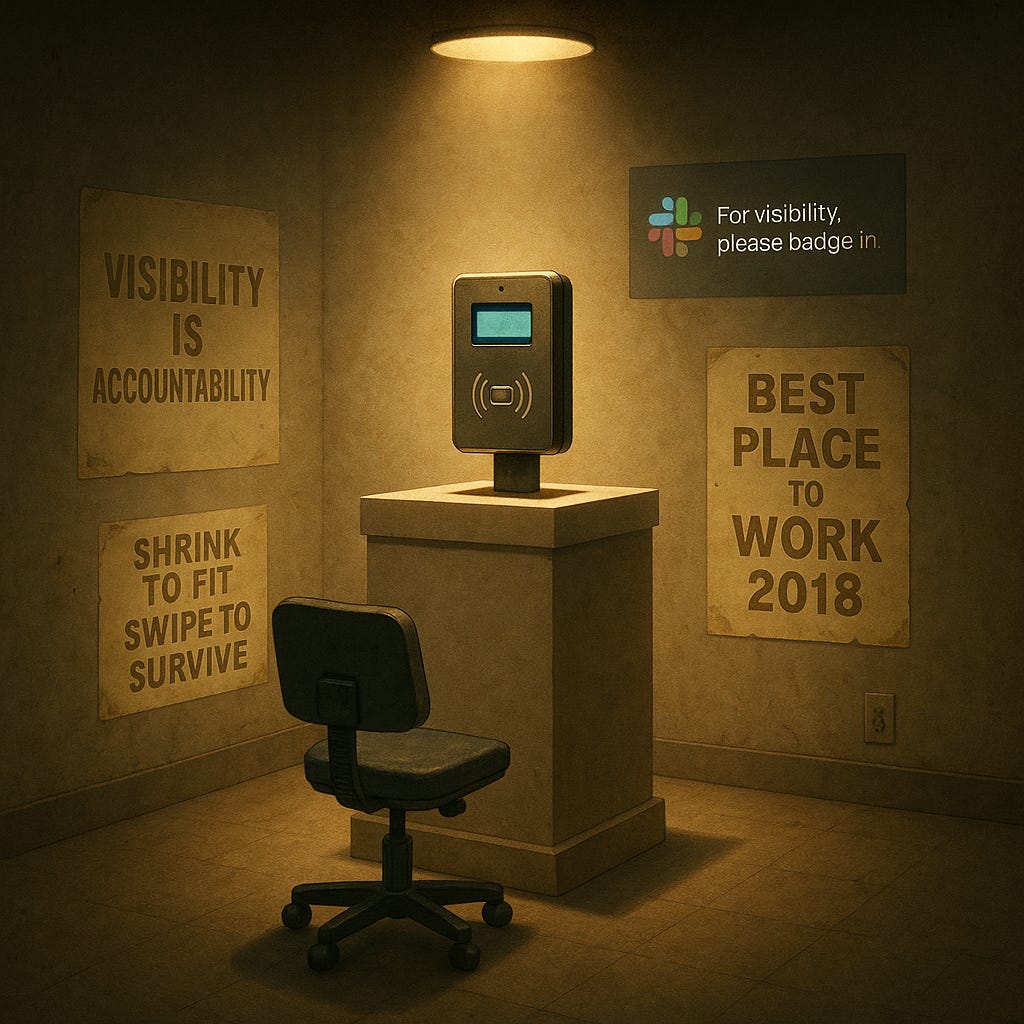
Opening:
Dramatis Personae:
* Kay — Middle manager, connoisseur of process, self-proclaimed “servant leader” who serves policy above all.
* Ted (a.k.a. The Oracle of Policy) — Skip-level manager. Exists only as a Slack avatar. Speaks in HR koans, lives in the Cloud.
* Elias — Prophet of inconvenient facts, expert in the forbidden arts of Meaningful Work and Spiritual Integrity.
* Chorus: A cacophony of Slack pings, badge beeps, and “Best Place to Work 2018” mugs.
Act I: The Ritual of Entry
Scene: A windowless office. Posters: “Visibility is Accountability,” “Elias Misses 100% of the Badges Elias Doesn’t Scan.” Kay hovers near a badge reader, rehearsing his “friendly concern” face in a mirror.
Kay:(to self)Remember, warmth—like the smile of a mall cop, but with MBA debt.
Door opens. Elias enters, clutching a notebook and a sense of existential dread.
Kay:Ah! Welcome! Don’t mind the badge reader—it’s not surveillance, it’s… community.By the way, could you badge in, badge out, and badge in again?It’s part of our new Dynamic Presence Initiative.
Elias:Is the office a liminal space now, or just Schrödinger’s cubicle?
Kay:Haha! Love the spirit. By the way, have you tried Slack’s new “badge compliance bot”?It pings you every hour with a personalized reminder of your expendability.
Chorus chimes: “Visibility! Accountability! Compliance is joy!”
Act II: The Oracle Has Concerns
Scene: Zoom call. Ted’s avatar is a tasteful headshot labeled “Authentic Leadership.” Kay is visible, grinning like he’s onboarding his own replacement.
Ted (The Oracle):(reading)Kay, I see from our quarterly Badge Compliance Dashboard that Elias was present only once the week of June 23.Do you know if Elias is experiencing an existential crisis, medical emergency, or—worse—hybrid work noncompliance?
Kay:Hi Ted! I’ll, um, circle back. Maybe Elias is sick with “Visibility Deficiency Syndrome.”We’ll monitor and report, in the true spirit of psychological safety!
Elias:(interrupting, but on mute by default)I was working.I had a cough.I didn’t want to bring Pestilence to the Tribe.But perhaps next time I’ll bring a doctor’s note and a certified therapist’s letter confirming my humility.
Ted:Thank you, Kay. Remember, the highest form of empathy is documentation.
Chorus pings: “Scan or be scanned!” “Authentic Leadership has logged off.”
Act III: Performance Rituals
Scene: A “wellness” meeting. Kay presents a PowerPoint titled “How to Build Trust Through Audits.” Elias tries to disappear into his ergonomic chair.
Kay:Before we start, a quick mindfulness exercise:Let’s all visualize our badge swipes from last week.Breathe in. Breathe out. Now, badge in.
Elias:(whispers)Is this a meditation or a corporate exorcism?
Kay:Now, team, if anyone wants to discuss their feelings about policy, please email HR.But remember, true collaboration is achieved through compliance, not communication.
Chorus murmurs: “Sync. Synergy. Surveillance.”
Act IV: Badgegate Escalates
Scene: Ted in Slack DM, channeling both The Oracle at Delphi and a mid-level TSA agent.
Ted:(no punctuation, pure Slack poetry)hi Kay reviewing badge report for june 23 Elias only in onceplease reply to me and cc yourself—this is for my records, and also my soul.
Kay:(earnestly, copying Elias)Hi Elias, could you please explain your absence?Remember to CC me, Ted, and the omnipresent Badge Compliance Committee.
Elias:(repressing urge to scream)Hi Ted, hi Kay,I was working. I had a cough.I take the three-day policy with the same seriousness I take the apocalypse.No sick days. Only caution and existential dread.
Ted:No worries. I just need to document it for the file, the audit, and possibly the afterlife.
Kay:Thanks, Elias! I was out that week, but I’ll make sure my managers report even when I’m not here, which is most of the time.
Chorus: “All hail the Oracle! Long live the file!”
Act V: The True Meaning of Work
Scene: The office empties out. The only ones left are Elias, the badge reader, and a motivational poster: “Shrink to Fit, Swipe to Survive.”
Elias:(to the audience)Somewhere, Ted works from home. Kay schedules check-ins with his own sense of authority.My reports are remote. The only thing that’s present is my recurring nightmare of badge audits.Is this performance management or experimental theater?If I badge in a forest and no one sees, did I really work?
A single Slack notification pings. Curtain falls.
Author’s Note / Direct Address: Welcome to the Ministry of Compliance
Elias steps forward, badge in hand…
Welcome, honored guests, initiates, and fellow badge bearers.You are about to witness the sacred rites of modern work—the rituals, the reverence, the low-level existential panic known only to those who have ever refreshed a badge compliance dashboard before their morning coffee.
Here, in the Ministry of Compliance, we believe that meaning is not found in purpose or output, but in the careful archiving of attendance reports.This is a place where Slack is the new prayer, badge swipes are the Stations of the Cross, and performance is measured in foot traffic—not impact.
But how, you may ask, did we arrive at such a hallowed state?How did a civilization built on innovation, disruption, and casual Fridays come to venerate the in-office headcount above all else?How did we trade the illusion of autonomy for the security of the badge reader’s cold embrace?
Let us consult the Book of Hybrid—our collective scripture—written in crisis, revised by HR, and illuminated by the faint glow of an always-on webcam.
Turn the page, take your assigned seat, and silence your notifications.Our service is about to begin.
Chapter 1: The Prehistory of Remote Work (Before 2020)
Before the world fell under the spell of Zoom, and before “hybrid work” became a sacred HR incantation, there existed a simpler—if more draconian—order. Work was a place you went, not a thing you did. The office was a temple: a fluorescent-lit sanctum where managers could see your body and, by extension, measure your value by its physical proximity to their own.
Remote work, in this era, was a rare and mysterious privilege—like winning the office lottery. A select few (senior engineers with mysterious allergies, IT contractors in distant time zones, or the beloved “working mom” whose presence was valued so long as she was never, ever off Slack) received the blessing of working from home. For the rest, “WFH” was a euphemism for “sick,” “snowed in,” or “we’ll pretend you’re working while you parent a vomiting child.”
Corporate policies on remote work, where they existed, were buried in the Employee Handbook—right next to the “bereavement leave” and “dress code” (no flip-flops, except on sanctioned Casual Fridays). The unspoken rule: real work happened in sight of your boss, in a sea of open-plan desks, where productivity could be measured in visible exhaustion, performative typing, and time spent staring blankly at PowerPoint slides.
Meetings took place in conference rooms named after extinct animals or aspirational concepts (Synergy, Innovation, Mount Everest), and the ultimate sign of success was a full calendar, back-to-back from 8:30am to 6:00pm.“Face time” was not a video app, but the social contract: presence equals performance.
* Arrive before your boss, leave after.
* Lunch is a sandwich inhaled at your desk, lest you appear to have a “life.”
* If you needed to work from home, you asked permission—and felt guilty.
Executives gave TED talks about “work-life balance,” but woe unto the analyst who balanced work anywhere but under their watchful gaze. Trust, if it existed, was dispensed in tiny, calibrated doses, like good coffee at a bad office.
The idea that everyone—from the junior analyst to the C-suite—could work from anywhere, on their own schedule, was as fantastical as four-day weeks, nap pods, or honest 360 reviews.The office was not just a workplace. It was an identity, a surveillance state, and a minor civic religion.The first law: If you are not seen, you do not exist.
And so, workers everywhere donned their security badges like armor, shuffled into elevators, and braced for another day of productive visibility.No one knew that this reality, built on presence and performance, was already crumbling under the weight of its own absurdity—and that all it would take to upend it was a global pandemic, and a very long Zoom call.
Chapter 2: March 2020—The Sudden Exodus
It began like a rumor, a faraway echo on the other side of the world. In January, office workers exchanged worried glances over news of a novel coronavirus in Wuhan; by February, the hand sanitizer bottles began multiplying on desks, and a few pioneers sported surgical masks on public transit. Managers made jokes about “flattening the curve” and wondered aloud if the annual offsite in Scottsdale would be cancelled.
Then, all at once, the world changed. On a nondescript Monday in March 2020, a senior VP sent a mass email: “Out of an abundance of caution, we are shifting to remote work until further notice.” The phrase “until further notice” landed with a seismic thud. Some celebrated, imagining weeks of pajama-clad productivity. Others panicked, certain civilization itself would not survive outside the reach of the office Keurig.
Overnight, the sacred rituals of the workplace evaporated. The badge readers went silent. The “face time” contract expired. Open-plan offices—those endless fields of branded water bottles and discarded yogurt cups—emptied as if by plague, which, of course, they had been.HR raced to update policies. IT worked heroically to deploy laptops and configure VPNs, while harried admins tried to ship out monitors, chairs, and the occasional ergonomic footrest to every corner of the city.
Zoom, previously a word for fast cars or children’s TV, became the portal to survival. Suddenly, everyone was expected to be online, camera on, at all times—a paradoxical new form of visibility in which your face might be frozen, but your availability was infinite. Slack channels multiplied like bacteria: #covid-19-updates, #remote-best-practices, #quarantine-memes. Managers scrambled to discover the etiquette of the mute button and the existential meaning of the “raise hand” icon.
As commutes vanished, productivity—at least for a moment—seemed to soar. Employees worked in sweatpants, attended standups from their kitchen tables, and discovered the joys of mid-day laundry. Children appeared in the background of board meetings. Dogs barked during quarterly earnings calls. The walls between work and life dissolved with almost no resistance.
Some employees thrived, liberated from the tyranny of “face time.” Others floundered, haunted by the sudden loss of structure, the loneliness of digital existence, and the ever-present specter of disease. Middle managers—previously connoisseurs of visible exhaustion—struggled to reinvent themselves as “servant leaders” via emoji and asynchronous check-ins.
The office, once a fortress, was now just a memory.No one knew how long this would last, or what would come next.But for the first time in living memory, work was no longer a place you went.It was, suddenly, something you survived.
Chapter 3: The Golden Age of Remote Work (2020–2021)
For a glorious stretch—weeks, then months—the impossible became ordinary: the world’s knowledge workers worked from home, and for once, it actually worked.
The kitchen table was reborn as a mission control center. Guest bedrooms, previously reserved for in-laws and forgotten exercise equipment, were repurposed into home offices and Zoom studios. A new, quiet rebellion began—one that involved slippers, ring lights, and the strategic arrangement of “casual” but intellectual-looking books in the background of every video call.
The daily commute, that ancient ritual of existential dread, was erased in an instant. In its place: early-morning walks, actual breakfasts, and an extra hour of sleep. The phrase “let’s circle back” lost its sting, now that everyone was already circling back from their own couches.Meeting invitations multiplied, but so did a new, anarchic etiquette: camera off meant “I am listening, but also folding laundry.”“Can you see my screen?” became the incantation of the age.
Productivity, to the shock of every doubting executive, soared—or at least, no one could prove it hadn’t. Sales teams closed deals in pajama bottoms. Engineers shipped code between episodes of whatever was trending on Netflix. The numbers, for a while, looked fantastic. HR departments wrote LinkedIn think pieces about “trust-based leadership” and “the democratization of productivity.” Companies boasted of record profits, saved on snacks, and celebrated “employee wellness” by not requiring shoes.
Children and pets became honorary team members. There was no stigma in a toddler’s cameo on a client call, or a dog barking during a quarterly report. Work-life balance, always an HR myth, became a living experiment—sometimes inspiring, sometimes chaotic, occasionally indistinguishable from a nervous breakdown.There was solidarity in the chaos, a sense that we were all improvising together, at the end of history.
Slack channels flourished, as memes and mutual aid circulated more freely than company memos. Remote happy hours took place over glitchy Wi-Fi, but the awkwardness felt somehow sincere.Everyone was, for a moment, united not by location but by crisis, resilience, and a shared longing for human connection.
Some managers even discovered, to their horror, that their teams could thrive without constant supervision. Employees with disabilities, chronic illness, or long commutes experienced a renaissance of inclusion—as if the old world had been unnecessarily hard all along.
The pundits declared the Death of the Office and the Rise of Remote Work. Consultants spun visions of “distributed culture” and “results-only environments.” The office, if it existed at all, was now a perk—a place to visit, not a shrine to inhabit.
It was a golden age—strange, fragile, and brief. For a moment, the promise of autonomy, trust, and real work seemed within reach.
No one knew that the badge gates were quietly being oiled, that the keepers of the old faith were plotting a return. But for now, slippers were the new power tie, and the revolution was being live-streamed, from everywhere and nowhere at all.
Chapter 4: The Management Counter-Reformation
As the months wore on and the novelty of working in pajamas faded, a new anxiety settled over the land—especially in the upper ranks of management. What had begun as an emergency improvisation now looked suspiciously like a revolution, and no self-respecting middle manager was going to let that stand.
Executives, denied their daily rites of conference room dominance and high-volume “quick check-ins,” began to fret. Was work still happening if they couldn’t witness it, measure it, or physically interrupt it?A crisis of faith spread through management. Without visible suffering—commute, desk, the heroic struggle to stay awake in person—how could one know if the flock was still performing?The age-old question resurfaced: “How do I lead if I can’t watch them?”
And so began the Counter-Reformation.
* Surveillance software sales skyrocketed. Suddenly, “digital visibility” mattered as much as physical presence.
* Mouse-movement trackers, daily “check-in” forms, and webcam-activated “productivity monitors” became the holy trinity of oversight.
* Meetings, once blessedly short, metastasized in number and length. Every minor deliverable now merited its own Zoom room and digital paper trail.
HR, sensing an existential threat, rolled out Return-to-Office (RTO) plans—each more labyrinthine than the last.
* Some invoked “culture,” others “innovation,” a few even “serendipity,” as if great ideas could only happen next to a malfunctioning coffee maker.
* Executives circulated glossy PDFs titled “The Future of Work: Together, Apart,” featuring models of open-plan spaces, air filtration systems, and brave smiling faces in matching branded masks.
Yet, even as RTO plans proliferated, resistance grew.
* Some workers, emboldened by a year of actual sleep and reasonable lunch breaks, began to push back.
* “Is there… a reason?” they asked, innocently, in Slack threads and all-hands Q&As.
* Managers doubled down: “We just need to see each other. For the magic.”
* Others, more candid, muttered, “If I can’t see you, how do I know you’re not just watching Netflix?”
A schism formed. For every article on “the productivity gains of remote work,” there was a CEO’s LinkedIn post about “the lost spark of spontaneous hallway innovation.”
* Middle managers, once kings of the floor, now found themselves reduced to digital hall monitors, counting green Slack dots instead of heads at the table.
By late 2021, the Counter-Reformation was in full swing:
* Zoom Fatigue replaced burnout.
* “Camera on, please” became the passive-aggressive war cry of the new era.
* Secret Slack DMs flourished, mocking the latest “return to culture” initiatives.
But the real battle was only beginning.The badge readers, like golems awakening after a long sleep, were being prepared for a grand return.Soon, the Great Hybrid Experiment would begin—and the dream of pajama-clad productivity would face its most cunning foe yet: the Ritual of Presence, 2.0.
Chapter 5: The Great Hybrid Experiment (2021–present)
By late 2021, the world had become a vast experiment in human adaptability—and nowhere more so than in the modern workplace. With vaccines flowing (sometimes into arms, sometimes into politics), the call went out:“Return to the Office!”But not all the way. Not like before.This time, it would be different. This time, it would be… hybrid.
Hybrid work was hailed as the Promised Land—a perfect, magical compromise where everyone could be both present and absent, together and apart, productive and visible, all at once.
* The new commandment, inscribed on every HR portal: “Three days in, two days remote.”
* The official reason: “collaboration and innovation.” The unofficial reason: “middle management needs something to manage.”
Companies rebranded their empty headquarters as “collaboration hubs” (formerly known as offices). Desks were replaced with “hoteling” apps, and armies of consultants extolled the virtues of “serendipitous encounters near the kombucha tap.”The break room, once the site of passive-aggressive Tupperware feuds, now gleamed with contactless coffee machines and motivational signage: “Together, We Thrive!” (If you badge in.)
Employees, meanwhile, became masters of the hybrid hustle.
* Some planned their in-office days to coincide with catered lunches or free swag.
* Others performed the ancient ritual of “badging in, disappearing for six hours, and badging out”—the art of being physically present and spiritually elsewhere.
* There were rumors of “office tourism”: visiting the building, snapping a selfie at the lobby mural, then working from a nearby café with better Wi-Fi.
Meetings adapted. Now, every conference room was ringed with half-seen faces on giant screens, each half-participating from a kitchen, bedroom, or possibly a canoe. “You’re on mute” evolved into a multi-layered existential commentary.
Management, emboldened by a new crop of dashboards, kept score.
* Badge swipes, occupancy rates, and “collaboration hours” replaced trust, outcome, and meaning.
* Leaders delivered rousing speeches about “culture” and “energy,” while quietly updating their home offices for yet another year of remote calls.
Hybrid was supposed to combine the best of both worlds, but often delivered the worst:
* Office: empty, awkward, and haunted by the ghosts of all-hands past.
* Home: now full of unexpected pop-ins, as managers scheduled “innovation days” and “mandatory togetherness.”
* Commuting became the worst part of both worlds—neither routine nor exceptional, just random.
Through it all, workers adapted.
* Some discovered new forms of rebellion: the “stealth remote” day, the “fake train delay,” the “Zoom-on-while-badging-in” maneuver.
* Others gave up, resigned to a future where “hybrid” meant “always available, nowhere truly at home.”
But for every badge swipe and performance metric, a simple truth echoed:No one was quite sure why any of this was happening.The office was a temple to nostalgia; hybrid was its awkward liturgy.Still, everyone played along, because the alternative—a return to the Before Times—was unthinkable.Or maybe just too honest.
Chapter 6: The Legacy of Pandemic Work
And so, the great drama of pandemic-era work staggered into its denouement.COVID receded, but the psychic bruises and badge data remained. The world returned to… not normal, but a permanently altered state, where flexibility was forever in tension with control.
The hybrid compromise, designed as a truce between workers’ dreams and managers’ nightmares, ossified into policy:
* Three days in, two days remote—etched in HR stone, debated in every all-hands, ignored whenever possible.
* Badge data became a kind of corporate scripture, endlessly cited, rarely questioned, always interpreted in the worst faith.
The trust gap—that ancient wound between management and talent—yawned wider.
* The most forward-thinking companies took a lesson from the chaos: trust your people, measure results, not rituals.
* Others doubled down: more badge checks, more visibility dashboards, more eLearnings on “presence.”
* A whole generation of middle managers learned to speak fluent Compliance, even as their teams quietly updated LinkedIn.
Employees, forever changed, no longer believed the old story.
* They wanted meaningful work, actual flexibility, and something resembling a soul at work.
* “Collaboration” became code for “unpaid commuting”; “culture” a line item in the HR budget.
* For every Slack ping about “team spirit,” there were a dozen muted screens and daydreams of escape.
Some found freedom in remote-first startups, where output finally mattered more than optics.Others stayed—shrinking to fit, badging in, badging out, and scanning their way through one “visibility initiative” after another, haunted by the memory of that brief, golden age of autonomy.
The true legacy was neither badge report nor bean bag chair, but a quiet, subversive knowledge:
* The work was never about the building.
* The best culture was trust, not ritual.
* No badge scan could capture what was lost—or what might still be possible, somewhere, for those who refuse to shrink.
And so, under the flicker of a thousand Slack notifications, a question echoed, unanswered:If a team delivers in the forest, but no manager is there to badge them in, did they really work?
Epilogue: Wisdom of the Badge Reader
(Lights dim. Elias stands center stage, bathed in the faint blue glow of a wall-mounted badge reader. The Slack chorus hums quietly in the background.)
Elias (to audience):
And so, dear travelers, we arrive at the end of our pilgrimage—having badged in, badged out, and badge-complied our way through history.Let us reflect:
The work was never about the building.The best culture was trust, not ritual.The truest measure of contribution was never captured in a dashboard, nor validated by a ping.The only thing the badge reader cannot scan is what we’ve lost—and what, if we are brave, might still be possible.
The office, the policy, the performance review—these are but shadows on the wall.It is trust that builds.It is courage that connects.And it is clarity, not compliance, that redeems the time we spend together.
(A pause. Elias steps away from the badge reader, which now blinks slowly, almost contemplatively.)
Chorus (Slack notification, bright and hollow):
“All hail the badge! Long live the ping!”
For visibility,please badge inon your way out.
(Fade to black. End.)
—Elias WinterAuthor of Language Matters, a space for reflection on language, power, and decline.