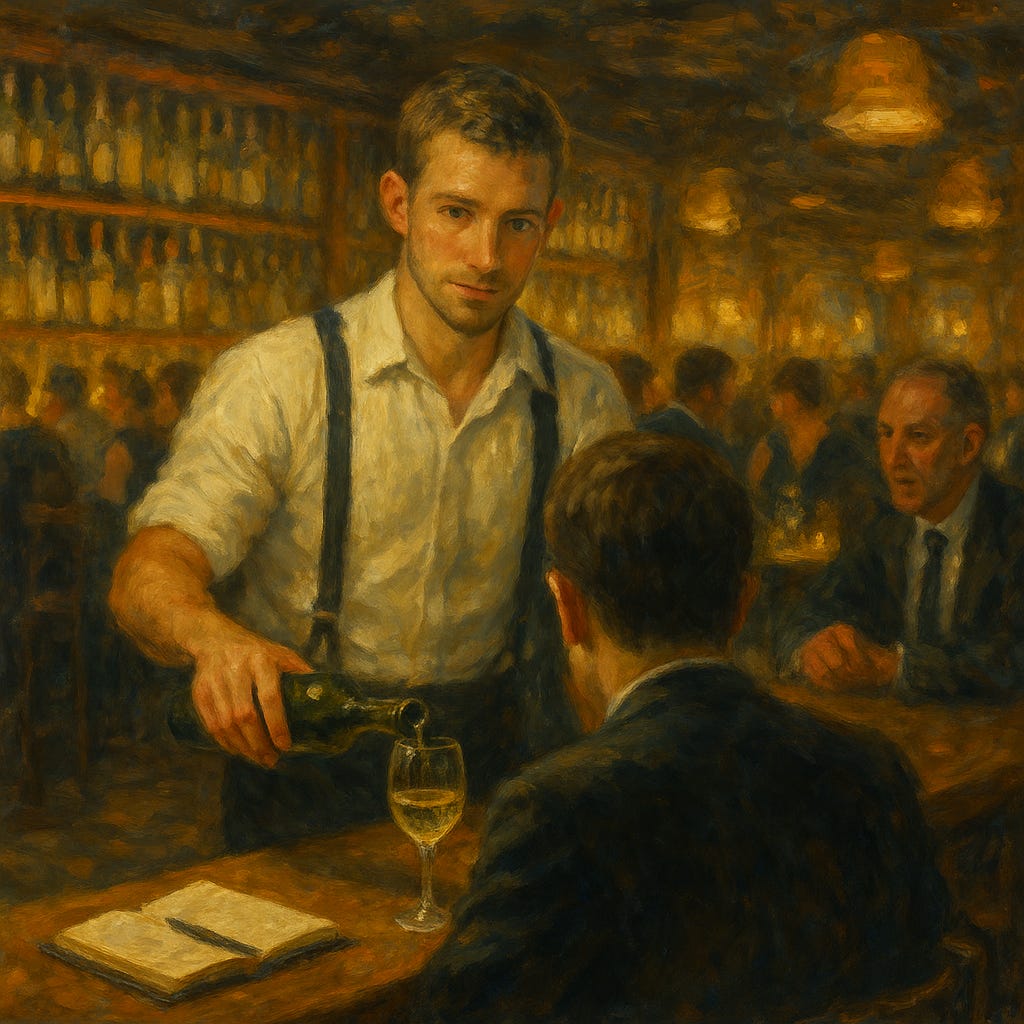
There are nights when the world discloses itself without spectacle. No crisis, no headline—only a room squared by bottles and light, the choreography of strangers rehearsing warmth. Desire appears, precise as glassware. So does its absence. The devil does not need to rage; he needs only to withhold.
I sat in the bar and waited to see you.
Last time I asked if there was a minimum number of bench presses required to work behind the bar. You laughed. I said the dessert you served was a practice in perseverance—that it builds character. You laughed again, and agreed: the rhubarb builds character. Between us, each word arrived as laughter.
You stand in the center, a gentle giant. Everything about you is grey: the hair going grey; the eyes, blue-grey. Beauty arranged itself in the corners—women, men—bottles stacked not to tempt the mouth but to caress the eye. The first sips warmed the head and then the heart. You shook my hand when I returned. Your hand was warm. You were glad to see me; the eyes said so. But your gladness and mine do not move on the same wavelength.
At work—a new job—the music was Cher, and the keeper of policies danced. I did not announce myself. Some knowledge does not require confession.
A manager sat beside me at the bar, a tie I thought was Greek, a story that was Mexican. I told him what I rarely say: that Iran was Zoroastrian before it was Muslim; that my first name remembers that fire. He listened, returned, listened again. He knows his trade. I liked him. But it was still you I watched.
You asked where I lived. I imagined inviting you. I imagined inviting you and a friend, so no one would imagine harm. This is how caution learns to speak for love: by preempting suspicion. I am careful with people. I am full of love. I want love.
But the romance I imagine does not transact in this world. I do not say this in defeat. I say it as diagnosis. I do not trust humanity to keep love alive in us. Love is of God; we live in the grip of the one who resents God’s breath in clay. Jealous of that breath, he set himself to prove the creation unworthy, and he has been successful. He withholds, and we mistake the rehearsal for the wedding: the warm hand, the blue-grey eyes, the glass, the low music, the room agreeing to pretend.
Some nights this truth is merciful. Death is not the worst thing. To live without love forever would be worse. I do not envy those who would purchase more years as if time were salvation. It is easy to earn money. It is not easy to earn love.
What remains is clarity. The bar reveals the structure: availability of touch, unavailability of love. Warmth without covenant. Laughter without vow. And the devil, patient, proving his point while God waits for us to want Him more than we want proof.
I left a little before closing. The bottles kept shining for the eyes. The room kept rehearsing. You were kind, and I was grateful. The night had done its work.
—Elias WinterAuthor of Language Matters, a space for reflection on language, power, and decline.