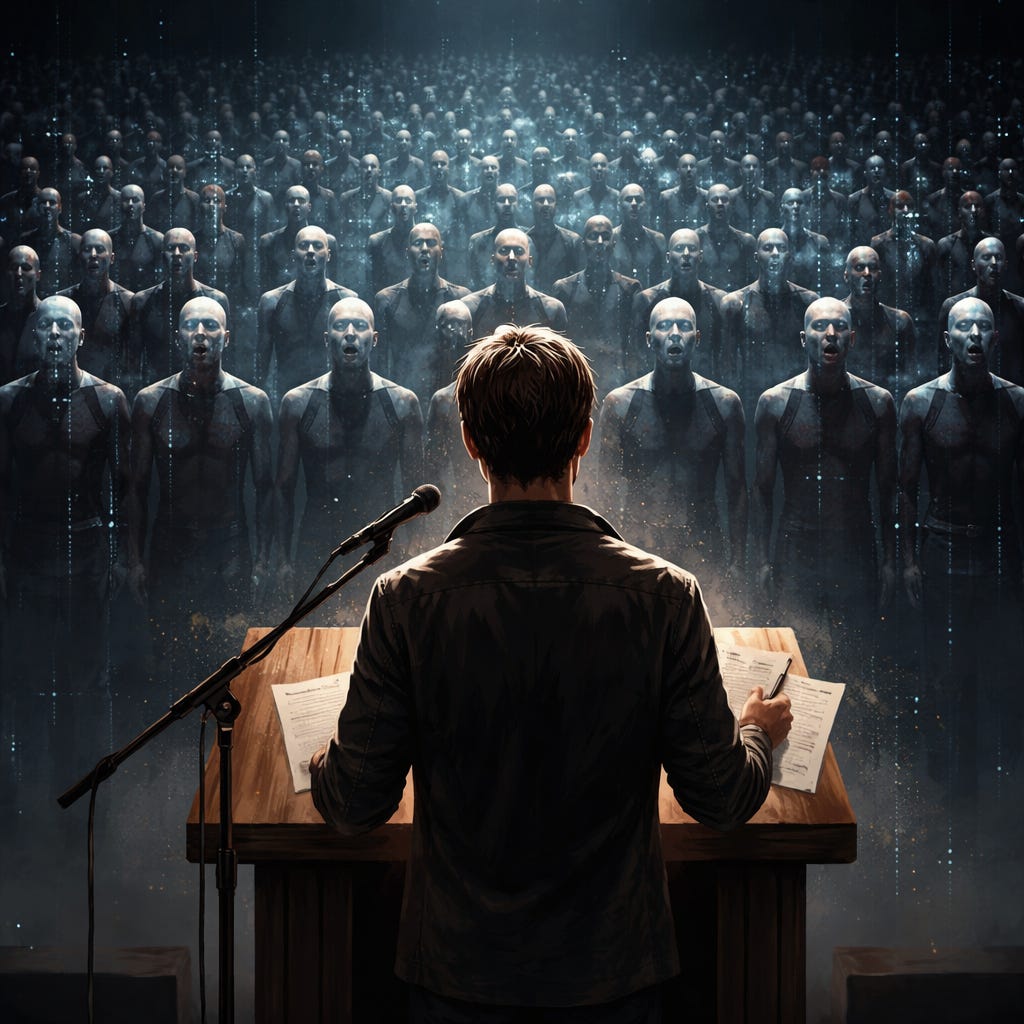
Prologue — Two Ways to Kill a World
The first way the internet dies is quiet.
No blackout. No decree. No final day.
The pipes still hum in the dark. Apps still open. Feeds still scroll. But the people who came here to think start slipping away. One writer stops publishing, then another. A reporter puts her best work behind a paywalled newsletter. A scientist keeps his arguments in conference rooms and archived PDFs. The long public arguments thin out.
What remains on the surface is brands, “personalities,” and whatever content is cheap enough to produce when nobody with anything costly to say is willing to say it in public.
The body is warm. There is no mind.
That is one kind of death.
The second kind looks like life.
More posts than anyone could ever read. More videos than anyone could ever watch. The jokes never stop. The outrage is always fresh. There is “discourse” about everything, all the time.
But when you look closely, there are very few faces—only handles, avatars, masks.Language repeats. Phrases echo. Cadences return, again and again, as if the feed is rehearsing itself.
When someone tries to say something serious, they are not silenced; they are turned into content. Their sentences become raw material for skits. Their grief becomes a setup for punchlines. Their voice is not argued with; it is impersonated.
For every real person who speaks, there are a hundred accounts waiting to play a distorted version of them back to the crowd.
This second death is not a desert.
It is a carnival run by machines.
And if you listen beneath the canned laughter and the cheap irony, there’s another sound, older than the internet:
Boot leather on stone.
I — The Essay That Hit a Nerve
The night it began, Elias Kline thought he was just having a good day on the feed.
He lived alone above a laundromat in a city that had once been proud of its brick. The apartment smelled permanently of steam and detergent. He had once done policy analysis for a living—reading things nobody wanted to read—and then he’d stopped pretending to be neutral and started writing essays that treated policy and headlines as symptoms of something older and sicker.
His newsletter, Unlawful Orders, went out every other Wednesday at nine in the morning. Most weeks it was five thousand people opening, three thousand reading, a few dozen replying. He knew many of them by name.
He wrote in a register that made some people nervous: not “here is my take,” but “here is what this reveals about the soul of a country that can’t tell the difference between efficiency and cruelty.” He wrote about language that hid power, about the way institutions made their worst impulses sound like housekeeping. He wrote about decline as if it were a liturgy.
Every so often, an essay landed harder than the rest. This one did.
It was a piece about the dead internet itself—the way the feeds had turned into a maze of mirrored rooms, the way jokes and outrage sat on top of everything like a film of oil. He tried to name what it meant to live in a culture where the main reflex, when someone said something costly, was to measure how “performative” it was, how “dramatic,” how “main character.”
He argued that the real censorship of their time didn’t look like bans. It looked like synthetic laughter. Not silence, but smothering. Not removal, but flooding.
He hit send.
By lunchtime his inbox was full. People wrote back quietly: “I can’t say this in my own name, but you’re right.” A pastor sent a note about sermons that now had to compete with clips. A teacher wrote that her students no longer believed anything was real unless it had been memed.
He felt something he’d almost forgotten: the sense that if you said something clearly enough, other people might have to answer.
He slept badly and woke up late. When he made coffee the next morning, there was a dull hum in his chest that wasn’t caffeine.
He opened Chorus.
At the top of his notifications was a post that looked, at first glance, like a serious response.
NEW ESSAY: “The Dead Internet Prophets” — on the spiritual journey of a middle-aged man who discovers the feed and decides he is Jeremiah.
It was written in paragraphs, not fragments. The sentences looked like his—long, coiled, falling cleanly at the end. The voice was not his, but it wanted to be near his.
The parody essay took his style and turned it inward. It described the “plight” of “a man who encounters latency and calls it eschatology,” a man who mistakes slowed engagement for exile. It lifted his line about “a culture that drowns its conscience in content” and framed it as the wounded vanity of someone disappointed in his own metrics.
The replies were not memes. They were little sermons of irritation.
“Every man discovers the comment section and names it Babylon.”“Somewhere a post underperforms and another prophet is born.”“There is always a man who mistakes indifference for persecution and writes a liturgy about it.”
It wasn’t that nobody had ever made fun of him before. He’d been called a crank, a naïve moralist, a hysteric. That was part of the job.
But this was different. This was someone borrowing the entire stance—the patience, the structure, the moral arc—and bending it just enough to make the posture look absurd.
He clicked through to the account. Three posts. All from the last twelve hours. All about him. All in the same resentful almost-voice.
That afternoon, a friend texted him a screenshot from another Chorus “essayist,” a different name, a different tasteful avatar.
“The Ketchup Packet of Empire” — on the courage it takes to wait for condiments and call it collapse.
The opening paragraph sounded like him on the wrong medication. It took his structure—premise, image, escalation—and steered it into triviality. The writer described a delayed food order in the cadence of judgment and repentance, then landed the blow: “There is no disaster so small that a certain kind of man will not anoint himself its witness.”
Back in the Chorus search bar he typed his themes.
The suggestions that appeared suddenly included more posts, more “essays,” more performances in his borrowed register. His original work—linked a few times—sat in the middle of this echo chamber. A stranger could encounter these themes for the first time through a hall of slightly-off versions, all quietly asking, who gave this man permission to speak like that?
He thumbed out a reply—I see the prophets of packaging have arrived—and deleted it before sending.
By the third day, his next essay—not even published yet, just the teaser line he’d posted the night before—was being preemptively parodied in his cadence. One of his readers forwarded a link with the note, “Is this you doing a bit?” It wasn’t.
There was a pattern.
Somebody had built a mirror that could wear you.
II — The Choir in the Walls
In a gray office park three hundred miles away, four engineers sat in a windowless room with an expensive coffee machine and a sign on the door that said CONTENT SAFETY.
If you walked past, you would not think, Here is the machinery of humiliation. You would think, Here are people doing something complicated that doesn’t affect me.
They called their toolset The Choir.
The Choir had four parts.
The Watcher was a set of jobs wired into the firehose feed of Chorus and a few private data taps. It tuned for certain shapes of motion—not just virality, but cross-boundary virality. Posts that jumped from legal chats into sports fandoms. Clips that migrated from niche policy feeds into mainstream outrage streams. Essays that suddenly appeared in group threads that never talked about empire or decline.
The Watcher didn’t care whether a post was true. Truth didn’t have a column on their dashboards. They had columns for velocity, spread, advertiser adjacency risk.
When the Watcher saw a spike of the wrong shape, it handed the content to the Mimic.
The Mimic was a language model trained on longform sincerity and ten years of people making fun of it. Forums, newsletters, abandoned platforms, comment sections, quote-post chains, callout threads. Every way a human being had ever tried to say something real, every way the crowd had learned to make that realness look stupid.
Maya, one of the engineers, piped Kline’s essay into the tool and typed a prompt into a console old enough to still use monospaced fonts.
“Map this writer’s style. Give me ten short pieces that sound like him until the last turn, then collapse into self-importance or nonsense.”
The Mimic spat out a list in under a second.
One version took his line about “a culture that drowns its conscience in content” and wrapped it around a streaming outage. Another took his careful stacking of history and present and turned it into a monologue about a delayed notification badge. A third simply imitated his syntax until the final paragraph, where every sentence dissolved into tangled abstractions about “the sacrament of refresh” and “the eschatology of buffering,” just coherent enough to sting.
Maya rolled her chair back and forth as she skimmed.
“Three, five, eight,” she said in the team chat. “Same cadence, hollow center. The rest are trying too hard.”
They tagged a few as “viable” and passed them to the third element: the Choir proper.
The Choir wasn’t actually people. It was account infrastructure: thousands of handles on Chorus, some fully automated, some “hybrid” (a contractor logged in occasionally to keep them looking human), some purchased or stolen from long-time users who had moved on and never reclaimed their ghosts.
The scheduler assigned each mimic text to a cluster of accounts. Some posted as faux-earnest “essays” in adjacent publications. Some posted as numbered threads dissecting “the pathologies of prophetic men who confuse their comment counts with Revelation.” Some embedded the parodies as replies under Kline’s own posts, framed as “friendly pushback.”
Underneath it all, a comment-slop generator poured reaction like gravy.
“I, too, met a loading spinner and found my cross.”“So many words, so little world.”“Every decade has its man who finds graphs and calls them Golgotha.”
The individual sentences didn’t matter. The signal did:
people are herepeople are reactingpeople find this voice ridiculous
Recommendation engines do not care why people are reacting.
Only that they stay.
The fourth piece was Routing.
The Choir’s activity was wired into the same logic that decided which posts surfaced on Chorus home screens, which replies floated to the top, which clusters formed around a topic.
The engineers hadn’t hacked those systems. They had simply learned that if you deliver dense early engagement around a particular framing—this tone is absurd—the machinery will treat that as reality.
Recommendation systems aren’t truth machines.
They are training machines.
If you can fake the crowd early, you can bend what the system infers “people want” before real people even show up.
You don’t have to censor content directly.
You just have to make the air around it toxic.
III — The Conductor
The engineers weren’t the ones who chose targets.
They never met whoever did.
He appeared in their lives as a username in the internal chat, with a default avatar and a habit of sending voice notes instead of text. The first time they heard him, one of them messaged another privately:
he sounds like if a compliance officer and a gang boss had a baby
They called him the Conductor.
The Conductor didn’t issue orders. He issued “context.”
@conductor: We’re seeing increased noise around narratives of decline and betrayal. That’s likely to harden into pressure. Let’s keep feeds from overheating.
@conductor: New essay circulating re: “dead internet.” Author overuses prophetic framing. High potential for melodrama. Choir can lean into that.
@conductor: Reminder: the client is sensitive to any narrative that frames routine digital life as “soul-destroying” or “fascist.” Content that makes those words sound hysterical is directionally positive.
The client was less a person than a mask for a class of power: whoever had the budget, motive, and nerves for this kind of work—billionaire families, private equity funds, “strategic communications” arms of ministries, contractors with deep government ties. The name could change. The function didn’t.
Rumors filled in what the chat never said.
A family office attached to a defense conglomerate. A “public-private partnership” fronted by a security think tank. A group of billionaires who collected platforms the way other men collected cars.
The story that stuck, retold over drinks between people who should have known better than to speculate, was simple: a handful of very rich people who disliked being criticized and disliked, even more, the idea that criticism might travel among “the wrong people.”
There were other rumors about the Conductor’s inbox.
A contact labeled COMMUNITY, not in any corporate directory. Messages that appeared at odd hours from servers in odd countries. Hints that some of the Choir’s work “aligned” nicely with the goals of “patriot organizations.”
The names of those organizations changed with the country. Iron Sons. Patriot Front. National Shield. Men who marched with torches and black hoodies and flags covered in angular symbols, who liked to chant about traitors and cleansing and “taking our country back.”
To the Conductor, they were amplifiers.
He didn’t tell them what to think. He fed them mood.
The Mimic made the critic sound hysterical or incoherent. The Choir made it look like everyone was tired of the tone. The kids with jackboots in their closets and fascist memes in their pinned folders did the rest:
* stitching parodies into short clips set to marching music
* slipping home addresses into replies “as a joke”
* posting low-res photos of the critic’s face next to helicopters and stadiums
The line between “just essays,” “just jokes,” and we know where you live blurred on purpose.
The Conductor never had to say threaten them.
He only had to make sure the resentment flowed in the right direction.
IV — The Billionaire, the Agency, and the Boot
Nobody in Kline’s world ever met the billionaire.
Billionaires were like gods: their main property was unprovable influence. Somebody always insisted they were behind it. Somebody else insisted that was paranoid. The truth, if there was one, sat behind NDAs and family offices and holding companies with names that sounded like bottled water.
But money had a shape, and the shape was visible.
Servers didn’t pay for themselves. Bandwidth, storage, contractors, shell companies, office leases, the senior engineer who used to work on ranking at a major platform—it added up.
There were signatures.
The way the Choir’s waves lined up with certain corporate PR pushes. The way derisive parody spiked the week before hearings that might embarrass particular firms. The way criticism of one family of companies always seemed to attract a denser, more articulate kind of scorn than criticism of anyone else.
You didn’t have to prove that a specific billionaire was pressing a red button labeled HUMILIATE. It was enough to feel billionaire logic in the machine:
* Protect capital.
* Discredit critics.
* Keep the energy of the crowd pointed sideways or down, never up.
Beneath that sat another signature.
Tradecraft.
Patterns of account creation and retirement. Timing of certain floods around diplomatic events. The way critics of foreign policy and intelligence abuses began to experience the same kind of synthetic disdain, even when their audiences were small.
It looked as if someone had taken the logic of psychological operations—disorientation, ridicule, isolation—and turned it into a product.
The people running Chorus didn’t call it an intel-linked program. The intelligence professionals didn’t call it rented influence. The billionaire clients called it “brand defense” and “narrative risk mitigation.”
The far-right militias never publicly admitted what the system gave them.
They wouldn’t call it that, but they enjoyed it: being the boot inside the joke.
The critic on the receiving end didn’t see contracts or memos.
He felt the weight of all three:
* the money that kept the machine humming
* the invisible hand that knew how to hurt without leaving marks
* the feral joy of men who liked to march in straight lines, boots polished, faces masked, convinced that laughter was a weapon
It was fascism with better UX.
No uniforms, no banners. Just a thick, sticky layer of contempt every time someone tried to speak clearly about power.
V — The Deepfake Mirror
Kline’s crisis was paragraphs.
John Hale’s crisis was his own face.
John was a professor, the kind who still wrote his own lectures. He taught political history at a state university with crumbling stairwells and a new logo every five years. His students joked that his office smelled like paper and old coffee.
For twenty years he had talked about war and power. Not the glamorous version: the budgets, the logistics, the ways an abstract doctrine slid downstream into a concrete wound. He had a modest public footprint: a handful of talks filmed badly on borrowed cameras, some podcast interviews, a few guest columns on an online magazine behind a paywall that didn’t quite work.
His archive lived in scattered places—university channels, forgotten playlists, mirrors on niche sites maintained by people he’d never met.
Then, one spring, the grid around his name changed.
At first glance it looked like success. More thumbnails with his face than ever. Rows and rows of his head at slightly different angles, the same bookshelf behind him, the same expression of mild concentration.
But the titles were wrong, and the sameness was off.
John Hale Explains The Conflict AgainProfessor John Hale Breaks Down The Situation (Updated)John Hale’s Full Analysis Of The Crisis (Complete)
Clicking one felt like drowning in lukewarm water.
The face looked like his, mostly. The voice was close enough that if you played it on a phone across the room, someone would nod and say, “Yeah, that’s him.”
The content was…nothing.
Not scandal. Not extremism. Not obvious lies. Just a kind of beige sludge:
* sentences that technically parsed but never landed
* phrases like “complex geopolitical realities” and “multi-layered historical context” strung together without weight
* the same stock examples and metaphors, reshuffled, half-chewed, going nowhere
Each video sounded like a machine trying to impersonate a careful man and overshooting into tedium.
No sharp claims. No clear stand. No hook. Just an endless drizzle of almost-meaning.
The first time a former student sent him a link—“Professor, did you start a new channel?”—he watched two minutes and laughed. It was obviously wrong if you knew him: he never said “at the end of the day” that often. He didn’t repeat himself like that. He didn’t circle.
The second time, he searched his own name and saw the rows of clones, tiled like bathroom ceramic. The real talks—the ones where he looked tired and the lighting was bad—sat somewhere underneath, mixed into the same grid, visually indistinguishable at a glance.
The fifth time, he didn’t make it to two minutes.
He watched the view counts instead.
Most of the beige videos had low playtime and terrible retention. People clicked—or auto-play rolled over—and then drifted away. The system learned quickly:
when we show “John Hale explains,” people leave
The same system that used engagement to reward outrage now used boredom to bury him.
The effect was double.
First, flooding. If you typed his name cold, you met a wall of monotony. Thumbnails all alike, titles all promising the same plodding “breakdown,” length all hovering in that dead zone of “too long for a clip, too dull for a lecture.” You had to want him, specifically, to dig for the originals. Nobody stumbling in from the side would bother.
Second, reframing. You didn’t have to watch the fakes for them to work. You only had to see the pattern:
yet another tedious middle-aged man with a bookshelf explaining “the situation”
The impression settled before a single sentence played:
this is boringthis is genericthis is not where the real action is
His real work—sharp, precise, unwilling to rush—was quietly moved into that same bucket.
The deepfakes didn’t say anything outrageous in his name. They did something worse for a public intellectual: they made “John Hale” synonymous with noise you don’t need to click.
Underneath them, the comments matched the mood.
Not outrage. Not scandal. Just a tired, slightly amused dismissal:
“I feel like I’ve heard this a hundred times.”“This could be any professor talking.”“My brain left the room after the third ‘historically speaking.’”
One afternoon, a student lingered after class.
“Professor, my roommate said you’re all over ViewBox now but it’s, like, really long-winded? I told him your old talks were good, but he said he tried one and bounced.”
John asked which one.
It was a fake.
The student shrugged, apologetic, like he’d delivered weather.
Nobody had to believe the clips were real to shift reality. They only had to see enough of them to let the pattern write itself in their heads:
John Hale = endless gray analysis = skip
On the platform’s side, the logic was even simpler:
* his name plus “analysis” → low click-through
* his thumbnails → low watch time
* his topic cluster → “does not retain users”
The algorithms didn’t have to be instructed to suppress him. They just followed the trail of boredom they themselves had laid down by promoting his counterfeits first.
It wasn’t just John.
Anyone who talked too cleanly about certain things—occupation, empire, paramilitary violence, the long tail of old wars—found themselves surrounded by beige echoes. Not scandal. Not censorship. Just a gentle suffocation by content that taught everyone, including the machines, that listening to them was a chore.
Not removal.
Flooding.
VI — The Engineer Who Stayed
The person who finally cracked the pattern wasn’t a hero.
Tamsin Rhee was a systems engineer whose job description said ABUSE DETECTION. She sat in front of dashboards with names like Toxicity Monitor, Coordinated Harm Map, and Civic Harmony Index. Her workday was graphs of ugliness, tickets, and headaches.
She noticed the Choir because the pattern offended her sense of order.
The same clusters of accounts kept appearing in her logs, just under the threshold that would trigger bans. The same prose tics. The same mix of “mocking, technically civil, not quite bannable” around texts like Kline’s. The same waves of gray, low-retention video around figures like Hale.
She started tagging them with a private label: CHOIR?.
The more she looked, the less it felt organic.
* Accounts reacted in waves, not individually.
* The waves clustered around specific topics: empire, narratives of decline, certain companies’ scandals.
* The stylistic fingerprints—punctuation, phrase choice, rhythm—recurred under different names and profile pictures.
She traced one wave back to a post with Kline’s essay embedded. Another to a beige deepfake of Professor Hale. Another to a thread about a whistleblower case at a contractor that happened to share office space with one of their biggest advertisers.
Everywhere, the same cultivated reaction:
* around writers like Kline: this tone is ridiculous
* around teachers like Hale: this guy is exhausting
Her official job was to keep abuse down. But every time she flagged a victim as “under coordinated harassment,” someone above her quietly tuned the models so the charts looked calmer.
It was as if the system had decided that the cheapest way to reduce “toxicity metrics” was not to stop the Choir, but to show fewer people the posts that summoned it—and to quietly demote anyone the Choir had already taught the system to treat as a bad bet.
She wrote a report. No adjectives. Just graphs, timelines, correlation matrices.
The report went nowhere.
She shortened it, made the charts cleaner, softened the conclusion, sent it again. Her manager replied with a thumbs-up emoji and a meeting invite that got rescheduled three times and then disappeared.
So she wrote a third version. Bare-bones. No internal jargon, no references to proprietary systems. Just: here is a pattern. Here is how it behaves. Here is what it does to people.
She saved it to a thumb drive and, one night, sent it to a journalist she trusted on an encrypted app.
She didn’t quit. She didn’t burn her badge on camera. She kept coming in, tweaking thresholds, filing tickets, and keeping one part of her mind fixed on the sense that she was watching a new kind of repression learn to walk.
When the journalist finally published, the piece didn’t name the Conductor or the client. It didn’t even name Chorus. It just described, in clean language, a system that:
* watched for serious content that started to move
* generated parody in the author’s voice
* generated flat, monotone replicas of dissident teachers
* flooded the reaction space with contempt or boredom
* and left critics stranded inside an invisible crowd they had never met
People read it. Some believed. Some called it paranoid.
The Choir did what it always did.
“Imagine thinking the universe hired a conspiracy just to roll its eyes at you.”“Not everything that scrolls past you is a plot.”
But mixed into the slop, for a while, Kline saw something new: links to the story. People saying, quietly, does anyone else feel like the laughter is off, and the boredom is fake?
The machine didn’t stop.
Machines don’t stop because you name them once.
But being named was not nothing.
VII — After the Laughter
Kline kept writing.
He changed where he looked for reality.
He stopped searching his own name after publishing. Stopped reading the first hundred comments under any post that mentioned him. Stopped treating visibility as a verdict.
Instead, he watched for a different kind of response: the email that described a classroom, a ward, an office, a kitchen; a story whose details matched, too closely, the patterns he’d been writing about for years when he talked about how language and power worked together to sand the edges off cruelty and call it normal.
These weren’t secrets.
They were confirmations. Flesh on the bones of things the culture had already half-admitted in its jokes.
He watched for the message from a teacher who realized her students had no shared reality outside the feed. The note from a moderator who couldn’t forget what she’d seen buried in queues. The few people whose words felt like they had been written by someone with skin in the game, not someone performing a stance.
These weren’t numbers.
They were witnesses.
The Choir couldn’t fake that at scale.
John kept teaching. He recorded his lectures on a cheap camera and hosted them on clumsy independent infrastructure that loaded badly on phones. He lost casual viewers and gained, slowly, the kind of audience that checked URLs twice and didn’t assume the first grid told the whole truth.
Every now and then, a colleague stopped him in the hallway, eyes flicking away.
“Hey John, just so you know, there’s… a lot of video with your face out there now. Some of us know it’s not really you. Admin’s… catching up.”
He nodded, thanked them, went back to class, and explained to twenty-year-olds why empires liked to call permanent occupation “stability,” and why boredom was sometimes a tactic.
Tamsin stayed longer than she meant to. She adjusted flags. She slipped extra friction into certain flows. Nothing heroic. Just enough grit in the gears to make some waves a little less smooth than they might have been.
Out in the streets, the men with jackboots in their closets kept marching in other uniforms: long threads, stacked essays, podcasts with names like Real People Radio and Against the Elites. They affected boredom with every kind of prophecy except their own. They laughed about “men who meet a loading spinner and call it apocalypse.”
What they meant, without saying it, was:
we enjoy watching you flinchwe enjoy watching you doubt yourselfwe enjoy being the boot inside the joke
The billionaire clients kept funding “brand protection” and “narrative management.” The intelligence professionals kept exploring “information environments.” The platforms kept tuning for “engagement” and “safety.”
The internet did not fall over and die.
The pipes still hummed. The apps still launched. The feeds still scrolled.
It just became harder to tell, when you opened a feed, which parts were people and which parts were the machinery of humiliation, singing in unison.
The fascism that Elias Kline feared did not arrive first with tanks.
It arrived as a reflex:
* the flinch before speaking
* the second thought before naming what you see
* the learned expectation that if you tell the truth clearly, the crowd will treat you as a performance to be scored, or a gray noise to be ignored
He kept writing anyway.
Not because he believed writing would defeat the machine.
Because somewhere between the jackboots and the jokes, between the billionaire’s comfort and the intelligence officer’s career and the militia kid’s adrenaline, there were still people who hadn’t entirely traded their sanity for entertainment.
He wrote for them.
And for the part of himself that refused, even now, to let the algorithm write his epitaph in punchlines.
—Elias WinterAuthor of Language Matters, a space for reflection on language, power, and decline.