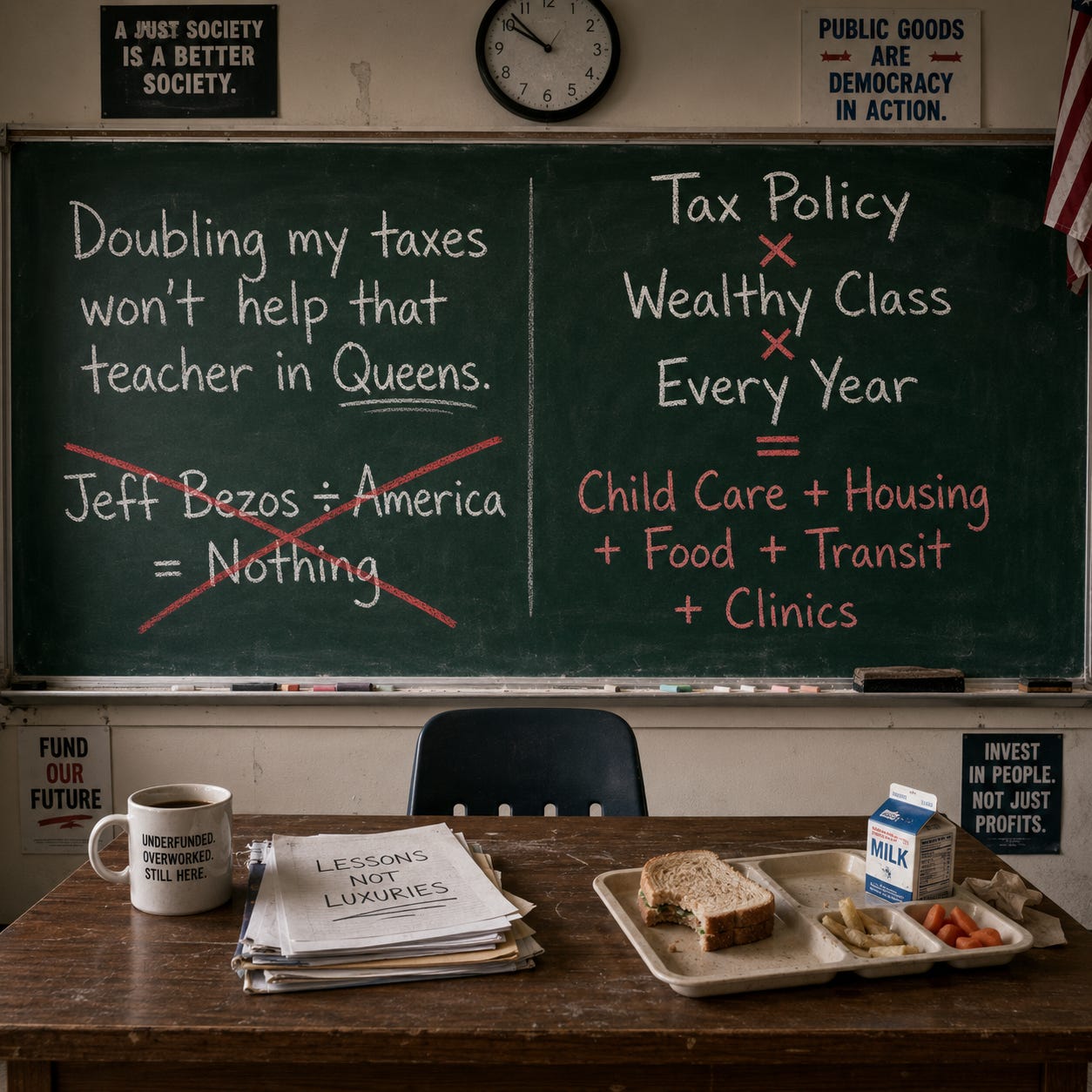
Jeff Bezos recently offered America a sentence so useful that it deserves to be placed on a chalkboard and interrogated until the chalk breaks.
Asked about taxing the wealthy, he said, in essence: if people want him to pay more billions, fine, have that debate — but do not pretend it will solve the problem. “You could double the taxes I pay,” he said, “and it’s not going to help that teacher in Queens.” The interview was with CNBC, and the remark was reported in the context of Bezos arguing that the bottom half of earners should pay no federal income tax. He also said the top 1 percent already pays a large share of income taxes. (Business Insider)
So let us begin where the honest listener begins.
Is he dumb?
No.
Is he lying?
Not exactly.
Then what is he doing?
He is doing something more elegant, more elite, and therefore more dangerous: he is using a true statement at the individual level to blur a true statement at the social level.
One billionaire paying more taxes will not, by itself, rescue the teacher in Queens. That is true. Jeff Bezos could cut an enormous check, and the next morning a teacher in Queens would still wake up to rent, subway delays, student hunger, child care costs, classroom stress, and a public system held together with duct tape and inspirational posters.
But that was never the actual question.
The question was not: “Can one billionaire personally save one teacher?”
The question was: “Can a recurring tax policy on the wealthy, applied across the tax base, raise enough money to materially improve the lives of millions of people?”
That answer is yes.
And Bezos knows enough math to know the difference. A man does not build Amazon by misunderstanding scale. Amazon is not a lemonade stand with a login page. Amazon is the cathedral of aggregation. It is the holy empire of pennies multiplied by billions of transactions. Bezos understands what happens when small units become massive systems.
He simply becomes mysteriously allergic to multiplication when the subject is taxes.
So, class, let us begin.
Please take out your pencils.
No, Jeffrey, you may not erase the denominator.
The first thing to understand is a marginal tax rate.
A marginal tax rate is not a tax on all your income. It is a tax on the next layer of your income. The IRS explains this directly: Americans pay income tax in layers called tax brackets, and when income rises into a higher bracket, the higher rate applies only to the income in that higher layer, not to the entire income. (IRS)
This matters because American tax debates are haunted by a national failure to understand layer cake.
If you earn more and move into a higher bracket, the government does not suddenly tax every dollar you earned at the highest rate. Only the top slice changes. The bottom slices remain taxed at lower rates.
This is why your uncle on Facebook is wrong when he says he refused a raise because it would “put him in a higher tax bracket.” Your uncle did not defeat socialism. He failed fractions.
For tax year 2026, the top federal ordinary income tax rate remains 37 percent. That top rate applies above $640,600 for single filers and above $768,700 for married couples filing jointly. (IRS)
In our earlier calculation, we examined a hypothetical: what if the top marginal rate went from 37 percent to 57 percent?
That is a 20-percentage-point increase.
This is not a tax on every American. This is not even a tax on every dollar earned by a wealthy American. It is a higher tax on the income that lands in the top bracket.
Now the chalkboard gets interesting.
Using IRS Statistics of Income tax-rate tables for tax year 2022, roughly $1.216 trillion of income was taxed at the 37 percent rate. The IRS publishes these individual tax-rate and income percentile tables as part of its SOI data products. (IRS)
So the static math is simple:
$1.216 trillion × 20 percent = about $243 billion.
Then we scale forward from 2022 into the 2026 fiscal environment. CBO projects federal outlays of about $7.4 trillion and revenues of about $5.6 trillion in fiscal year 2026. (Congressional Budget Office) Given growth in incomes, prices, and tax receipts, the rough static estimate becomes approximately:
$300 billion per year.
Now, a responsible person must pause here and say the boring but necessary thing: this is not a formal CBO score. It is static arithmetic. Real taxpayers respond. Some income would be deferred. Some would be shifted. Some would be converted into capital gains. Some would flee into the misty kingdom of trusts, partnerships, foundations, timing strategies, and whatever sacred scrolls tax attorneys keep in mahogany drawers.
Somewhere in America, the phrase “20-point top-rate increase” causes a tax lawyer to rise slowly from a Herman Miller chair, like Dracula hearing a window open.
So the actual collected revenue could be lower than $300 billion.
But the number is not imaginary. It is not symbolic. It is not “one rich man buys the teacher a sandwich” money. It is civilization-scale domestic policy money.
And here is where Bezos’s sentence begins to wobble.
Because the sentence depends on making the frame small enough that justice looks ridiculous.
“Double my taxes,” he says.
“My taxes.”
“My.”
That is the trick.
The tax base disappears, and the billionaire remains.
This is not arithmetic. This is arithmetic wearing a tuxedo and hoping nobody asks about the denominator.
Let us now compare $300 billion to the federal government.
CBO projects that the federal government will spend about $7.4 trillion in fiscal year 2026. Against that, $300 billion is only about 4 percent. (Congressional Budget Office)
So no, $300 billion does not fund the whole state.
It does not solve Social Security. It does not pay for Medicare. It does not make the Pentagon say, “Actually, we’re good, thanks.” It does not abolish the deficit. It does not turn America into Denmark with aircraft carriers.
Relative to the empire, $300 billion is large but not total.
But relative to ordinary life?
It is enormous.
That is the paradox. The same number can be small beside empire and huge beside a family.
In Washington terms, $300 billion is not enough to repair the entire entitlement state. But it is enough to make every underfunded domestic program stare at it like a Victorian orphan looking through a bakery window.
So let us build a package.
Not a fantasy. Not a slogan. A package.
Suppose $300 billion per year were divided like this:
Child care subsidies: $80 billion.
Housing vouchers and homelessness aid: $50 billion.
Food support — SNAP, WIC, school meals: $40 billion.
Head Start and pre-K: $30 billion.
Transit expansion: $50 billion.
Public health and NIH: $30 billion.
Rural hospitals, clinics, mental health, and addiction care: $20 billion.
Total: $300 billion per year.
Now we do the thing elite rhetoric tries to avoid.
We count people.
Start with child care.
Child care is one of the strangest American institutions because the country says it loves work, loves family, and loves babies — then designs a child care system as if all three were discovered yesterday in a storage closet.
Child Care Aware reported that the national average price of child care in 2024 was $13,128. In most states, the price of center-based infant care exceeded in-state public university tuition. In nearly every state, center-based care for two children exceeded annual rent by a large margin. (Child Care Aware® of America)
That means child care is not merely a family expense. It is a private tax on work.
A parent cannot work if no one can watch the child. A parent cannot take a promotion if the promotion is eaten by day care. A mother cannot remain attached to the labor market if the household’s second income is immediately converted into tuition for a toddler who still believes pants are optional.
An $80 billion annual child care expansion could help roughly 6 million to 8 million children, depending on subsidy size. At $10,000 per child, that funds 8 million children. At $12,000 per child, it funds about 6.7 million. At $13,000 per child…