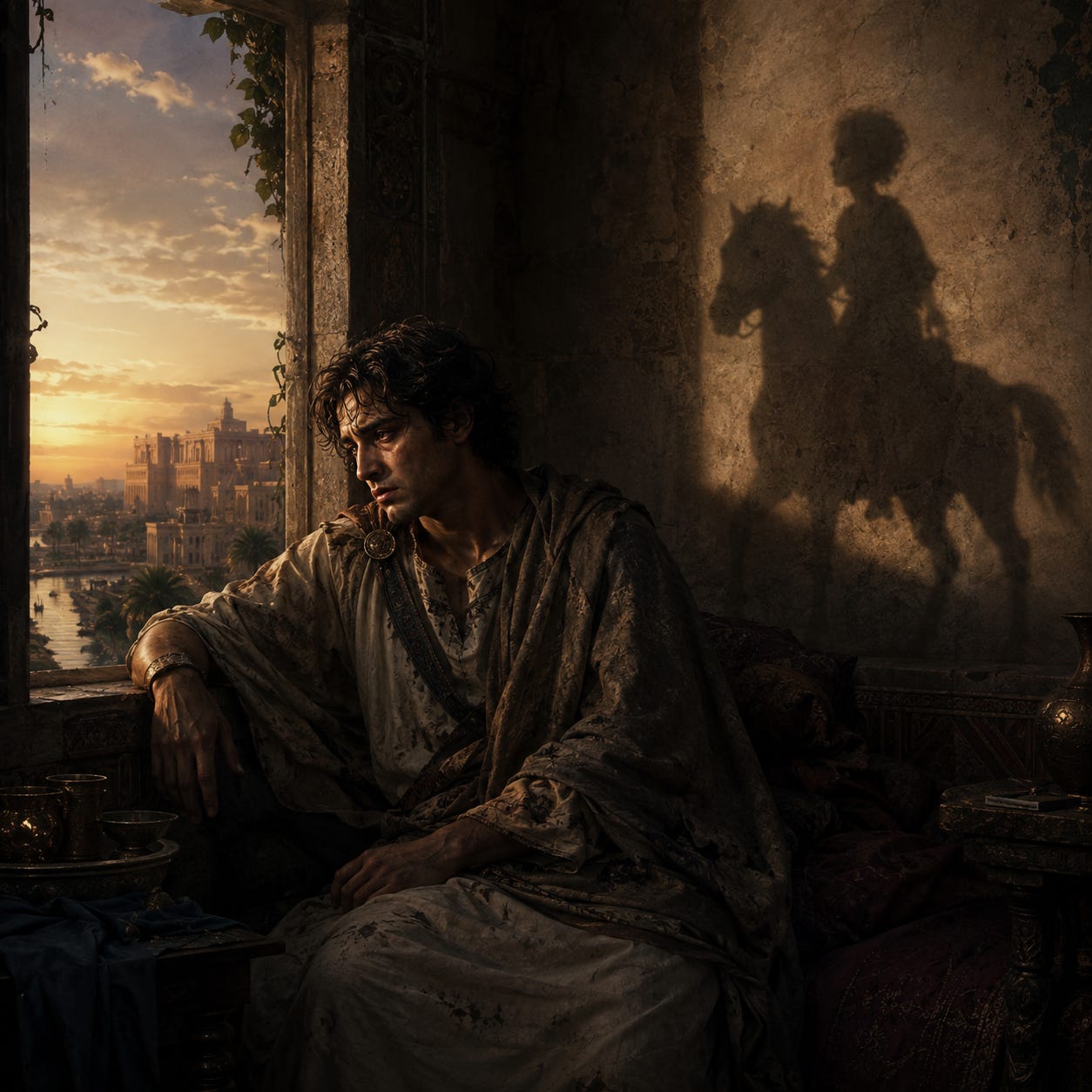
There is still Arabia.
They tell me this as though I have forgotten.
The ships are waiting on the Euphrates. The engineers have measured the water. Men have counted horses, grain, timber, sails. Somewhere beyond these walls there are scribes making lists of things I will need for countries I have not yet conquered.
I am thirty-two years old.
My body is burning.
Babylon breathes outside the chamber. I can hear water sometimes. Voices. Sandals on stone. Men whispering because kings are not supposed to hear men whisper.
They think I am dying.
Perhaps I am.
I have been wounded before. Spears, arrows, stones, blades. My body contains a geography of men who tried to stop me.
None of them did.
Now there is something inside me without a face.
I cannot charge it.
I cannot surround it.
I cannot negotiate with it.
I cannot ask where its cavalry is positioned.
I lie beneath linen in Babylon, in the country that once belonged to the kings I was raised to hate, and think of a place I have not seen since I was twenty-one.
Macedonia.
The word feels smaller than I remember.
Sometimes, in the fever, I see rain.
Not the rains of India, which came like the sky breaking open.
Macedonian rain.
Cold rain.
Mud beneath a horse.
My mother’s hands.
My father’s voice.
And I find myself wondering something that no general ever asked me and no philosopher prepared me to answer.
When did I stop going home?
The horse was not wild.
That was the first thing I understood.
The men said he was vicious. Impossible. A waste of money. He reared and twisted beneath their hands, and each man who approached him became another proof that the animal could not be mastered.
I watched.
He turned.
The shadow moved.
He frightened himself.
I was a boy, but I knew something the men did not know: fear often looks like defiance when you are standing on the wrong side of it.
I took his reins and turned him toward the sun.
The shadow disappeared behind him.
His body changed beneath my hand.
I climbed onto him.
For a few breaths there was only horse beneath me and sky above me, and then the earth began moving very fast.
I remember laughter.
I remember shouting.
And I remember my father.
Philip.
He was watching.
There are victories I cannot remember clearly. Men tell me where I stood at Gaugamela. They tell me which formations moved, which units broke, which horsemen followed me through the gap.
But I remember my father’s face that day.
Pride is a strange thing to see in the face of the man whose pride you fear.
He told me Macedonia was too small for me.
Find yourself a kingdom worthy of you, he said—or something close enough that men have repeated it ever since.
They think it was a blessing.
Perhaps it was.
But blessings are dangerous things to give children.
A child does not know when to stop obeying them.
Bucephalus carried me away from that field.
He would carry me farther than either of us could have understood.
Across Asia.
Across mountains.
Across kingdoms whose names had not yet entered my mouth.
I thought I had learned how to master fear by turning it toward the light.
It took me many years to understand that men also run from shadows.
Some of us run so far that we call it conquest.
My father kept winning.
That was the problem.
Messengers came to Pella carrying news of another city, another army, another agreement bent into obedience by Philip’s patience or Philip’s violence.
The adults celebrated.
I counted.
Each victory seemed to remove something from the world.
What would remain for me?
There are boys who wish their fathers immortality.
I wanted mine to live forever and feared that if he did, there would be nothing left beneath the sun that did not already carry his fingerprints.
I loved him.
That is the part men simplify.
They want fathers and sons to be either devotion or hatred because history is easier when everyone contains only one emotion at a time.
I loved him because he was enormous.
I resented him because he was enormous.
He had lost an eye and still saw farther than most men.
He had taken Macedonia, a country Greeks mocked, and turned it into the instrument by which Greece itself could be commanded.
He built the army I would inherit.
He imagined Asia before I crossed into it.
Even Persia was, at first, my father’s idea.
And so I began competing with a man who had not asked me to compete with him in every breath.
When he remarried, when the court shifted, when wine made insults possible that daylight might have prevented, I sometimes hated him with the peculiar hatred only sons can feel: hatred made almost entirely from love and terror.
Then he died.
Not in battle.
Not before Troy.
Not beneath the walls of some impossible city.
At a celebration.
A blade.
Blood.
Confusion.
A king falling where everyone could see him fall.
I was twenty.
That morning I had a father.
Soon after, I had a kingdom.
People speak of succession as though a crown travels cleanly from one skull to another.
It does not.
A crown passes through blood.
Men tested me immediately.
They had known me as the prince who spoke too quickly, rode too hard, argued too freely.
Now they had to decide whether they would kneel.
I gave them reasons.
I became king quickly because hesitation is a luxury granted to men who are not surrounded by people calculating whether they can survive your death.
But there was something no coronation solved.
Philip was gone before I could become greater than Philip.
He never saw Issus.
He never saw Gaugamela.
He never saw Babylon open its gates.
He never saw me enter Susa.
He never stood beside me beneath the columns of Persepolis.
Everything I did afterward became, in some secret chamber of myself, a message sent to a dead man.
Look.
Look what I did.
Look how far I came.
Look what your son became.
But the dead are terrible fathers.
They never answer.
I had heard of Persia before I knew what empire meant.
Darius.
Xerxes.
Marathon.
Thermopylae.
Athens burning.
Men standing in narrow places against armies larger than stories could hold.
Persia entered my childhood not as geography but as scale.
It was what lay beyond Greece.
The great eastern thing.
The throne from which kings commanded peoples whose languages they could not speak.
At court I saw Persians too.
Not the Persians of Greek memory.
Men.
Nobles.
Exiles.
Men who understood roads and satrapies and the habits of kings.
When Persian envoys came, I wanted to know distances.
Which road led where?
How long between cities?
What sort of man was their king?
Children are supposed to ask about golden cups.
I wanted to know how the machine worked.
Then Aristotle came.
He gave names to distinctions Greeks already carried in their bones.
Greek and barbarian.
Freedom and servitude.
Reason and appetite.
The proper order of men.
He taught me to classify the world.
Homer taught me to enter it.
Achilles mattered more.
I slept with him near me in words.
A young man who crossed the sea into Asia knowing that glory and death were perhaps the same road viewed from opposite ends.
When I crossed the Hellespont, I knew exactly which story I was entering.
I went to Troy.
I honored Achilles.
I touched the soil of Asia as though the earth itself had been waiting.
I was twenty-one years old.
Behind me was Macedonia.
Before me was everything I had been told was too large.
Do you know what it feels like to stand at the beginning of your own myth?
It feels nothing like myth.
The wind moves.
Horses s**t.
Men complain about equipment.
Someone is hungry.
Someone has forgotten something.
The sea looks like water.
And yet beneath all of it is the knowledge that you can still turn around.
There is one final moment before every great act when the life you already possess remains available.
Then you move.
I moved.
For eleven years I did not stop.
At first Darius frightened me.
I should say that.
Kings are allowed fear. They merely hire poets to rename it afterward.
Persia was still immense.
I had won battles, but winning a battle against an empire is not the same as owning the morning after it.
At Issus I saw what happened when scale became panic.
The Great King’s army broke.
Darius fled.
His family remained.
His mother.
His wife.
His children.
There is some…