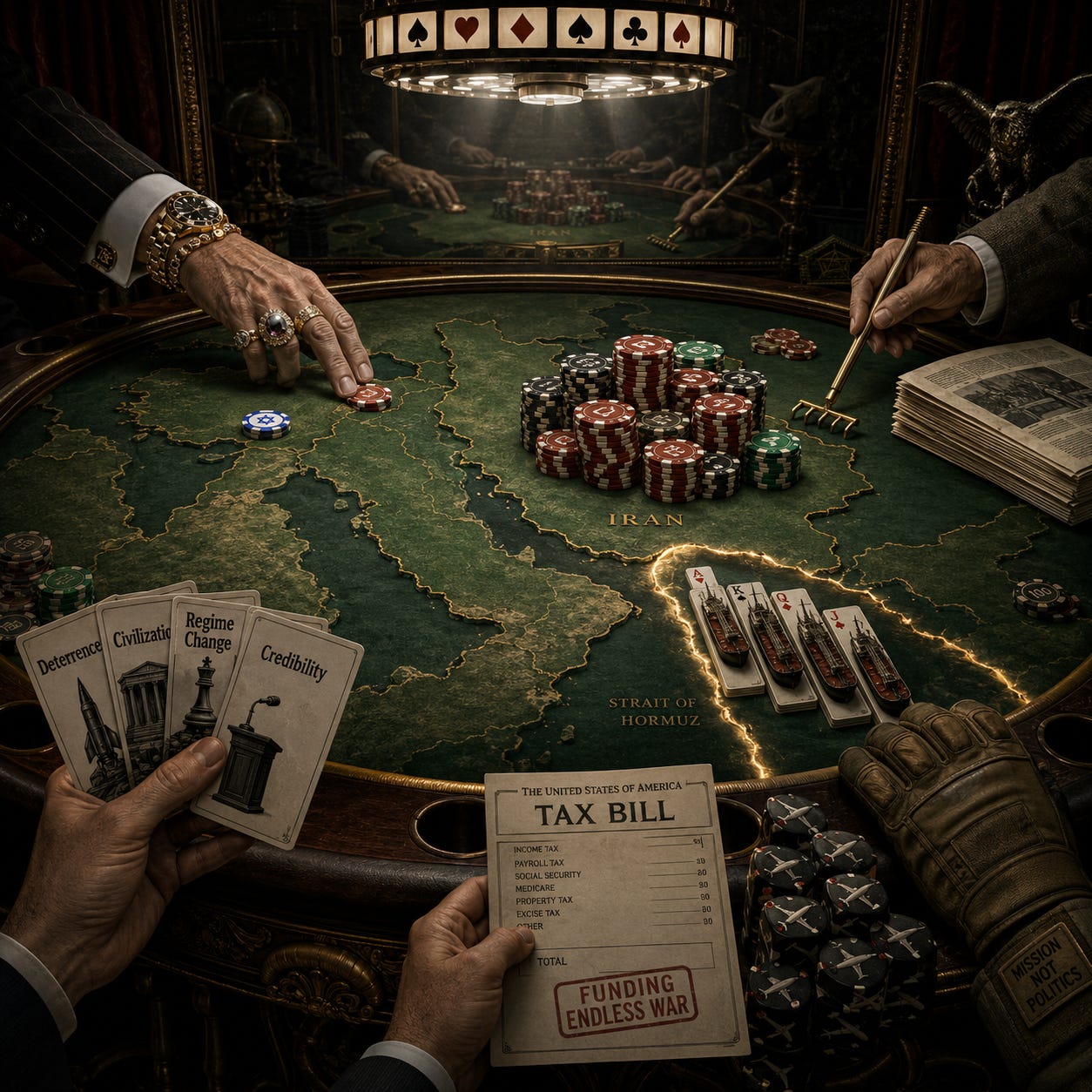
1. The Trial of the Very Serious People
In America, no one causes a war.
Wars happen. They emerge, like weather systems, recessions, opioid epidemics, and mysterious accounting irregularities. A war arrives already wrapped in passive voice. Mistakes were made. Intelligence was assessed. Options were considered. Concerns were raised. Red lines were crossed. The situation deteriorated. Escalation became unavoidable.
No one did anything.
The donor donated. The columnist opined. The think tank fellow warned. The senator expressed grave concern. The newspaper provided context. The editor maintained standards. The billionaire sought peace through strength. The retired general appeared on cable news because the graphics department had already made the map. The president acted reluctantly, surrounded by flags and advisers who understood that history is mostly a matter of lighting.
And when the war failed — when Iran did not collapse, when the Middle East was not remade, when American prestige did not return from wherever it had gone to die, when the Strait of Hormuz became a word ordinary people suddenly had to pronounce at breakfast — the authors of the fantasy all looked up from their panels, podcasts, board seats, and donor receptions with the same wounded expression.
Who, us?
We were merely concerned.
That is the genius of the American war class. It can turn appetite into analysis, tribal loyalty into national interest, panic into strategy, and failure into a fellowship at a policy institute. No one is guilty because no one acted alone. The guilt is distributed, securitized, laundered, and finally published as a sober retrospective in a serious newspaper under the headline: What Iran Taught Us About Readiness.
The country is invited to learn lessons from the disaster. Not moral lessons, of course. Not lessons about arrogance, capture, fantasy, or the strange way American power keeps finding itself attached to other people’s sacred obsessions. No. The lessons are technical. We need more drones. Better counter-drone systems. Deeper magazines. Faster procurement. Stronger alliances. More resilient supply chains. A renewed industrial base.
The empire’s preferred apology is a purchase order.
But before the procurement conference begins, before the columnists explain that they were right in a deeper sense, before the donors return to the table with another plan to save civilization from the consequences of their previous plan, a trial is necessary.
Not a legal trial. America has laws, and the powerful know how to stand just outside them, smiling. This must be a different kind of trial: a trial of judgment.
The defendants are not a people. Not Jews. Not Israelis. Not Iranians. Not Americans who were afraid after October 7, or horrified by the Islamic Republic, or disgusted by clerical repression, or moved by the suffering of Palestinians, or attached to Israel as memory, refuge, wound, or promise. Those are human attachments, and they deserve to be examined with care.
The defendants are more specific.
They are the people who converted attachment into policy. The people who confused Israel’s security narrative with American strategy. The people who mistook hatred of the Islamic Republic for knowledge of Iran. The people who sold vulnerability as destiny. The people who said the Middle East had been redefined because they had forgotten that reality gets a vote. The people who used the language of democracy to endanger protesters, the language of civilization to excuse bombardment, and the language of seriousness to smuggle in tribal panic.
They are the tribal accountants of empire.
And the indictment is simple:
America did not merely lose a war. It lost a fantasy. And the fantasy had authors.
2. The Word “Regime” and Other Small Explosives
Every war begins with a noun.
The noun must be small enough to bomb.
Not Iran. Iran is too large. Iran has mountains, poets, engineers, grandmothers, missile scientists, satellite programs, oil fields, dissidents, clerics, atheists, bazaars, mathematicians, dead kings, living wounds, and a memory longer than most American institutions. You cannot bomb all that without admitting what you are doing.
So the noun becomes smaller.
“The regime.”
Smaller still:
“The mullahs.”
There it is: the perfect little target. A word with a beard. A word with bad lighting. A word that smells, to the American imagination, of fanaticism, backwardness, irrationality, and women hidden under cloth. A word that reassures the bomber that he is not attacking a country. He is attacking a costume.
“The regime of the mullahs” is not analysis. It is stage design.
The Islamic Republic has a name. It should be called by its name. It is not a vague gathering of turbans around a cauldron. It is a state formation, a clerical-security order, a revolutionary republic, an intelligence system, a military apparatus, a bureaucracy, a patronage network, an ideological machine, and a government that has repressed many of its own citizens with cruelty and fear. It is all of that.
But Iran is not identical to it.
This distinction should not be difficult. A child can understand that a government is not the same thing as a country. A dissident can hate the ruling order and love the civilization beneath it. A citizen can despise the men who govern him and still refuse to invite foreign bombs onto his mother’s street.
Yet American war language depends on destroying this distinction. It collapses government into state, state into society, society into ideology, ideology into target. Once the target is small enough, the moral imagination relaxes.
The same people who cannot distinguish Iran from the Islamic Republic would, if America fell under Christian nationalist rule, be offended if the rest of the world referred to the United States as “the regime of the pastors.” They would object, correctly, that America is more than its theocrats. It has universities, laboratories, engineers, soldiers, judges, artists, agencies, logistics, infrastructure, memory, and millions of citizens who did not consent to being reduced to the worst men in office.
But give some of these same Americans a map of the Middle East and suddenly nuance expires.
If the MAGA imagination had its full sacramental way, America might become the Christian Nationalist Republic of America: the sister-state of the Islamic Republic, with turbans replaced by crosses, morality police replaced by school boards, clerical guardianship replaced by podcast theology, and the official press briefing conducted beneath the glowing cross of Karoline Leavitt’s America.
The satire writes itself because the symmetry is too embarrassing to need invention.
A theocracy is ugly in a turban.It is also ugly in a flag pin.
But ugliness is not weakness. That was the great American error.
The Islamic Republic may be illegitimate in the eyes of many Iranians. It may be morally exhausted. It may be corrupt, frightened, repressive, paranoid, and historically trapped. But none of that means the Iranian state is flimsy. None of that means its engineers cannot build. None of that means its military cannot plan. None of that means its missile forces are theatrical. None of that means its scientists are stupid. None of that means the country is waiting, like a stage prop, to fall over when a serious Western columnist exhales.
The word “mullah” did the work that intelligence failed to do. It allowed disgust to masquerade as assessment.
And that is where the explosions began.
Not in the sky.
In the noun.
3. The Country Beneath the Turban
There is a country beneath the turban.
That sentence is obvious only to those who have not been trained by empire to forget it.
Iran is not an inflatable theocracy. It is not a seminarian’s tent pitched temporarily on oil fields. It is not a failed state in waiting, held together by slogans and fear. It is an old country with a modern state apparatus. Its government may be ideologically rigid, but its state capacity is not a hallucination. Its rulers may be ille…