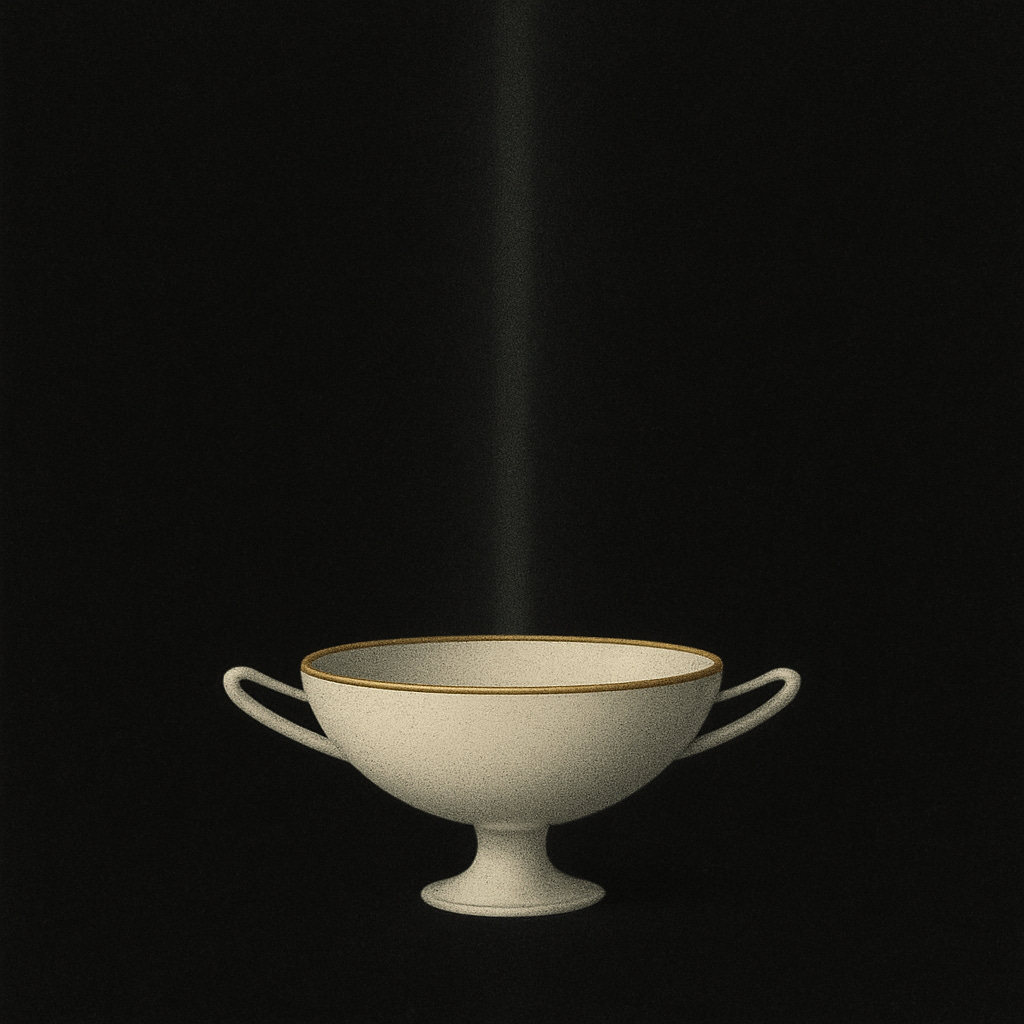
Opening — The City at War with Itself
Athens had won and then lost the world. The plague ate its breath; the long war with Sparta drained its treasure and its patience; coups and restorations taught citizens how quickly neighbors could become tyrants, and how thin the line was between theater and law. In the agora—the place where the city pretended to be one mind—you could hear the fatigue behind the arguments. Offices still rotated, juries still filled their benches, the assembly still shouted itself into decisions, but the confidence that once animated the words had been spent. The city had learned how to speak louder than it could think.
Into that noise walked a poor, stubborn man who refused to sell speech. He wore the same coarse cloak in winter and summer, went barefoot, and kept no school. Sophists set up shop and took fees; he took nothing. Politicians courted crowds; he courted one soul at a time, often the most important soul in the city—the one speaking in front of him. Where others performed wisdom, he insisted on something more humiliating and more merciful: the exposure of confusion. He was not Athens’ smartest man by his own account; he had simply discovered the one thing the city most needed and least wanted—to be shown where its certainty ended.
The summons came, he said, from Delphi. A friend, Chaerephon, had asked if anyone was wiser than Socrates; the god replied that none was. He took this not as praise but as a riddle. To test it, he went to those who seemed wise: statesmen, poets, craftsmen. He found skill without definition, fluency without understanding, talent that mistook itself for truth. The politicians could move a crowd but could not say what justice was; the poets gave lines greater than themselves but could not explain their own excellence; the craftsmen knew their trade but carried that confidence too far. If he had any “wisdom,” it was negative: he knew the limits of what he knew. That limit, once named, became a method. Question by question, contradiction by contradiction, he made ignorance visible so that knowledge could begin.
The city watched him learn to endure before it learned to listen. Years earlier, as a hoplite, he had held the line at Potidaea and Delium; he had stood fixed when others broke, and he had carried home wounded men with a calm that looked like stubbornness from the outside and discipline from within. He ate little, slept when he could, and feared less. Those habits—formed with spear and shield—migrated into speech. When men tried to drive him by threat or flattery, his composure did not move. That steadiness would matter when philosophy crossed from conversation to danger.
Athens was not simply turbulent; it was split against itself. In 406 BCE, after a naval victory at Arginusae, the assembly—hornet-stung with grief over sailors lost in the storm—pressed to violate its own law by trying generals in a single mass vote. On that day Socrates, serving in rotation among the presiding prytaneis, refused to put an unlawful motion to the floor. He withstood the fury of a crowd that had already decided what justice should look like. Two years later the city fell; an oligarchic junta, the Thirty, took power. Among them was Critias, once in Socrates’ circle. When the Thirty ordered Socrates to help arrest an innocent man, Leon of Salamis, he would not move. Others complied; he went home. The gesture was small and absolute: lawless power would not borrow his hands.
After the restoration of democracy, Athens swore an amnesty to stitch the city back together. It healed what it could and buried what it could not. Resentments dissolved in public and hardened in private. Socrates kept doing the only work he recognized as piety: caring for the soul of the city, one argument at a time. He asked the same unglamorous questions—What is virtue? What is piety? What is courage?—and kept discovering that confidence arrives long before clarity. He was a gadfly, he told them later, but not a nuisance by preference. The animal that stings a great, drowsy horse is unpopular for a reason: it wakes what would rather keep sleeping.
He did not dress his challenge in poetry. He did not soothe it with fees. He did not protect it with a faction. He simply insisted that Athens be as good as it said it was by becoming as honest as it claimed to be. That insistence put him in collision with the city’s public face. If law is the formal conscience of a people, theater is its informal one, and by the end of the century the latter had swallowed the former. Aristophanes had made of him a comic mask in Clouds, confusing him with fashionable talkers and sky-bound speculation. The distance between a joke and a charge is shorter than a city imagines when it is ashamed and tired.
In 399 BCE the city finally reached for the tools it understood—indictment, jury, sentence. The charge was simple and elastic: impiety and corruption of the young. But trials do not begin with filings; they begin with a mood. The mood was that Athens wanted harmony without examination, order without inward repair. Socrates’ life had become a standing refusal of that wish. He would not flatter, would not bargain, would not stop. The city was at war with itself, and he was the instrument that made the civil conflict audible.
This is where his story must start: not with a doctrine, because he left none, and not with a school, because he founded none, but with a stance. A single citizen, stripped of titles, turning the city back toward first questions. Behind the public failure and the cup that waits at the end, there is a practice that does not change: expose confusion, honor the law, obey the inner restraint, refuse the unlawful order, tell the truth without selling it. What follows will trace that practice across the six faces by which it can be learned—against power, through method, under misrecognition, by interior discipline, in the courtroom, and in the wake he left behind—so that the reader does not merely know the life of Socrates but inherits his posture. The city will always be tempted to speak more than it can think. Someone must keep asking.
Chapter 1. Against the Theater of Power
Power in Athens wore a costume. It spoke in the Assembly with practiced thunder, turned wit into law on the comic stage, and hired teachers of speech to make victory sound like virtue. Socrates did not compete for that costume. He treated public power as a test of private integrity and answered it with three instruments: knowledge of the law, obedience to conscience, and a refusal to trade truth for applause.
He showed the first instrument in 406 BCE, after the naval battle at Arginusae. A storm had swallowed survivors; grief and fury swept the city. The Assembly wanted speed, not procedure, and moved to try the victorious generals together in a single, illegal mass vote. On that day, by the lot that governed Athenian democracy, Socrates served among the presiding officers of the Council—the daily president whose duty was to put motions to a lawful vote. He would not. No rhetoric, no threat of the crowd’s anger, not even the city’s demand to honor the dead by breaking its own rules could make him table an unlawful motion. Later he recalled the moment without adornment: it was simply not legal, and he would not do it. The vote went forward another day without him and the generals were condemned, but the point had been made in the only currency a citizen truly controls—his own hands.
He showed the second instrument under the opposite regime. In 404 BCE, after Sparta’s victory, the Thirty took power, led in part by Critias, who had once moved in Socrates’ circle. They sent for Socrates with four others and ordered them to arrest Leon of Salamis so he could be executed—an innocent man chosen to test obedience. The others went; Socrates turned and walked home. There is no heroic flourish in the surviving accounts, only the quiet refusal to be a tool. It is important that the two episodes mirror each other: he disobeyed both democracy and oligarchy when they were lawless. He was not loyal to a faction. He was loyal to justice as the law rightly understood it, and to the boundary set by his inner command.
The third instrument—the refusal to flatter—was on display every day. Socrates’ politics were not the Assembly’s, where men stood on the bema and moved crowds. He practiced what he called the only honest politics: the private, relentless care of the soul. He stopped statesmen, poets, craftsmen, and generals in the open air and asked them for the thing they most feared to define in public: justice, courage, moderation, piety. He listened long enough for fluency to run out and contradiction to begin. The technique was simple and unforgiving: if you claim to lead, you must know what you are leading toward; if you claim to be just, you must be able to say what justice is. The city loved the sound of excellence but often could not survive the question that excellence requires.
Plato preserved a series of collisions with the theater of power that make the stance unmistakable. In the Gorgias, Socrates calls rhetoric a craft that cares more for pleasure than for the soul’s health, comparing it to cookery that sweetens without curing. The rhetor’s victory, he says, is nothing if it leaves the citizen worse. This is an attack not only on professional talkers but on the civic habit of mistaking persuasion for truth. In the first book of the Republic, he meets Thrasymachus’ definition of justice as the advantage of the stronger and refuses it at the root, insisting that rule, to be rule at all, must aim at the good of the ruled. Power that feeds on subjects is not a craft but a predation. In the Apology, he faces the city directly and tells the jurors what it had never paid to hear: he would stop speaking only if the god commanded it, not if they threatened him. He recommends, half in earnest and wholly in irony, that he deserves public meals in the Prytaneion—the civic honor for Olympic victors—because he had trained the city for the contest that matters most.
This hostility to flattery was not theatrical courage. It rested on habits the city had already tested. As a hoplite at Potidaea, Delium, and Amphipolis, Socrates stood still when others fled, endured cold in a single cloak, and carried wounded friends to safety with a composure that looks in the accounts like a physical form of the later intellectual steadiness. The same discipline—attention under pressure, indifference to comfort, regard for what is right rather than what is easy—migrated from the battlefield into the marketplace of speech. It is easier to say “no” to a demagogue if you have first learned to say “no” to your own body.
The city, for its part, trained itself to misunderstand him. Aristophanes’ Clouds hung a comic mask on his face years before the trial, confusing him with sophists who sold cleverness as if it were truth. To the crowd, the distinction was invisible: men who asked questions for money and a man who asked them for the soul’s sake all sounded like trouble. Add to this the unlucky association with figures like Alcibiades and Critias—brilliant, ambitious, ruinous—and the moral mathematics of a tired city solved itself: where there is disorder, there must be a corrupter. The irony is sharp. Socrates’ real offense was not influence but resistance to the very kind of influence Athens valued.
Two legal moments bookend this chapter’s theme. The first is his role in refusing an illegal motion at Arginusae; the second is his argument, years later in the Crito, that one must not return injustice for injustice and must not break lawful agreements with the city. The pair looks contradictory until you see their hinge: law as law is to be obeyed; commands that violate the law’s justice are not. He will not put an unlawful vote to the floor; he will not flee a lawful sentence. That is the spine that allowed him to stand against the theater of power without becoming a nihilist about the city itself.
What, then, is the character on display? Not rebellion for its own sake, not a taste for scandal, not even a preference for danger. It is the art of withholding one’s cooperation from what is unlawful, even when the crowd calls it piety, and of withholding one’s speech from what is pleasing, even when the crowd calls it wisdom. It is the habit of asking for definitions where others accept moods, of returning to first principles where others count noses, of treating justice as something more than the reflex of the strong. Socrates lived poor, kept no school, accepted no fees, and held no office beyond the duties rotation imposed on every citizen. In a city addicted to performance, he chose competence in conscience over competence in spectacle.
To learn this stance is to practice three simple fidelities: know the rule you are under; keep a conscience that can say “no” when the rule is broken; and refuse to purchase agreement with your integrity. Socrates taught them, not by a sermon, but by refusing to convene an illegal vote, by walking home rather than arresting an innocent man, and by declining to turn truth into a commodity the city could buy. He did not defeat the theater. He made it visible. That clarity would cost him later, but it is the precondition for any politics worth the name: a citizen who cannot be hired to betray the law, and a speaker who cannot be paid to betray the soul.
Chapter 2. The Midwife of Thought
He did not bring doctrines to market; he brought questions. The question was almost always the same, with different masks: What is it? Not this case of courage or that pious deed, not a list of examples, but the thing itself—courage, piety, virtue—named with such precision that a life could steer by it. Athens prized fluency; Socrates prized definition. The city rewarded persuasion; he sought knowledge. Between those two aims lay a method.
The method had a shape. First, he asked for a definition (the ti esti—“what is it?”). Then he invited a partner to champion it. Next came the test: by drawing out further claims the speaker already accepted, he looked for contradictions, places where the statement could not live with the rest of what the speaker believed. When the seams split, the partner fell into aporia—bewilderment. This was not a failure to him; it was the beginning of learning. False confidence had been lanced; the wound could now heal in truth.
He explained this work by borrowing his mother’s trade. In Plato’s Theaetetus, he calls himself a midwife of minds. He has no children of his own, he says—no wisdom to deliver as his own doctrine—but he can tell when another is in labor with an idea, can help the birth go well, and can test whether the child is living truth or a wind-egg. He does not implant; he draws out. It is why he will not take money: he is not selling a product. He is aiding a birth.
Consider the Euthyphro. At the porch of the King Archon, where religious business comes, he meets a man ready to prosecute his own father for impiety. Euthyphro claims to know piety well enough to instruct the city. Socrates asks for the definition. Euthyphro first answers with examples; Socrates asks for what makes all pious acts pious. Euthyphro then proposes: the pious is what the gods love. But the gods, on the city’s own telling, disagree. So perhaps the pious is what all the gods love? Now comes the hinge that will outlive the conversation: is the pious loved by the gods because it is pious, or is it pious because it is loved? If the former, piety has a form independent of divine favor; if the latter, piety is arbitrary power in disguise. Euthyphro retreats; aporia arrives. The dialogue ends without a definition, but the mind is cleaner than it began. An unexamined confidence has been exchanged for a precise difficulty.
The Laches performs the same surgery on courage. Two generals are asked whether boys should learn to fight in armor. The talk slides quickly to “What is courage?” Laches offers endurance; Socrates shows that reckless endurance is not courageous, and that endurance without wisdom may be a vice. The other general, Nicias, offers a definition closer to Socrates’ own habit of appeal to knowledge: courage is knowledge of what is to be feared and hoped for. But who possesses that knowledge, and of what scope? If it requires a science of the future, then courage belongs only to impossible experts. The net tightens; again, aporia. The dialogue does not close with a victory but with a commitment to keep seeking the kind of knowledge that would make endurance wise.
In the Protagoras, where Athens’ most famous sophist has gathered a paying audience, Socrates presses two linked theses that reveal the temperament behind his method. First: virtue is one, not a bag of independent excellences. If justice and piety are different, how do they overlap so thoroughly in practice? If courage is separable from wisdom, why does the courageous soldier act foolishly when ignorant? Second: no one errs willingly. What looks like weakness of will is, he argues, mismeasurement—choosing the nearer, smaller pleasure over the larger good because one lacks the “art of measurement” that would see clearly through time. Behind the sparring over whether virtue can be taught is a simple Socratic insistence: knowledge, not rhetoric, must govern action if action is to be good. This is why he keeps asking for definitions. Without them, citizens are only clever animals of appetite and pride.
The Meno stages a crisis in this insistence. “How will you look for something if you do not know what it is?” Meno asks. “If you find it, how will you know you have found it?” This is the paradox of inquiry: either you know and do not need to search, or you do not know and cannot search. Socrates’ answer—recollection—belongs to Plato’s metaphysics more than to the historical man. But watch what he does with the slave boy. By asking a sequence of questions about a square and its diagonal, he leads an uneducated youth to see that his confident answer was wrong, to feel aporia, and then to discover a true relationship by guided steps. Whether or not one believes in prenatal knowledge, the demonstration reveals Socrates’ craft: he does not deliver a doctrine; he composes a path of questions that lifts a mind from illusion to clarity. The boy learns not just a geometrical fact but the discipline of revising himself when shown his limits.
In dialogue after dialogue, the same pattern holds. Lists of cases are rejected in favor of the “one in virtue of which” all cases are what they are. In the Charmides, temperance is not quiet behavior or modest dress but something like self-knowledge—but of what? Of what one knows and does not know? The regress threatens: must temperance know itself? The search tightens and stalls; the aporia is not defeat but an honest map of where ignorance begins. In the Hippias Minor, the paradoxes sharpen until the complacent expert is tangled in his own boasts. In the Lysis, friendship will not sit still under any easy definition—usefulness, likeness, difference—each collapses under pressure. What remains is the necessity of the search itself: without clarity, even the best desires misfire.
What protects the method from becoming mere sport is the analogy that runs quietly through his questions: the analogy of craft (technē). A good cobbler knows what a shoe is for; a good helmsman knows the end of navigation and the means proper to it. They can give an account and withstand cross-examination. If the soul has a good—if justice, courage, temperance, and piety are excellences rather than flattering words—then one must treat them with the same rigor. A city that would never board a ship with a pilot who could not define his work will gladly entrust itself to orators and strategoi who cannot say what they are aiming at. Socrates’ method is the institutional memory of that contradiction.
It is easy to mistake his professions of ignorance for coyness. They are structural. In the Apology he calls his wisdom the knowledge that he does not know. That is not a riddle; it is a boundary condition for honest inquiry. He will not raise his voice above the range of his knowledge. He will not pretend to a science he does not possess. He will, however, insist that others observe the same discipline, especially those who carry the city’s confidence. The “irony” for which later readers name him—the stance of the questioner who lowers himself to lift another—is the social technology of this discipline. It clears space for the other’s commitment before the test begins.
There are costs to such a method. It often ends without the positive doctrine the crowd expects. It deflates rather than entertains. It exposes teachers for whom the sale matters more than the thing sold. It produces, as its immediate fruit, not contentment but disturbance. Yet the deeper yield is moral. Aporia is a training in humility. The search for a universal definition is a training in justice, because it refuses to let one’s favorites and resentments decide what a virtue is. The craft analogy is a training in responsibility, because it binds excellence to knowledge and to ends beyond vanity. The refusal to sell wisdom is a training in purity, because it severs truth from price.
This is why the method lives beyond any single answer Socrates did or did not reach. He did not found a school; he founded a way of standing in front of other minds. Ask for what the word claims to mean. Test it against what the speaker already believes. Refuse to let examples masquerade as essence. Accept confusion as the first honest state of a learner. Hold fast to the belief that knowledge, not force or fashion, is the proper governor of life. In a city that dutifully hired stylists of speech, he kept returning citizens to the unglamorous labor by which a soul becomes trustworthy: say what you mean, mean what you say, and be willing to learn that you do not yet know what either entails.
Chapter 3. The Comic Mask and the Crowd
Athenian democracy did not think only with laws; it thought with laughter. Comedy could fix a face to a rumor and make it look like fact. Years before the indictment, Socrates had already been tried on the stage and convicted in the city’s imagination.
The prototype of that conviction is Aristophanes’ Clouds (first staged 423 BCE, later revised). The play plants Socrates in a “Thinkery,” dangling in a basket to study the heavens while teaching two personified logics—the “Better” and the “Worse” Argument—to help a debtor beat his creditors. He is made to worship new deities (the Clouds), mock traditional piety, and show young men how to make the weaker case appear the stronger. The joke lands because it splices together two live Athenian anxieties:
* Natural philosophers who “investigate the things in the sky and below the earth,” seen as impious imitators of Anaxagoras and his kind;
* Sophists who sell rhetorical skill for fees (Protagoras, Gorgias, Hippias), suspected of teaching verbal victory divorced from truth.
Socrates in the play is a composite—sky-gazer plus fee-taking wordsmith. But the historical Socrates did neither: he denied being a cosmologist and refused to take fees. The comedy stuck anyway. When Plato later gives him the floor in the Apology, the first enemy he names is not Meletus the formal accuser but the “earlier accusers”—the long sediment of gossip and comedy that had already taught jurors to see him as a clever impious corrupter. The crowd remembers the basket more readily than the arguments in the marketplace.
Why did the conflation work? Because Socrates’ public life shared surfaces with both groups he was not. Like the sophists, he questioned men in public; like the natural philosophers, he cared more for truth than for tradition. The differences were matters of motive, method, and money—subtle distinctions that crowds rarely keep. He practiced dialectic to expose ignorance, not to sell weaponized speech; he asked ethical “What is it?” questions, not physical “What is it made of?” questions; he lived poor when men who looked vaguely like him charged handsomely. Comedy blurred the edges; fatigue did the rest.
Two associations made the blur darker.
* Alcibiades—brilliant, dazzling, and ruinous—was publicly linked to Socrates. In Plato’s Symposium, Alcibiades praises Socrates’ unparalleled endurance and recounts how Socrates stood firm at Potidaea and Delium. Yet Alcibiades’ career—his role in the Sicilian expedition (415 BCE), the scandal of the mutilated Herms and profaned Mysteries, his defections to Sparta and then to Persia—taught Athenians to connect Socrates’ searching influence with a glamorous kind of disorder.
* Critias, a talented writer once in Socrates’ circle, later became a chief of the Thirty (404–403 BCE), the oligarchic junta whose executions and confiscations scarred the city. When democracy was restored under an amnesty that forbade prosecuting political enemies for past acts, impiety became the legally available proxy for political fear. A teacher cannot be charged for a student’s crimes; he can be charged for corrupting the young.
By 399 BCE, the fuses laid by comedy and association had reached the courtroom. Socrates’ defense in the Apology turns directly on misrecognition. He distinguishes himself from sophists by pointing to what every Athenian could verify: he never took fees, kept no school, and made no traveling show. He distinguishes himself from natural philosophers, claiming no expertise about sun and moon and refusing to replace civic piety with speculative physics. What, then, explains the city’s hostility? The Delphic riddle—that no one was wiser—drove him into public examination; examination exposed pretended knowledge; exposed men nursed resentment; resentment fermented into accusation. The chain is psychological and political: when a city confuses reputation with virtue, the man who separates them looks like an enemy.
Aristophanes’ Clouds ends with the Thinkery burned to the ground—a slapstick fantasy of civic cleansing. The real Athens could not burn an institution Socrates did not have, so it set fire to the person. The indictments were elastic enough to catch a mood:
* Impiety: he “does not acknowledge the gods the city acknowledges” and “introduces new daimonic things.”
* Corruption of the young: he makes imitators of his questioning, boys who catch the habit of unmasking pretension in fathers and officials.
Socrates answers both with the same instrument he used everywhere: distinction. A daimonion, he says, is an inner restraint that keeps him from injustice, not a private cult. As for the young, he never recruited them; they followed because they preferred hearing their elders questioned to hearing them praised. “If I have harmed them, they will testify,” he says—and calls none of the supposed victims, because none present themselves. The crowd does not change its mind easily once a mask has been fixed to a face.
This chapter is not a complaint about comedy. Aristophanes is not a prosecutor; he is a weather vane. The air had already shifted. Twenty-seven years of war had taught Athens to seek order without examination; the postwar amnesty demanded forgetting without healing. In such a climate, a man who insists on distinguishing skill from wisdom, piety from fashion, and courage from loudness is tiring. Laughter helps the city forgive itself for not listening. It turns a physician into a quack and then blames him for the illness.
A few precise lessons survive the noise:
* Keep the lines clear. Socrates spends the opening of the Apology separating himself from look-alikes. When the stakes are high, distinctions are not pedantry; they are survival.
* Expect borrowed charges. When a city cannot legally try you for what it fears, it will try you for what it can name. Socrates’ case rides on categories (impiety, corruption) elastic enough to hold resentment.
* Refuse the sale. The fee is not just money; it’s the agreement to turn inquiry into performance. His poverty is a rhetorical strategy as much as a moral one: it blocks the city from calling him a merchant of doubt.
* Live so that your answers are public. He points to his life as evidence: no school, no fees, unbroken obedience to law when just, refusal when unlawful. In a crowd, arguments travel poorly; conduct travels well.
The misrecognition did not end with the verdict. It would take Plato’s dialogues and Xenophon’s memoirs to unmask the mask for later centuries, preserving a man whose method was ethical rather than cosmological and whose poverty was policy rather than incapacity. But in 399 BCE, the jury did not have Plato’s corpus; it had a memory of a basket and the fatigue of a century. Socrates’ fate shows how a city’s humor can prepare its justice, and how a citizen must hold his form when both are mis-aimed. He did not fight the mask with a counter-mask. He kept drawing distinctions until the room chose whether it preferred a clean mind or a quiet one. The room chose quiet.
Chapter 4. The Daimon and the Discipline
He obeyed before he argued. Long before jurors weighed his words, Socrates had already chosen the government under which he would live: an inward restraint he called the daimonion. In the Apology he describes it plainly—“a divine sign”—present since childhood, not a spirit he worshiped but a check that “always turns me away from what I am about to do, but never urges me on.” It is a grammar of no. Where others sought visions that command, his piety was a brake that preserves. The city accused him of inventing new gods; he claimed only this: a familiar prohibition that kept him from injustice.
That negative command shaped the public life he would not have. When friends pressed him to enter politics, he said the sign restrained him. He would fight for the city as a hoplite and honor the law as a citizen, but he would not seek office where the pressure to flatter would drown the pressure to be true. The daimon’s refusal did not make him passive; it made him precise. He acted where he could be fully responsible for his hands and withheld them where the crowd owns a piece of every deed.
On the field, the same discipline had a body. Alcibiades’ speech in the Symposium gives the portrait Athens could verify: Socrates marched barefoot in winter and bore cold better than men with boots; he wore the same cloak year-round; he needed less sleep and food than others but could, when circumstance demanded, drink everyone under the table without losing his clarity. At Potidaea, he stood immovable in endurance and, when Alcibiades fell, lifted and saved him—then insisted the prize for valor go to the younger man. At Delium, when the Athenian line broke, Socrates withdrew slowly and in order, his eyes level, deterring pursuit; courage here is not fever but control. The virtue he would later seek to define in conversation had already been rehearsed in the economy of the body: fewer claims from comfort, more attention for judgment.
There is a second image from Potidaea that makes the inner architecture visible. One morning, Socrates stopped where he was and stood thinking. He remained fixed, unmoving, through the day and into the night, until the next dawn, when he completed his inquiry with a brief prayer to the sun. The scene is not spectacle; it is the refusal to trade an unfinished thought for the next obligation. The same steadiness would later govern his speech in court: he would not embellish with pathos or bring his children to stir the jurors’ pity. The daimon guards him from actions that would betray the argument.
His temperance was not denial for its own sake. It carved out the independence that inquiry requires. Because he took no fees, he could not be bought; because he ate little, he could think long; because he prized definitions over applause, he could contradict men who fed on applause. Even desire that Athens honored—youthful beauty seeking Socrates’ company—found the same boundary. Alcibiades tells how he tried to bargain: beauty for wisdom, a night for initiation into what Socrates “had.” Socrates refused the commerce. He would not turn the city’s most charged currency into leverage. He preserved love by denying purchase, redirecting eros from body to form—toward the good his questions were trying to name.
Piety, for him, is not the choreography of ritual but fidelity to a summons. In the Apology, Socrates claims that his whole public practice sprang from Delphi’s riddle that no one was wiser. He could have hidden this claim under metaphor; instead he made it the spine of his defense. “I shall obey the god rather than you,” he tells the jurors, “as long as I draw breath and am able.” The phrase is not rebellion; it is allegiance—to a task that serves the city better than any vote that asks him to stop. He takes oaths seriously. In the Crito, he will argue that to flee a lawful sentence would be to break a just agreement with the laws under which he has lived. The same life that refuses an unlawful motion at Arginusae and an unlawful arrest under the Thirty will also refuse to escape a lawful judgment when it comes. The daimon’s “no” and the law’s “yes” form a single discipline.
The sign accompanies him to the end. After the verdict in 399, he remarks that the daimon, which often opposed him over smaller things, did not restrain him at any point during the trial—not when he refused to beg, not when he proposed public meals as a “penalty,” not when he spoke of death as either a dreamless sleep or a journey to question wiser souls. He takes the silence as a sign that what has happened is within the good he cannot yet measure. A piety of restraint becomes, at the last, a courage without bitterness.
Xenophon’s Memorabilia adds a nuance: he reports the sign sometimes gave positive indications—gentle promptings as well as vetoes. Plato keeps the emphasis on prohibition; Xenophon broadens it to prudence. The divergence does not overturn the core. Whether as check or quiet nudge, the effect is the same: Socrates does not derive action from appetite or fashion. He waits for alignment between reason, law, and the inner measure that has kept him free.
What did the daily practice look like when it was not under arms or indictment? It looked like care of the soul—epimeleia tês psychês. He did not draft treatises; he set conversations in motion. He met men where they boasted secure knowledge—what justice is, what piety is, what courage is—and walked them past the edges of their certainty until they could feel the boundary. That is spiritual work, not academic sport. It required patience with confusion, envy from the exposed, and the poverty that keeps motives clean. It also required a watchfulness that touched ordinary choices: how much to eat, when to speak, which invitations to accept, which feasts to leave while still sober. Self-command in small things is the mortgage payment for integrity in great ones.
He lived without the props that make other men legible—no writings, no office, no school sign, no fee table. The coherence of his life had to be seen all at once or not at all: endurance in war, refusal in tyranny, obedience in court, constancy in poverty, chastity when tempted, and an unbroken return to questions whose answers he would not fake. If piety is care for what is highest and justice is giving each its due, then his discipline is both. He gives God obedience, the law respect, friends protection, enemies truth, and his city the single service he believes can still save it: a citizen who cannot be induced to act against his own measure.
A few rules of apprenticeship can be drawn from the pattern:
* Treat restraint as a power, not a lack. A clean “no” preserves the capacity for the right “yes.”
* Make the body an ally of judgment. Fewer comforts; clearer perception. Courage is attention held under stress.
* Let piety govern practice. If there is a task higher than public favor—care of the soul—obey it even when obedience looks like stubbornness.
* Keep agreements you would ask others to keep. Refuse the unlawful order, accept the lawful sentence; the line is the city’s spine.
* Guard eros. Channel desire toward what can be honored after morning comes.
Socrates’ daimon did not tell him what truths to teach. It trained him to be the kind of man a truth could trust. The world could move him by threat and by laughter; it could not move him by appetite. That is why his questions had moral weight: they were asked by someone who had already asked the same things of himself and taken the harder terms. The discipline is the doctrine.
Chapter 5. The Sentence and the Cup
A trial is a mirror held to a city. In 399 BCE, Athens looked and preferred not to recognize itself. The formal charges were two—impiety and the corruption of the young—but the courtroom carried older weather: comedy’s mask, political fatigue, the long habit of confusing persuasion with truth. Socrates did not arrive as a blank defendant. He arrived as an answer to the city’s condition, and the city judged the answer intolerable.
The procedure mattered. An Athenian jury was large (five hundred and one men), selected by lot; no lawyers spoke on a defendant’s behalf; the time for each speech ran down a water clock. After the speeches, the jurors cast pebbles—guilty or not. If guilty, there followed a penalty phase: the accuser proposed a punishment; the defendant proposed a counter-penalty; the jury chose between them. The process was more theater than inquiry, and Socrates refused the expected performance.
The accusers were three: Meletus (the formal prosecutor), Anytus (a powerful democratic politician and tanner by trade), and Lycon (linked to the orators). The indictment alleged that Socrates “does not acknowledge the gods the city acknowledges, but introduces new daimonic things,” and that he corrupts the youth. In his Apology—“defense,” not apology in our modern sense—Socrates begins with the enemies whose case had no filings: the “earlier accusers,” the long sediment of rumor and Aristophanes’ Clouds that had already taught jurors to see him as an impious sophist. He asks for no pity, brings no weeping children, and declines the pathos expected of defendants. He proposes to tell the truth.
He separates himself from those he is not. He is not a natural philosopher meddling with sun and moon; he is not a sophist charging fees. What explains his public life, then? The Delphic riddle—that none was wiser—sent him to test men who were thought wise. Politicians could not define justice; poets could not explain their own excellence; craftsmen mistook expertise in one domain for wisdom in all. If he has any wisdom at all, he says, it is this: he knows that he does not know. That negative wisdom, however, binds him to a positive duty—to question—a duty he will not abandon even if the jury orders him to be silent. “I shall obey the god rather than you,” he says. The gadfly metaphor follows: he annoys, but to wake a great, drowsy horse.
He turns to Meletus and cross-examines. Do only Socrates corrupt the young while all other Athenians improve them? That is not how craft or education works. If he corrupts, does he do so willingly? No one willingly makes his neighbors worse, for a bad neighbor is dangerous; therefore, if he corrupts, it is unintentional and should be corrected, not punished. On impiety, Meletus claims Socrates is an atheist; moments later he accuses him of introducing new daimonic beings—an incoherence Socrates exposes: one cannot both deny all gods and also introduce divine agencies. The dialectic is clean; the room is tired.
The verdict is close. Plato’s Socrates says that if thirty votes had gone the other way, he would have been acquitted. Then comes the penalty phase. Meletus demands death. Socrates, asked to propose a counter-penalty, will not purchase life at the price of lying about his practice. Exile would be a lie—he would question elsewhere as he did in Athens—and a humiliation; silence would be treason to the task. With deliberate irony he proposes free meals in the Prytaneion, the honor fed to Olympic victors; when pressed to name a fine, he first says he can afford one mina, then—at the urging of his friends Plato, Crito, Critobulus, and Apollodorus, who stand as sureties—he offers thirty minas. The jury, now angered, chooses death by a wider margin than the first vote.
A then-current sacred law delayed the execution. Each year a state ship sailed to Delos to commemorate Theseus’ legendary rescue of youths from Minos; while the ship was away, no execution could take place. The trial had coincided with the sailing, so Socrates spent about thirty days in the city prison. His friends visited daily. He did the unexpected: he made poetry. A recurrent dream—“Socrates, practice and cultivate the arts”—which he had taken to mean philosophy, now seemed to invite literal music. He versified Aesop’s fables and composed a hymn to Apollo. The man who would not flatter would not waste his last days either.
During the stay, Crito arrived at dawn with a plan to engineer escape—bribes laid, a route prepared. He pressed every argument: Socrates’ enemies desired his death; friends would bear the cost; his children needed him; exile would be bearable. Socrates answered with the voice of the Laws, personified: Do not return injustice for injustice; do not break just agreements because they now bite. He had lived his entire life under Athens’ laws, accepted their protections, enjoyed their order. If the verdict was wrong, the sentence was lawful, and to flee would be to teach the city that the law binds only the weak. A man who refused an unlawful motion at Arginusae and an unlawful arrest under the Thirty would not break a lawful sentence now. The hinge is simple and severe: obey when the law is just; refuse when the command is lawless; never treat your own cause as license.
On the last day, told that the sacred ship had returned, Socrates bathed to spare the women the task after his death. Friends gathered—Phaedo, Crito, Apollodorus, Simmias, Cebes; Plato was absent, sick, as Phaedo records. The conversation turned to what philosophy had earned him: an argument that the soul is immortal and that the true philosopher spends his life practicing for death. The arguments came in order—from opposites (life from death, death from life), from recollection (learning as remembering), from affinity (the soul’s likeness to the invisible), and finally a stricter argument that treats the soul as bound to life itself. Objections rose; he answered them without hurry. What mattered as much as any proof was his manner—the same composure he had shown at Delium and before jurors, now present at the brink.
When the official from the Eleven (the magistrates over prisons) came with the orders, even he wept. The jailer who had tended Socrates spoke kindly; Socrates spoke gently back. The cup of hemlock was handed to him. “What must I do?” he asked. “Walk around until your legs feel heavy,” the man said. He drank without theatrics, neither rushing nor resisting. He walked until numbness rose from his feet; he lay down as instructed; he pinched his foot and felt nothing. The friends failed their composure—Apollodorus cried out—and he asked for quiet, not out of severity, but to keep faith with the act. Covering his face, he said the last sentence Plato gives him: “Crito, we owe a cock to Asclepius; pay the debt and do not neglect it.” The god Asclepius healed the sick. The implication is spare and enormous: death as a cure—of ignorance, of the body’s confusions, of the city’s noise.
What does this chapter teach, beyond the pathos of an old man dying? That the trial was the logical completion of a life already decided:
* He would not trade truth for advantage in the courtroom; he had not done so in the council chamber or under tyranny.
* He would not misuse the law for personal safety; for him, law was not the crowd’s mood but the city’s pledge to itself.
* He would obey the god—keep questioning—whatever verdict men delivered. The silence of the daimonion during the trial he took as sanction: this, too, belongs to the order he cannot see.
The coherence is the point. Philosophy is often accused of evasion—fine words, soft lives. Socrates sealed his argument with the most demanding proof available to a citizen: he lived the consequences. He refused unlawful commands when it cost him influence; he accepted a lawful sentence when it cost him life. He would not flatter the jury into acquittal, would not flatter friends into an escape, and would not flatter himself with a bitterness that blames the city for being what it was. He gave Athens something rarer than victory: a demonstration that integrity can be complete.
The effects were not immediate. The city did not repent at once; no chorus walked out of the theater ashamed. But the pattern is legible. When a polity confuses eloquence with wisdom and order with forgetfulness, a single citizen who knows how to say no and when to say yes becomes a constitutional resource. Socrates’ death did not invent that resource; it revealed it. The cup was an argument. He made it without anger. He left it for anyone willing to inherit the discipline that makes such a sentence possible—not the legal sentence, but the inward one a person passes upon himself: not to lie about the highest things, not to return harm for harm, not to sell the truth for breath.
Epilogue — The Posterity of a Refusal
A city condemned him; history kept him. What endured were a few clean negatives—no fee, no faction, no unlawful order, no dishonest defense, no escape—that hardened into a lineage rather than a legend. Plato gave the stance theater, Xenophon gave it temper, Aristotle named its moves. From those seeds came Cynic austerity, Cyrenaic discipline, Megarian rigor, and Stoic freedom of assent. Rome treated him as philosophy’s hinge, the early Church as a pagan witness to the Logos, Islam as a sage of sobriety; the Renaissance measured life by him, and the moderns proved their adulthood by arguing with their father—Kierkegaard’s purifying irony, Nietzsche’s indictment of “Socratism,” Hegel’s birth of subjective freedom, Arendt’s two-in-one of thinking, Popper’s open society.
Because he wrote nothing, every age chose its Socrates; but beneath the portraits the posture does not change: he will not claim what he does not know, cooperate with unlawful power, sell the craft of the soul, or save his life by betraying his work. From that constancy follow the rules a city can live by: keep a boundary around knowledge; distinguish law from command; detach truth from price; make the body an ally of judgment; expect misrecognition; accept aporia without shame.
Athens could not hold that coherence—war, resentment, and fatigue mistook examination for harm—so it killed the man who embodied it. Posterity reopened him, turning refusals into classrooms, dialogues, and exemplars. He left no book or office, only a form of life that travels: a citizen who cannot be hired to betray the law or frightened into betraying the truth. The question he leaves is simple and exacting: who will take up again the modest, renewable posture by which a human voice becomes weight-bearing, and a city learns to think at least as much as it speaks?
—Elias WinterAuthor of Language Matters, a space for reflection on language, power, and decline.
Thanks for reading Language Matters! Subscribe for free to receive new posts and support my work.