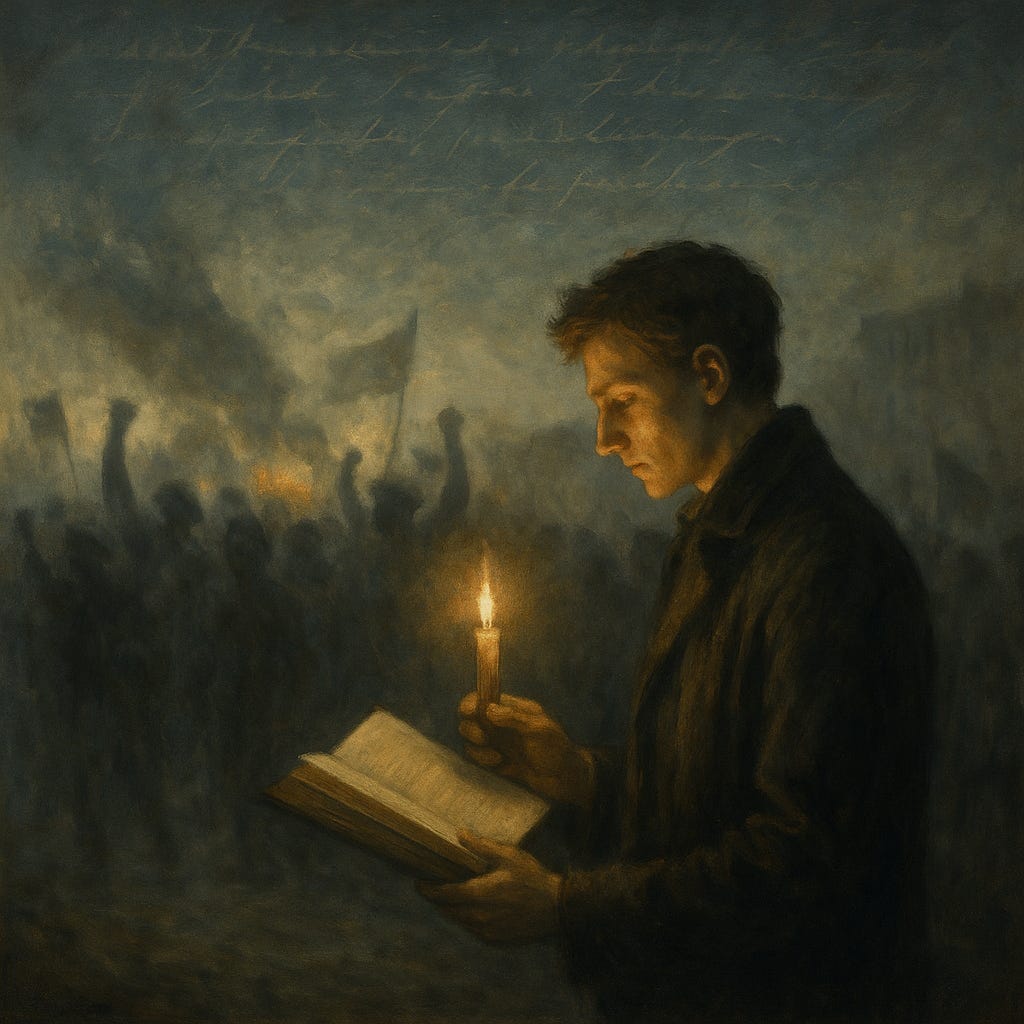
The day belongs to the drum. It always has. A hand lifts, a cadence starts, and the animal in us stands. A city is a lung then, breathing in unison, grateful to be released from the ache of deciding. The drum is kind like that. It offers relief: no more weighing, no more waiting—only direction and the warm absolution of belonging. If you have ever been tired—and you have—you know why the drum wins the daylight.
But there is another voice under the noise, the one that does not cancel the ache but teaches you what it is. It speaks slower than your pulse, asks what a word means before using it, counts the cost before promising a victory. It is not colder; it is kinder in a harder way. Where the drum recruits, this voice returns you to yourself. It treats you as a citizen rather than a crowd, as someone whose judgment is not an inconvenience but the point.
We met both voices in the beginning. A man in a market asking what justice means while the sun burns his shoulders; another on a dais promising that fear will end if only we become harder than our enemies. One voice loses the afternoon. The other outlives the century. This is not romance; it is logistics. A slogan can cross a city in ten minutes. A method can cross a millennium.
The method has many names: parrhesia, public reason, the republic of letters, investigation, peer review, show your work. It is the long habit of daylight—how to test a claim without a war, how to share a country with people who do not love your certainties. It is not a caste; it is a craft. Philosophers practiced it when the tyrant was listening. Pamphleteers practiced it when the censor slept. Reporters practiced it when the camera could still be turned off. Today, a few creators practice it with the algorithm breathing on their necks. The tools change; the burden stays.
The drum also changes costumes without changing its job. It is a demagogue, then a pamphlet, then a headline, then a broadcast, then a clip. It does not ask you to think; it offers you a feeling in which thinking becomes unnecessary. It simplifies the world until there is only loyalty. It lives on enemies. It cannot afford contrition, because contrition cools the room. It does not need to be false to be dangerous; it only needs to be faster than the truth.
You know this already. You have felt the relief of certainty that arrives at the tempo of applause, and you have felt the aftertaste—a thinner self, a smaller map. You have also felt the drag of a paragraph that asks for five more minutes and pays you back with a tool you can use when no one is watching. The choice is not between passion and logic. Human beings do not think in ice. The choice is the order: feeling in the service of reasons, or reasons as costumes feeling wears to pass a checkpoint.
History is a rehearsal of this order. A city nearly kills a whole island and then sends a second ship after the first because someone, that morning, argued consequences instead of catharsis. An empire applauds a speech and then murders the speaker and later still makes textbooks out of his distinctions. A pamphlet turns a colony; an encyclopedia builds a climate. A camera crowns an accuser; a television anchor slows the room and asks for evidence until the fever breaks. A march becomes a moral grammar because its leaders refuse to hate as an epistemology. A platform pays in outrage; a small newsletter pays in errata, citations, and the unprofitable grace of “I was wrong.”
If the ledger seems unfair—if you have watched a careful mind be heckled into silence while a carnival was handed the microphone—you are not mistaken. The physics of virality is not on our side. Anger has a low market price. Certainty travels light. But time is not the market. Time is a different device. It keeps what can be used again. It forgets almost everything else.
Time does not keep a scrapbook of our moods. It keeps a workshop. It remembers the checklist that allowed a jury to stand against a mob. It remembers the footnote that prevented a purge. It remembers the careful difference between law and vengeance, between dissent and sabotage, between attention and witness. It remembers the language we repaired so that lies had fewer places to hide. When the lights go out, people do not reach for last year’s monologue. They reach for matches and methods.
What, then, is our work—yours and mine—inside the noise? Not to become puritans of tone. The city needs heat; no one follows a spreadsheet into danger. Our work is to yoke heat to reasons that can be shown in daylight; to practice the humility that can be corrected without humiliation; to add structure until strangers can arbitrate truth without first joining a tribe. Our work is to refuse the purchase of unity with amnesia. To keep sentences honest enough that they can be handed to a child without turning the child into a weapon.
The world will keep making drums. They are easy to build and glorious to play. We do not need fewer drums so much as better ears—ears trained by rooms where disagreement is not a prelude to exile, by pages that define terms before they demand pledges, by voices that treat us as jurors instead of recruits. If enough of us learn to want that, the market will follow. If not, time will still do its patient work, forgetting the parades and keeping the tools.
I cannot promise that the conscience will win a ratings slot. I can promise that it will win the archive. Not because it is always right—it isn’t—but because it leaves equipment behind: concepts, distinctions, procedures, habits of fairness. These are the things that let a free people sweat out its fevers without breaking.
So keep a few questions in your pocket, the way others keep charms: What is this voice asking of me—my judgment or my badge? Where is the proof—in the light or behind charisma? What happens after correction—gratitude or war? What does this train in me—patience or dependency? Ask them before you share, before you cheer, before you become a chorus against your own mind.
The day will go on belonging to the drum. Let it have the day. Give the century to something else. Give it to the quiet labor that makes thought possible in public: to definitions that outlive quarrels, to procedures that restrain panic, to words that do not panic when they meet the dark. Give it to the conscience that teaches a city how to think without asking it to stop being human.
If you need a benediction, take this one: when the next fever comes—and it will—let us be found with tools in our hands.
—Elias WinterAuthor of Language Matters, a space for reflection on language, power, and decline.