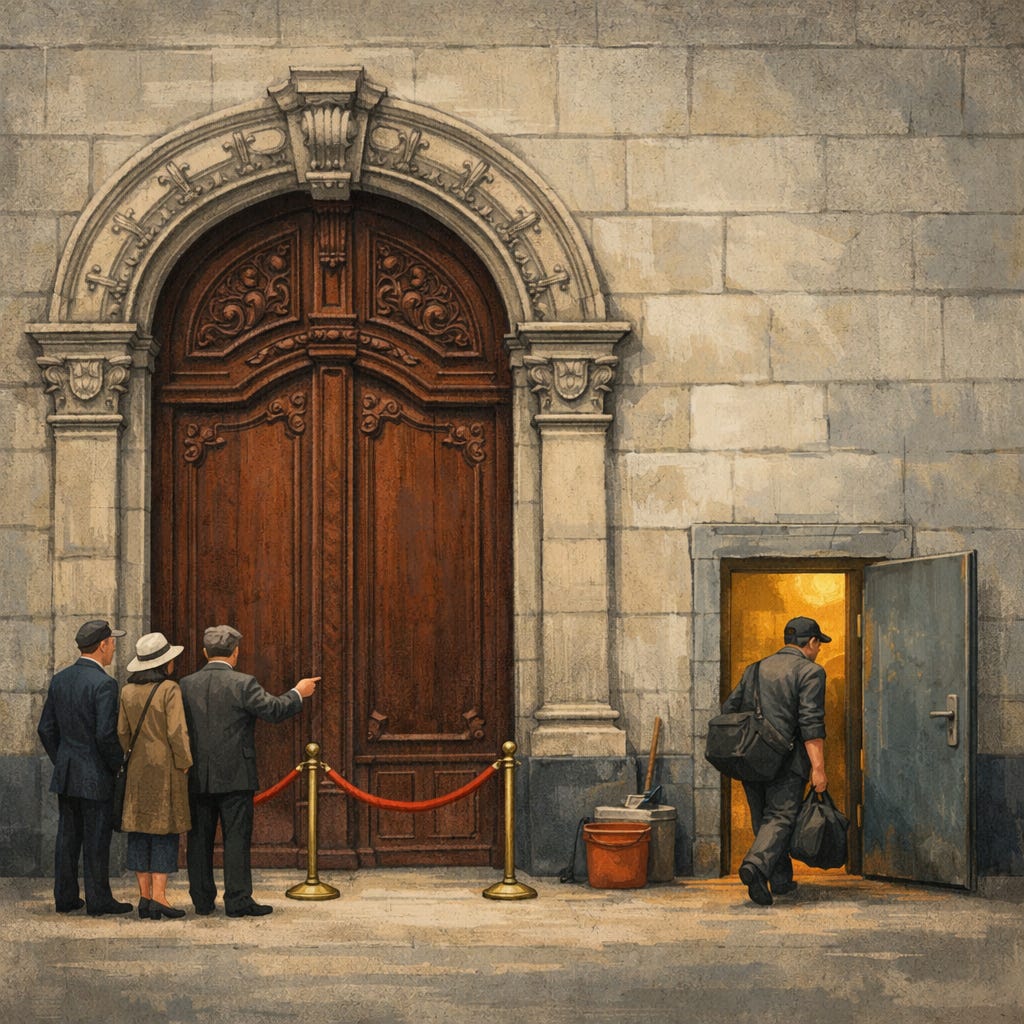
I. The Door
The first time the illusion cracked again, I was back in Paris.
Not the postcard Paris—no cafés, no curated nostalgia—but the perimeter. The RER. The concrete. The long blocks of social housing where the state stores what it cannot integrate fast enough.
When I was a child, these suburbs were already mixed. This time, the shift hit physically. More African faces than I remembered. Different languages in the air. Different food, different music, different rhythms.
It felt foreign.
Later, in London, I walked through a neighborhood where Pakistani families formed the overwhelming majority. Shop signs, smells, sounds—London outside, Lahore inside.
That jolt is real. Anyone who denies it is lying.
But that jolt is also a trick of scale.
If you extract that sensation from my body and hand it to a man who has never left his town—then flood his phone with clips captioned “invasion”—you have the emotional raw material of modern European populism.
You also have the beginning of a misdiagnosis.
France remains overwhelmingly of European origin. Britain remains majority white by a wide margin. The United States—now treated by some Europeans as a demographic warning—is already far more diverse than either.
The macro picture is stable. The neighborhood picture is not.
Humans do not live inside macro pictures.
We live inside neighborhoods.
And the human brain does not compute demographic averages. It computes territory.
For most of our evolutionary history, a sudden shift in the visible composition of the tribe meant danger. New bodies meant new loyalties, new rules, new competition for mates and food. The circuitry is ancient. It does not wait for census data.
The fear is real.
The conclusion is often wrong.
II. The Numbers, the Street, and the Algorithm
If a country is eighty percent one thing but has neighborhoods that are eighty percent something else, the neighborhood wins emotionally.
One suburb becomes the future. One borough becomes prophecy.
Social media finishes the job. You do not need to visit a place to experience it. A fight on a tram. A foreign-language sign. A protest framed as civilizational clash. The clip travels faster than context.
Your brain updates probabilities silently:
This is spreading.This will reach me.No one is in control.
But the algorithm does not show you distribution curves. It shows you volatility. It monetizes the most intense five percent of reality and feeds it back as the whole.
A country that is still four-fifths ethnically European begins narrating itself as already replaced.
The fear feels empirical. It is perceptual.
This distinction matters because policy built on perception without scale is unstable by design.
III. Immigration Is a Wage Policy
Strip away the slogans and immigration in the Atlantic world has always been, first, about labor.
Not love. Not diversity seminars. Labor.
The American story begins with coerced labor. It continues with imported labor. The British Empire ran on labor extraction and labor movement. Industrial Europe did not industrialize on poetic attachment to soil.
Land and capital accumulate. Labor is scarce. Migration bridges the gap.
After slavery:
* Irish famine refugees.
* Italians escaping rural poverty.
* Chinese railroad workers.
* Eastern Europeans in factories.
* Mexicans in agriculture.
* Today’s migrants in logistics warehouses, elder care, construction, food service.
The faces rotate. The function remains.
Immigration expands the labor supply.
And when labor supply expands faster than productivity or bargaining power, wages compress—especially at the lower end. In some sectors migrants complement local workers; in others they substitute for them. The gains and losses are uneven, but the pressure is real where skills overlap.
This is not moral judgment. It is basic economics.
Meanwhile:
* Aging Western societies face dependency ratios collapsing toward insolvency.
* Pension systems require more workers per retiree.
* Healthcare systems require younger taxpayers.
* Employers face skill shortages in some sectors and cheap-labor demand in others.
So immigration becomes a pressure valve.
Borders are not only cultural lines. They are wage instruments.
Tighten them and certain wages rise while certain industries choke.Loosen them and capital breathes while low-skill labor competes harder.
The populist error is claiming immigration is a purely leftist moral project.
Historically, the loudest quiet supporters of labor inflows have been employers.
If you want to understand border policy, read the donor list.
IV. Decline Came First
The great reversal in the populist narrative is chronological.
“We were fine. Then they came.”
No.
Factories closed before the latest asylum wave.Union density collapsed decades earlier.Financial deregulation preceded refugee boats.Manufacturing was offshored long before Syrian families reached Germany.
The order is not migration → decay.It is decay → migration into a system already buckling.
Entire regions in the West were stripped of:
* industrial employment,
* stable civic institutions,
* upward mobility,
* believable futures.
This hollowing was policy-driven.
Shareholder primacy.Trade deals optimized for capital mobility.Tax codes friendly to financial engineering.Housing turned into an asset class rather than shelter.
By the time immigration intensified, many working-class communities were already economically dislocated.
Into that vacuum walked the migrant—or more precisely, the image of the migrant.
Immigration did not create late-stage Western inequality.
It arrived inside it.
And because migrants are visible while capital flows are abstract, resentment found a face.
Class anger was redirected downward.
This is the central tragedy:
The same economic architecture that weakened workers also demanded new workers.
The anger should have climbed.Instead, it descended.
V. The Invention of White Nobility
When modern nationalists speak of “our civilization,” they rarely picture their real ancestors.
They do not picture tuberculosis in crowded tenements.They do not picture agricultural servitude.They do not picture child labor in textile mills.
They picture:
* cathedrals,
* symphonies,
* Renaissance paintings,
* emperors and philosophers.
They claim the aesthetic output of aristocracy as ancestral inheritance.
But most Europeans were not patrons of Mozart. They were fuel for the system that allowed Mozart to exist.
“White civilization” is often a retrospective alliance between descendants of peasants and the memory of palaces.
The people whose ancestors scrubbed those palaces now talk as if they owned them, and as if today’s migrants are the first servants ever to cross the threshold.
This matters.
Because when people say “we built this,” they unconsciously compress two lineages:
* the ruling class that commissioned culture,
* the working class that survived beneath it.
The same elite strata that once extracted from European peasants later imported new labor when convenient.
The working poor who now rage at migrants are historically raging at the wrong floor of the building.
They are shouting sideways instead of upward.
VI. Democracy Meets Capitalism at the Gate
For most of modern history, ordinary workers did not get to vote on immigration levels.
Ships arrived. Labor markets adjusted. Elites decided.
Mass democracy changed that.
Now:
* Every citizen has a vote.
* Every resentment can become a political platform.
* Every demographic shift can be framed as betrayal.
Capitalism requires labor mobility.Democracy demands perceived consent.
When wages stagnate for decades while GDP grows, trust collapses.When housing prices double while median incomes barely move, trust collapses.When politicians explain migration in terms of macroeconomic necessity while neighborhoods change faster than institutions can integrate, trust collapses.
Telling voters “you just don’t understand economics” is gasoline on that collapse.
People understand something simpler:
No one asked us.
And in a democracy, that feeling is combustible.
VII. The Algorithmic Tribe
Then we layered the internet on top.
The internet does not just transmit in…