I. Ten Wars Disguised as One
Once again, Iran and the United States are negotiating. Once again, intermediaries move between rooms because the two countries that have spent nearly half a century defining one another as enemies still struggle to sit normally across a table. Once again, uranium is somewhere near the center of the conversation. But uranium is no longer the whole conversation, if it ever was. As of September 2026, Qatari mediators have been carrying proposals between Washington and Tehran concerning not merely Iran’s nuclear program but the Strait of Hormuz, sanctions, frozen Iranian assets, maritime passage, military operations and the larger terms by which two countries already at war might stop fighting. Even now, one of the principal disputes is not necessarily over the existence of a possible bargain but over its sequence: who moves first, who surrenders leverage first, and who trusts that the other side will still perform once that leverage is gone.
It is tempting to describe all of this as the Iranian nuclear crisis. That is convenient. It is also inadequate.
There are at least ten distinct conflicts living inside the American-Iranian confrontation. There is the nuclear program and the question of whether Iran can enrich uranium without ultimately building a weapon. There is the vast American sanctions regime and Iran’s demand for normal access to trade, oil markets and finance. There is Israel, whose security the United States regards as a major interest and whose existence officials of the Islamic Republic have spent decades placing inside the language of resistance and rejection. There is Iran’s network of armed partners, from Hezbollah to Iraqi militias and other groups whose histories and objectives differ but whose relationships with Tehran give Iran strategic reach beyond its borders. There is the American military architecture of the Middle East: bases, fleets, alliances and security guarantees that Washington calls deterrence and Tehran often experiences as encirclement. There are Iran’s missiles and drones. There is the Strait of Hormuz. There is the older argument about sovereignty, regime security and interference. There are disputes over repression, prisoners and human rights. And underneath all of these sits the accumulated conviction on both sides that promises made by the other cannot safely be trusted.
American policy itself has often treated several of these as separate objectives. The Trump administration’s 2025 maximum-pressure directive identified Iran’s potential acquisition of a nuclear weapon, its ballistic-missile program, its regional network and its asymmetric military capabilities as related but distinct security concerns. Yet the analytical mistake begins when these conflicts are placed beside one another as though they were ten independent objects.
They are not.
Sanctions are not as foundational as the conflict that produced the sanctions. Hormuz is not as foundational as the confrontation that transformed a waterway into strategic leverage. Missiles are not as foundational as the fears for which missiles became an answer. Hezbollah is not merely a freestanding dispute between Iran and the United States; it is also an instrument through which Tehran has tried to create strategic depth against enemies vastly stronger than itself in conventional air power. Even Iran’s nuclear program—the issue around which decades of diplomacy have revolved—may be less the original disease than the most dangerous symptom of an older condition.
Beneath the ten arguments are several more primitive questions. Does Iran belong as a powerful state in the Middle Eastern order, or is Iranian power itself a problem to be constrained? Does Israel belong permanently in that same order, or does its security remain conditional upon the eventual resolution of a revolutionary struggle against it? Can American security interests coexist with Iranian strategic autonomy? Can Palestinian safety and political dignity be treated as ends rather than variables in someone else’s security doctrine? And can any agreement survive when every participant believes history has taught it never to make the first irreversible concession?
These questions are closer to the foundation. The missiles, sanctions, proxies, centrifuges and blockades sit above them like layers of sediment deposited by decades of unresolved fear.
The nuclear question illustrates the distinction. The United States has lived with nuclear weapons possessed by allies, partners, competitors and enemies. It has opposed proliferation, sometimes intensely, but it does not interpret every nuclear capability identically. Capability matters; relationship gives capability political meaning. A British nuclear weapon does not mean what a North Korean nuclear weapon means in Washington. An Iranian centrifuge does not exist outside politics. It sits inside a relationship defined by threats, sanctions, Israeli vulnerability, American military power and the expectation of betrayal.
The question, then, is not whether uranium matters. It is whether negotiations that begin with uranium are beginning far enough down the causal chain that failure is almost built into them.
Perhaps the oldest dispute is not over enrichment at all.
Perhaps it is over recognition.
And recognition is precisely where history becomes inconvenient, because Persia did not arrive in the Middle East with the Islamic Republic. Neither did the Jews arrive with the State of Israel.
II. Before America Had a Name
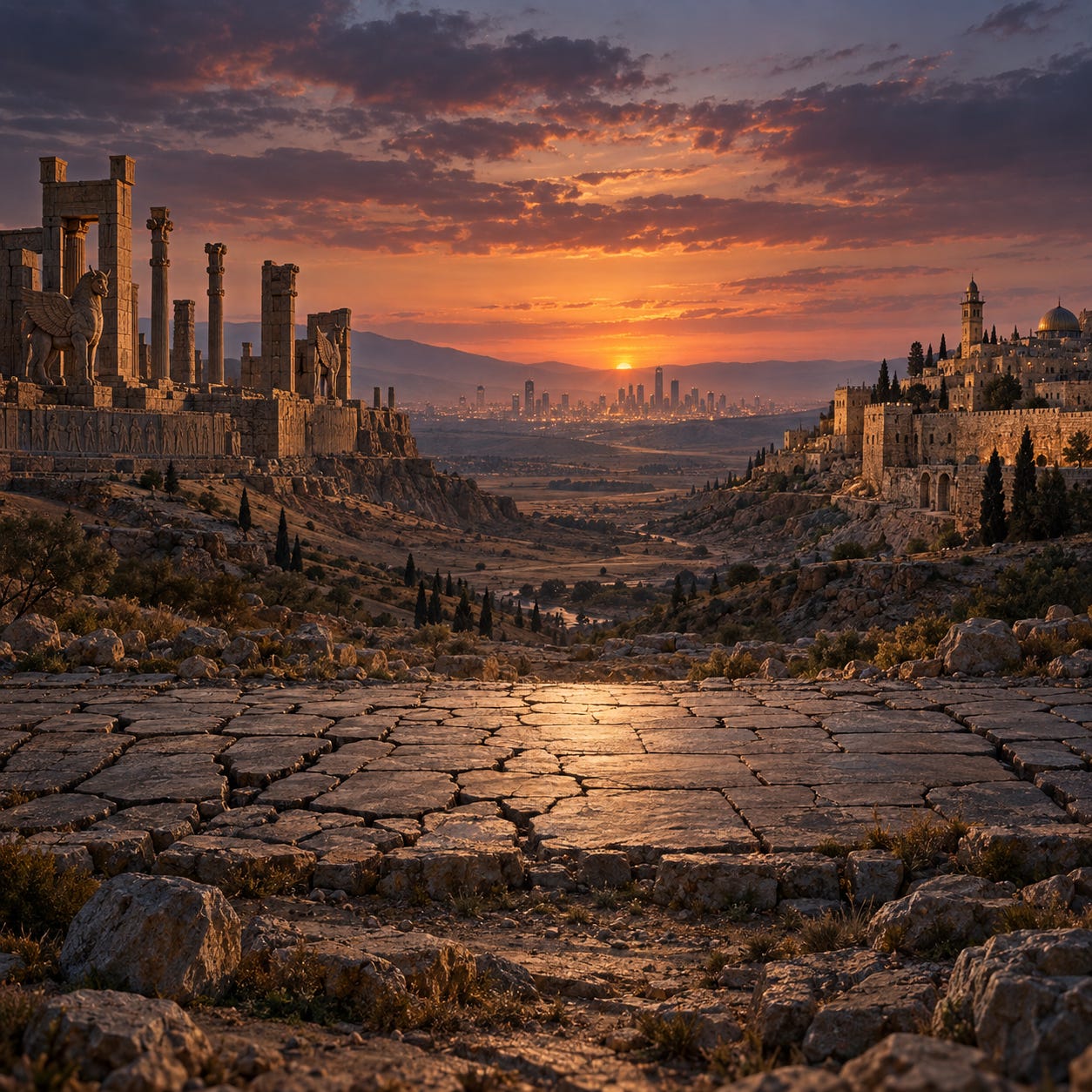
Long before there was a United States, before Christianity, before Islam, before anyone could imagine an Islamic Republic or a Zionist congress, Jerusalem was destroyed and its people were carried east.
The story is older and stranger than the political categories through which it is now remembered. The Assyrian Empire destroyed the northern Kingdom of Israel and deported populations from it in the eighth century BCE. Jewish communities appear on the Iranian plateau from roughly this period; Encyclopaedia Iranica traces communities there to around 721 BCE, when Israelites were relocated into “the cities of the Medes.” More than a century later, it was not Assyria but Babylon under Nebuchadnezzar II that conquered Judah, destroyed Jerusalem and the First Temple in 586 BCE, and deported part of the Judean population to Babylonia.
Empires often believed themselves permanent immediately before they ceased to be.
In 539 BCE, Cyrus II of Persia conquered Babylon. Persian rule did something consequential with the human debris left by the empires it replaced. Cyrus permitted displaced communities to return to their lands and restore religious institutions; Jewish tradition remembers the Persian conquest as the opening through which Judeans could return toward Jerusalem and rebuild their temple. Iranica notes both the permission to return and the restoration associated with Persian policy, while the biblical tradition gives Cyrus an extraordinary place in Jewish memory.
The Hebrew Bible does not merely mention him. Isaiah describes Cyrus as the Lord’s “anointed”—mashiach. The word that becomes “messiah” is applied, remarkably, to a Persian emperor.
That fact should not be romanticized. Cyrus was an imperial ruler, not an Enlightenment humanitarian somehow misplaced by two thousand years. Persian imperial policy had strategic purposes. Ancient empire remained ancient empire. But Jewish memory preserved something real: Persian power had made restoration possible where Babylonian power had produced captivity.
And the relationship did not end when some Judeans returned west.
Many Jews remained in Mesopotamia and throughout lands ruled by Persian empires. For roughly nine centuries under Parthian and then Sasanian rule, large Jewish populations lived within an Iranian imperial world. The Babylonian Jewish academies eventually produced the Babylonian Talmud, one of the central works of rabbinic Judaism. Persian and Iranian cultural influences inside that wo…