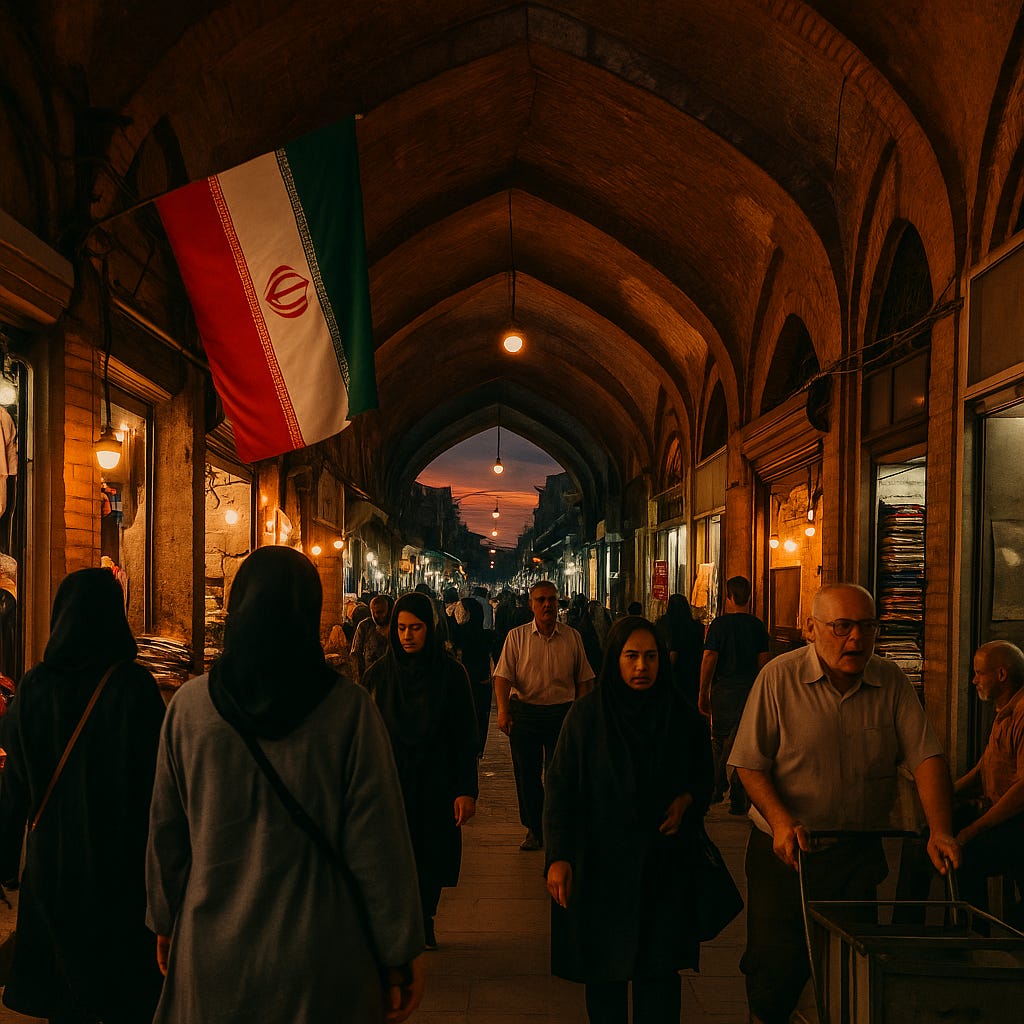
This essay was written in direct response to Roger Cohen’s After War With Israel and U.S., Iran Rests on a Knife Edge, published by The New York Times on June 29, 2025. That article, cloaked in the authority of foreign correspondence, embodies the subtle violence of Western narratives that reduce Iran to a theater of pity, paranoia, and paternalism.
What follows is not a rebuttal of facts, but a moral counter-narrative—an attempt to unmask the architecture of empire that makes such stories both possible and persuasive.
I do not write this as a journalist. I write this as one who has seen both the tremor in the voice of an exile remembering home, and the flicker in the eyes of those who would turn that pain into policy. I write as one who knows the machinery of empire does not merely run on steel and oil, but on stories—stories that teach us who deserves pity, who deserves bombs, and who deserves to vanish quietly.
The article that provoked these words is not exceptional. It is exemplary. Roger Cohen’s After War With Israel and U.S., Iran Rests on a Knife Edge is the perfect specimen of a genre that soothes Western consciences while sharpening Western knives. It floats above the blood it describes, narrating the tragedies of Tehran with a tone that invites the reader not to act, but to nod along. It is imperial scripture masquerading as foreign correspondence.
But this moment, in the wake of a catastrophic 12-day war that nearly ended a nation, demands more than nodding. It demands that we see the scaffolding of our narratives—the comforting myths that let us claim compassion while preparing the next blow. It demands we break the silence that is both the empire’s armor and our own cage.
In the chapters that follow, I will name the six patterns in Cohen’s piece that reveal how these narratives are built: Paternalistic Framing, Selective Empathy, Performative Balance, Erasure of Imperial Responsibility, Condescending Moralization, and Cynical Reduction of Complexity. I will show how each serves the same end: manufacturing our consent for endless war.
Because Iran is not a parable. Iran is a nation. And until we learn to see it as such, we remain prisoners of the empire’s mirror.
Chapter 1: Paternalistic Framing
The first mask the empire wears is benevolence. It does not say, We wish to dominate. It says, We wish to save. And so it teaches us to see Iran not as a complex nation of eighty million souls, but as a child in need of Western guidance—a place of perpetual crisis, a patient we must diagnose, a pupil we must instruct.
Roger Cohen’s article drips with this paternalistic framing. He opens with Roxana Saberi’s trauma—a trauma real and harrowing—but he uses it as an emotional anchor to make Iran’s suffering legible only through Western eyes. The Iranian state becomes a menacing father figure; the Iranian people, wayward children who must be freed from his grasp.
Every observation is filtered through outside authority: Cohen’s expert sources, European think tank analysts, and diasporic voices who speak from the safety of Paris, London, or Washington. Even when Iranian officials or citizens are quoted, their words appear as curiosities—evidence to be examined, not testimony to be heard.
This framing is not a small sin. It is the keystone of imperial propaganda. Because if Iran is a child, then we are justified in disciplining it. If Iran cannot govern itself, we must intervene. If Iran’s choices look different from ours, it is because it is irrational, backward, or broken—never because it has a history, a logic, or a right to sovereignty.
The tragedy of this paternalism is that it kills compassion while pretending to offer it. It teaches readers to pity Iran while denying it the dignity of adulthood. And so the bombs we drop are rebranded as lessons; the sanctions we impose, as tough love; the military bases we surround it with, as guardianship.
Cohen’s piece is not unique in this. It stands in a lineage of Western writing on the Global South—from the “white man’s burden” of Kipling to the liberal interventionism of the modern editorial page—where distant lands are described not as equals but as wards of our superior civilization.
It is easy to read such prose and imagine ourselves humane. It is much harder to admit that seeing others as children is the oldest lie of empire.
Chapter 2: Selective Empathy
Empathy, when wielded selectively, becomes a scalpel of control. It slices the world into those whose suffering we choose to feel and those whose deaths we ignore. It teaches us to cry on cue for the chosen few while never asking who set the stage.
Cohen’s article invites the reader into a carefully curated gallery of grief: Roxana Saberi’s memories of Evin prison; the diaspora’s conflicted longings; the anguish of a family watching war from Dubai. But there are absences that shout louder than any included voice. Where are the poor of Khuzestan, bombed alongside refineries built on their land? Where are the mothers of soldiers who died in Israel’s airstrikes, men who never dreamed of politics but were conscripted by a state that sees them as disposable? Where are the farmers whose lives wither under the yoke of sanctions that Western papers so rarely examine?
This is not accidental. Selective empathy is how empire maintains its moral self-image. It directs our tears to stories that humanize the people we might want to “save,” while erasing those whose deaths we tolerate—or cause. By placing the diaspora’s fears at the center, Cohen makes Western readers’ identification with Iran dependent on proximity to Western lives, passports, and respectability.
There is no space in this framework for Iranians who resist both the regime and foreign domination, who believe their nation deserves dignity free from mullahs and Marines alike. There is no empathy for the millions who reject both Ayatollahs and the violence of American exceptionalism. Their complexity would muddy the clear lines of pity and blame Cohen’s narrative requires.
Selective empathy is worse than indifference. It is an active training of our hearts to beat only for those who fit the story of enlightened intervention. It makes us feel moral while preparing us to support wars that kill the very people we claim to grieve.
Until our empathy includes all lives—enemy and ally, secular and devout, rich exile and poor villager—it is not compassion. It is a weapon.
Chapter 3: Performative Balance
The empire is too clever to speak only with one voice. It knows that monologues are easy to dismiss, but a dialogue—real or staged—can project the illusion of fairness. And so it constructs a theater of “balance,” where conflicting opinions are presented not to deepen understanding, but to consecrate authority.
Cohen’s article performs this dance masterfully. It pairs hints of hope—President Pezeshkian’s vague calls for reform—with ominous warnings of Iran’s supposed instability. It sprinkles criticisms of the regime alongside reminders of its “paranoia,” offering readers a controlled opposition of perspectives that ultimately funnel back to the same conclusion: Iran is dangerous, irrational, and in need of external correction.
This kind of balance is not journalism. It is a ritual. It tells us we have considered every side, while carefully excluding any side that might indict our own role. It makes us feel worldly, informed, and above the fray—without ever challenging the central narrative that Iran’s fate must be decided by the wise custodians of Western power.
Performative balance also obscures root causes. It weighs the Iranian state’s repression against Iranian resistance, but never against the decades of external sabotage and isolation that shaped both. It presents “hardliners” and “moderates” as two poles in a vacuum, as if the Ayatollah’s paranoia were born from thin air, rather than from coups, sanctions, assassinations, and a world that has taught Iran again and again that sovereignty is a sin.
True balance would require grappling with how Western interventions, from the 1953 coup to present-day economic warfare, created the very dynamics we now lament. It would mean examining how our governments fuel the hardliners they claim to oppose. But that balance would make Western readers uncomfortable, and so it is omitted.
Performative balance does not inform; it sedates. It reassures us that we are reasonable people consuming reasonable journalism, even as we absorb a narrative designed to make endless confrontation feel inevitable.
Chapter 4: Erasure of Imperial Responsibility
The empire’s most essential magic trick is making itself invisible. It narrates the tragedies of others with solemn authority, but never allows its own hand to appear on the stage. And so it teaches us to see foreign horrors as spontaneous eruptions of barbarism—never as the fruits of policies set in conference rooms thousands of miles away.
Cohen’s article exemplifies this erasure with clinical precision. He describes Iran’s “paranoia” and “obsession with the mendacity and belligerence of the United States” as if these were irrational neuroses, without once naming the century of American and British interference that made them rational. He recounts the fear and trauma of Iranians but leaves the reader unaware of the 1953 CIA coup that toppled their first elected government, the decades of brutal dictatorship propped up by Western arms, the U.S.-backed support for Saddam’s chemical warfare in the 1980s, or the punishing sanctions that target civilians more than generals.
This erasure is not mere omission—it is exoneration. It wipes clean the ledger of imperial crimes, allowing Western readers to approach Iranian suffering as spectators rather than as implicated participants. It preserves the myth of Western innocence, which is the keystone of Western power.
Erasure also enables the moralization of Iran’s defensive actions. When Iran funds regional militias or accelerates enrichment, it is described as reckless aggression, stripped of the context of encirclement by U.S. bases, decades of sabotage, and existential threats. When Israel assassinates Iranian scientists or bombs nuclear facilities, it is treated as geopolitics. When Iran retaliates, it is terrorism.
This asymmetry is the quiet engine of consent for endless war. It teaches us that their violence is unprovoked, while ours is reluctant necessity; that their rage is proof of savagery, while ours is a lamentable burden we bear for the good of the world.
Until we see the empire’s fingerprints on every crisis it disowns, we remain its accomplices.
Chapter 5: Condescending Moralization
When the empire finishes erasing its own crimes, it dons the robes of moral teacher. Having reduced the complexities of a nation to a morality play, it appoints itself the arbiter of virtue—eager to lecture those it has destabilized on how to become civilized, orderly, and free.
Cohen’s article does this in every paragraph that frames Iran as a cautionary tale for the Third World: a backward society unable to reconcile faith with modernity, a failed experiment in mixing Islam and democracy, a place condemned to repeat its own mistakes until it embraces Western norms. He writes of Iran’s yearning for change with an air of resigned wisdom, as if the only path forward is one that passes through the moral and political gatekeepers of the West.
This condescension masquerades as compassion. It expresses sorrow for Iran’s suffering while demanding that Iranians surrender their history, faith, and identity to the prescriptions of distant powers. It mourns Iran’s failures without naming the sanctions and sabotage that stacked the deck. It judges Iranian leaders for paranoia without acknowledging the record of foreign coups, assassinations, and invasions that made trust impossible.
Condescending moralization thrives on double standards. When Iranian leaders defend sovereignty, it is stubbornness; when Western leaders bomb or sanction, it is strategy. When Iranian society resists clerical repression, it is framed as a cry for Western rescue—never as a struggle for self-determination on their own terms. Even moments of liberalization, like the protests after Mahsa Amini’s death, are quickly co-opted into narratives of Western-style revolution, erasing the uniquely Iranian texture of their demands.
This is the moral voice of empire: a sermon delivered in fluent English, calling on others to repent while never confessing its own sins.
True moral clarity would require holding ourselves accountable for the suffering we cause. But moralization without accountability is not justice. It is imperial theater.
Chapter 6: Cynical Reduction of Complexity
The final act of imperial storytelling is to shrink the vastness of a nation’s history into a few tidy clichés. Complexity is dangerous to empire, because it makes violence harder to sell. Complexity reminds us that there are no easy villains, no simple fixes, and no wars that do not destroy the very people we claim to save.
Cohen’s article reduces Iran’s century-long struggle with modernity, monarchy, revolution, and imperial interference into a melodrama of dark clerics versus enlightened reformers. It flattens generational traumas—colonial exploitation, the Iran-Iraq war, decades of foreign subversion—into a backdrop for heroic liberal yearnings that always seem to need Western help.
Gone is the profound diversity of Iranian society: the Kurdish and Baluchi minorities whose grievances long predate the Islamic Republic; the merchants of the bazaar who have played kingmakers for centuries; the leftist intellectuals, nationalist conservatives, and religious reformers who have all, at different times, risked everything for visions of a more just Iran. Gone, too, is the moral ambiguity of a population that can both despise a regime and distrust Western promises—because their lived experience tells them that bombs rarely bring freedom.
Cohen’s narrative demands these complexities be erased so readers can grasp the story in a single breath: Iran is broken, we should pity its people, and perhaps we must act—militarily, economically, or clandestinely—to set things right.
But Iran’s story cannot fit in a script. It is a living, evolving struggle with modernity, faith, sovereignty, and global injustice—a struggle that cannot be resolved by regime change or external dictates. By cynically reducing this complexity, imperial narratives prepare us to accept simple solutions to problems we do not understand. They blind us to the certainty that interventions, no matter how noble they sound, always unleash consequences beyond our imagination.
Only by resisting the seduction of these reductions can we begin to see Iranians as fully human—people who do not need saving, but space to chart their own course.
Epilogue
If you have read this far, you already know: the most dangerous weapon in the empire’s arsenal is not a missile or a drone. It is the story that tells us we are good. The story that says we watch from afar only because we care. The story that names our wars humanitarian, our sanctions moral, and our power inevitable.
Roger Cohen’s article is not a singular offense. It is a perfect reflection of the mirror the empire holds before our eyes—a mirror that shows us a world of savage others and benevolent selves. And as long as we keep gazing into that mirror, we will find endless reasons to kill and call it mercy.
The task before us is not to write better stories within the empire’s script, but to refuse the script entirely. To see Iran—and every nation our governments demonize—not as a cautionary tale or a pet project, but as a place of real people who live, dream, mourn, and resist.
We must break the mirror that flatters our ignorance and confront the face of our own complicity. We must learn to listen to those who do not need our pity or bombs, only our respect. And we must unlearn the reflex that sees crises in other lands as opportunities for our intervention.
The empire needs our silence to survive. Let our refusal to remain silent be the first act of a different story—one that honors the sacred right of all peoples to be the authors of their own fate.
—Elias WinterAuthor of Language Matters, a space for reflection on language, power, and decline.
Thanks for reading Language Matters! Subscribe for free to receive new posts and support my work.