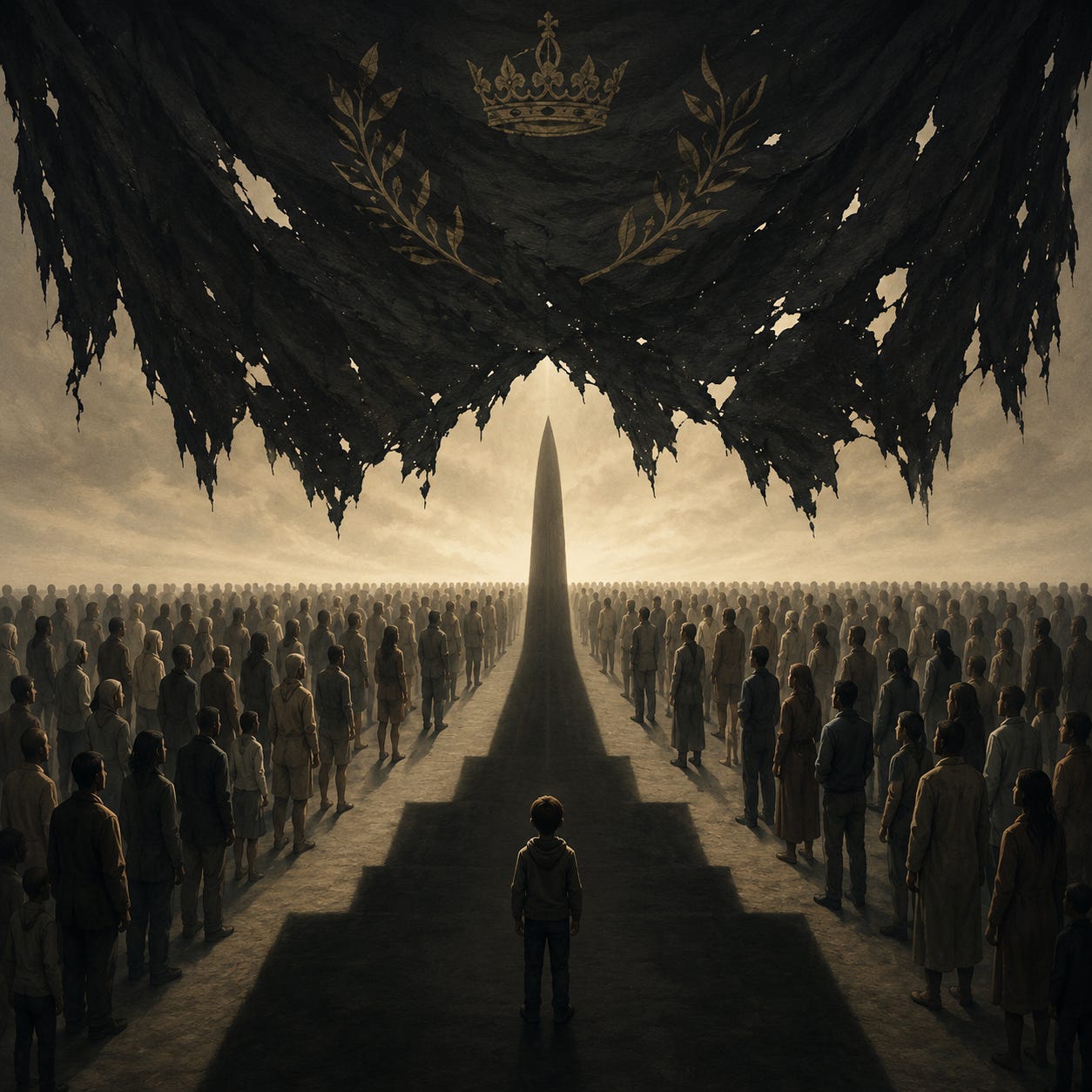
Opening — Before They Were Enemies
Before they were enemies, they were people.
Before the state taught them the map, before the cleric gave them the vocabulary of God, before the party placed them inside history’s furnace, before the flag demanded a simplified love, before the checkpoint, before the missile, before the prison, before the slogan, before the martyr poster, before the national anthem turned grief into obedience, they were people.
They were mothers setting tables.Children learning the names of birds.Old men remembering orchards.Students walking through cities built before their grandfathers were born.Workers waiting for buses.Women touching the graves of the dead.Jews praying in languages older than the states that now claim them.Muslims breaking bread at sunset.Christians lighting candles in towns that predate Islam.Atheists who no longer believe in heaven but still feel something sacred when the mountains appear.Secular people who have lost theology but not tenderness.Mystics who distrust every government that speaks too easily in the name of God.
Before they were enemies, they were neighbors in possibility.
Not innocent. No people is innocent. Not pure. No civilization is pure. Not without memory, wound, grievance, pride, cruelty, blindness, or inherited fear. But human. Plural. Unfinished. Capable of becoming more than the story assigned to them.
Then power arrived and asked a question.
Who are you against?
This is the old question. Older than the modern state, older than nationalism, older than the treaties, older than the intelligence agencies, older than the borders drawn by men who would not have to live inside them. Who are you against? Tell me that, and I can govern you. Tell me that, and I can simplify you. Tell me that, and I can turn your loneliness into belonging, your wound into ideology, your fear into loyalty, your grief into a weapon.
A people is difficult to govern when it remembers too much.
A people is difficult to govern when it speaks many languages, loves many dead, celebrates many seasons, carries many gods, doubts many doctrines, and refuses to become one thing. Plural life is hard to command. It spills beyond the category. It does not march in clean formation. It resists the slogan because it knows too many songs.
So the state narrows the people.
It places one identity on the flag, then teaches the population to tremble before its opposite. It says: this is who we are. That is who threatens us. Whoever complicates this story has already defected.
And this is how the neighbor becomes the enemy.
Not all at once. Not always through hatred at first. Sometimes through fear. Sometimes through humiliation. Sometimes through myth. Sometimes through memory. Sometimes through real injury, which is then refined into sacred permission. Sometimes through the dead, whom the living recruit for future violence. Sometimes through the oldest wound in the room.
The tragedy is not that human beings disagree. The tragedy is not that civilizations have borders, religions have differences, peoples have attachments, or histories contain blood. The tragedy is that power so often turns difference into destiny. It takes plural human beings and assigns them to camps. It tells them that to belong, they must hate. It tells them that to be safe, they must obey. It tells them that to remember, they must avenge.
But before the flag, there is the face.
Before the enemy, there is the neighbor.
And before politics teaches us whom to fear, there remains the unbearable fact that most people simply want to live.
Chapter I — Iran Is Older Than the Regime
There are about ninety-two million people in Iran.
Even that number is too small for what Iran is, because Iran is not only a population. It is a civilizational memory carried by a living people. It is a country, yes. A state, yes. A territory with borders, ministries, prisons, armies, provinces, mountains, deserts, oil fields, mosques, shrines, bazaars, highways, universities, cemeteries, and exiles. But beneath the state there is something older: a memory-system, a weather of belonging, a layered inheritance that no regime can fully possess.
The Islamic Republic wants the world to believe that Iran is an Islamic state because Iranians are an Islamic people. The West often accepts the same lie from the opposite direction. It sees turbans, missiles, uranium, veils, chants, militias, and clerical decrees, then mistakes the regime for the civilization. It speaks of Iran as if it were born in 1979, as if the mullah created the mountain, as if the revolutionary state invented the language, as if the country’s soul can be read from the mouth of its jailer.
But Iran is older than the Islamic Republic.
Iran is older than the Pahlavis. Older than the Qajars. Older than the Safavids. Older than the Arab conquest. Older than Islam. Older than the modern map. Older than the names by which outsiders have tried to contain it.
Even the word “Persian” is incomplete. It does not accurately describe every ethnicity inside Iran. It comes from the outside, from ancient Greek naming, from the encounter with Persis, Parsa, Fars. Yet the word still carries something in the Western imagination that “Iranian” sometimes fails to carry: not merely citizenship, not merely ethnicity, but civilization. Poetry. Memory. Empire. Loss. Refinement. Defiance. Gardens. Fire. Language. The old house.
When I use the word Persian in this larger sense, I do not mean only ethnic Persians. I mean the Kurds and the Lurs, the Azeris and the Baluch, the Gilaks and Mazandaranis, the Armenians and Jews, the Zoroastrians and Christians, the Muslims and seculars, the atheists and mystics, the people who speak Persian and the people who do not, the people whose dialects branch across Indo-European memory and the people whose belonging is older than modern classification. I mean a civilizational field, not a bloodline.
This is why Nowruz matters.
Nowruz is not just a holiday. It is evidence. Every spring, the old country remembers itself. The table is set. The house is cleaned. The fire is crossed. The dead are visited. The year begins not with conquest, not with clerical permission, not with the decree of the state, but with renewal: light returning to the world.
That ritual survives because it belongs to a deeper Iran than the one administered by ministries.
The regime may control television, courts, prisons, schools, guns, and borders. But it does not own the first morning of spring. It does not own the smell of sabzi polo, the grief inside Hafez, the ruins of Persepolis, the stubborn tenderness of mothers, the language of exile, the memory of fire, the way a people can continue to know itself even when its government lies about its name.
Nor does the regime own religion.
Islam has shaped Iran profoundly. No honest account can erase that. Persian poetry, architecture, jurisprudence, mysticism, mourning, philosophy, and political imagination have all passed through Islam. Shi‘ism gave Iran forms of ritual, sacrifice, lament, and resistance that became inseparable from parts of Iranian life. But Islam entered an older house. It did not build the house from nothing.
Iranian Islam became Persianized. It passed through poetry, metaphysics, kingship, martyrdom, mourning, aesthetic refinement, and the civilizational memory of a people who had already learned how to absorb conquest without disappearing.
And Iran was never only Muslim.
Iran contains Zoroastrian memory, not only as a formal religion but as a subterranean grammar of light, fire, renewal, and cosmic struggle. It contains Christianity, Armenian churches, Assyrian memory, old liturgies that survived under empire and revolution. It contains Jewish life older than many modern nations. The story of Esther and Mordechai belongs to the Persian imperial world. Their tomb is traditionally associated with Hamadan. The tomb of Daniel is traditionally associated with Susa. Jews did not merely pass through Iran. For millennia, Iran was …