They.
A word that turns the light off. The room is still full, but faces fade. Mouths keep moving, papers keep moving, the clock keeps moving. “They” is a shortcut when the path through a name feels too slow. It slides across a headline, a meeting, a border, a mouth. It leaves less to answer for.
At dawn a door buzzes and a line shuffles in. Metal benches, plastic cups, the sharp smell of cleaner. A clerk checks boxes with a dull pen. Intake complete. Case opened. Transfer pending. The file travels faster than the voice that tries to follow it. “They,” the clerk says later, “they keep coming.” It isn’t cruelty; it’s a habit formed by tired hands. The habit has consequences all the same. A boy learns the number to his case before he learns how to ask for water without shaking.
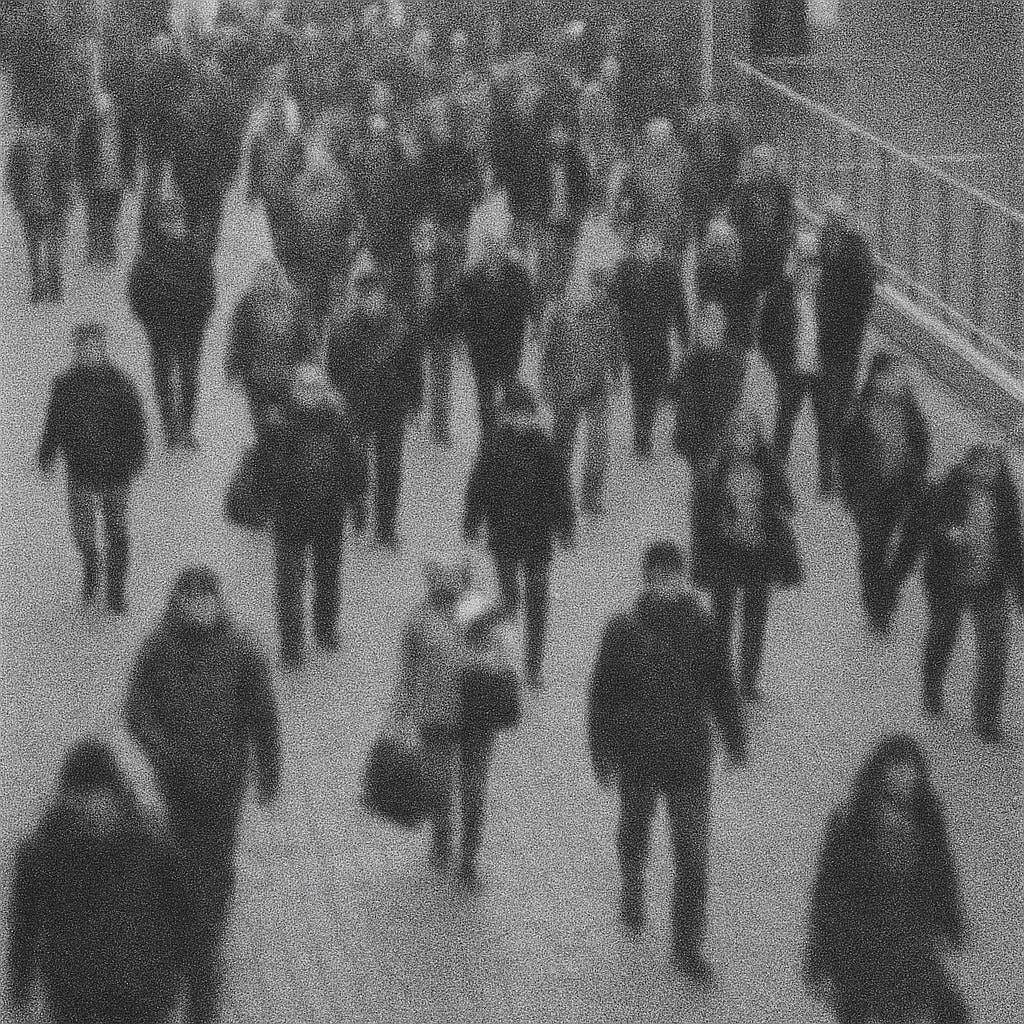
The camera prefers altitude. It pulls back until people turn into movement: heat on a screen, dots on a map, a cluster near a fence. From far away, fear makes more sense. From far away, you can say “they” and the word seems accurate. It is smaller up close. It wants to change its shape when you can hear breath.
Later, sirens. A podium. “They did this,” someone says into a gray bank of microphones. There is a gap between harm and confirmation, and the gap is hungry. The vague word feeds it. Anything can be poured into that outline: the enemy you already fear, the neighbor you don’t trust, the figure your friends warned you about. A story hardens in air. When a single face is finally named, when the facts settle, the earlier spell doesn’t fully break. We remember our certainty and misplace the correction.
In another building: fluorescent light, stale coffee, the soft click of keys. A dashboard glows—bars, ratios, “trends.” A manager says, “they underperformed.” The bar does not tell you who missed a bus or hid in a bathroom to cry, which block lost a job, whose mother got sick. The table looks responsible. It invites a clean decision. It keeps its calm. Calm can be a curtain.
We have done this a long time. Empires wrote their enemies in plural because it made the work tidy. Ships crossed water with cargo holds where cries were counted as weight. Ledgers learned to balance without the friction of names. The forms have changed; the instinct has not. The plural is still a sedative. It is easier to manage totals than to meet eyes.
None of this needs a villain. It needs only our fatigue and our hurry. A newsroom on deadline. A court with a stack. A nurse with six alarms blinking. A feed that rewards speed, not care. “They” is the house style of haste. It makes harm sound like housekeeping.
And yet, the interruption is embarrassingly simple. A face. Not a symbol—just a face that refuses to be carried by the plural. A jawline, a tremor, the way someone says yes like they’re apologizing, a scar that makes a policy slow down. A name pronounced slowly rearranges the room. The sentence that was sprinting loses interest in speed. Procedure remembers its purpose. Precision returns: not “they,” not “the population,” not “the trend,” but this person, right here, with a life that will be heavier than our neat words if we let it land.
I don’t mean we should never count. Counting keeps lights on and bridges standing. I mean our counting should confess its limits. If a measure can’t hold a person, the failure belongs to the measure, not the person. Add a line where a story can breathe. Read one name before the metrics begin. Let one face stay in the frame long enough to move a vote. Say less at the podium until you can speak without silhouettes. Refuse the satisfaction of being right too quickly. The right that arrives without a face will spend itself like cheap currency.
Listen to how the word sits in your mouth. You can feel when it’s doing distance-work. You can feel the small relief it brings, the way it lets you keep moving. That relief has a cost. We pay it downstream. Someone always pays it downstream.
So I practice a clumsy repair. When the plural rises, I ask for a name. When a room glides toward totals, I drag in a story like a chair that scrapes the floor. When rumor wants my mouth, I close it and wait. When a screen shows a crowd, I look for one pair of eyes and hold them until the picture deepens. The repairs are small and they will always be late. But they add weight back to words. They make language honest enough to carry love without spilling.
“They” is useful. It will not disappear. Let it keep its proper size. Let it name what is truly many without erasing the one who stands in front of you. And when the habit returns—as it will, because we are tired and the world is loud—let the old discipline rise to meet it: not they—this one. Then another. And another. Until the room is lit again.
—Elias WinterAuthor of Language Matters, a space for reflection on language, power, and decline.