Chapter 1: The Waiting Room
The first thing you notice in a collapsing city isn’t the fire—it’s the waiting. Sirens come and go. The lights flicker. Coffee goes cold on the chipped Formica. If you’re lucky, you find yourself marooned with company—though luck is a matter of perspective. That’s how Julian Roth, whose phone still buzzes with unread think pieces, and Rhett Walker, who can fix a carburetor but not a country, ended up in the same station waiting room as the world outside got uglier by the hour.
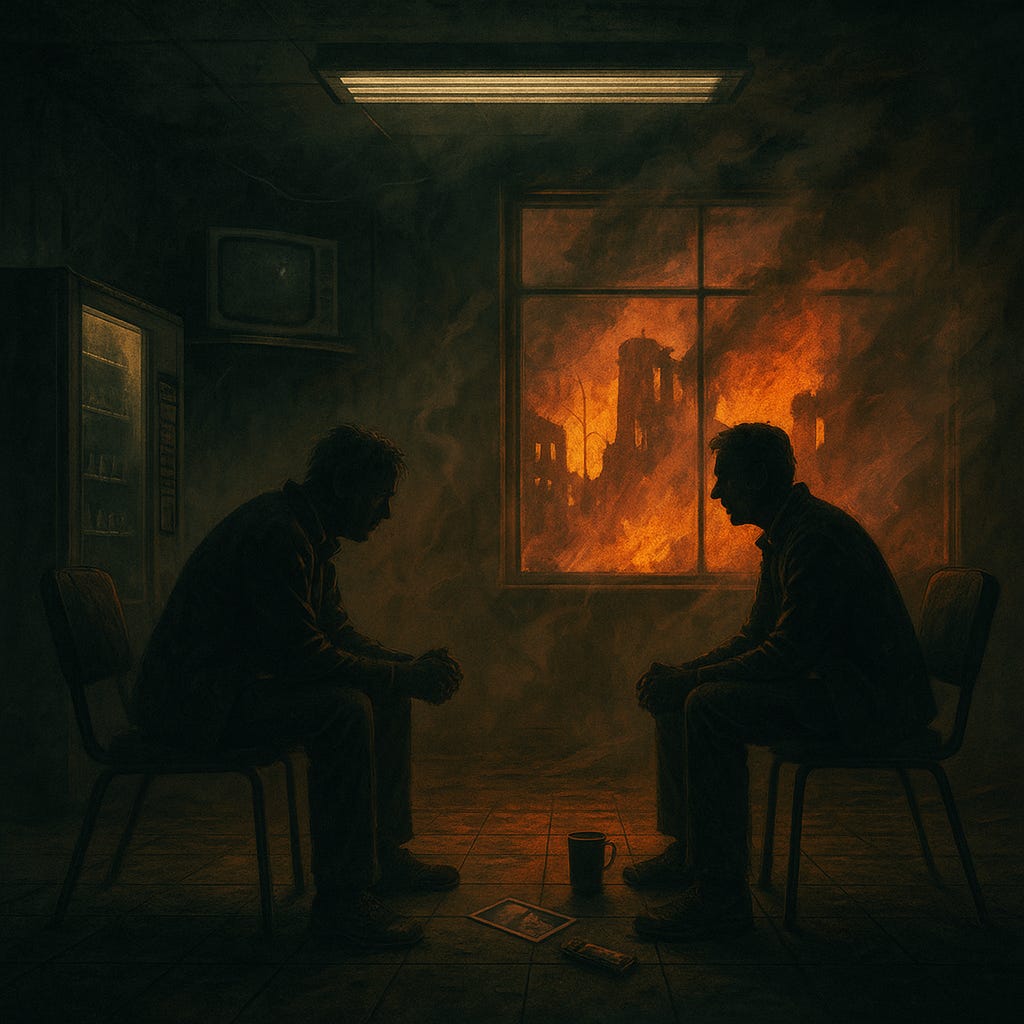
The building had once been a post office or a DMV—nobody was sure. All that remained was the bureaucracy: dead potted plants, a faded safety poster (“Our People Make the Difference!”), and a vending machine whose only working product was off-brand root beer. The fluorescent lights hummed with that specific pitch calculated to drive grown men insane, but nobody dared turn them off. At the back, a TV looped emergency broadcasts and insurance commercials in a kind of unholy alliance.
Julian had claimed the least-stained plastic chair and was scrolling his phone with the grim dedication of someone afraid the algorithm might finally outsmart him. Rhett, boots propped on an overturned recycling bin, surveyed the room like a man sizing up a bad hand at poker. There was an old magazine, a cup of instant noodles growing more gelatinous by the hour, and the unmistakable scent of government-issue disinfectant mixed with distant smoke.
Outside, the city was dissolving into rumor: looters or “protestors,” depending on your network, crowds stampeding downtown, one corner store already gone to glass and memory. Inside, there was only the ticking of the wall clock, slow as grief.
“Wouldn’t mind if that thing just stopped,” Rhett said, nodding at the clock. “Time’s not doing us any favors.”
Julian looked up, halfway between bemused and irritated. “Time’s all we’ve got. Unless you’d rather be out there.”
Rhett snorted. “Out there, at least you know who you’re fighting.”
Julian flicked his eyes back to the phone. “Inside, you just fight boredom.”
“Speak for yourself. I was fighting DMV-induced rage before you got here.”
They let that hang in the air a moment, listening to the TV anchor warn of “rolling outages” and “isolated unrest.” Rhett shook his head.
“Unrest, my ass. That’s called a riot where I come from. But I guess you people got new words for everything now.”
Julian gave a half-smile. “I’m sure we do. Words are safer than weapons, most days.”
“That’s the problem. Y’all spent so long naming things you forgot how to fix ‘em.”
Julian set the phone down, finally giving Rhett a real look. “And what would you have us do—bring back the National Guard, or just hand out more root beer?”
Rhett grinned, showing crooked teeth. “Wouldn’t hurt to start with a little honesty.”
Julian sighed, glancing at the vending machine. “If I wanted honesty, I’d read the nutrition facts on that root beer.”
For a second, they both laughed—a brittle, exhausted sound. Then the silence fell again, thicker this time.
Somewhere far off, glass shattered. Rhett leaned back, boots thumping the bin.
“My old man used to say, when the world ends, it won’t be fire or flood. It’ll be everyone waiting for someone else to make the first move.”
Julian raised his cup of cold coffee in salute. “Here’s to the end, then.”
Rhett tipped an imaginary hat. “May it be slower than last time.”
The TV flickered. The clock ticked. Two Americans, one argument, and all the time in the world—for now.
Chapter 2: The Accusation Game
By the time the root beer was gone and the emergency broadcasts had looped for the third time, boredom had curdled into suspicion. You could feel it in the room: two men, two Americas, forced into truce by nothing more than a locked door and the knowledge that there were worse dangers on the street.
Julian tried to read a printout from his phone—a long essay about the algorithmic weaponization of outrage. The words blurred. Rhett watched him with the practiced skepticism of a man who had lost more jobs than friends.
“So,” Rhett finally said, “what’s it like being in charge?”
Julian blinked. “Excuse me?”
“You know. Steering the ship. Making the rules. Telling the rest of us what’s wrong with us, then sending us the bill.”
Julian snorted. “You think I’m running things? I can barely run my own life.”
“Could’ve fooled me,” Rhett said, gesturing at the phone. “You people got words for everything. Equity, privilege, digital hygiene, whatever the hell that is. I spent my life hearing what I’m not allowed to say. Then y’all go and change the rules again.”
Julian set the phone aside. “Nobody’s trying to ruin your life, Rhett. Some of us are just—trying to keep the machine running. You ever try running a system this size?”
Rhett laughed. “I run trucks, not systems. But I know when a machine’s out of oil. And I know when the guy driving it’s never changed a tire.”
Julian pressed his lips together. “You want to talk about responsibility? Fine. Let’s talk about it. Where were you when it was time to vote for something other than a circus? Where were you when it was time to stand up to the real con men?”
Rhett straightened. “Oh, I voted. Didn’t do a damn bit of good. Not when the options are between a sermon and a snake-oil salesman.”
Julian’s eyes narrowed. “You know what I think? I think you people like the circus. You like being angry. Makes it easier to blame someone else for the mess.”
Rhett’s face tightened. “You think I like seeing my town boarded up? You think I like funerals? Maybe if you’d left us something to believe in besides hashtags and hot takes, we wouldn’t need the circus.”
Julian shook his head. “Nobody stopped you from building anything. You just wanted it to be easy. The minute the world changed, you wanted to roll it back to 1954 and call it justice.”
Rhett grinned, a jagged thing. “At least we had something real in 1954. Jobs. Neighbors. Meaning. You replaced all that with screens and policies and told us we should be grateful.”
A silence stretched between them—hostile, but almost alive. The TV played a car insurance commercial, a woman in a pantsuit promising safety no matter the disaster.
Julian stared at the floor. “It’s not that simple, Rhett. The world changed. Progress is messy.”
Rhett leaned forward, elbows on his knees. “Yeah, and every time it got messy, you made sure the mess didn’t touch you.”
Julian met his gaze. “You think being ‘elite’ means not suffering? You think you know my life?”
Rhett shrugged. “I know you never got evicted. I know nobody’s ever locked your dad up for stealing copper wire out of an abandoned factory.”
Julian closed his eyes. “I’m sorry for your father.”
Rhett looked away. “You’re sorry for everything except what matters.”
Thunder rumbled outside, or maybe it was just another explosion. The building shuddered, dust drifting from the vent. Rhett stood, paced, then stopped.
“I guess what I’m saying,” he said, voice low, “is you people never listened until the roof was already on fire.”
Julian almost smiled. “Well, you sure got our attention now.”
Rhett sat back down, exhausted. “Maybe that’s the problem. By the time anyone’s listening, there’s nothing left worth saving.”
They stared at each other, the night pressing in—two men, one room, a thousand miles of blame between them. Outside, the city burned on, but inside, the fire was just getting started.
Chapter 3: The Stories We Tell
The clock in the waiting room crawled past midnight, though neither man trusted the time. The vending machine had jammed, trapping a package of peanut butter crackers behind the glass—a silent metaphor Julian chose not to mention. Outside, the city’s glow was flickering now, as if even the chaos was growing tired.
For a while, Julian and Rhett let the TV drone fill the silence: insurance claims, a politician at a podium, a public service announcement on “resilience in uncertain times.” Rhett threw a pen cap at the screen.
“Resilience,” he muttered. “Last time I heard that, my health insurance tripled.”
Julian managed a thin smile. “You could run for office with that line.”
Rhett barked a laugh. “Yeah, but who’d vote for a trucker who can’t spell ‘algorithm’? Only thing I ever campaigned for was a decent raise and a working air conditioner.”
Julian eyed him, then nodded at the cracked clock. “Ever think it was all a story? The American dream. The melting pot. Land of the free, home of the invoice.”
Rhett tilted his head, suspicious. “You sound like my old man after two beers—except he’d tell you America was chosen by God, and you’d better not laugh.”
Julian shook his head. “My father taught literature. He used to say America was the greatest unfinished novel. These days, it’s just writer’s block and overdue bills.”
They both chuckled, but the humor didn’t hide the ache. Rhett fidgeted with a faded wallet photo—two boys, maybe brothers, grinning by a river. Julian caught the glance.
“Family?” Julian asked.
Rhett hesitated. “My sons. One’s in Texas. The other—” He stopped, jaw tightening. “Other one’s gone.”
Julian looked away, feeling the old guilt. “I have a daughter. In college. Says she doesn’t know what’s real anymore. Everything’s performative, everything’s a brand. I try to talk, but—” He shrugged. “Maybe I’m not real to her, either.”
Rhett grunted. “You ever wonder if we did this? Told stories we wanted to believe. I raised my boys to trust hard work. You told your daughter to trust ideas. World changed, and both of us got left behind.”
Julian nodded, words catching in his throat. “We handed them scripts that stopped making sense. Then we blamed them for not following along.”
Rhett glanced at the TV, where now a canned laugh track filled the silence. “My ex used to say Americans would rather watch someone fall on TV than help their neighbor up. I always thought she was bitter. Now I think she was just early.”
Julian’s laugh was bitter. “In my neighborhood, we only see our neighbors on Zoom. The only thing anyone helps up is a stock price.”
Rhett eyed him sideways. “You ever done a real job? Like, with your hands?”
Julian thought about it. “I built a compost bin once. It collapsed in the rain.”
Rhett grinned. “Hell, that counts.”
The silence grew softer, less armored.
“I guess what I’m saying,” Rhett said, voice rough, “is maybe it was all b******t—both our stories. Maybe that’s why this country’s burning.”
Julian studied the vending machine, the crackers still unreachable. “We kept the stories going long after they stopped feeding anyone. Now all that’s left is the glass.”
A dog barked in the distance. The lights flickered. Julian reached into his pocket, pulling out a granola bar and offering half to Rhett.
“Truce?” he said.
Rhett took the granola, considering. “Round three,” he said. “Nobody’s won yet.”
Julian smiled. “That’s America for you.”
They chewed in silence, the city outside roaring and receding, as if pausing to catch its breath before the next round.
Chapter 4: The Children We Lost
At some point the power gave out for good, and the waiting room was lit only by the uncertain glow of the city burning through the windows. The TV died mid-advertisement, leaving an awkward silence in its wake. For a long time, neither man spoke.
Rhett broke the quiet first, rolling the photo of his sons between thick fingers. “You said you had a daughter, right?”
Julian hesitated, then nodded. “A daughter. Nineteen. Smart, maybe too smart for her own good. We text. Sometimes she answers.”
Rhett nodded, staring at the dark. “One of mine’s in Houston. Calls once a month, always after midnight. The other—he OD’d last year.” The words came out flat, like a weather report, but his hands shook.
Julian’s voice softened. “I’m sorry.”
Rhett shrugged, but his eyes glistened. “Opioids, fentanyl. You know how it is. Factory closed, jobs gone. He was too proud to move, too tired to fight. I told him to get help. He told me not to preach.” He wiped his nose on his sleeve. “Didn’t even make it to twenty-three.”
Julian looked at the floor. “My daughter started therapy after the pandemic. Says she can’t trust anyone. Doesn’t know what’s real, what’s performed for a screen. She’s angry all the time. I tried to help, but I just made it worse. She says all we left her is debt and anxiety.”
Rhett let out a brittle laugh. “I told my son hard work would save him. All it did was break him down faster. He believed me until he couldn’t anymore.”
For the first time, Julian saw Rhett not as an adversary but as a father. A man grieving. The fire outside seemed smaller, less urgent than the one flickering in Rhett’s eyes.
“We did our best,” Julian said, the words hollow.
Rhett shook his head. “Did we? Or did we just do what was easiest?”
Julian’s voice caught. “I wanted to change the world. I ended up changing the channel.”
Rhett blinked hard. “I wanted to keep my family together. I ended up alone with a bottle.”
They sat in silence, the kind of silence that asks for mercy and rarely receives it.
Somewhere, glass shattered. Sirens wailed, but now they sounded far away.
Rhett spoke into the darkness. “You ever wish you could start over? Go back before everything got so…complicated?”
Julian nodded. “I wish I could tell her I’m sorry. Not just for my mistakes, but for the world I left her. For the mess I couldn’t fix.”
Rhett’s voice was rough. “I wish I could tell him he didn’t have to be so strong. That it was okay to be scared.”
Julian’s hand shook as he reached for his coffee, finding only cold, black dregs. “We gave them stories about America. None of them came true.”
Rhett stared at the firelight dancing on the wall. “We left them the ruins, then blamed them for leaving.”
The silence returned, heavy as stone. They let it stay, because for once there was nothing left to argue about—only the shared ache of being fathers in a country they no longer recognized.
Outside, the fires burned lower. Inside, two men sat with their ghosts.
Chapter 5: The Language We Killed
The fires outside had burned down to a dull, sullen glow. Inside, the waiting room felt smaller, as if the air itself had thickened with things unsaid. Rhett and Julian sat in the dimness, eyes adjusted to the dark, the silence now companionable, almost reverent.
It was Julian who broke it, his voice softer, haunted. “Do you remember when words meant something?”
Rhett rubbed his hands together, warming them against the cold. “My preacher used to say a man’s word was his bond. Then they turned the church into condos. After that, everybody started lying—first to each other, then to themselves.”
Julian half-smiled. “My father said language was the only inheritance that mattered. But now everything is branding, performance, algorithmic mimicry. Truth is just another feed to scroll past.”
Rhett snorted. “You folks built the towers—media, universities, courts—turned words into weapons. ‘Equity.’ ‘Misinformation.’ Half the time I don’t know if I’m being warned, indicted, or sold a new mattress.”
Julian winced, but didn’t argue. “I used to write speeches. Words that might have changed something, once. Now they’re just copy—optimized for clicks, stripped of weight.”
Rhett stared at the cracked linoleum. “Sometimes I miss when people just said what they meant. Even if it hurt.”
Julian nodded. “Now, if you say what you mean, you’re canceled, fired, or algorithmically buried.”
Rhett laughed, a sharp bark. “I ever tell you I tried to run for city council? Gave a speech about potholes and ended up on YouTube as ‘Angry White Guy Loses It at Civic Meeting.’ My ex sent me the link as a joke. Got more views than the mayor’s apology for embezzling city funds.”
Julian almost smiled. “At least you were real. I don’t know if I’ve been real in years. Even this conversation—I keep wondering what part of me is still broadcasting, still defending.”
Rhett was quiet. “Maybe that’s what America is now. We don’t talk. We just brand. We broadcast. We defend.”
Julian’s gaze drifted to the window, where the fire’s reflection warped his face. “Do you ever wonder if the country died when the language did? When everything true had to be softened, spun, made marketable?”
Rhett’s voice was low. “Or maybe it’s dying because we stopped believing anything could be true.”
The silence returned, thick as smoke. Outside, the last sirens faded, the city finally quiet.
Julian closed his eyes, then whispered, almost to himself. “Maybe the only honest word left is ‘enough.’”
Rhett leaned back, exhausted. “Enough noise. Enough b******t. Enough pretending.”
They sat with that—two men in the ruins, mourning the death of speech, unsure whether their words still mattered or if they were only echoes, lost in the static.
A new day would come, or maybe not. For now, all that remained was witness: the truth they’d failed to keep alive, and the hope—frail, flickering—that someone, someday, might find it again.
Chapter 6: The Country We Deserted
Dawn seeped into the waiting room with the color of old bruises. The fires had guttered out, leaving only ribbons of smoke and the distant echo of sirens. Rhett and Julian hadn’t slept, though neither mentioned it; fatigue had settled into their bones like another form of waiting.
Rhett broke the silence, his voice rough as gravel. “You ever think about your old man?”
Julian’s eyes flicked to the window, unfocused. “Every time I try not to. He was a professor—wrote essays about democracy, free speech, the American promise. Spent more time talking to students than to his own son. When Vietnam came, he found a way to stay out—said protest was the higher courage. I believed him, until I realized it was fear wearing a slogan.”
Rhett nodded, rubbing his eyes. “Mine came home from ‘Nam mean as a snake and quiet as a ghost. He could fix anything with his hands, except himself. Drank to keep the silence at bay. Never talked about the war—never talked about much, really. All I got was the rules: work hard, don’t whine, keep your mouth shut, pray before dinner. Most nights, he just stared at the TV and waited for the world to leave him alone.”
Julian leaned back, remembering. “My father had rules, too. Be clever, be useful, never let them see you sweat. Truth was just another mask to wear.”
Rhett’s mouth twisted. “Funny thing, isn’t it? Both of us raised by men who couldn’t say what mattered. One hid behind books, the other behind a bottle.”
Julian looked at his hands. “We inherited their silence. Their fear. All dressed up in different costumes.”
Rhett let out a long, tired breath. “I tried to do better—be open, teach my boys to talk. Didn’t work. They learned my silences better than my words.”
Julian nodded, eyes wet. “My daughter, too. She can out-argue anyone, but she doesn’t trust a thing I say. Maybe she can smell the doubt under my sentences.”
The sun crawled up the walls, showing every stain, every crack in the old building. The city outside was still, the aftermath revealing more ruin than either man had expected.
Rhett stood and stretched, joints popping. “Whole country’s built on old ghosts. Men who fought, or didn’t. Rules we inherited and never questioned. Maybe that’s why we’re stuck—too scared to break the code, too tired to keep it alive.”
Julian managed a hollow laugh. “America: home of the brave, land of the unspoken.”
They both smiled—wry, self-mocking, but softer now.
For a moment, the silence was less an enemy and more a kind of truce. Not forgiveness, not hope, but an exhausted acknowledgment that some wounds run deeper than politics, deeper than class or tribe. Wounds handed down, like a debt nobody remembers borrowing.
The city waited outside, gray and watchful. Inside, two men sat with the ghosts of their fathers, the country they’d deserted, and the ache of all they could not say.
Chapter 7: The Fire Within
For a long while, they listened to the city breathe. It was not peace—only exhaustion. The light through the windows was jaundiced, picking out the ash that drifted in through a broken pane. Somewhere, distant voices rose—a chant, or a warning, or maybe just the city waking up to itself.
Rhett stood, shoving his hands into his pockets. “Well. Looks like we outlasted the night.”
Julian smiled, a weary shadow of himself. “Or the night outlasted us.”
A boom sounded—closer this time. Both men flinched, instinctive. Smoke curled past the door. The waiting room—sanctuary, prison—was filling with the first real threat of morning.
“We should go,” Julian said, but his feet stayed rooted.
Rhett stared at the fire eating its way across the parking lot. “You know, I used to think I’d be the hero in the end. Stand up, make a speech, fix something.” He laughed, dry. “Turns out, I’m just another man hiding in a waiting room.”
Julian pressed his hand to the glass. The city outside was battered, but alive—people stumbling from buildings, carrying what they could, faces streaked with fear and ash.
“We could go out together,” Julian offered, tentative.
Rhett shook his head. “You still believe in together? After all this?”
Julian hesitated. “I don’t know what I believe anymore. But I know the room’s on fire.”
Rhett looked at him, a thousand arguments and stories between them. “Maybe all we ever had was this—one room, two men, the fire closing in. Maybe that’s all America is, at the end: a choice to walk out, or burn down together.”
A window shattered behind them. Heat licked at the walls. Julian shouldered his bag—full of books, papers, the last weight of a life lived in words.
Rhett glanced at the photo of his sons, then slipped it into his jacket.
“So,” Rhett said, “what’s it gonna be? You lead, or I do?”
Julian almost smiled. “We walk out. Side by side. No speeches.”
They pushed open the door. The smoke hit them—real, choking, purifying. The world outside was changed. Sirens in the distance, neighbors stumbling into the street, a hush waiting to be filled.
Julian took a step. Rhett followed.
Behind them, the waiting room crackled and roared. Ash scattered in the wind—memory, grievance, regret, and everything that hadn’t been said.
They disappeared into the morning—changed, or not, the fire within carrying them forward.
What remained was not victory, or healing, or even hope—only witness. Two men, seven rounds, the ruins of a country, and a silence that, for once, did not feel like surrender.
Epilogue: The Record and the Reckoning
There are nights—like this one—when history feels close enough to taste: burnt sugar in the air, the tang of riot smoke, the metallic hush of a city out of words. These are the nights when a country weighs itself in silence and finds, at last, no one left to blame but itself.
All empires manufacture their own innocence. Ours was no different. We built towers of glass and grammar; we engineered the market, the meme, the meritocracy. We told ourselves the old lies with new technology, believing—always—that this time would be different. The elite wrote the script, rehearsed it on cable news, and hid behind the right hashtags when the curtain trembled.
But if history is anything, it is a mirror that breaks for everyone.
We speak often of the elite, as if they are a foreign power, a caste apart. But they were ours: neighbors in better zip codes, sons and daughters of towns they learned to pity but not to love. They inherited stewardship and traded it for plausible deniability, performing virtue on borrowed platforms, outsourcing risk while moralizing the consequences. They erected institutions for justice but built exits for themselves. They spoke the language of equity but hoarded all authority. Their greatest crime was not malice but abandonment: abandoning stewardship for spectacle, abandoning the country for the brand.
But what of the people—the ones who named themselves forgotten, neglected, left behind? It is a lie to call them innocent. They were given the power to vote, to refuse, to organize, to ask for more than spectacle, and too often they settled for grievance as a birthright. They made a god of resentment, nursed it on talk radio and chain emails, and called every new wound proof of persecution. They shunned the hard work of self-examination, preferring the old fable: if I suffer, it must be someone else’s fault. When offered a savior, they asked only that he hate the same enemies. Their greatest sin was to confuse pain with clarity, and rage with redemption.
And in the end, both sides found solace in performance: the elite performing humility, the people performing outrage, each keeping score as the world slipped further from their grasp.
We—those who lived through this long night—are left with the ruins and the record. We inherited a system built on borrowed time and broken promises. Our fathers taught us silence or speech, never witness. Our mothers taught us hope or resignation, never refusal. We came to maturity in the interval between collapse and confession, between spectacle and exile. We learned to call survival wisdom and distraction truth. We forgot, utterly, how to love a country that could not love us back.
If there is mercy, it is in the act of naming. To say: We were here. We failed each other. We burned together. To refuse both innocence and cynicism. To tell the truth about what was lost, and why.
A country is not just an argument. It is an inheritance—a pattern of trust, labor, betrayal, and repair. The elite abandoned repair for management; the people abandoned repair for revenge. Between them, the story unraveled.
But even at the end, witness remains. Not the kind that pleads for absolution or scripts a new myth. The witness that stands in the ashes, remembers, and refuses to lie.
The fire between us was always a mirror. The silence that follows is what we make of it. If the record endures, let it be for this: that we did not turn away from the reckoning, and did not mistake our failure for fate.
—Elias WinterAuthor of Language Matters, a space for reflection on language, power, and decline.
Thanks for reading Language Matters! Subscribe for free to receive new posts and support my work.