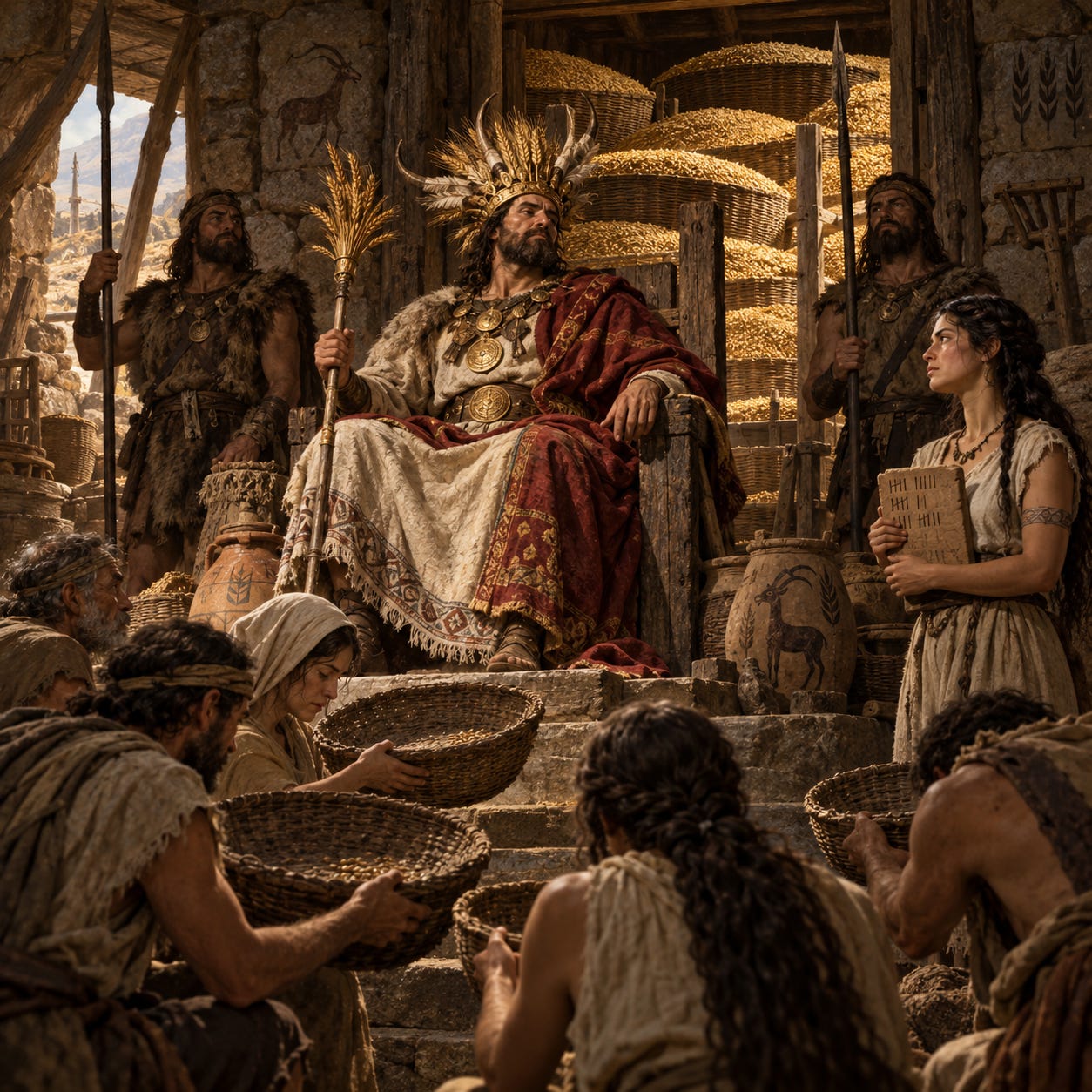
Author's note: This essay combines historical analysis with fictional scenes and dialogue.
Chapter I: The Man Who Would Not Share His Goat
Long before there were kings, taxes, armies, or economists, there was a man named Urak who killed a goat.
It was a magnificent goat, with enormous horns and an expression of permanent disappointment. Urak had followed it for three days through the mountains of the southern Caucasus, sleeping beneath rocks, drinking from streams, and occasionally wondering whether the goat was deliberately leading him somewhere. On the fourth morning, he drove his spear into its chest. The goat collapsed, looked at him with the same expression of disappointment, and died.
Urak was delighted. He had never killed anything so large. He dragged the animal back to his people, a wandering band of forty-two humans who had survived for generations by hunting, gathering, sharing food, and arguing about whose turn it was to watch the children. They greeted him with tremendous excitement. The children danced. The women prepared a fire. An elderly woman named Duma congratulated him and announced that the goat would feed everyone.
Urak considered this an extraordinary interpretation of events.
“I killed the goat,” he said.
“Yes,” said Duma.
“I followed it for three days.”
“We are very proud.”
“I was hungry.”
“We are all hungry.”
Urak looked at the goat, then at the forty-one people surrounding it. He had imagined a rather different celebration, preferably one involving everybody admiring him while he ate the finest portions.
“I think,” he announced, “that I should keep the goat.”
There was silence.
Duma was the oldest member of the band. Nobody knew exactly how old she was, because nobody had invented numbers large enough to express her age. She had survived six severe winters, three migrations, two feuds, and a particularly unpleasant incident involving a bear. She had also outlived three men who had confidently explained how she ought to behave.
“Keep it for whom?” she asked.
“Myself.”
“And when you are sick?”
“Someone will feed me.”
“Who?”
Urak looked around at the people he had just informed he would not feed.
The problem with living among forty-two humans was that everyone knew everything about everyone else. They knew who hunted well, who lied, who snored, who secretly ate berries while pretending to collect them for the group, and who had once attempted to mate with the wrong person’s sister. Privacy was a concept that had not yet been invented, although Urak was beginning to see its advantages.
Duma gathered the others. They discussed the matter and reached a collective decision: Urak was selfish, arrogant, and unworthy of the community’s protection. Unless he shared the goat, nobody would share food with him again.
Urak protested that this was coercion.
Duma replied that he was free to leave.
He asked where he might go.
Duma gestured toward the mountains.
There were wolves in the mountains. Urak knew this because he had recently seen several, none of which had expressed any interest in philosophical discussions about property rights.
That evening, he surrendered the goat.
The people ate, sang, and congratulated themselves on the wisdom of collective living. Duma explained to the children that no individual could be permitted to dominate the group, however strong or successful he might become. The people must always stand together against anyone who tried to place himself above the others.
Urak sat beside the fire, chewing a portion of meat considerably smaller than the one he had imagined.
He had learned something important. A single strong man could defeat another man. But forty-one weaker people could defeat the strongest man alive, provided they agreed on whom to defeat.
This discovery pleased Duma enormously.
It troubled Urak.
Unfortunately, the discovery also pleased the other forty people, who soon began applying it to matters beyond goats.
A young woman was accused of hiding berries. Nobody had seen her do it, but somebody’s cousin believed he had seen her walking suspiciously near a berry bush. The group demanded an explanation. She said she had merely been walking. This was considered evasive. For three days, no one spoke to her.
A young man refused to participate in a ritual intended to improve the weather. When rain failed to arrive, the group concluded that his refusal had offended whatever invisible being controlled the clouds. He was made to apologize to the sky.
Duma participated in these decisions. She considered herself a guardian of fairness, and she generally was. But she had begun to confuse the agreement of the group with the correctness of its judgment.
One evening, a woman named Nara asked her whether forty-one people could be wrong.
“Of course,” Duma answered. “But it is less likely than one person being wrong.”
Nara considered this.
“What if all forty-one are repeating the same fool?”
Duma disliked the question. The others disliked it too, particularly because several suspected she might be referring to them.
Nara was young, observant, and inclined to ask questions that ruined otherwise pleasant evenings. She had little interest in deciding who deserved the greatest portion of meat. She wanted to understand why certain plants grew where other plants did not.
One morning, while gathering wild grain beside a river, she noticed several stalks growing near a place where she had spilled seeds the previous season.
She wondered whether the seeds had produced the plants.
She began experimenting.
That winter, the band moved south. When spring returned, Nara insisted they revisit the riverbank. Urak protested that goats did not wait patiently for human beings to conduct botanical investigations. Duma declared the experiment a waste of time.
But Nara was stubborn.
They returned to the river, and there, beneath the spring sun, stood a small patch of grain growing exactly where she had hoped.
She looked at the plants.
Then she looked at the river.
Then she looked at the people who had spent generations walking enormous distances in search of food.
“I think,” she said, “we might not have to keep moving.”
Chapter II: The Invention of the Hungry Soldier
The first year was difficult. The second was promising. By the third year, the people had learned to cultivate enough grain to supplement their hunting and gathering. They constructed shelters, dug storage pits, and began keeping animals nearby instead of spending entire days chasing them across mountains.
Nara was pleased. The children ate more regularly. Older people no longer had to travel so far. The village began producing things that would have been absurd to carry on a long migration: heavy pottery, larger containers, and elaborate tools.
For the first time, the people possessed more food than they needed immediately.
They called it a surplus.
Urak called it an excellent development, particularly because agriculture allowed other people to produce food while he continued hunting.
Then came Tamak.
Tamak had never killed a goat. He had never killed anything larger than a beetle, and even that had been accidental. He disliked hunting because it involved unnecessary physical exertion, uncertain outcomes, and the possibility of encountering animals that objected to being hunted.
But he possessed a remarkable talent: he could persuade people that whatever he wanted was also what they wanted, provided he spoke long enough.
At first, he offered to organize the grain stores.
“It would be sensible,” he explained, “to keep part of everyone’s harvest together, in case somebody falls ill or a crop fails.”
Nara agreed. This was an excellent idea. A communal reserve could protect everyone.
Tamak supervised the construction of a larger storage building. He kept track of contributions using marks on clay. Soon he knew how much grain every family produced and how much each family consumed.
This information fascinated him.
He discovered that knowing what people owned was nearly as useful as owning it himself.
One afternoon, strangers arrived from the hil…