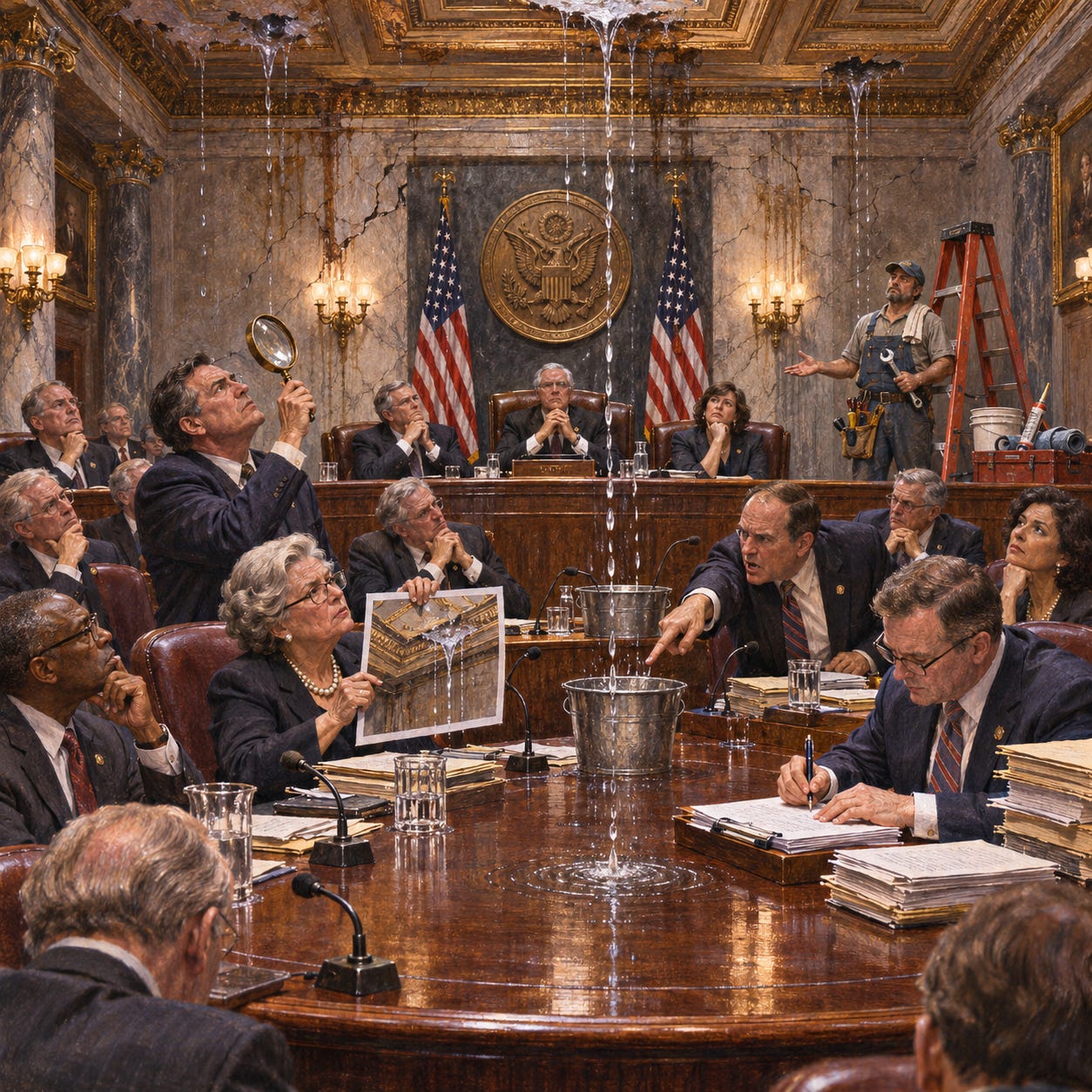
The Democrats have won Congress, and Washington is preparing for the restoration of its most cherished democratic institution.
The congressional subpoena.
Committees are assembling witness lists. Lawyers are reviewing executive privilege. Television producers are preparing dramatic graphics. Former officials are presumably contacting attorneys, who are experiencing the familiar patriotic sensation of discovering that democracy requires billable hours.
The investigations will be extensive. Financial conflicts. Government contracts. The Justice Department. Immigration enforcement. The war in Iran. Jeffrey Epstein. Corporate influence. The political uses of federal authority.
Much of this deserves examination.
But somewhere beneath the growing mountain of anticipated testimony lies a small constitutional inconvenience.
Congress was also supposed to make laws.
I. The Institution That Was Supposed to Make Laws
The American Constitution established a legislature, not a national detective agency with unusually comfortable chairs.
Congress possesses legitimate investigative powers. It must oversee the executive branch, examine government misconduct, scrutinize public expenditures, and determine whether existing laws are functioning. Investigations can uncover abuses that prosecutors have ignored or institutions have concealed.
But Congress is not the FBI with better stationery.
Criminal investigations belong principally to law enforcement. Guilt is determined in courts. Legislative oversight serves a different purpose: understanding how government operates and deciding what rules should govern it.
The distinction matters because investigating misconduct and preventing its recurrence are not the same achievement.
A congressional committee might spend eighteen months establishing that a wealthy donor enjoyed extraordinary access to government officials.
Excellent.
What happens next?
If the campaign-finance system remains unchanged, the next donor can purchase the same access, presumably after consulting the committee’s published findings to avoid repeating the previous donor’s administrative mistakes.
America will have achieved something remarkable.
It will have converted corruption into a publicly funded educational program.
II. The Difference Between a Scandal and a System
I have spent the past week writing about corruption, political influence, institutional patronage, and the extraordinary difficulty of discovering how decisions affecting millions of people are actually made.
I examined the past because I am worried about the future.
The point was never merely to identify another collection of powerful individuals whose conduct deserved scrutiny. American history contains a generous supply of such people. We are unlikely to run out.
The deeper problem is that political power can reproduce itself through perfectly recognizable arrangements: private fortunes finance campaigns, lobbyists cultivate access, personal relationships circumvent ordinary channels, and public authority becomes increasingly responsive to people whose principal democratic qualification is possessing considerably more money than everyone else.
Some transactions are unlawful. Others are entirely legal.
That is precisely the problem.
A system can produce profoundly unequal political influence without requiring everyone who participates in it to commit a crime.
Investigating a scandal asks what particular people did.
Reforming a system asks what their successors will be permitted to do.
The first can produce accountability.
The second can change the future.
And a democracy that confuses them may become exceptionally skilled at punishing yesterday’s abuses while preserving tomorrow’s opportunities.
III. The Laws Nobody Seems Particularly Excited About
Consider campaign finance.
American politicians must raise enormous sums to compete for public office. Wealthy donors and organized financial interests consequently possess opportunities for influence unavailable to most citizens.
One response is to investigate which billionaire contributed to which campaign and subsequently received which telephone call.
Another is to reduce candidates’ dependence on private fortunes in the first place.
Public financing, small-donor matching systems, and voter-directed campaign vouchers offer possible approaches. Stronger disclosure rules could make major political expenditures easier to trace. Enforcement could become more independent and consistent.
These ideas are not imaginary.
In August 2026, Senator Kirsten Gillibrand introduced the Clean Elections Act, proposing a system of public financing through voter-directed vouchers.
It has not become law.
Then there are conflicts of interest.
Why should Americans need an elaborate congressional investigation every time a public official’s personal financial interests intersect with government policy?
Establish enforceable disclosure requirements. Strengthen recusal rules. Restrict self-dealing. Protect inspectors general and whistleblowers. Make violations carry meaningful consequences.
The objective is not to prohibit wealthy citizens from participating in politics. It is to prevent private wealth from acquiring privileges incompatible with equal citizenship.
Then consider lobbying.
A democracy should not require historians to reconstruct political influence from calendars, memoirs, leaked correspondence, and the occasional disgruntled former employee.
Major lobbying relationships should be transparent, searchable, and connected to identifiable policy decisions, with appropriate protections for privacy and legitimate confidential deliberation.
And consider war.
Congress can investigate the decision to attack Iran. It can examine intelligence, military objectives, foreign influence, costs, and the legal basis for hostilities.
But if it does not also confront the recurring constitutional struggle over presidential war powers, the next administration may inherit essentially the same discretion.
The particular war will change.
The institutional argument will remain available for reuse.
Apparently, Washington has discovered a renewable resource.
IV. The Great Congressional Distraction
The incoming Democratic majorities face a genuine dilemma.
Investigations may uncover serious misconduct. They may also expose institutional weaknesses that deserve legislative remedies.
But investigations can become political industries of their own.
Subpoenas produce resistance. Resistance produces litigation. Litigation produces hearings about the resistance to the original hearings. Eventually, Congress may find itself investigating whether someone improperly refused to cooperate with an investigation into another investigation.
By then, the republic will have developed an impressive documentary record of its inability to govern itself.
Meanwhile, legislative calendars are finite. Political attention is finite. Public patience is finite, although Washington continues conducting ambitious experiments to determine just how finite.
There are also genuine obstacles to reform. President Trump retains the veto. Senate procedural rules can prevent legislation from advancing. Campaign-finance restrictions face constitutional constraints.
These realities cannot be overcome by writing an especially indignant press release.
But they make legislative strategy more necessary, not less.
An incoming Congress could identify structural reforms, introduce legislation, conduct focused hearings to establish their factual foundations, and force recorded votes on the resulting proposals.
Even when legislation fails, the public would know what institutional changes were proposed, who supported them, and what prevented their enactment.
That would be a considerably more informative democratic exercise than discovering which congressman delivered the most emotionally satisfying interrogation on television.
V. Democracy Is Not a Congressional Television Series
There is a temptation in American political life to mistake exposure for transformation.
A scandal is revealed. Th…