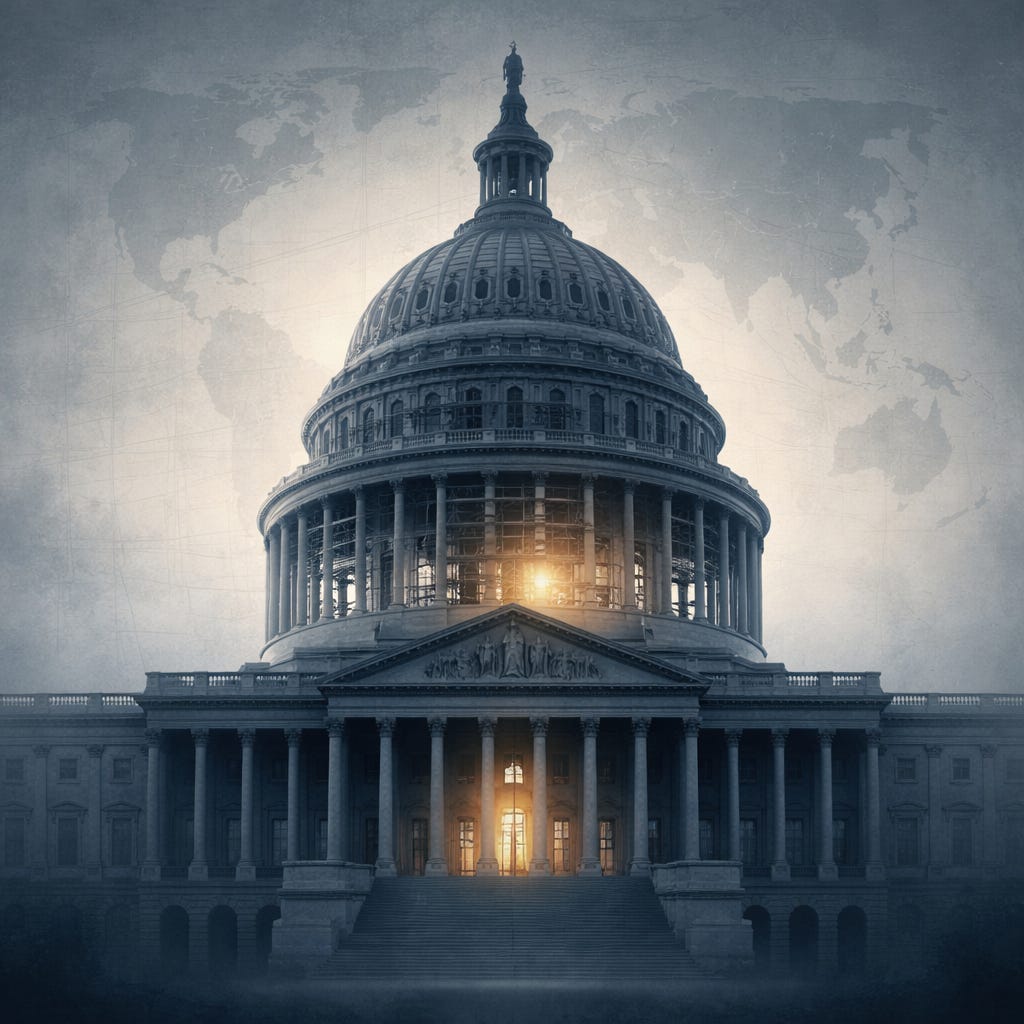
I. The Unipolar Dream and Its Quiet Funeral
For a brief stretch at the end of the twentieth century, the world behaved as if history had made a final executive decision. American carrier groups moved across the oceans, American dollars flowed through every serious transaction, American software ran on the screens of rich and poor alike, and American stories about “leading the free world” provided the soundtrack. Even those who loathed the empire mostly argued about how to resist it, not whether it was real. There was one center; everything else was orbit. That was the unipolar moment.
It did not end the way schoolbooks like to end eras. There was no climactic battle, no formal surrender. The belief simply frayed. The Iraq War showed that the sheriff would happily blow a hole in the saloon wall chasing imaginary weapons and then spend years insisting the dust was democracy. The 2008 financial crisis revealed that the global monetary core was a casino disguised as a cathedral; when the structure collapsed, its high priests rescued themselves first and called it stabilization. Russia’s annexation of Crimea proved that borders in Europe were once again negotiable by force and that economic sanctions, while painful, were not a veto. The election of an American president who treated allies like delinquent tenants made explicit what had been implicit for years: a large share of American voters no longer wanted to underwrite other people’s security at all.
Underneath those shocks sat an older architecture: the dollar system. For decades, American power was not only ships and bases. It was also a lattice of payment rails, reserve holdings, and sovereign debt that made Washington the quiet counterparty to almost everything. When the United States began to weaponize that system more openly – freezing reserves, cutting banks off from networks, turning sanctions into a default response – it preserved leverage in the short term and advertised risk in the long term. Rivals and uneasy partners drew the obvious lesson: if your prosperity depends on a switch in Washington, you had better build a backup grid.
What replaced the dream of a single sun was not a dignified, balanced “multipolar order.” It is something more unstable: a crooked triangle.
One corner remains the United States: still unmatched in global military reach, still issuing the world’s primary reserve currency, still housing the headquarters of the most powerful technology platforms, still sitting at the center of a vast dollar-denominated web of debt. But it is politically fractured, strategically inconsistent, and increasingly tired of its own script. The second corner is China: industrially formidable, strategically patient, knit into global supply chains from cobalt mines to smartphone factories, and yet hemmed in by geography, demographics, and fear of internal fracture. The third corner is Russia: a mid-sized economy with the arsenal of a superpower and the psychology of a resentful ex-empire, willing to weaponize chaos, energy, and nuclear risk in ways more cautious powers are not.
Around this warped geometry, medium powers have discovered that they are no longer just clients. India buys discounted Russian oil while courting Western capital and technology. Turkey hosts NATO bases and Russian gas. Saudi Arabia entertains Washington and Beijing in the same gilded rooms, certain that both need its oil and its money. Brazil, South Africa, Indonesia, Mexico, and others learn to balance, hedge, delay decisions, and extract concessions. This is no longer the “non-aligned movement” as moral statement. It is a very practical refusal to let one empire’s financial plumbing or another’s security guarantees define the limits of possibility.
At the same time, the map of power is being rewritten by physics. The twenty-first century is an energy transition conducted in the middle of a climate crisis. The empire that once treated oil chokepoints as the main arteries now discovers that control over lithium, rare earths, high-voltage grids, and semiconductor fabrication is just as strategic as tankers in the Strait of Hormuz. Europe’s dependence on Russian gas was one form of vulnerability; its dependence on imported solar panels, batteries, and critical minerals is another. The question is no longer only who controls the sea lanes, but who can keep the lights on when supply chains snarl and rivers run low.
The anxieties of this era cluster on the edges of most people’s maps. Venezuela, once a symbol of ideological struggle, now matters in Washington largely as a potential pier – a place where Chinese capital or Russian warships might one day sit too close to Florida, or where new offshore energy and infrastructure projects might plug into rival circuits. Iran is no longer just a “rogue regime,” but a regional hinge with drones, missiles, and political networks stretching from the Gulf to the Mediterranean, plugged into Russian warfighting and Chinese energy demand. Greenland, briefly a global joke when a president suggested buying it, sits under ballistic flight paths and future Arctic shipping lanes, with rare earths and radar sites embedded in ice that is turning to water. Sahel states, Pacific islands, Central American corridors: all become bargaining chips and pressure points in a game where climate, migration, minerals, and security are fused.
These places are not central because they are powerful in themselves. They are central because an empire that spent the twentieth century thinking in terms of central fronts and European plains suddenly finds itself worrying about flanks: the Caribbean, the high north, the digital sea, the Strait of Hormuz, the Taiwan Strait. In each theater, the cost of miscalculation is raised by the presence of nuclear weapons. Russia’s willingness to brandish its arsenal as a shield for conventional aggression, and the visible wobble in Western resolve, send a signal far beyond Europe: if the umbrella is unreliable and the center is a pendulum, serious countries will quietly consider their own deterrents.
Europe, meanwhile, has been living like a very cultured teenager whose rent is mysteriously paid every month. For three generations it outsourced serious violence to the United States. NATO and the American nuclear umbrella allowed conscription to end, shipyards to rust, and political imagination to turn inward to welfare states, climate policy, and regulation. The European Union could define itself as a market with a conscience, a combination of trade rules and human-rights rhetoric resting quietly on American logistics and Russian gas.
Germany’s pre-2022 energy policy – closing nuclear plants while deepening dependence on Russian pipelines – made sense only inside that comfortable assumption. When the gas stopped and the tanks rolled, the illusion evaporated. Eastern European states had always suspected the arrangement; their national histories are written in tank tracks. For them, American brigade deployments are not think-tank abstractions but the difference between a deterrent and an invitation. For southern Europe and Britain, migrant boats and asylum crises are the domestic front of the same story: a world system fraying at its edges, and the bill arriving on their shores.
You can tell an era is ending when its phrases keep being used after their meaning has gone. Officials still invoke “the rules-based international order” on panels that feel like religious services held after the congregation has quietly lost its faith. Policy papers still call the United States “indispensable,” even as allies quietly war-game scenarios in which Washington is absent, paralyzed, or preoccupied. Rivals no longer ask whether American power can crush them in a straight fight; they ask how much internal chaos it takes to keep that power from being used at all.
The unipolar moment did not end because a disciplined rival stormed the fortress. It ended because the custodian stopped behaving as if guardianship was a vocation and began treating it as an optional lifestyle brand – while the material basis of empire, from cheap energy to unquestioned financial primacy, eroded underneath. The world has not woken up in a “Chinese century” or a neat concert of powers. It has woken up in an in-between zone: an empire that can still break almost anything it leans on, but cannot decide what it wants to build; a periphery that has learned to hedge; and a planet whose physical systems are increasingly impatient with human delay.
A protector stepping back is also an invitation to grow up. Whether Europe, the United States, and the rising belt of states between them and China take that invitation remains a live and deeply uncomfortable question.
II. The Empire That Learned to Bleed Itself
When a great power falters, everyone looks for saboteurs. It is chilling but oddly reassuring to believe that decline is the work of traitors in boardrooms or infiltrators in bureaucracies. Fire them, expose them, and the machine will run again. The American empire denies that comfort. Most of the damage is being done by people who are, in their own frame, doing their jobs.
Washington still looks like a capital. There are hearings, motorcades, news conferences, think-tank lunches with soggy sandwiches and important name tags. Under that choreography, however, the United States effectively operates with two mutually hostile foreign policies.
One sees alliances, trade, and institutions as tools of a liberal order: flawed, often hypocritical, but still the best way to keep a dangerous world from reverting to raw predation. The other sees those same structures as parasitic: treaties as traps, allies as freeloaders, institutions as devices for constraining American freedom of action. Each camp, when it gains power, treats the other’s strategy as not just mistaken but illegitimate. Arms-control agreements are shredded to prove toughness. Long-term climate accords are discarded to signal defiance. Trade deals are torn up and rebuilt, not primarily for their content but for who gets to sign them. Commitments to defend far-flung allies are alternately solemn vows and “maybe we won’t show up” improvisations, depending on which channel’s viewers need feeding.
From the vantage point of Warsaw or Tokyo, “America” is no longer a single actor with a long memory. It is a pendulum. Every promise now arrives with an invisible footnote: valid until the next election, or until a cable host needs a new enemy, whichever comes first. The same uncertainty applies at home: agencies plan on ten-year horizons and see their budgets rewritten every two. Infrastructure bills pass, then dissolve into permitting purgatory and local obstruction. Industrial policy is announced with fanfare and then choked by the very regulatory thicket the announcements refuse to confront.
This oscillation rests on a deeper problem: the collapse of the time horizon. Congress thinks in two-year cycles; presidents in four. Cable news runs on a 24-hour churn. Social-media outrage cycles last hours, sometimes minutes. Markets judge executives quarterly. In such an environment, the questions that should guide an empire – What balance of power do we want in our lifetime? What dependencies are genuinely intolerable? What alliances are worth real sacrifice? What physical infrastructures must exist thirty years from now, regardless of who wins the next election? – are crowded out by more urgent ones. How will this play tonight? What will it do to the polls next month? Will this hurt earnings next quarter?
Inside this churn, a second erosion has been quietly underway: the decay of state capacity. The administrative state is easy to denounce and hard to replace. Decades of politicized appointments, hiring freezes, outsourcing, and performative budget fights have left many agencies hollow. The country can still write checks; it struggles to build. High-speed rail, modern transmission lines, new ports, refineries, semiconductor fabs – these require permitting regimes that can say yes or no in finite time, procurement systems that do more than feed consultants, and a civil service that is rewarded for competence rather than survival. An empire that cannot lay track or string wire at speed has already chosen a kind of decline, even if it has not named it.
Short-term self-harm, under these conditions, is often rewarded. A senator can torpedo a defense arrangement twenty years in the making, present it as “standing up for American workers,” and watch donations soar. A president can impose tariffs on allies to look tough, damage trust in the process, and still enjoy a boost in approval. A network can frame a necessary compromise with a rival power as surrender, intensify public disgust with diplomacy, and still please advertisers. A platform can let its recommendation systems funnel millions of users toward the angriest, most hysterical content on every issue and present the resulting engagement spike as success.
Every so often, someone inside one of these institutions does remember the future. A civil servant points out that gutting a particular capability will be very expensive to rebuild. A junior staffer notes that humiliating this ally today will cost real blood later. A product manager quietly questions whether stripping another layer of attention from teenagers is a good idea. Their concerns are listened to patiently, filed under “long-term risks,” and then steamrolled by the next news cycle or the next earnings call. When accidents are averted or small wars are delayed, the victories are invisible. When disasters erupt, they are narrated as if no one ever saw them coming.
None of this means the country is devoid of people who can think beyond the horizon. There are serious strategists, from left and right, who grasp the stakes. There are voters who understand that burning down every institution will not produce the republic they wanted. Cities and states sometimes run counter to national dysfunction, quietly building infrastructure or reforming police or stabilizing finances. But the feedback loops that could elevate such efforts into a new common sense are clogged by noise dialed up for profit and by structures that make execution slow even when there is rare political will.
An empire can survive folly. History is full of recoveries from misrule and miscalculation. What it cannot survive is a structural inability to prefer its longer-term survival over its next little hit of stimulation – coupled with a machinery of governance that cannot translate rare moments of seriousness into concrete, timely action. That incapacity is not encoded in American DNA. It is the result of choices: about how to fund campaigns, how to report politics, how to structure markets, how to evaluate performance, how to staff and protect institutions capable of doing anything difficult.
Those choices can, in principle, be unmade. The same machinery that currently rewards performative self-harm could make genuinely responsible behavior politically and commercially attractive, if enough people with power decided to pay the initial cost and rebuild the boring, unglamorous parts of state capacity. So far, the courage for that has been rarer than op-eds about the lack of courage.
III. The Market That Ate the Soul
At some point, the center of Western power quietly changed professions. The archetypal titan stopped being a builder of railroads or bridges and became a manager of abstractions. The old industrial barons were often brutal, but they wrestled with things that did not care about their theories: ore, steam, stone, voltage. Their world punished fantasy with collapse.
Their successors in status sit atop balance sheets, financial instruments, index funds, and “platforms.” They operate in a universe where fortunes appear and disappear as numbers on screens, and where the boundary between making value and siphoning it is blurred. They are no longer merely domestic elites. They are transnational actors with their own foreign policies, expressed through capital flows, supply chains, data centers, and terms-of-service agreements.
Finance led this transformation. Once companies are seen primarily as streams of cash instead of communities of work, certain moves become obvious. A manufacturing firm in Ohio or the north of England becomes “under-utilized assets” on a spreadsheet. A private-equity fund buys it, loads it with debt, sells off its buildings, leases back its equipment, cuts “excess” staff, and demands higher “return on capital.” Hedge funds pressure listed firms to focus on “core competencies,” which usually means shutting down the inconvenient, locally rooted parts. Large asset managers, entrusted with pensions and sovereign wealth, reward “discipline” – by which they mean a visible willingness to put margins above messy obligations.
The fallout is not theoretical. Towns anchored for decades by a factory or refinery find that anchor removed. The old plant becomes a logistics warehouse with far fewer jobs and no apprenticeships. Local newspapers close; churches shrink; petty crime and quiet despair grow. Young people leave for cities; those who cannot leave self-medicate. On quarterly earnings calls, this is all captured under phrases like “portfolio optimization” and “cost efficiencies.” It is slow euthanasia, narrated in euphemism.
Silicon Valley did something similar to human attention. Technology once meant hardware innovation and useful tools. Increasingly, the most profitable line of business became selling access to users’ minds. A phone is a device. An app is a product. A habit is a revenue stream. So firms built interfaces designed not to be used and put down, but to become the background of waking life. Infinite scroll, autoplay, push notifications calibrated to hit when you are most likely to respond – none of this emerged by accident. It was tested and tuned, often with the help of psychology and neuroscience, until it reliably extended “time on platform.”
If you have ever opened a social app to “check one thing,” surfaced an hour later with a worse mood and a vague sense of contamination, you have participated in this business model. The point was not to inform or connect you in any deep sense. It was to keep you there. At scale, that attention capture becomes a kind of private foreign policy: platforms can tilt elections, amplify or bury movements, and shape how entire societies perceive distant wars and crises, all through algorithmic tweaks that answer to shareholders, not citizens.
To thrive in these environments, the new elite personality has to be shaped in a particular way. It learns to think in spreads and margins – arbitrage, in plain language, means profiting from small differences between two prices or situations without improving either. It learns to see changes in interest or return measured in “basis points” – tiny fractions that mean little to an ordinary life but huge volumes of wealth in aggregate. It thinks in “engagement,” “conversion,” “lifetime value,” “basis risk.” This language is not evil. It is just incomplete. As it becomes the dominant way of perceiving, everything that cannot be translated into it – loyalty, beauty, place, sanity – fades from view.
The class trained in this way is not confined to New York and California. It populates Brussels, London, Singapore, São Paulo, Johannesburg. It staffs central banks, sovereign wealth funds, global law firms, consultancies, rating agencies. It lives in different countries but in the same neighborhoods: districts of glass and steel, ringed by airports, fed by global schools. Their children can move between these hubs with ease. The people in the hollowed-out towns and outer suburbs of their own countries cannot.
That geography of privilege and abandonment is the domestic map of imperial decline. The outer rings see the inner cores prosper from trade, immigration, asset inflation, and technologized attention – and pay the social cost of deindustrialization, drug epidemics, and cultural dislocation. Populist movements on left and right are not mere outbreaks of irrationality; they are crude attempts to articulate the sense that the regime serves one class-culture and presents that service as neutral progress.
The people themselves are not necessarily monsters. Many are generous in private, proud of their creativity, uneasy about the broader effects of their work. Some leave and become philanthropists or critics. Some stay and quietly try to bend things. But inside the machine, conscience is constrained by a simple rule: if a choice increases the right numbers, it is good; if it reduces them, it requires extraordinary justification. That is a moral education, even if no one calls it that.
The damage is external and internal at once. Externally, regions are abandoned, ecosystems degraded, political discourse turned into an outrage casino. Internally, the class that runs the system loses the habit of asking “Should we?” and instead perfects the art of asking “Can we?” and “Will somebody else do it if we don’t?” A culture embedded in a market can tell its markets where to stop. A culture that has embedded itself inside the market cannot.
Markets are not demons. They are mirrors and amplifiers. They do not decide what counts as value. They merely intensify whatever definition they are given. For a long time, Western societies, despite all their hypocrisy, fed their markets the assumption that certain things were not for sale: offices, verdicts, children, some lands, some promises. Over time, that assumption thinned. The market was instructed, by practice more than proclamation, that everything is in principle tradeable – including attention, social trust, and political stability. It adjusted. “Capitalism” did not suddenly mutate. The civilization did.
IV. After the Death of the Center
Empires can be described in inventories: ships, bases, banks, databases. Civilizations cannot. They are held together, at bottom, by answers to questions most people rarely articulate: Who are we? What can we ask of each other? What do we owe to those not yet born? What must we never do, even if we could get away with it?
In older Western language, these answers were wrapped in religious terms. God, law, nature, and history provided an architecture of meaning. You did not need to be a believer to feel their pressure. The idea that life was for more than consumption, that promises mattered, that some acts stained the soul and some duties could not be shrugged off, seeped into law and habit.
That architecture cracked over the last two centuries. Industrial slaughter, scientific revolutions, and the sheer speed of change undermined confidence in providence and inherited order. The language of virtue and sin gave way to the language of rights and harm. The self stopped being a creature in a story and became a project under construction. MacIntyre was right to note that we kept many of the old moral words while evacuating the frameworks that gave them sense.
The result is not moral collapse in the sense of universal depravity. It is moral disorientation. Publicly, the West still speaks of “values,” “human rights,” and “democracy.” Privately, it rarely agrees on what those entail beyond a baseline aversion to obvious cruelty. The highest operational good, in much legislation and culture, has quietly become maximizing the zone of individual choice so long as no immediate, provable harm can be demonstrated to others. That is not nothing. It is also not enough.
America is acutely exposed because its national identity was always hinged to an idea: a people under God, committed to liberty and opportunity. As actual belief in God sinks below the level of polite conversation, as liberty thins into lifestyle and branding, as opportunity closes for large regions and classes, the story loses its grip. Rituals remain – flags, songs, holidays – but they become floating symbols that different factions fill with incompatible content. For one, the flag means emancipation; for another, conquest; for a third, an abstract team logo. There is no shared agreement about what it demands of them.
Europe stands on thicker historical ground – older nations, older cities, older scars. But much of its contemporary identity was built on negations (“never again war here,” “never again fascism”) and on delegation (let America handle the high-risk parts of power). As that bargain frays, Europe has to discover a positive center or watch centrifugal forces take over. So far, its statements read like carefully drafted mission statements: earnest, humane, and curiously thin.
China, for all its brutality, illustrates what it looks like to have a functioning civilizational center. Its ruling idea is not a personal God but a continuous “China” whose unity and status are sacred. Confucian traditions, filial duties, centuries of imperial bureaucracy, and a vivid narrative of national humiliation and revival all reinforce this. Individuals are framed, officially and often sincerely, as existing within a larger project of rejuvenation. The Communist Party’s original Marxist theology has faded; what remains is performance legitimacy and nationalism wrapped around that civilizational core.
From one angle, this gives Beijing an advantage. It can demand sacrifice and obedience for something that feels larger than personal preference. That is an advantage in mobilization, not in morality. Civilizational clarity does not equal goodness. A regime can be both coherent and cruel. The Chinese center enables impressive discipline and appalling repression. It is a serious competitor, not a hidden sage.
The West’s problem is not that it lacks power. It is that it lacks a widely trusted answer to the question “For what?” Without such an answer, every major decision devolves into a contest of interests. Should a country accept higher costs to protect its environment? Should it forego profitable technologies that corrode social trust? Should it restrain its own power abroad to avoid blowing up the system that supports its prosperity? If there is no accepted hierarchy of goods beyond short-term comfort and abstract rights, these questions cannot be resolved at the level they demand. They get handed down to courts, lobbyists, and consultancy-written legislation.
Into that vacuum step three things: markets, identities, and resurgent faiths.
Markets offer meaning through consumption and careers: you are what you can buy and sell and signal. Identity politics, on both left and right, offers meaning through belonging to an aggrieved group: you are what has been done to you, or what you fear will be done to you. And in the background, or sometimes in the streets, religion returns in sharper, more politicized forms – from Christian nationalism to Islamist movements to civil-religious cults of nation and race that borrow ritual and fervor while denying they are religions at all.
None of these can carry a civilization on its back. Markets dissolve solidarity in choice. Identity corrodes it in resentment. Sacralized politics turns every disagreement into heresy and leaves no room for ordinary compromise. Yet for many people, these are the only available answers to the question “Who are we?” They are not drawn to them by evil so much as by the absence of anything sturdier.
Migration and demographic imbalance sharpen this crisis. Aging societies that have quietly decided against children in sufficient numbers still need workers, carers, taxpayers. They import them from poorer, younger countries while refusing to decide what belonging means. The result is neighborhoods, schools, and workplaces in which people live together physically but not symbolically. For those on the receiving end, integration into “nothing in particular” is not a compelling offer. For those who feel their inherited identities eroding, every new arrival can feel like an accusation.
Power abhors a vacuum; so does meaning. If the West does not articulate a new center – secular, religious, or hybrid – that can command loyalty across tribes and decades, something harsher will eventually fill the space: a cult of security, a charismatic demagogue, or the patient pressure of external empires and internal zealots. The uncomfortable opportunity of this moment is that no one has to pretend the old center was better than it was. A different one can be built that remembers duty, limit, and continuity without replaying previous cruelties. But it will not emerge from a TED talk or a branding exercise. It will be hammered out in institutions, families, congregations, unions, and local fights, by people who decide to act as if civilization is more than a brand.
V. The Work of Repair
Viewed from a sufficient height, the West looks finished. An empire that cannot remember what it is for, a ruling class trained to optimize away its own foundations, a population fed a diet of agitation, comfort, and dread. China ascendant, Russia disruptive, Europe anxious, America oscillating between denial and rage. The mood naturally tilts toward tragic flourish: We had a good run; now it’s over.
That posture is seductive and lazy. The reality is more ambiguous. The West is not dead. It is badly oriented. It still holds enormous technical capacity, deep scientific cultures, complex legal and civic traditions, and millions of people whose instincts run toward decency even if their institutions do not. The question is whether any of that can be re-anchored around a purpose more stable than quarterly earnings and daily outrage – and whether there is still enough state capacity and social trust left to turn decisions into concrete outcomes.
Repair begins with the unromantic.
Material sovereignty. A society that cannot power itself, feed itself, or equip itself without the consent of potential adversaries is not sovereign. This does not require Fortress Autarky. It does require redundant capacity in critical domains: energy, key manufacturing, digital infrastructure, logistics, food systems. When the COVID-19 pandemic choked supply chains, countries discovered which medicines they no longer made, which chips they could not source, which ports and factories were single points of failure. When wars and sanctions rearranged energy flows, they learned who held the valves and who held the refineries.
Some responded. The American CHIPS Act, European attempts at semiconductor and battery production, Japanese onshoring of strategic components, regional experiments in renewable build-out and grid reinforcement – imperfect, politicized, but real – are early steps toward rebalancing. The energy transition sharpens the urgency: whoever controls the extraction, refining, and processing of critical minerals, and the fabrication of key technologies, sets terms not far below those once set by oil producers.
These steps need to be deepened, not just announced. That means pricing resilience into policy. It means accepting that some goods will be more expensive if they are made closer to home, and treating that as insurance rather than inefficiency. It means structuring tax codes so that capital gains from long-term investment are not taxed like casino wins, and designing procurement so that governments do not always pick the cheapest vendor with the longest, most fragile supply chain. It means fixing permitting and planning regimes so that necessary projects can be built in years, not decades, without turning every valley into a strip mine.
State capacity. Decline is not only about bad choices; it is also about the inability to execute good ones. Repair requires rebuilding the boring machinery of competence: civil services that can attract and retain talent, agencies protected from constant partisan purges, clear lines of authority for major projects, and legal frameworks that distinguish between justified constraint and mindless obstruction. If a country can mobilize trillions in emergency liquidity in weeks but cannot replace a crumbling bridge for fifteen years, the problem is not money. It is institutional design and political will.
This work will not trend. It will feel, for a long time, like maintenance. It is also the precondition for any serious climate response, industrial refounding, or security guarantee. No one believes promises from a state that cannot deliver passports, trials, or trains on time.
Social cohesion. A civilization that runs out of children, or treats them as luxury goods, has already voted on its future. Fertility crashes are not simply matters of “personal choice.” They are tightly linked to economic insecurity, housing absurdity, the disappearance of extended families, and cultural stories that present adulthood as a curated solo experience. Small countries that have confronted this – from robust family-support policies to experiments with childcare, parental leave, and housing – show that it is possible, with effort, to make raising children less economically suicidal. Those experiments have limits and contradictions, but they exist.
Repair here means building lives in which forming families, caring for elders, and staying rooted are not signs of failure. Zoning and housing policy that allow more than investor-grade condos and car-bound sprawl; labor norms that do not punish parenthood and caregiving; educational systems that do not require taking on lifetime debt for credentials of diminishing value; a culture in which commitment is not treated as naivety – these are part of the work. They are not soft issues. They are demographic and civilizational survival.
Migration is part of the same equation, not an optional add-on. Aging societies will depend on immigrants whether they admit it or not. The choice is between chaotic influx into systems that refuse to name a shared culture, and intentional integration into a story that is demanding but intelligible. That story cannot be “you are here to keep our pension system solvent while we despise your presence.” Nor can it be “nothing in this place is worth inheriting; start from zero.” Repair requires the courage to say: this is who we are, this is what you must accept to join us, and this is what we will change because you are now part of the ‘we.’
The digital environment. The platforms that now host much of public life are designed, quite openly, to maximize engagement, not health. Some jurisdictions are beginning to push back. Privacy regulation, transparency requirements for recommender algorithms, age checks for addictive services, and restrictions on the most manipulative design patterns are all experiments in treating digital life as infrastructure rather than weather.
Repair does not mean banning technology. It means treating certain aspects of digital life as public health issues. You cannot legislate wisdom or kindness into existence. You can, however, stop subsidizing mass nervous-system vandalism. If you cannot imagine governments acting with that kind of restraint in the tech sphere, remember they already do so with food, drugs, aviation, and building standards. Those regimes are incomplete, contested, and full of loopholes. They also save lives every day. Similar regimes for attention and information will require confronting companies that currently profit from destabilization – and will impose real costs on some of the world’s most powerful firms.
Honor, distribution, and responsibility. Underneath all of this, the axis of honor has to tilt – and with it, the distribution of loss. In the current order, the most admired figures tend to be those who extract the most – attention, money, influence – with the most visible flourish. “Success” is defined largely by scale and visibility: the size of an exit, the reach of a platform, the volume of a following. Repair requires a different pantheon – and it requires that some of today’s winners stop winning quite so much.
There are already people living by a different standard. A mayor in a coastal city chooses to spend limited funds on sea walls and pumping systems rather than stadium naming rights. Years later, a storm arrives and the city stays mostly dry while a neighboring one floods. A manufacturing CEO keeps more production domestic than the spreadsheets recommend, survives a global shipping shock, and keeps paying workers while competitors furlough. A school district refuses to cut history and art in favor of wall-to-wall testing, and graduates students who can at least recognize their own country in a book. A small credit union keeps lending locally when larger banks retreat. A pension fund accepts slightly lower headline returns in exchange for anchoring essential infrastructure at home instead of chasing yield in distant derivatives.
These are not miracles. They are decisions made by people who put stewardship above extraction, and who are willing to accept that someone – sometimes themselves, sometimes their class – must take home less so that institutions and places can endure. They do not trend. They do not usually make the authors of airport books. But they are proof of concept. It is not that the West has forgotten how to act responsibly. It is that such actions do not yet define the center of its story, and that the costs of responsibility are still allocated downward.
The point of describing repair is not to sprinkle optimism over decline. It is to strip inevitability from the conversation and to name the price. Decay is not destiny. It is a pattern of choices. Many of those choices are currently made by people who have incentives to look away from their consequences. But not all. There are mayors, judges, engineers, nurses, teachers, parents, and even some executives and ministers who behave as if something larger than themselves is at stake – and who are willing to pay for that belief.
The first necessary act is conceptual: stop speaking about “the system” as if it were weather. It is not. It is the accumulated residue of decisions and defaults, written into law, code, budgets, contracts, and habits. The second is practical: in your own narrow domain – a budget line, a hiring decision, a feature roadmap, a sermon, a classroom, a zoning vote, a family conversation – behave as if stewardship is already the rule and as if future people are real. That will usually look unimpressive and small. So did most of the actions that produced the current mess.
An empire is a machine for projecting power outward. A civilization is the story a people tell themselves about why that power should exist at all, what it may not do, and what it must protect. The West still has the machine. The story is tattered, but not irretrievable. Whether it chooses to rewrite it, to share authorship more widely, or to let others write its ending will not be decided by a single election or a single crisis. It will be decided by whether enough people, in enough unremarkable rooms, quietly decide they are tired of living in a hollow empire and begin, without permission, to live as if it were still possible to have a purpose – and to pay the cost of one.
—Elias WinterAuthor of Language Matters, a space for reflection on language, power, and decline.