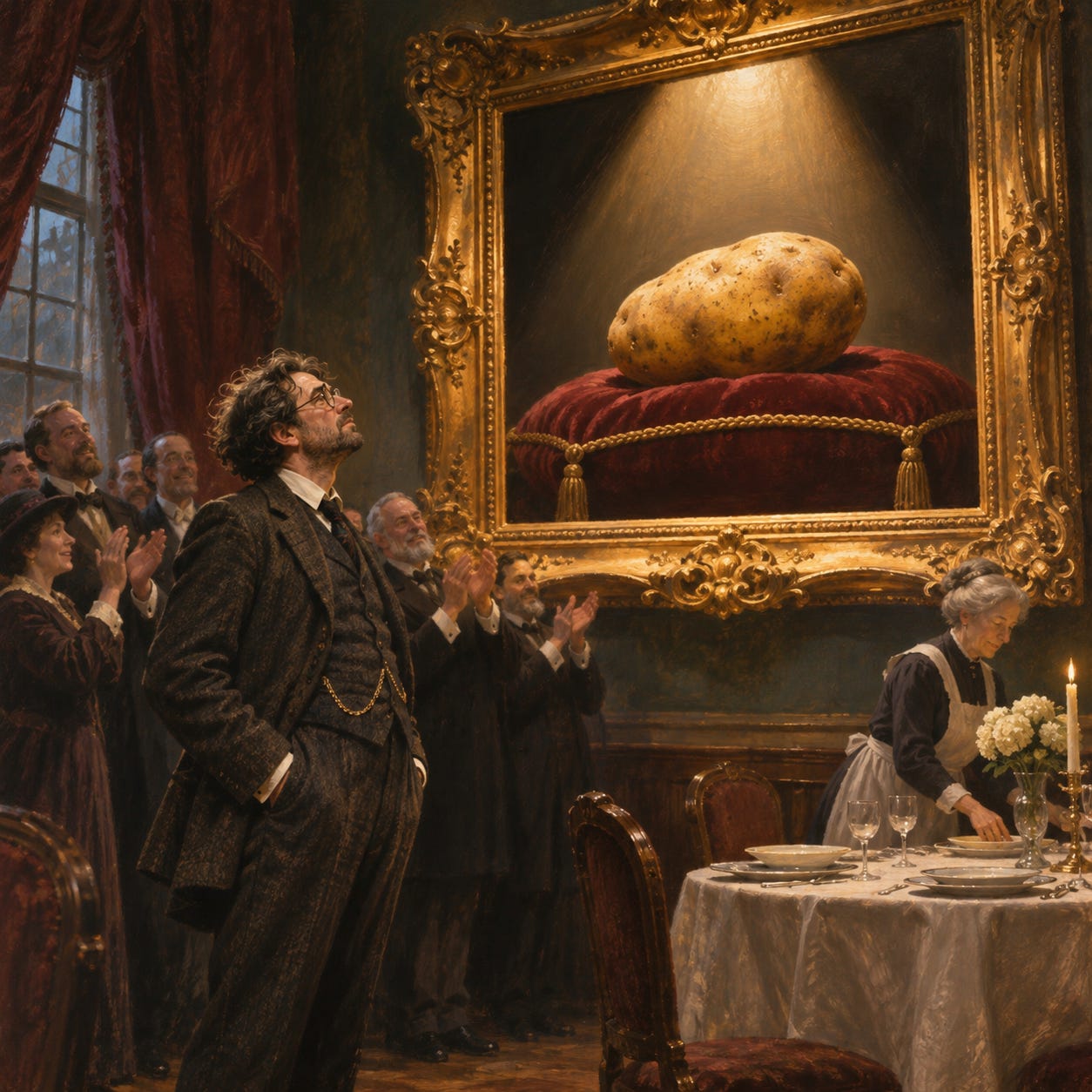
I. The Incident at the Lift
Ambrose Wetherby had survived three corporate reorganizations, two parliamentary inquiries, a divorce, and a panel discussion at Oxford on the future of human dignity. But nothing had prepared him for three young women in an elevator who declined to say good evening.
The incident occurred on a Monday, at precisely 6:43 p.m., in the lobby of his apartment building in Kensington. Ambrose had returned from work carrying a leather briefcase, a copy of Hegel’s Phenomenology of Spirit, and the accumulated disappointment of forty-two years. The women were young, attractive, and apparently pleased with themselves. They wore expensive coats, carried little handbags, and possessed the extraordinary confidence of people who had never been asked to justify their existence before a university appointments committee. Ambrose stepped aside to allow them through. Not one said thank you. Not one made eye contact. The tallest appeared to be laughing at something on her telephone. Ambrose waited. Nothing. He had been reduced to architecture.
Now, Ambrose was not an unreasonable man. He understood that London was a busy city, that young people had their preoccupations, and that modern technology had altered the rituals of interpersonal exchange. He had written extensively about these developments, including a paper entitled The Phenomenology of Digital Absence: Toward a Post-Human Ethics of Mutual Acknowledgment, which had been downloaded forty-seven times, eleven of them by Ambrose himself. But there were limits. Civilization, he believed, was not constructed upon constitutions, legal systems, or the rule of law. These were merely its external scaffolding. Civilization began when one human being acknowledged the existence of another. The women had failed this elementary test.
He followed them into the lift. One pressed the button for the seventh floor. Ambrose lived on the eighth. This, too, seemed significant. He considered announcing his title. Dr. Ambrose Wetherby, Director of Computational Identity and Human Recognition. He decided against it. Dignity should not have to introduce itself. Instead, he cleared his throat. Nobody responded. He cleared it again, with greater constitutional gravity. The tallest woman glanced at him. For an instant, Ambrose experienced the sweet anticipation of vindication. “Are you all right?” she asked. The question wounded him more deeply than silence. “I am perfectly well,” he replied. “Okay.” The lift opened. The women departed. Ambrose remained motionless until the doors closed, wondering whether Western civilization had ever truly recovered from the invention of individualism.
At 7:12 p.m., he began drafting a complaint to building management. Its title was On the Progressive Erosion of Reciprocal Civic Recognition in Shared Vertical Spaces. By 9:30, it contained seventeen pages, four footnotes, and a quotation from Aristotle. He concluded: If the management of this building cannot guarantee the minimum conditions of mutual acknowledgment among its residents, I must seriously reconsider whether the present arrangement constitutes a community in any meaningful philosophical sense. The next morning, the manager replied. “Thanks, noted.” Ambrose printed the email. He had discovered a second offense.
II. The Wetherby Tribunal
On Tuesday evening, Ambrose telephoned his father. Sir Alistair Wetherby was eighty-one, a retired professor of metaphysics and the last surviving representative of a generation that believed an incorrect statement was a moral emergency. He lived with his wife, Constance, in a modest house in Oxfordshire, surrounded by books, several clocks that disagreed about the time, and an atmosphere of intellectual correction so persistent that the family dog had eventually stopped barking.
“Father,” Ambrose began, “I’ve had a rather disturbing experience.” “Disturbing in what sense?” “In the ordinary sense.” “There is no ordinary sense. Disturbance requires an object.” Ambrose closed his eyes. “Three women ignored me in the lift.” “Were they acquainted with you?” “That is not the point.” “It seems rather central to the point.” “They failed to acknowledge my presence.” “Did you acknowledge theirs?” “I allowed them to enter first.” “That is a physical accommodation, not necessarily an acknowledgment.” Ambrose felt a familiar pressure gathering behind his eyes. “I don’t think you’re understanding me.” “On the contrary, I understand you perfectly. I simply disagree.”
This was his father’s favorite distinction. It permitted him to reject every emotional claim while maintaining the outward appearance of attentive listening. When Ambrose was nine, he had once returned from school with an observation about the stars. He had noticed that the sky seemed to move differently at different times of year. His father had been reading in the sitting room. “Daddy,” the boy announced, trembling with discovery, “I think the stars are moving around us.” Sir Alistair lowered his newspaper. “No, Ambrose. Strictly speaking, it is the Earth whose rotation produces the apparent movement. The stars themselves possess proper motion, of course, but on an entirely different timescale.” The boy stood in the doorway. His father, pleased with the opportunity, spent the next twenty minutes explaining celestial mechanics. It was a beautiful explanation. It was also the last time Ambrose volunteered a discovery without preparing a defense.
Years later, he would earn a doctorate in mathematics, publish papers on machine learning, and become internationally respected for his work on computational identity. His father attended the graduation ceremony and pointed out that the university’s Latin inscription contained an irregular construction. Yet the relationship was not without tenderness. Sir Alistair had taken him to bookshops in Paris, bought him illustrated volumes about the cosmos, and introduced him to the extraordinary proposition that the universe was comprehensible. He had given Ambrose infinity. He had simply neglected to give him the last word.
“Ambrose?” His father’s voice returned him to the telephone. “Are you still there?” “Yes.” “You’ve gone quiet. I assume you’re reconsidering your position.” From the background came Constance’s voice. “Alistair, leave the boy alone.” “He is forty-two.” “He’s still your boy.” “That’s sentimentality, Constance.” “Have you eaten, darling?” she asked Ambrose. “Mother, I’m trying to discuss a serious philosophical problem.” “I’ve made shepherd’s pie.” “I’m in London.” “I know where you are, darling.” Sir Alistair resumed his argument. Constance asked whether he was sleeping. Ambrose attempted to explain the distinction between ontological recognition and social acknowledgment. Nobody listened to anybody. It was, by Wetherby standards, a successful family conversation.
III. The Department of Human Recognition
On Wednesday morning, Ambrose arrived at work to discover that his company had solved loneliness. The announcement came from Lord Percival Fothergill, founder and chief executive of AcknowledgeMe™, Britain’s most ambitious technology company dedicated to the monetization of interpersonal dignity. Fothergill had made his first fortune selling productivity software, his second selling artificial intelligence, and his third explaining why artificial intelligence would eliminate the need for productivity software. He was a man of extraordinary foresight, particularly regarding industries in which he already owned substantial shares.
His latest innovation was called the Recognition Index. The premise was elegant. Human beings suffered because they were insufficiently acknowledged. Until now, recognition had been subjective, informal, and tragically difficult to monetize. AcknowledgeMe would change that. Using facial recognition, speech analysis, sentiment classification, workplace communication data, and advanced computational inference, the platform would assign every employee a Recognition Score be…