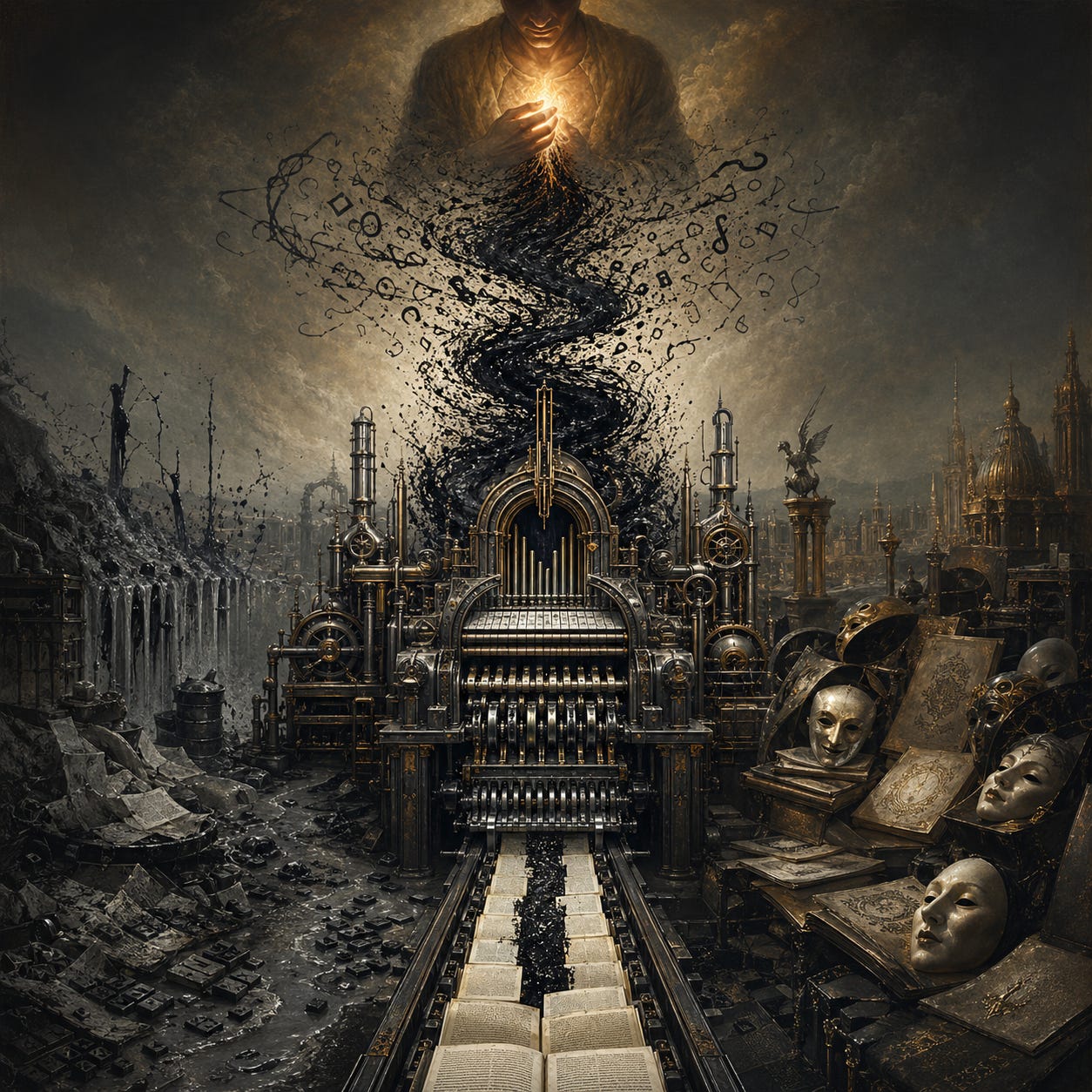
1. The Night of the Mourners
They are mourning again.
Not a person this time, not a city, not a vanished republic, but a boundary: the old confidence that when a sentence appeared before us, a human being had paid the full cost of its making.
The mourners gather wherever language still matters. They gather in literary circles, classrooms, publishing houses, group chats, comment sections, faculty lounges, and private resentments. They say the age of writing is ending. They say the machine has entered the sentence. They say authorship is finished. They say the page has been desecrated.
Some of them are not wrong.
Artificial intelligence has entered writing at a depth no previous tool ever reached. It does not merely store the sentence. It does not merely print the sentence. It does not merely transmit the sentence. It can help make the sentence. It can propose the structure, smooth the transition, imitate the tone, complete the argument, generate the paragraph, mimic the confession, simulate the wound.
That is not nothing.
So I do not write this as an AI optimist. I do not believe every invention is liberation. I do not believe efficiency is innocence. I do not believe the market becomes moral because it discovers a new machine. I do not believe the owners of capital will use this technology primarily to free the human spirit. They will use it, as they have used most machines, to lower labor costs, accelerate output, consolidate power, and call extraction innovation.
AI threatens work. AI threatens credit. AI threatens apprenticeship. AI threatens the already fragile connection between effort and recognition. It gives corporations a new way to harvest value from language while paying less for the people who once carried that value. It gives institutions a new way to automate competence while avoiding responsibility. It gives employers the possibility of saying, with a straight face, that the worker has become expensive because the machine has become fluent.
And worse, AI has flattened the question of credit.
Credit was never simple. It was always a spectrum. No author writes alone in an absolute sense. A writer inherits language, form, teachers, books, wounds, editors, conversations, traditions, enemies, lovers, dead ancestors, living ghosts. A writer is never pure origin. But AI has made that old complexity newly vulnerable. It has given suspicious readers and resentful temperaments an easy weapon: You used AI, therefore nothing is yours.
This is false.
But it is a useful falsehood for those who already wanted to diminish others.
AI has given resentment a passport. It has allowed people who never cared about the true architecture of authorship to pretend they are defenders of purity. It has allowed the lazy critic to collapse every distinction: a student who submits untouched machine-generated work, a corporation flooding the internet with synthetic marketing sewage, a propagandist laundering falsehood through fluent prose, and a serious writer using AI to help structure sentences after the real thought has already arrived.
These are not the same act.
To treat them as the same act is not moral seriousness. It is conceptual vandalism.
And yet the resentment is not all imaginary. Some of it has a material cause. People are angry because they can see, correctly, that the gains of automation are being privatized while the costs are socialized. They can see that workers are being asked to compete with tools trained on the accumulated labor of humanity. They can see that corporations will praise creativity while replacing the creative worker, then sell the replacement back to the public as progress.
A society that automates labor without redistributing the fruits of automation has not simply innovated. It has automated theft.
So no, I am not here to baptize the machine.
But neither am I here to join the mourners who refuse to define what they are mourning.
Before one can say AI has destroyed writing, one must ask what writing is. Before one can ask what writing is, one must ask what language is. Before one can ask what language is, one must ask what thought is. And before one can accuse a writer of fraud, one must know where authorship actually lives.
That is the purpose of this essay.
Not to defend AI.Not to defend laziness.Not to defend deception.But to defend distinction.
Because fear without distinction becomes superstition.Purity without distinction becomes cruelty.And criticism without definition becomes noise.
2. What I Mean Before I Defend Myself
I use AI.
I do not hide this.
I also do not surrender the word author.
I use AI as a linguistic instrument. I use it as a thought partner, a pressure tool, a structuring aid, a mirror, a challenger, sometimes a sentence-maker. I ask it to help organize what is scattered. I ask it to test whether a thought has coherence. I ask it to show me alternate phrasings. I ask it to help me move from pressure to architecture.
But I do not ask it what to love.
I do not ask it what to serve.
I do not ask it what wound matters, what question matters, what grief matters, what truth must be defended, what lie must be named, what silence must be broken.
The machine may help make the sentence, but it must not become the source of what the sentence serves.
That is the distinction.
The author is not located only in the final arrangement of words. The author is located upstream: in the thought that demanded language, in the values that governed the thought, in the method that tested it, in the judgment that accepted or rejected the sentence, and in the accountability that remains after publication.
Authorship is not purity of process.
Authorship is accountable governance.
AI-assisted writing remains authored only when the writer can answer for the work without hiding behind the tool.
If AI writes a sentence I use, the sentence is not automatically false. If AI helps structure an argument, the argument is not automatically stolen. If AI clarifies a paragraph, the paragraph is not automatically empty.
But if there is no human upstream, then the result is slop.
If there is a human upstream, but that upstream is governed by deception, resentment, manipulation, propaganda, or indifference to truth, then the result is worse than slop. It is forgery.
And if there is a human upstream governed by truth, care, discipline, judgment, and accountability, then AI assistance does not erase authorship. It changes the instrument through which authorship passes.
This is not a minor distinction. It is the whole matter.
The crude anti-AI position says: if AI touched it, it is not yours.
But no writer has ever written from untouched materials. Language itself is inherited. Grammar is inherited. Metaphor is inherited. The essay is inherited. The page is inherited. The alphabet is inherited. The reader is inherited. Even one’s rebellion is often inherited from those who rebelled before.
Originality cannot mean untouched origin.
Originality means that something real in the writer entered the shared world of language under the pressure of a distinct perception, a distinct conscience, a distinct arrangement of meaning.
The sentence is never pure. The question is whether it is faithful.
I am not against innovation. I am against the worship of innovation. I am against the lie that technical capacity dissolves moral responsibility. I am against the corporate theology that calls every displacement progress and every objection nostalgia. I am against the spiritual stupidity that treats fluency as wisdom. I am against the resentment that treats every assisted act as theft.
AI-assisted writing is ethical only when the machine remains downstream of human thought, human judgment, and human accountability.
That is my position.
Now we must define the terms.
3. Thought, Language, and Writing
Thought is not identical to language.
Something moves before the sentence arrives. A pressure. A perception. A fear. A pattern. A question. A recognition. A felt contradiction. A grief that has not yet found its grammar. A mora…