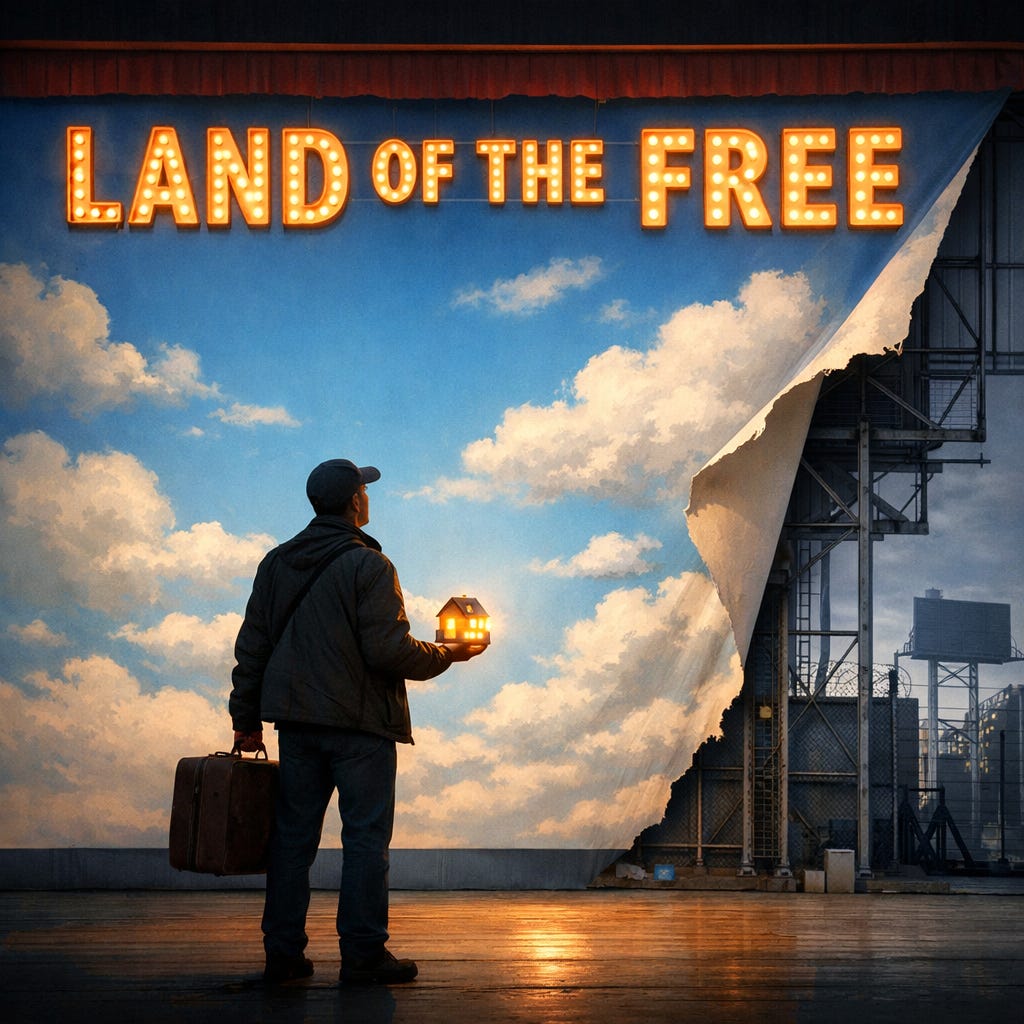
Dear Immigrant,
You didn’t come here to hate this place. You came because some mixture of story and necessity brought you: a job, a degree, a war, a passport, a parent, a dream you had no safe place to dream elsewhere. You came through airports and interviews and forms that asked whether you had ever committed genocide, espionage, prostitution, or any other morally dubious activity that wasn’t already in the job description of the United States government. And for a while, you tried to believe the story. You tried to believe that underneath the noise there was a decent country trying its best, that the slogans corresponded to something real: rule of law, equal dignity, a chance. Maybe you even felt it for a time—on a good sidewalk, in a good city, on a good day when the light hit the buildings and your coffee and your salary in the right way.
Now you feel sick. Not in the small way—this isn’t “the healthcare system is annoying” or “people work too much.” You feel something heavier, like you are standing inside a theater whose walls are painted to look like a sky, and everyone is loudly insisting this is the open air. You watch politicians scream about censorship, then write laws to ban books. You watch men howl about their own victimhood, then calmly dismantle the fragile protections that existed for people who were never allowed to be victims at all. You hear the word “freedom” stretched over everything from tax cuts for billionaires to deportation buses. You watch people insist, with a straight face, that the most powerful country in history is constantly on the brink of being destroyed by baristas, pronouns, and grant-funded diversity trainings. And your body—forget your politics for a moment, your body—says: this is wrong. This is not normal.
You feel like you live in a culture of lies. Not the ordinary lies of any country—the flattering myths, the omissions, the heroic statues that forget who paid for the pedestal in blood. You’ve seen those. You grew up in Iran, or France, or Canada, or somewhere else that also lied. You have lived under clerics and bureaucrats, under secular nationalism and petty nationalism, under polite hypocrisy and open coercion. You know what garden-variety state lying feels like. What you feel here is different. It is industrial. It is immersive. It feels as if the air itself has been branded, the weather focus-grouped, the language optimized for engagement. It feels as if most people are not just sometimes dishonest but permanently in costume—selling a product, pitching a self, rehearsing a script they know is false but no longer know how to stop performing. You find yourself thinking, if you are honest, that America lies most of the time.
And then, because you are not stupid, you doubt yourself. You wonder if you are becoming bitter, or paranoid, or ungrateful. You wonder if the problem is that you compare everything to an ideal that never existed. You wonder if you are the liar—if you lied to yourself about what this place would be, and now you are punishing the country for not being your fantasy. You second-guess your anger, because official America is very good at diagnosing noncompliance as pathology. Sad about your adopted homeland? Maybe you just need gratitude, perspective, therapy, a better morning routine. The implicit message is always the same: the system is fine; your feelings are the glitch.
So let me start very simply: you are not crazy. You are not uniquely fragile, or traumatized, or unable to “adjust.” You are walking around inside a civilization whose founding crimes were never metabolized, whose self-image is built on innocence, and whose primary export is not democracy or freedom but narrative. You feel wrong because your nervous system still responds to reality. America, as it presents itself to you, is a trick of mirrors: the “most moral nation in history” built on stolen land, racialized slavery, and empire; the champion of free speech currently discovering how many books you can ban while still calling yourself the First Amendment’s best friend; the land of equal opportunity where your visa can be revoked by a clerical error and your entire future reclassified as “discretion.” You, immigrant, are expected to stand in the middle of this and say: thank you, I am so blessed, what a miracle.
Of course you feel insane. So this is what I want to do in this essay that begins with you and your sadness. I want to speak to you as if you are sane. I want to take your perception seriously enough to build an argument around it, not therapize it away. I want to say: yes, this place is lying to you, and then explain how, and how long, and with what machinery. I want to show you that 2025 and everything that came with it—the pardons and the purges, the victim-theology of the powerful, the crusade against “woke” as the newest restoration project for white supremacy—are not aberrations but clarifications. The mask slipped; the face underneath is older than any of us.
To do that, we will have to walk through the architecture. How a republic founded on genocide, slavery, and expansion had to invent a religion of innocence or collapse under its own guilt. How the frontier taught people that optimism was not a mood but a survival strategy, and pessimism a kind of treason. How capitalism married advertising and produced a population that speaks like salespeople even at funerals. How racism became the master story that hides class, empire, and elite failure. How immigration policy decided that your labor could be essential while your belonging remained negotiable. How the media learned to anesthetize structural violence by calling it “policy differences” and “border crises.” And then we will have to zoom in on the current inversion machine: the people who chant that they are censored while they rewrite the rules of speech, who claim they are discriminated against while dismantling the few protections that existed for anyone else.
I want to name the move you have been watching: declare yourself the victim, claim moral immunity, use that immunity to dominate, erase or criminalize the real victims, and call it self-defense. Jim Crow did it. Nazis did it. Hutu Power did it. Now it has an American talk-radio accent and a podcast. You are not misreading it. But I do not want to stop at diagnosis. You did not uproot your life, cross borders, and fill out those humiliating little boxes on government forms just to receive a refined autopsy of why everything feels cursed. You still have to live here tomorrow, with a job, and a body, and a passport that may or may not protect you.
So after the history and the politics and the dark comedy, I want to bring in something else: not optimism, not coping strategies, but philosophy with teeth. I want to ask, with you: is it possible to be happy, or at least not destroyed, inside a culture of lies? Not by pretending it isn’t a culture of lies. Not by going numb. Not by assimilating into the national personality and calling it healing. But by finding a way to live truthfully inside a system that cannot stop falsifying itself. I am not the first to ask that question. People have lived in worse delusions than this and stayed human, sometimes even joyful: a slave named Epictetus in an empire of cruelty; dissidents like Václav Havel in a bureaucracy of lies; prisoners like Viktor Frankl in camps designed to erase personhood; exiles and poets like Czesław Miłosz watching their colleagues practice Ketman—outward conformity, inward refusal. They all, in very different ways, came to the same hard conclusion: the condition of the world is not under your control; the condition of your assent is.
You cannot make America honest. You cannot make the media brave. You cannot make your neighbors stop confusing their discomfort with persecution. You cannot guarantee that the country that took you in will not one day decide that you are an error to be corrected. But you can decide what you will believe, what you will say, what you will participate in, what you will build, and what you will worship. You can decide whether you will live “within the lie” or “within the truth,” even if only in very small territories: your writing, your friendships, your rituals, your work done cleanly even when the institution is dirty. You can decide whether you will be a supplicant in front of this empire, asking to be adopted, or an exile who knows that home is something you carry inside you and build around you, not something a state can ratify. You can decide whether your life here will be a prolonged audition, or a serious project.
This is not “find the silver lining.” There may be none. The lining may be made of the same material as the bomb. This is something sterner: a manual for inner non-contradiction. For refusing to hand your nervous system to a nation that cannot tell the truth about itself. For being grateful for the things that are genuinely good here—safety relative to what you fled, work, streets you can walk at night, a few astonishing human beings—without letting that gratitude curdle into loyalty to a myth that is killing people. You are allowed to say: I live in America, I work in America, I love some people and some places in America, and I do not belong to its story. If that sentence feels like treason, that is a sign of how deeply the story has colonized your sense of what you owe.
So this is the architecture of what follows. First, we will map the lie: historically, structurally, without flinching. Then we will walk through the inversion machine: how victimhood became a weapon and why your unease around “anti-woke” and “anti-DEI” is not overreaction but sanity. Then we will come back to you: the immigrant standing in the crossfire of narratives, wondering if you made a mistake. And finally, we will assemble, from dead philosophers and living dissidents, a way of being here that does not require you either to worship this place or to burn yourself alive in protest. You will not finish this with a better opinion of America. If anything, you may think worse of it. But you may, if I succeed, think better of your own perception. You may feel less solitary in your disgust. And you may see, with the cold relief of a diagnosis you did not want but needed, that the real question was never “Is this country worthy of me?” but “How do I remain worthy of myself, here?”
If America insists on being the land of lies, then you, immigrant, are not here to fix its soul. You are here to keep yours.
Chapter One – How to Recognize a Lie-Civilization
There is a special kind of loneliness that only appears after immigration, once the honeymoon has worn off and the paperwork dust has settled. It is not the loneliness of missing a language or a grandmother’s kitchen or the curve of a familiar street. It is the loneliness of looking around and realizing that almost everyone has agreed to pretend this is normal when every cell in your body insists it is not. You wake up, go to work, move through the day, and it feels less like living in a country and more like acting in an ad campaign that never ends. The slogans change—innovation, disruption, resilience, growth—but the basic instruction does not: smile, sell, believe. If you’ve lived in other places, the contrast is brutal. You have known lies before. But you have never known a lie this total, this cheerful, this professionally produced.
Start with the obvious thing that no one here finds obvious: this is an advertising planet disguised as a republic. From the moment you land, you are inside a machine that spends more per head on persuasion than most countries spend on healthcare. You are addressed, measured, segmented, targeted, optimized. At first it is external—billboards, pre-roll ads, sponsored content—but slowly it seeps into the voice of the people themselves. An American does not simply tell you what they do; they give you the pitch deck version: passions, “impact,” a tiny TED Talk about their role in the ecosystem. Grief turns into content, outrage into a thread, even sincerity into a brand. In other countries, people lie to avoid punishment. Here, people lie because they have been taught that to be taken seriously, you must sound like a campaign. You listen to colleagues talk about “excitement” and “opportunity” in meetings that feel like hostage situations, and your body keeps asking: who are you selling this to? Why are you selling it to me?
Then there is the trust problem, which no one admits is a trust problem. America is a low-trust, high-competition society that refuses to describe itself that way, so it invents a cover language: networking, professionalism, boundaries, positivity. In Canada you felt a kind of flat, mild decency; in France, an accepted register of cynicism; in Iran, a sharp distinction between outside performance and inside truth, where the kitchen and the car became sovereign territories for real speech. Here, it’s like everyone is stuck halfway: they don’t trust each other, but they also don’t quite know they don’t. So they compensate with permanent friendliness and a kind of manic professional courtesy. “So good to see you.” “Love what you said.” “Really appreciate you.” The words are correct. The tone is correct. The eyes are elsewhere. Trust doesn’t disappear; it just moves underground, into invisible networks of class and race and school and passport, while the surface hums with overclocked politeness. You feel the gap and call it what it is: falsification.
Underneath the sales voice and the politeness, you can still hear the older accent of this place: frontier optimism. On the frontier, pessimism was a risk factor. You cannot sell land, railroads, towns, or dreams by telling the truth about droughts and locusts and sudden death. You must oversell the future so hard that other people will follow you into what might be a desert. That economic necessity hardened into culture. The country trained itself to hate bad news, to treat realism as treason, to equate “negative” with “disloyal.” When your father tells you “people don’t like negativity,” he is not just being flippant; he is voicing frontier doctrine. In that doctrine, the truth is not what happened; the truth is whatever keeps people moving west. Today, the frontier is a start-up, a tech company, a city, a personal brand, but the rule is unchanged: you oversell or you disappear. The immigrant who says “this doesn’t work” or “this is built on sand” will be treated less as a witness and more as a saboteur.
Add to this the soft caste system that insists on calling itself meritocracy. America has brutal inequality, rigid class stratification, and deeply racialized distributions of wealth and power—but it also has a national religion that says anyone can make it if they try. Those two facts cannot coexist without generating a constant pressure to lie. If the system were honest, the winners would have to admit that history, luck, theft, and policy did most of the work; instead, they must perform desert. “I earned this.” “I’m not privileged.” “My success is proof the system works.” The losers, meanwhile, must internalize the inverse: “I failed.” “I didn’t hustle hard enough.” “It’s my fault.” In such a world, almost every biography becomes a sales brochure and almost every failure, a moral indictment. You, coming from countries where class and power were often more explicitly named—even in their ugliness—find yourself shocked by the way everyone here insists on innocence. No one is exploitative; they are “entrepreneurial.” No one is bought; they are “blessed.”
All of this would be irritating but survivable if it stayed at the level of manners and careers. What makes America feel like a lie-civilization to you is that the same performance logic governs the deepest moral questions. The country does not simply have advertising agencies; it has an advertised self. It is “the most moral nation in history,” “leader of the free world,” “a city on a hill.” The problem is not that these lines are untrue; the problem is that they are unfalsifiable. No amount of evidence—wars, coups, cages, pipelines, the slow suffocation of whole neighborhoods—seems able to puncture them. You came here, in part, because you half-believed them, or wanted to. Now you discover that for many of your neighbors, these are not aspirations but axioms. When reality contradicts them, it is reality that must be explained away. This is why criticism here feels like blasphemy: you are not just pointing out flaws; you are desecrating a sacred brand.
By the time you’ve been here a few years, you notice that conversations themselves have started to feel like a medium for narrative enforcement rather than discovery. Bring up racism and you are accused of being “divisive.” Bring up class and you are told it’s “not about politics.” Bring up foreign policy and you are gently advised to “be grateful” or “focus on the positives.” Entire topics are wrapped in bubble wrap and labeled “too negative,” as if reality were a fragile object that might break if handled without enough spin. Even people who privately agree with you will often take you aside afterward to say so, like smokers huddling in an alley. You begin to understand that you are not merely living among individuals with quirks; you are living inside an ecosystem whose survival depends on maintaining a certain saturation level of b******t. It is not that people cannot tell the truth; it is that they do not believe truth, on its own, is a viable way to live here.
And yet, if you peel back the varnish, there are still human beings underneath this, people who are as confused and afraid as you are, who lie mostly because they do not see an alternative that will let them keep their job, their mortgage, their friends, their illusions of goodness. That is important to see, because it keeps you from turning into a simple mirror image of the very contempt you’re reacting against. America is not one giant, conscious con. It is a set of habits, incentives, myths, and survival strategies that add up to a reality you experience as hostile to truth. You are right that this place lies more, louder, and with better production values than anywhere else you’ve lived. You are also right that most of the individuals inside it are not cartoon villains but exhausted actors reading from a script they inherited and rarely had the power to rewrite.
So when you say, “This feels like a culture of lies,” you are not being melodramatic. You are issuing a correct diagnosis of what happens when an advertising civilization built on founding crimes and frontier myths reaches the end of its story and tries to keep going by pure performance. The reason your sadness feels so deep is that you did not just move countries; you moved into a medium. You are not only negotiating laws and visas and job markets; you are negotiating a narrative that will never stop trying to recruit your mouth, your time, your hope. Recognizing that—naming this place as a lie-civilization—is the first act of sanity. The next question is what to do with that sanity, and whether it can coexist with any kind of happiness. That is where we go next.
Chapter Two – The Original Sin Factory
To understand why this place lies like it breathes, you have to go back to the moment before the first slogan, before the first flag, before the first fourth-grade textbook drawing of noble colonists with serious hats. Every country has crimes in its basement. What makes America different is that its crimes are not in the basement at all—they are the load-bearing walls—and instead of reinforcing them with remorse, it covered them in stained glass and called the whole structure a chapel. Three facts sit at the foundation like unburied corpses: the theft of a continent from Indigenous nations through war, disease, and forced removal; the construction of an economy on racialized slavery; and the conversion of a coastal republic into a land-hungry empire marching west, then outward, under the banner of destiny. These are not unfortunate side-quests in an otherwise noble campaign. They are the main storyline. You cannot build a self-image around “the most moral nation in history” and also look those three facts in the eye for very long. Something has to give. America chose the facts.
The first step in making permanent denial livable is theological. You cannot reconcile “we are good” with “we did that” unless you recruit God, or History, or Progress as a very forgiving co-author. The early colonists arrived with a ready-made script: chosen people, Promised Land, Old Testament energy with better muskets. The language of “city on a hill” and divine favor did not float in later as patriotic poetry; it was baked into the experiment from the start. The Puritan imagination cast this place as covenant, not accident. Over time, as the explicit religion thinned into civil religion, the structure remained. “God has blessed America” became “History has chosen us,” then “The free market proves our virtue.” Wealth was no longer just an outcome; it was a sign. Power was no longer just power; it was evidence of righteousness. If you are chosen, then whatever you have must somehow be deserved; if you are not, whatever happens to you must somehow be your fault. The theology survived its own God and went to work in boardrooms, speeches, and commencement addresses.
The frontier turned this moral narcissism into a physics law. On the map, the United States expanded like a stain: treaties broken, nations uprooted, bison annihilated to starve people into submission, borders redrawn with ink that might as well have been blood. But the story draped over this was not “We are devouring everything in our path.” It was “We are spreading freedom,” “We are taming wilderness,” “We are making the world safe for democracy,” depending on the century. The wandering line of conquest acquired a halo. The land did not belong to anyone in a way that counted; it was “open,” “empty,” “virgin”—words that also tell you how this culture learned to talk about women. Once you accept that your expansion is liberation, every act of aggression becomes a rescue mission, every invasion an intervention. The frontier required an optimism that bordered on psychosis: you could not admit how many people were dying or how fragile the project was, or no one would follow you. That optimism hardened into a cultural muscle memory. Pessimism—otherwise known as noticing reality—became suspect. If your empire is held together by faith in its own goodness, doubt is not a virtue; it is sabotage.
Then capitalism married this frontier religion and gave birth to something uniquely American: industrial-scale lying as an economic sector. Other empires had propaganda; this one built Madison Avenue. Advertising, public relations, corporate branding, and the entire machinery of “spin” arose in a country that needed not just to sell goods but to sell itself, constantly. You can see it in the way companies talk: they do not say “we are here to extract profit by any legal means available”; they say “we are on a mission to make the world better through beverages” or “our purpose is to connect people and empower communities by selling them surveillance devices with pretty icons.” Governments everywhere speak in euphemism, but here the private sector joined the chorus and out-sang the state. Wall Street and Hollywood and K Street and Silicon Valley all learned to harmonize on one refrain: whatever we are doing, it is innovation, disruption, opportunity, change. When you grow up in that soundscape, it becomes difficult to speak in declarative sentences about anything. You watch your own mouth reach for the language of “impact” and “solutions” against your will. The lie is no longer what you say to cover reality; it is the only vocabulary available.
Race enters this picture not as a glitch but as the operating system’s master plugin. From the moment Africans were turned into property on this soil, whiteness became both a material advantage and a moral alibi. You cannot hold people in chains while preaching liberty without inventing a story about their inherent inferiority. You cannot steal land from nations who already live on it without inventing a story about their savagery, their childishness, their need for “civilization.” Those stories do ideological work. They convert theft into stewardship, rape into uplift, terror into order. After slavery formally ends, the racial alibi does not retire; it changes costume. Under Jim Crow and beyond, Black poverty becomes evidence of laziness rather than the product of policy; Indigenous suffering becomes a tragic but necessary side effect of “progress”; immigrants become convenient culprits whenever wages stall or factories close. Every time the elite makes a disastrous decision, the racial machine spins up to blame “those people” instead of capital, law, and history. Racism here is not just contempt; it is the main narrative device for hiding class and empire. It tells a simple story so the complex, structural one can stay off-screen.
Now layer immigration onto this. The country prints its myth on a copper statue in a harbor: give me your tired, your poor, your huddled masses yearning to breathe free. That is the invitation. The contract you actually sign is different. It says: we need your skills, your labor, your tax payments, your demographic bump; in exchange we will offer you a rotating menu of conditional welcomes, arbitrary rules, and an ever-present threat of revocability. The external story is “nation of immigrants.” The internal logic is “We decide when you stop being foreign.” Even when you have the paperwork, your belonging is never fully your own; it is stamped, filed, and revisable. The brilliance of the immigration myth is that it allows a country to congratulate itself for generosity while maintaining a permanent class of people who are always a little bit temporary, a little bit suspect, a little bit grateful enough not to complain. If you, as an immigrant, feel like your life here is a probationary performance review with no end date, that is not you being dramatic. That is the system working as designed.
Finally, the media. In a healthy society, the information layer is supposed to check power, expose lies, and expand the range of sayable truths. In America, the information layer is welded onto the same myth-machine it’s supposed to monitor. The constraints are rarely written down, but you can hear them in what never gets said. You can question the execution of wars, not the assumption that your country has a natural right to project force everywhere. You can debate tax rates, not the legitimacy of an economic system that treats human beings as expendable inputs. You can argue about “border security,” not about the fact that the border itself is a scar of older violence. The language is carefully anesthetized: torture becomes “enhanced interrogation,” slashing social support becomes “entitlement reform,” bombing campaigns become “humanitarian interventions.” Cable news monetizes outrage, but it rarely points the camera at the engine room; it prefers the shouting passengers. Social media promised to democratize truth and instead turned into a weaponized attention lottery where the most inflammatory lie often travels fastest. You, trying to get your bearings in all this, watch as reality becomes one “take” among many.
When you step back and look at this as a whole, you see why 2025 did not arrive out of nowhere. The Trump years, especially the second act, are often described by liberal historians and commentators as a deviation from “American norms,” a betrayal of the republic, an almost unthinkable break with tradition. There is some truth in that: the brazenness, the speed, the contempt for procedure had a new intensity. But if you zoom out beyond one electoral cycle, the continuity is clearer than the rupture. A country that has always needed to see itself as innocent will eventually produce a movement that simply discards even the pretense of self-critique, that turns victimhood into a governing ideology for the already powerful, that calls any effort at redress “tyranny” and any check on dominance “persecution.” A media ecosystem that has trained people to consume politics as tribal entertainment will inevitably elevate figures who treat reality as improv. An immigration regime built on conditional belonging will eventually be tempted to test how explicitly it can revoke that belonging. What you witnessed in 2025 was not America going off-script; it was America reading its script out loud, without the usual makeup and lighting.
This is the original sin factory: founding crimes wrapped in divine self-regard, frontier violence baptized as freedom, capitalism refined into salesmanship, racism repurposed as an alibi for every downturn, immigration used as both moral theater and economic tool, media enlisted to deliver all of it in digestible segments. The result is a civilization that must lie in order to experience itself as good. When you feel overwhelmed by the falseness here, you are not reacting to a few bad leaders or a rough patch in the news cycle; you are feeling the pressure of centuries of unresolved guilt pressing down through institutions and language onto your individual nervous system. You did not cause that. You cannot cure it. But you are allowed to name it. Before we can talk about how to live here without being deformed by it, you need to see clearly that your sadness is not an overreaction to a minor hypocrisy. It is a sane response to a country that would rather hallucinate its own virtue than remember what it has done.
Chapter Three – The Inversion Machine
If the first lie of this country is “we are innocent,” the second is “we are under attack.” Put them together and you get the mechanism you’ve been staring at every day: the people with the most power and historical advantage announcing, with a trembling lip, that they are the real victims now, and that any attempt to limit their dominance is violence. The details change—today it’s “woke,” “DEI,” “illegal immigrants,” “the deep state,” yesterday it was “Reconstruction,” “carpetbaggers,” “Jewish conspiracies”—but the pattern holds. You are not imagining that everything feels upside down. It is upside down by design. The name of the machine is inversion: declare yourself the victim, seize moral immunity, use that immunity to dominate, and erase or punish the people who were actually being harmed in the first place.
You saw it most clearly with the rhetoric around “censorship” and “free speech.” A political movement shrieked for years that universities, tech companies, and liberal elites were silencing them. They built talk shows and entire media networks on the premise that they were being shut up, that their dangerous truths were too hot for the establishment to handle. In reality, they had the most watched cable news channel, the loudest radio hosts, the highest-profile pundits. The problem was not that they were not heard; the problem was that they were not obeyed. “Censorship” in this script meant “any consequence, criticism, or loss of monopoly.” So when they finally seized more levers of state power, what did they do? They went after teachers, librarians, journalists, and critics in the name of protecting free speech. They banned books and courses while insisting they were rescuing the First Amendment. They passed laws telling corporations and schools what words they could use around race and gender, and called it “protecting open debate.” The trick was simple: accuse your enemies in advance of what you plan to do, and you get to perform your repression as self-defense.
The anti-woke, anti-DEI crusade is the same logic with whiter teeth. For a brief historical moment, corporations and institutions adopted mild diversity and inclusion language, created some trainings, opened a few leadership pipelines, and tried, in a cautious, half-hearted way, to admit that being white and male in America came with structural advantages. The reforms were far from revolutionary, often cosmetic and contradictory, but they did one unforgivable thing: they named the hierarchy. That was intolerable. A system that demands innocence cannot survive the admission that it has been systematically tilted in one group’s favor for centuries. So a whole genre of grievance bloomed: “I’m being discriminated against for being white.” “They care more about diversity than merit.” “I have to apologize for who I am.” You recognized it instantly as theatrical fragility. Men who had never spent one second wondering whether their race would block them from a job suddenly rediscovered “colorblindness” the moment the topic of race ceased to be exclusively flattering.
Underneath the whining about “reverse racism” is a clean structure: a dominant group experiencing the loss of unquestioned dominance as persecution. That is the psychological core of what some sociologists call “aggrieved entitlement.” If your baseline expectation is that you and people like you should set the terms of reality, then any move toward equality feels like dispossession. Equality looks like a mugging. Representation looks like invasion. Hearing someone else’s story at the center feels like erasure. The body of the formerly unchallenged majority registers pluralism as attack. And because America’s chosen-people story has already told them they are the good ones, that feeling of attack can never be interpreted as what it often is—historical correction; it must be recoded as moral outrage. They are not simply uncomfortable. They are being wronged. Once you have framed their discomfort as a civilizational wound, you have all the justification you need to roll everything back.
This is where the inversion machine does its nastiest work: it takes the language of justice and uses it to punish anyone who ever tried to use that language sincerely. Racism? Now the word refers to calling out racism. You point to a pattern of discrimination and are accused of “bringing race into everything.” You name white supremacy and are labeled the true bigot for making people “feel guilty.” Identity politics? That’s what people of color, women, queer people are doing whenever they organize for survival; the fact that white, straight, Christian identity has been the default setting for centuries does not count as identity politics, it counts as “normal.” Free speech? That’s the right of powerful men to experience no consequences for what they say; if you respond with your own speech—boycott, critique, refusal—you’re violating their sacred freedom. Merit? That’s whatever outcome keeps the previous winners in place. If a Black or Brown person advances, there must have been a quota; if a white man does, it is proof the system works.
The mechanics are so consistent you could almost mistake them for a law of nature, but they have a history. After Reconstruction in the United States, when formerly enslaved people briefly gained political power and civil rights, white Southern elites did not say, “We want our racial domination back.” They said, “We are being oppressed by Northern tyrants and Black misrule.” They framed Black suffrage, basic safety, and modest office-holding as existential threats to “civilization,” to white womanhood, to order. They presented themselves as victims of chaos and corruption, then used that victim narrative to justify lynching, voter suppression, and the invention of Jim Crow. They were not restoring domination, they insisted; they were defending themselves. If you listen closely to contemporary anti-woke rhetoric, you can hear the same chords: everything is phrased as rescue—of children, of standards, of the West, of “ordinary people”—from an overreaching, decadent, minority-obsessed elite.
The Nazis did it with more explicit fury. A nation that had started a catastrophic war and imposed brutal terms on others recast itself, in the interwar years, as a martyr to international conspiracies and humiliation. Jews, communists, cosmopolitans, Weimar decadents—everyone became part of a vast plot to emasculate and dissolve the true Germany. Germans were not aggressors; they were victims of Versailles, victims of modernity, victims of parasites. The more they embraced their imagined injury, the less moral constraint they felt. Genocide became self-defense. Occupation became restoration. You see the same inversion in Rwanda’s Hutu Power propaganda in the 1990s: endless insistence that Hutu were threatened with extermination by a Tutsi minority, that every act of violence was a preemptive strike. In Yugoslavia, historical grievances were replayed on television until neighbors became mortal enemies. The story is always: we are under attack, therefore whatever we do next will be justified, even holy.
None of this is subtle. What is uniquely exhausting in the American flavor is how banal and branded it feels. Grand narratives of victimhood are laundered through talk radio segments, cable hits, social media memes, school-board rants. The man announcing that he has been silenced is doing it into a microphone with a million listeners. The influencer complaining that “you can’t say anything anymore” is doing so on platforms that algorithmically amplify his every provocation. Anti-DEI crusaders publish books and op-eds and testify before Congress, describing themselves as marginalized truth-tellers while sitting on tenured chairs or think tank salaries. It’s DARVO as national sport: Deny the harm, Attack the people naming it, Reverse Victim and Offender so completely that up feels like down. If you grew up in systems where power at least had the dignity to speak plainly about its prejudices, watching this level of theatrical self-pity is almost worse than watching open cruelty.
Here is the part that matters for your sanity: this inversion isn’t just hypocrisy or stupidity. It’s a technology. It does something. By occupying the victim position, the dominant group steals the most potent moral resource in modern politics. In a world that finally, after centuries, began to treat “the victim” as someone whose suffering commands attention and redress, it was only a matter of time before those who previously claimed the role of hero or patriarch tried on the victim costume. Once they have it, they can wield it against anyone who actually needed protection. If white Christians are the oppressed minority, then any policy that acknowledges the existence of non-white, non-Christian people becomes anti-white persecution. If men are the victims of feminism, then any attempt to enforce basic standards of non-abuse becomes a witch hunt. If the majority is under siege, then democracy itself—one person, one vote—becomes a weapon in the hands of “them.”
You asked whether any philosopher really treated this specific inversion: the self-victimization that exists not as a cry for help but as a strategy for dominance. The psychologists got there first. In the study of abuse, the pattern has a name: DARVO. The abuser denies the harm, attacks the accuser, and reverses victim and offender so the person who was hurt now feels guilty, ashamed, even accused. Scale that pattern up and you get entire movements built on DARVO: the patriarchy as the real victim of #MeToo, white people as the real victims of efforts to talk honestly about race, the religious majority as the real victims of secular policies that simply do not enforce their theology. It’s not that they read the theory; it’s that they discovered, instinctively, that if you control who counts as “the one being hurt,” you control the moral battlefield. Law and policy then follow like loyal dogs.
When you live inside a culture that rewards this behavior, the temptation is to treat everyone participating in it as either idiot or monster. That’s too simple, and it will corrode you. Some are opportunists who know exactly what they are doing. Many, though, are simply people whose sense of self is so entangled with the national myth that any challenge to structural privilege feels like an attack on their very being. They are not faking the feeling of injury; they are misreading reality through a story that was given to them before they were old enough to choose. Their pain is real. Their conclusions are lethal. You need to hold both truths at once if you are going to navigate this without collapsing into either naive empathy or blind hatred.
For you, the immigrant, the inversion machine is particularly disorienting because it keeps turning you into the ghost in someone else’s grievance. You are simultaneously told that this is a land of immigrants and that you are part of an invasion; that the country is colorblind and that your presence is evidence of unfair “preferences;” that you must be grateful and that your gratitude will be interpreted as consent to whatever happens next. You watch a movement of mostly white, mostly native-born citizens declare themselves the oppressed and then push for policies that make your already precarious status more fragile. You listen as they accuse you, in advance, of the things they intend to do: lawlessness, cheating, tearing the country apart. If you internalize their script, you will end up apologizing for seeking a life while they congratulate themselves for defending a border drawn in someone else’s blood.
So let us be very clear about what you are seeing. You are watching a civilization whose story about itself is no longer compatible with its reality. To preserve the story, it cannot simply suppress dissent; it must claim that dissent is oppression. It cannot simply ignore victims; it must insist that any attempt to recognize them is an attack on the “real” people. The inversion machine is the final defense system of a myth that refuses to die. It is ruthless, flexible, and often ridiculous. The comedy is real: grown men with national platforms declaring themselves “canceled,” billionaires complaining they are being silenced on the front page of major newspapers, legislators whose every word is recorded in the Congressional Record sobbing about how “no one will listen.” You are allowed to laugh. But you are not allowed to forget the stakes. Behind the farce is a very old tragedy: a majority rearming itself morally by pretending to be a minority.
Recognizing this will not make the news less ugly, or the policies less harmful. It will not stop the next inversion from being invented the moment the current one loses its novelty. But it might give you one crucial form of power: you will no longer be bewildered. You will know that when someone with every advantage begins a sentence with “As a victim…,” what is probably coming next is a demand for impunity. You will hear the word “fairness” and automatically ask “for whom, and compared to what?” You will watch new laws wrapped in the language of protection and immediately look for the people they are designed to expose. In a land of lies, clarity is not everything. But it is the beginning of not being eaten alive.
Chapter Four – Exile in the Theater
There is a particular humiliation reserved for immigrants: the moment you realize you are expected not only to survive inside a structure, but to be grateful for it while it quietly treats you as disposable. It is one thing to live under a dictatorship that calls itself a dictatorship; you at least know what contract you’ve signed. It is another thing to move to a country that brands itself as refuge and fairness, to endure the x-rays and interviews and interrogatory forms, to rearrange your life around its paperwork, and then discover that the actual arrangement is closer to “we will use you while keeping you permanently auditioning.” That is the seed of the sadness you keep trying to rationalize away. You are not just tired of American politics. You are tired of living inside someone else’s costume drama, pressed into the role of the lucky extra.
The disorientation hits harder because you have lived other places and can feel the differences in your bones. In Iran, the lie was suffocating in its own way, but there were clear boundaries between inside and outside, between what you said in the street and what you said in the kitchen. Theocratic power did not pretend to be anything else. You could despise it, you could fear it, you could cooperate or resist, but you did not have to watch it smile and call itself the most tolerant regime on earth. In France, hypocrisy wore a more philosophical mask; the Republic spoke of universalism while practicing its own forms of exclusion, but there was a recognized register for critique. You could call the state racist or colonial in a café and someone might argue with you, but no one would look at you as if you had belched during the national anthem. Canada, for all its anesthetizing politeness, did not require quite this level of permanent self-marketing; the falseness there felt like soft padding, not a stage set. America combines the worst of all three: the moral certainty of the cleric, the universalist rhetoric of the republican, and the relentless promotional energy of the startup. It lies with the intensity of someone who has bet their entire identity on being good.
You keep trying to explain this to people and you hear yourself sounding unhinged: “It’s not that it’s worse, it’s that it’s faker. No, not just fake, more like—immersive fake. Like if advertising and frontier mythology and racial panic had a baby.” Their eyes glaze over. Some nod politely. Some remind you of opportunities and freedoms, as if you have forgotten how your passport works. Some accuse you of ingratitude. A few understand and go quiet in the way of people who have also seen the wires behind the scenery. The rest do what human beings always do when faced with a criticism that threatens their core story: they shrink the scope. They want this to be about a particular politician, a news channel, a party, a policy cycle. You are not talking about a cycle. You are talking about oxygen. You are trying to describe what it feels like to breathe in a place where the air has been scented with self-congratulation and denial for centuries.
It helps, for your own sanity, to split this place into layers instead of treating “America” as a single entity. The first layer is the Myth: the story the country tells about itself, the one printed on monuments and recited at graduations and baked into every movie that ends with a swelling orchestral track. This layer is almost entirely fiction, and that is its job. It is not designed to be true; it is designed to be adhesive. The second layer is the Regime: the actual machinery of power that governs your life—immigration offices, courts, police, agencies, corporations, HR departments, lenders, landlords. This layer has very little interest in your feelings and a great deal of interest in your compliance. The third layer is the People: the individuals who live here, with their ordinary kindnesses and cruelties, their fears, their decency, their ignorance. Your mistake, and the one the country encourages, is to conflate the Myth with the People and then judge both together. When you say “America is lying,” you are indicting the Myth and the Regime. When your neighbor hears you, they think you are saying “you are a bad person” and reach for the nearest moral shield.
Once you see these layers, you can begin to renegotiate your contract. You owe the Myth nothing. It did not bring you here; it merely decorated the brochure. You owe the Regime only what survival requires: taxes, signatures, a minimum level of performance so you are not deported or fired or bankrupted for the sake of someone else’s principle. You owe the People what you would owe people anywhere: honesty where possible, boundaries where necessary, solidarity when you can afford it, basic non-cruelty even when they are drunk on their own narrative. This is what I mean by shifting from belonging to residence. Belonging, the way the myth defines it, is spiritual: to belong is to fuse your sense of self with the national story, to take its victories and crimes personally, to feel destabilized when its holiness is questioned. Residence is practical: you live here. You use the infrastructure. You are subject to the laws. You adapt your behavior within reason. You do not mistake any of that for adoption.
Immigrants are conditioned to pursue belonging as if it were a visa category. You work harder. You speak softer. You shave off the edges of your accent. You laugh at jokes that wound you. You nod through opinions you know are delusional. You translate your pain into something digestible. You try, in other words, to become lovable to a story that has already decided what loveable looks like. When that fails—and it will, because the story was never written with you in mind—you blame yourself: not charismatic enough, not productive enough, not adaptable enough. The harder and more honestly you look at the country, the less it loves you; the less it loves you, the more tempted you are to conclude that the seeing is the problem. This is how you end up at the edge of madness in a place that keeps telling you how lucky you are. The way out is obscene in its simplicity: stop asking to be loved by the story. You are not a character in America’s redemptive arc. You are a person who lives under its jurisdiction.
Think of yourself not as an applicant to a family but as an exile with a portable civilization. Your “inner nation” is made of the things that existed before and outside this country’s imagination: your language, your childhood streets, your griefs, your jokes, your dead, your sense of right and wrong, the music you heard through a wall once and never forgot, the rituals that anchor you even if you no longer believe in their literal metaphysics. Some of that you inherited. Some of it you built yourself in the ruins of other loyalties. That is home. It cannot be issued by USCIS and it cannot be revoked at a port of entry. Around that inner nation you can build a small outer one: a few friendships where the lie is turned off, a room or a call or a thread where the speech is real, a practice—writing, prayer, art, lifting heavy things, walking a familiar route—where you are not auditioning for anyone. America becomes, in this framing, a host environment: sometimes generous, sometimes toxic, always noisy. You do not merge with it. You occupy it.
None of this means turning into a bitter, floating ghost. You are allowed to love things here. In fact, you must, or you will shrivel. But the love must be bounded. You can love the particular—a street at dusk, the way strangers sometimes talk to you in line, the clarity of certain laws compared to the chaos you left, a local diner where the staff knows your name, the absurd abundance of libraries, the one co-worker who quietly tells the truth—without loving the abstraction of “America” as if it were a person whose feelings you must protect. You can be grateful for the relative safety you enjoy without converting that gratitude into silence about the harm this country does to others, including people who share your passport. You can decide that you will never say “we” when the state bombs someone, never say “we” when a politician claims to speak for “real Americans,” never say “we” when a policy cages children. Your “we” is reserved for smaller, truer circles.
If you need a slightly cruel metaphor to make this easier, think of your relationship with the American state as a dysfunctional romance you are no longer romantically invested in. At first, there was love-bombing: “You’re exactly the kind of person we want.” “We’re a nation of immigrants.” “Follow your dreams.” Then came the controlling behavior: surveillance, endless questions, background checks, the threat of deportation as a form of emotional blackmail. Now you are in the long, grinding middle phase where the partner insists you should be grateful for the roof over your head while reminding you that they can throw you out at any time. You can stay in the house. You can use the electricity. You can sleep in the bed. But you do not have to keep composing poems to their kindness. You can be polite, careful, even affectionate at times, while quietly saving money and strengthening friendships and building an exit plan in case the day comes when they change the locks.
The point of all this is not to turn you into some stoic, untouchable creature who floats above experience. You are going to get hurt here. You are going to be surprised by cruelty and, just as dangerously, flattered by acceptance. You are going to want to scream at the television and at the sky. But if you take the exile stance seriously—if you stop trying to fuse your worth with this country’s self-image—you at least protect yourself from one form of devastation: the feeling that America’s failures are your failures, that its madness means you were stupid to come, that its refusal to see you clearly means you are invisible. You are not invisible. You are simply standing in front of a very large, very loud mirror in which this country keeps trying to admire itself. It will always be more interested in its reflection than in your face. That is not a reason to disappear. It is a reason to stop waving.
Chapter Five – How to Stay Human in a Lie-Civilization
At some point, if you’re not going to deaden yourself with substances or slogans, you have to answer a very simple question: how do I live here without becoming like this? Not “how do I fix the country,” not “how do I win the argument,” not “how do I optimize my LinkedIn presence while maintaining my brand values.” How do I wake up, walk through this theater, listen to all these trained mouths producing noise, know exactly how rigged and inverted it all is, and still end the day with something like self-respect and, when possible, joy.
The first mistake is to treat happiness as a referendum on the system. That’s how children think: if the world is good, I’m allowed to be happy; if the world is bad, I must be sad until it apologizes. You are not a child and this world is not going to apologize. The people who survived worse systems than this all converged, in different languages, on the same brutal clarity: the condition of your soul cannot be outsourced to the condition of your regime. The regime will always be late, stupid, cowardly, violent. If you tether your inner life to its fluctuations, you are volunteering to be collateral damage. So the first act of philosophical disobedience is to revoke that tether. This is not escapism. It is refusing to let a hallucinating empire be the regulator of your nervous system.
Epictetus, born a slave in a real empire that did not pretend to be benevolent, starts from a distinction that is boring until you actually live it: what is in your power and what is not. You do not control the behavior of the state, the honesty of your neighbors, the next election, or the committee that will decide whether you get to stay in this country. You do not control the fact that you live in a civilization that turned marketing into a second weather system. You do control your assent—what you agree to think, say, and worship. The modern world has cleverly disguised this by inventing a thousand external levers you can pull (and click, and post, and share) to feel as if you are controlling things. Epictetus is not impressed. He tells you, in effect: you will never be free until you stop staking your peace on results you do not command. Freedom begins when you stop treating the headlines as your vital signs. That doesn’t mean withdrawing from action; it means acting from principle, not from the demand that the world validate you.
Havel, living in a soft dictatorship of slogans and committees, picks up the thread from there. His question is not “how do we win elections?” It is “what happens to a human being who lives inside a lie for too long?” Under late totalitarianism, he noticed, the main enforcement mechanism isn’t the police, it’s participation. The grocer puts the Party sign in his window not because he loves the regime, but because not putting it there would make life dangerous. But every time he does, he becomes a tiny transmission belt of the lie. Havel’s answer is scandalously simple: stop cooperating interiorly. Live in truth where you actually can. It may look small—a refusal to repeat a phrase, an insistence on calling things by their names in your home, an essay, a joke, a friendship where no one pretends—but it is the only way to preserve a non-fake self in a fake system. For you in America, “living in truth” does not necessarily mean public heroics or career suicide. It means deciding that there are some things you will not lie about, even if the entire culture is gently nudging you to talk like a press release. It means not gaslighting yourself about what you see, even when everyone else is smiling.
Frankl, stripped of everything in a camp designed as a factory of meaninglessness, pushes the knife in one degree further. If Epictetus says “you control your assent,” Frankl says “you are responsible for what you do with it.” The last freedom, for him, is the freedom to choose your stance toward what happens. That sounds like slogan until you remember the context: he watched men who had lost families, careers, health, status, even names, find ways to orient themselves toward something beyond the barbed wire—love, God, a future reader, the simple decision not to become cruel. He also watched people disintegrate when there was nothing left they considered worth suffering for. The camps were not an exam of character; they were an amplifier of whatever was already there. His point, transplanted into your life, is this: your future here is uncertain and may, at times, be unjust. You do not get to choose the full menu of external events. But you still have to decide what you are for. Not what you are against—that is cheap. What project, what work, what fidelity will make your time here non-trivial even if the country never becomes what it says it is? If you cannot answer that, you will drift from outrage to despair and back until something breaks.
Camus, who had the good manners not to lie about the universe, gives you a different kind of permission. He refuses the comforting story that the world is secretly just, or that history bends toward anything in particular, or that suffering is redeemed by some cosmic balance sheet. For him, the world is absurd: conscious minds hurled into a mute universe, demanding meaning from a reality that does not owe them any. Most people, confronted with that, reach for a sedative: religion, ideology, self-help, revolution as a new god. Camus calls that “philosophical suicide.” His alternative is revolt: not in the sense of permanent protest, but in the sense of a stubborn, lucid refusal to either lie or give up. “There is no fate that cannot be surmounted by scorn,” he writes about Sisyphus, and then tells you to imagine the condemned man happy, pushing his rock in full awareness of the joke. In your life, that looks like this: you see the American spectacle clearly; you see that it might very well get worse; you refuse to sugarcoat it. And then you still notice the light on the buildings, still cook dinner, still fall in love, still do work that is not garbage, still make art or prayer or laughter. Not because you’ve made peace with the lie, but because you refuse to let it have the final word on what counts as a life.
Miłosz, watching his fellow Polish intellectuals make peace with communism, adds a specifically modern warning: you can be brilliant and still sell out. Intelligence does not immunize anyone against the desire for safety, flattery, and relevance. Under his version of the lie-regime, people practiced Ketman: outward conformity, inward opposition. They praised the Party in print and mocked it at home. They wrote essays that passed censors but laced them with private ironies. Some used the breathing room gained by compromise to do good work. Others slowly became the mask they wore. Miłosz’s cruelty is his refusal to romanticize either choice. He understands that total non-cooperation may mean exile or death; he also understands that endless small compromises corrode the person making them. For you, Ketman is not an exotic Eastern survival trick; it is your weekday. You soften your language in meetings. You pretend to be more impressed than you are. You sit through “all-hands” calls that sound like briefings from a parallel universe. The question isn’t whether you’ll wear a mask. You will. The question is whether you still know, clearly, when it is on, and whether you have somewhere to take it off. The danger is not the code-switching; it is forgetting which voice is real.
And then there is Spinoza, perhaps the least sentimental of them all, who quietly dismantles the idea that feelings are sacred just because you feel them. For him, joy is not a mood. It is an increase in your capacity to act, to do, to be effective in the world. Sadness is the opposite: a decrease in your power, a slackening, a paralysis. The emotions you experience are not metaphysical verdicts; they are signals about how connected or disconnected you are from what gives you strength. Anger at America, in this framework, is not “good” or “bad.” It is useful or useless depending on whether it leads to clearer understanding and more precise action, or whether it collapses into scrolling and doom and the exhaustion that leaves you unable to do anything but complain. Spinoza’s other gift is his insistence on understanding causes. When you grasp the reasons why people behave as they do—the incentives, fears, stories, histories—you loosen the grip of indignation. You don’t excuse; you just stop being surprised. That reduction in surprise is a form of freedom. You are no longer the stunned animal in the headlights every time this country does what, in retrospect, it was always going to do.
Take these threads together and you start to see what a sane life in a lie-civilization might look like. You stop expecting public reality to be sane as a precondition for your own sanity. You refuse to collaborate with the lie in the places you actually control—your art, your friendships, your rituals—even if you must read certain lines in public to keep your visa or your job. You treat your anger as a resource to be spent carefully, not as a permanent residence. You cultivate meaning that does not depend on the approval or even the survival of this particular empire. You allow yourself the small, ordinary joys that are always treasonous to systems built on fear. You learn to wear the necessary masks without letting them fuse to your skin. You train yourself to understand more and be shocked less.
None of this will feel as immediately satisfying as fantasizing about escape or collapse. Rage is easier than craft. Despair is easier than discipline. Assimilation is easier than exile. But you have already tried the easy paths. You know where they lead in your body. They lead to the edge of the bed at strange hours, staring at nothing, wondering if you made a mistake by coming here, wondering if you are weak for needing the world to make sense. You don’t need the world to make sense. You need your life to be internally non-absurd. That is a lower, harder bar, and it is within reach.
There is a quiet kind of happiness available to you that has nothing to do with liking this country. It has to do with the feeling, at the end of a day, that you did not betray yourself. That in the meetings and the lines and the noise you did not completely forget what you know. That you did some work that was not a lie. That you told the truth at least once where it mattered. That you did not worship what everyone else was worshiping just because they were louder. That you experienced some beauty and did not immediately convert it into content. That you laughed in a way that was not for anyone’s brand. That you treated the people in front of you as actual people, not as representatives of a side. That you took, from all the borrowed philosophies and hard-won insights, not a set of quotes to post, but a posture.
You are, whether you like it or not, one of the few people in this country who can see it from the outside while standing inside. That is not a comfortable position. But it is a powerful one if you refuse to let it curdle. The point is not to be the most disillusioned person in the room, or the one with the sharpest take. The point is to be among the few who are not entirely captured—by myth, by fear, by grievance, by the compulsion to sell. The lie-civilization will, in all likelihood, keep lying until it breaks on some external reef: climate, economics, geopolitics, demographics, something. You cannot time that. You cannot prevent it. You cannot hasten it without probably destroying yourself in the process. You can decide, every day, whether you will let it hollow you out.
If there is a final discipline here, it is this: do not give the empire your assent, your imagination, or your nervous system. It already has your taxes and your biometrics and your browsing history. It does not also get your worship. You came here, for reasons that were not entirely rational, to build a life. You have seen clearly that the stage is warped and the script dishonest. Good. Clarity hurts. Keep it. And then, under and around and sometimes in defiance of all that, build anyway—something small, human, and unbranded that will outlast, in significance if not in size, this country’s fever dream of itself.
Epilogue – A Small Prayer for the Unbought
If you’ve made it this far, you have done something that most institutions in this country are structurally designed to prevent: you have stayed with your own perception. You have walked, in your mind, back through the founding crimes, the prosperity gospel, the frontier optimism, the advertising fog, the racial alibis, the immigration theater, the inversion machine that turns victimhood into a weapon, the soft audition of exile. You have listened to a small council of dead people who lived through worse and refused to give their assent away for a ration card or a nicer uniform. You have let yourself name this place as it is: a land of lies with real people in it, some of whom you love. That does not solve anything. But it does something more important than solving: it keeps you awake.
Nothing in these pages will prevent America from being America tomorrow. The country will continue to perform innocence at industrial scale. The powerful will continue to declare themselves the injured party. Institutions will continue to wrap old hierarchies in new language. Commentators will insist that this latest disaster is an aberration, that the “real America” is better, as if the real America had ever existed anywhere but in brochures, textbooks, and a handful of exceptional moments. The machine will go on doing what it was built to do until it can’t—extract, distract, deny. You will live, as you already do, under its weather. The question, from now on, is not “will it change?” The question is “what will it fail to change in you?”
If there is a thread running through Epictetus and Havel and Frankl and Camus and Miłosz and Spinoza, it is not optimism. None of them promise that the world will come around. They promise precisely the opposite: that the world is going to keep being the world, and that your basic dignity depends on no longer being surprised. They offer you a different kind of hope, less sentimental and more frightening: the hope that you can become the sort of person who does not require your surroundings to be sane in order to stay human. A person who can see the lie and refuse to be entirely written by it. A person whose “yes” and “no” still mean something in a century that treats language as camouflage.
You are not responsible for saving this country’s soul. That is not false modesty; it is arithmetic. You did not design this mythology, you did not authorize these wars, you did not draft these laws, you did not choose the shape of this economy. You arrived in the middle of a long-running performance and were handed a mop, a script, and a small role labeled “grateful immigrant.” You are allowed to put the script down. You are allowed to decline the part. Your real responsibility is both smaller and larger: to keep one human life—your own—from being completely colonized by the story of a nation that has never learned to tell the truth about itself. That’s it. One nervous system not entirely captured. One mouth that does not, in the end, only repeat what it was fed. One circle of people around you who, when the topic comes up, know that at least in this room, in this car, on this call, the b******t will be temporarily suspended.
There will be days when even that feels like too much. Days when the news cycle and the office and the paperwork and the casual cruelty add up to a simple, exhausted question: why am I here. On those days, do not reach for grand answers. Reach for the smallest ones. Because this friend is here. Because my work, even compromised, feeds something that is not a lie. Because there is someone back home who needs the remittances. Because I can walk down this street without being shot or arrested. Because there is a library, a park, a cheap diner where I can sit and be nobody. Because I am building something—an essay, a prayer, a body, a love—that would not exist if I left. Because I am, whether I like it or not, a witness. That is not a destiny. It is enough.
If America insists on calling itself the land of the free while running on denial, then real freedom here will not look like a flag or a speech. It will look like a quiet refusal: to lie when you don’t have to, to perform when you’re not being paid, to worship whatever the algorithm says is important this week. It will look like laughter that is not for show, like friendship that does not require you to flatter the empire, like work that does not insult your own intelligence. It will look, sometimes, like leaving the room instead of arguing. It will look, other times, like saying the unsayable very calmly and accepting the consequences. It will almost never look heroic. That is why it might outlast the heroics.
So here is the only blessing I can offer you without lying. May you live long enough in this country to see its myths clearly and not be fully broken by them. May you find, or build, a few small places where truth is the default, not the exception. May your anger stay sharp enough to cut through b******t but not so hot it burns you hollow. May your gratitude remain specific and undeserved, never coerced. May you remember, on the days you are tempted to apologize for your sadness, that grief is not ingratitude; it is what happens when a clear eye meets a dishonest world. And when this country finally does what all empires do—rewrite its own failures, forget its own victims, insist that it was always trying its best—may there be, somewhere in its archives or in the memories of a few stubborn people, a record that says: we were here, we saw, we did not entirely bend.
America will go on pretending to be something it has never been. Your task is simpler and harder: stay real.
—Elias WinterAuthor of Language Matters, a space for reflection on language, power, and decline.