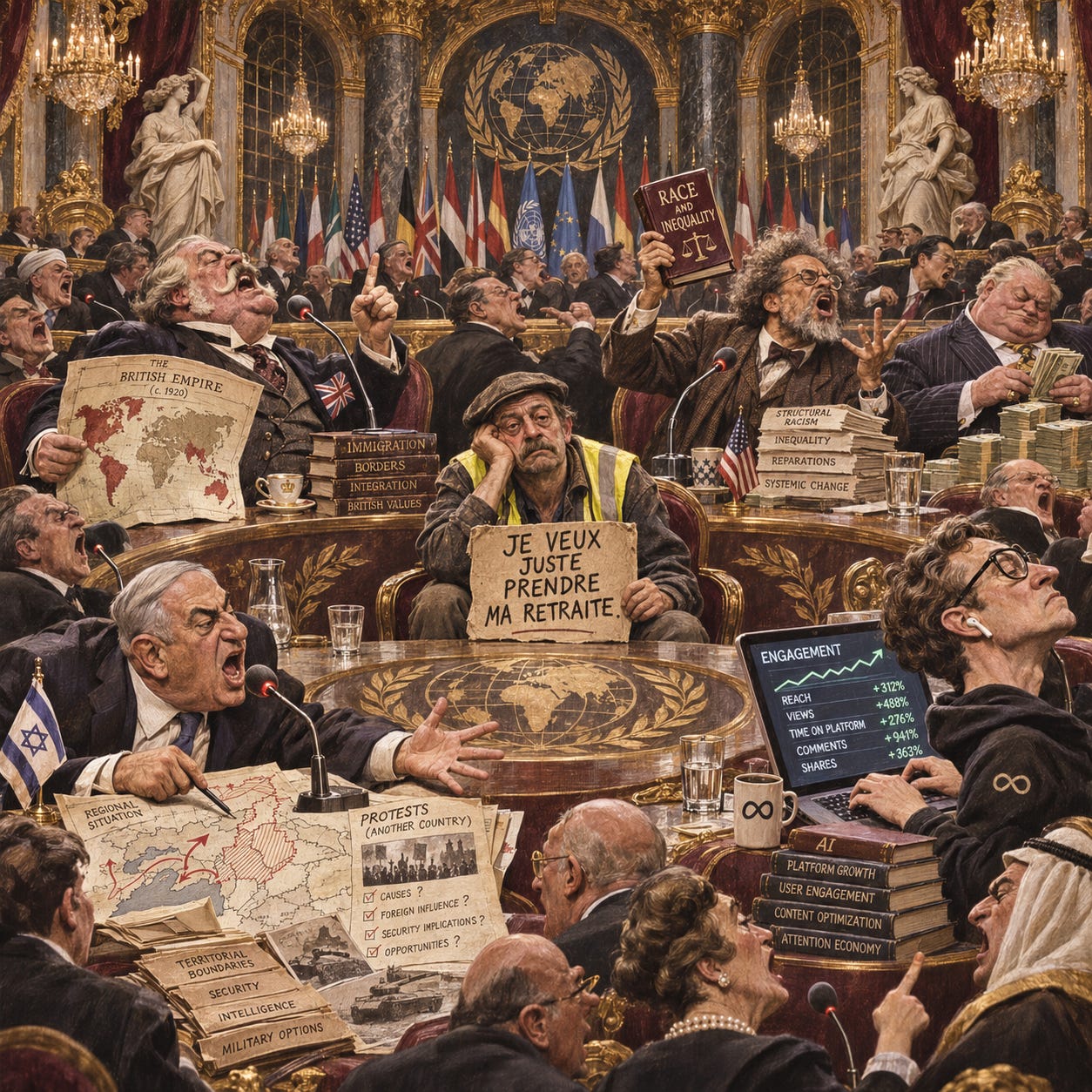
There is a Frenchman standing in the street protesting a pension reform. He is sixty-two years old. His back hurts. He has worked for forty years, paid his taxes, and would like to spend whatever remains of his life doing something other than working. Unfortunately, he has made the catastrophic mistake of allowing himself to be photographed.
Within minutes, an Israeli commentator discovers that his protest is somehow connected to Palestine. A British conservative identifies the familiar symptoms of Islamic extremism. An American progressive recognizes a manifestation of systemic racism. An American conservative concludes that Western civilization is collapsing under the weight of immigration. Somewhere in Silicon Valley, an algorithm carefully examines these interpretations and determines that the Frenchman is likely interested in purchasing a tactical flashlight.
Nobody asks the Frenchman why he is protesting.
This is the great achievement of globalization. We have connected eight billion people through satellites, fiber-optic cables, smartphones, artificial intelligence, and an extraordinary infrastructure of instantaneous communication, only to discover that everybody is still talking about himself.
The world has become a giant international conference in which every delegation has arrived with exactly one PowerPoint presentation, prepared forty years ago, and absolutely no intention of listening to anybody else’s.
Consider Britain.
Britain has a fascinating relationship with immigration, largely because it spent several centuries traveling around the world uninvited and now finds the arrival of foreigners at Heathrow somewhat unsettling.
The British Empire once governed roughly a quarter of humanity. It extracted resources, established trading systems, reorganized economies, and introduced people who had never heard of Yorkshire to the magnificent possibilities of working for a British industrialist. Then came the Second World War, the decline of empire, and the inconvenient discovery that a modern economy still required workers.
So Britain recruited labor from the Commonwealth and former imperial territories. Pakistanis arrived to work in textile mills and factories across Yorkshire and the Midlands. People from India and the Caribbean entered manufacturing, transport, and public services. Families followed. Communities formed. Mosques appeared. Children were born who spoke English, supported English football clubs, and occasionally made the unforgivable decision to remain in the country of their birth.
France performed a related experiment with Algerians. Having spent 132 years ruling Algeria, appropriating land, and violently suppressing resistance, the French discovered that Algerian workers were extremely useful in French industry. They came to build cars, maintain infrastructure, and perform labor that metropolitan society preferred not to perform itself. The French then expressed astonishment when Algerian neighborhoods appeared in France.
One might call this the return on imperial investment.
There were real consequences. Industrial employment declined. Immigrant communities remained concentrated in neighborhoods where housing was cheap and opportunities limited. Some communities preserved conservative religious and social practices. Others experienced unemployment, discrimination, educational disadvantage, and alienation from mainstream institutions.
And there were serious failures that no romantic account of multiculturalism should conceal. The organized sexual exploitation of children in Rotherham and Rochdale exposed horrifying crimes and institutional cowardice. Baroness Louise Casey’s 2025 audit found disproportionate representation of Asian and Pakistani-heritage men among suspects in certain local investigations, while also finding that national ethnicity data was too inadequate to establish the overall pattern reliably. The crimes were real. The victims were real. So was the failure of authorities to investigate uncomfortable questions.
But notice the extraordinary historical compression that follows.
A problem involving particular towns, generations of industrial migration, cultural practices, failures of policing, poverty, and the peculiar inheritance of British imperialism becomes a general theory of Muslims.
Then a general theory of Muslims becomes a general theory of immigration.
And eventually the theory arrives in Texas.
The British have a remarkable talent for this sort of thing. They lost the empire, but retained the language, the publishing industry, and an impressive ability to explain other people’s countries to them.
Douglas Murray, author of The Strange Death of Europe, writes and speaks extensively about immigration, Islam, and European civilization. Konstantin Kisin, co-host of TRIGGERnometry, moves comfortably between British political debates and enormous American podcast audiences, including Joe Rogan’s. The Telegraph, The Spectator, American conservative media, and the podcast circuit form a transatlantic marketplace in which the anxieties of British society can acquire an American accent without changing their historical content.
There is nothing inherently wrong with a British commentator discussing America. The problem begins when a Pakistani family whose grandfather worked in a Bradford textile mill becomes intellectually interchangeable with a Guatemalan laborer crossing the Rio Grande.
These people have different histories, religions, economic circumstances, migration routes, and relationships to the countries receiving them.
In England and Wales, Muslims constituted 6.5 percent of the population in the 2021 census. Britain’s Muslim communities are heavily shaped by migration from Pakistan and Bangladesh and their descendants. In America, Muslims constitute roughly 1 percent of adults, with a strikingly different composition that includes African Americans, Middle Easterners, South Asians, Africans, converts, and highly educated immigrants.
The United States also has its own immigration controversies, but its unauthorized immigrant population is disproportionately drawn from Mexico, Central America, and South America. Many are Christian. Many are fleeing different combinations of economic hardship, violence, authoritarianism, and institutional failure.
Meanwhile, Britain’s contemporary Channel crossings involve a different migration system again. In 2025, more than 41,000 migrants arrived by small boat, including substantial numbers from Afghanistan, Eritrea, Iran, Somalia, and Sudan.
Apparently, however, all these people can be understood through a single theory developed somewhere between Bradford and a London podcast studio.
The British have accomplished something the empire never quite managed: they have made Yorkshire a universal condition.
There is another delicious historical irony. Colonial domination sometimes helped make religion a language of political resistance. In Algeria, Islamic identity could become part of the struggle against French rule, alongside secular nationalism. British India and the territories emerging from Partition developed their own complex relationships among religion, nationalism, and state power. Not every religious radicalism originated in colonialism, but colonial domination certainly did not occur in a political vacuum.
Imagine reversing the arrangement. A Muslim empire conquers England, takes its coal, reorganizes its economy, and establishes a ruling elite. Christian resistance movements emerge, some peaceful and some violent. A century later, the empire’s intellectuals discover that Christianity is associated with resistance to Muslim rule.
They publish a book called The Strange Death of Arabia.
The book becomes a bestseller.
Unfortunately for the British, America is not a passive recipient of imported neuroses. It possesses an enormous domestic supply.
America has its own history, and what a spectacularly particular history it is. A republic declaring that all men are created equal while ma…