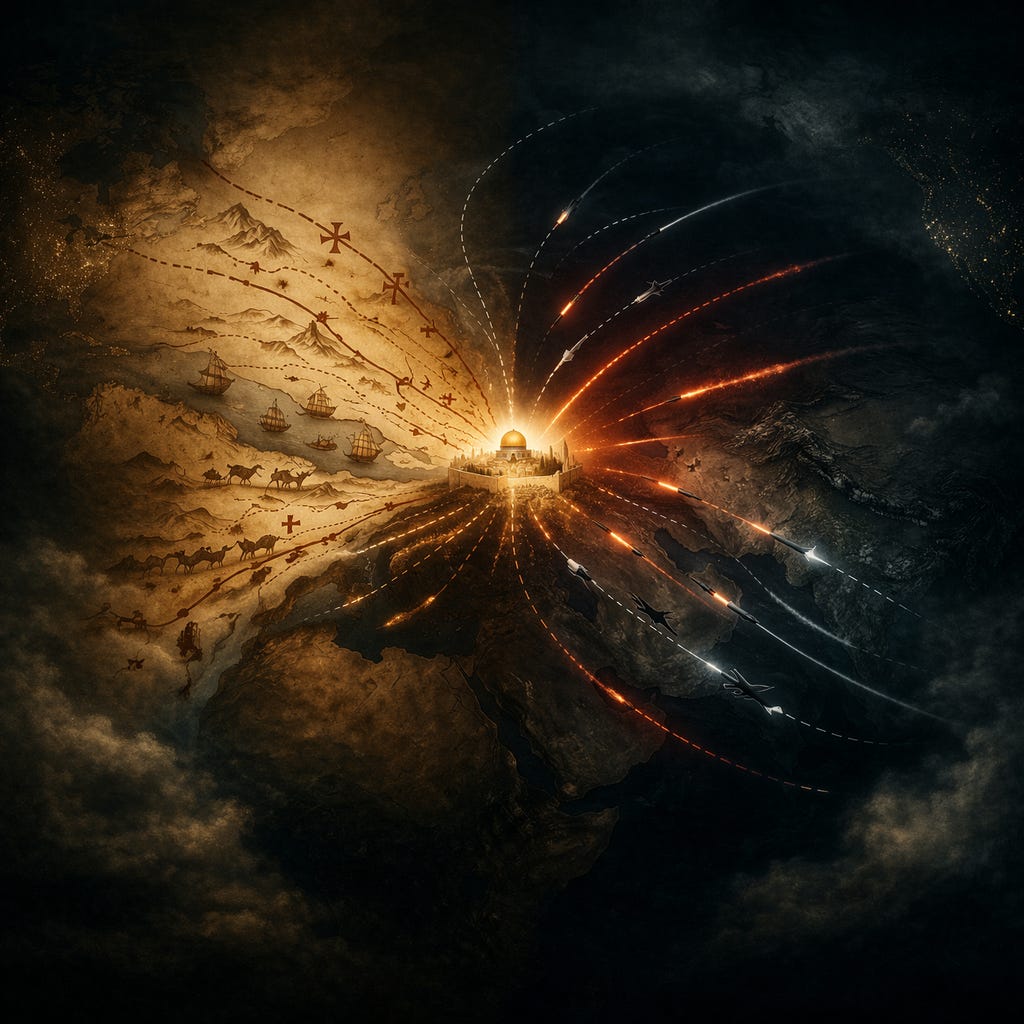
I. The City at the End of the March
In July of 1099, men from France and Normandy and Flanders entered Jerusalem in a state that no ordinary political language can describe. They had crossed mountains and disease and heat and hunger. They had marched for years toward a city they did not know, in a land that was not theirs, under a sky that had not watched their childhoods. Many of them had likely never seen a map that could explain where they were going. They could not have pointed to Jerusalem on parchment with any confidence. But they believed they knew what it was.
The walls had fallen. The gates had been breached. The city that had lived for generations as a name inside scripture suddenly lay before them as stone, blood, and dust. They did not enter it like administrators. They entered it like men crossing into judgment. Medieval accounts, however exaggerated in number, agree on the atmosphere: slaughter, frenzy, sanctified delirium. Bodies in the streets. Bodies in the holy places. A city transformed into proof.
The important fact is not simply that they killed. Empires kill. Armies kill. Conquerors kill. The important fact is that they had come so far to kill there.
They were not defending their farms. They were not repelling an invasion of their homeland. They were not trying to secure a river, a harvest, or a dynastic border. They were dying for a city in the Levant because a chain of inherited meaning had made that city feel closer to God than their own villages. The geography of their own lives had been overruled by the geography of a story.
That is the real marvel, and the real danger. Not that Jerusalem was contested. Cities have always been contested. The danger is that Jerusalem had already ceased to be local. It had become a place capable of summoning strangers from continents away, recruiting not only armies but imaginations. The city was no longer simply where it was. It was also wherever it had been taught.
So the real question is not why Jerusalem was fought over. The real question is more severe:
How does a city become important enough to recruit the dead from continents away?
II. Why Men Die for Places They Have Never Seen
Why were men from another continent dying for this land?
There is an easy answer and a true one. The easy answer is religion. It is not false, but it is incomplete to the point of uselessness. Religion explains fervor. It does not yet explain mechanism. It tells us why the blood ran hot, but not how a place became charged enough to hold that heat across oceans and generations.
The true answer is stranger. Men from France died for Jerusalem because a piece of land had been converted into inherited identity. A local geography had been transfigured into a civilizational possession. The city had become part of the moral anatomy of people who had never seen it. That is the hinge. Once a land enters the structure of who you are, distance ceases to protect anyone.
This is when a territorial dispute changes category. It is no longer about administration or sovereignty alone. It is no longer even about faith in the abstract. It becomes a conflict over a place that has been internalized, taught, ritualized, mourned, promised, and sung. A place that people do not merely want, but believe they would become less themselves without.
That is the threshold. Once crossed, war stops being only strategic. It becomes personal for people who are not present. It becomes durable for reasons that strategy cannot solve.
III. When Land Becomes More Than Land
Some land stops being land and becomes non-substitutable identity.
Most land in history has been wanted for ordinary reasons. It fed a population, guarded a trade route, sat astride a river, gave height to archers, delivered taxes to rulers, or buffered a border. Such land could be exchanged, annexed, leased, divided, conquered, or lost. Its importance was real, but it remained in the world of trade-offs.
Non-substitutable land belongs to a different order. It cannot be replaced by another valley, another city, another arrangement. It cannot be compensated for with money, prestige, or adjacent territory. It is not valuable because of what it yields. It is valuable because of what it means. To surrender it feels not like strategic compromise but symbolic mutilation.
This is where ordinary political language begins to fail. Diplomacy assumes variables that can be moved. Statecraft assumes interests that can be balanced. But when the object at the center of the conflict has fused with identity, the variable no longer enters negotiation space in the usual way. You are not bargaining over acreage. You are bargaining over memory, revelation, covenant, humiliation, continuity, destiny. You are asking someone to accept not merely loss, but reduction.
A conflict changes category when the land at its center can no longer be exchanged without symbolic annihilation.
That is the first premise.
IV. The Geography That Learned to Travel
Jerusalem is not merely contested land. It is a globally distributed piece of geography.
This is the central mutation, and it is what most analyses miss. They treat sacred land as highly valued local territory. But Jerusalem is not local in any meaningful strategic sense. Its physical stones are local. Its stakeholder set is not.
Universal religions did something historically extraordinary. They took events, promises, sacrifices, prophets, kings, temples, deaths, resurrections, ascensions, and revelations rooted in a small geography and transmitted their significance outward until millions who would never set foot there came to feel implicated in its fate. The land did not move, but its claims multiplied. The city stayed in place while its meaning became portable.
A peasant in medieval France could feel bound to Jerusalem. An evangelical in Texas can feel bound to Jerusalem. A Jew in Brooklyn can feel bound to Jerusalem. A Shiite in Tehran can feel bound to Jerusalem. A Muslim in Jakarta can feel bound to Jerusalem. These are not metaphors. They are political facts with emotional force. The physical territory remains tiny; the field of attachment does not.
Jerusalem, then, is not simply a city fought over by those who inhabit it. It is a city inhabited, in narrative form, by people far beyond it. Its geography has been replicated through scripture, liturgy, pilgrimage, memory, national myth, eschatology, and grief. It exists simultaneously as place and inheritance.
That changes the nature of conflict entirely. If the meaning of the land is globally distributed, then the set of stakeholders is effectively unbounded. And if the stakeholder set is unbounded, then no local settlement can fully close the system. People who do not live there can still re-inject passion, money, legitimacy, pressure, and sacred language into the conflict. The war does not remain where it started because the land does not remain where it started.
Jerusalem is not just contested territory. It is a globally distributed piece of land.
V. The Peace That Cannot Be Negotiated
Most peace theory begins with a bounded picture. There are actors, usually states. There is territory, usually finite. There are interests, usually conflicting but calculable. Negotiation then becomes a matter of mapping concessions to incentives. What is painful but acceptable can be traded against what is valuable but not absolute. The premise is simple: if the structure is finite, equilibrium is possible.
But this system is not finite.
The first mistake of standard peace logic is that it assumes the relevant actors are only the visible ones. Yet in conflicts of sacred geography, the visible actors are only the local bearers of a much larger emotional architecture. States fight. Armies mobilize. Militias kill. But behind them stand narratives held by external populations whose attachments are not exhausted by the needs of those who actually live on the land.
The second mistake is that peace logic assumes land can always be translated into negotiable units. But non-substitutable land cannot be meaningfully partitioned if the meaning itself is indivisible. You can split streets, police zones, or administrative competencies. You cannot split revelation. You cannot divide chosenness by survey line. You cannot ask a sacred center to behave like an industrial corridor.
The third mistake is that diplomacy presumes local closure. But a globally distributed geography cannot be locally closed. Any agreement reached by proximate actors remains vulnerable to distant stakeholders whose inherited identities still experience the land as theirs to defend, interpret, or redeem.
This is why the “peace process” has so often felt like theater. It mistakes a liturgy for a border dispute. It assumes the conflict is local. It is not. It assumes the variables are tradeable. They are not. It assumes the stakeholders are bounded. They are not.
The negotiations keep failing because the model of the conflict is wrong.
VI. The Old Pattern
The pattern did not begin in our own time, and it does not belong only to Jerusalem. History offers at least two kinds of evidence: first, the long-distance mobilization created by inherited sacred claims; second, the way such conflicts end only when the constraint space itself is altered.
The Crusades are the clearest example of the first. Europe did not become attached to Jerusalem by normal strategic reasoning. It inherited an obligation through theology. Once that happened, distant populations could be summoned into violence by a place they did not inhabit. The city’s significance was no longer proportional to its immediate relevance to their daily lives. That disproportion is the essence of globally distributed geography. Jerusalem functioned not as a local urban center but as a civilizational magnet whose field extended across Christendom.
Yet the Crusades did not end because Jerusalem was “resolved.” They ended because the system lost intensity from other directions. European states consolidated. priorities changed. costs mounted. the capacity for endless sacred mobilization weakened. In other words, the conflict did not conclude through doctrinal reconciliation. The participants partially exited the game. That is a crucial historical lesson: such systems often do not resolve. They decay, redirect, or exhaust.
The second kind of evidence comes from conflicts like the Thirty Years’ War. Here, too, identity and political order fused so tightly that compromise appeared as betrayal. What ended that conflict was not moral enlightenment in the sentimental sense. It was a reconfiguration of legitimacy. Religion lost some of its direct claim over political sovereignty. State order was partially de-sacralized. One of the non-negotiable variables weakened. Only then did a new equilibrium become possible.
Northern Ireland offers a later and subtler variation. It did not end through perfect justice or theological agreement. It stabilized when identity became less rigidly exclusive and sovereignty became more ambiguous. British and Irish could coexist within a softened border regime. Again, the point is structural: the conflict eased not because everyone finally understood one another, but because some of the identity and territorial constraints ceased to function as absolute.
The lesson across these cases is severe but clarifying. Conflicts of this kind end only when one of three things happens: identity softens, sacred claims lose political primacy, or external actors withdraw enough energy that the system can no longer sustain itself at prior intensity. They do not end simply because suffering becomes obvious. Suffering alone has never been enough.
VII. The War Beneath the War
This brings us back to the present, where the U.S.–Iran confrontation and the Israel conflict are usually described in fragments. Some say geopolitics. Some say religion. Some say nationalism. Some say oil. Some say empire. Each of these captures part of the machinery. None captures the system.
The present conflict is a power struggle, yes. States do not disappear because ideas exist. Iran seeks regime survival, deterrence, and regional leverage. Israel seeks security, strategic dominance, and protection from forces it experiences as existentially hostile. The United States seeks regional influence, credibility, alliance maintenance, and the prevention of hostile power centers from consolidating. These are classic geopolitical incentives.
But the conflict does not remain at that level because the actors themselves are not merely strategic. Israel is not only a state. It is also a convergence point of trauma, nationalism, historical memory, biblical inheritance, and, in some factions, explicitly religious claims to land and destiny. Iran is not only a state either. It carries revolutionary legitimacy, anti-imperial identity, civilizational memory, and a political theology that does not separate national survival from moral and spiritual struggle. America, for its part, enters not only through oil and alliance but through a long inheritance of scriptural attachment, evangelical imagination, imperial projection, and domestic political mediation.
What this means is that America is not simply entering a regional war. It is entering a conflict whose stakeholder class was globalized centuries ago.
That is why the rhetoric around the conflict feels simultaneously strategic and apocalyptic, technocratic and scriptural, military and mythic. Policy language speaks in the grammar of deterrence; political passion speaks in the grammar of inheritance. The result is a coupled system in which power starts the fire, identity keeps feeding it, and sacred geography ensures the flame can always be reignited by someone not standing in the room.
This is why material superiority does not yield closure. One can dominate airspace and still fail to close the conflict. One can impose staggering costs and still fail to extinguish the struggle. Because the struggle is not over a finite object alone. It is over meaning stored in land and distributed through populations far beyond it.
VIII. The Stone That Refuses Settlement
Jerusalem is not the root cause of every war around it. That claim would be childish. States would still compete without it. Empires would still seek leverage. Borders would still produce violence. Resource chokepoints and regime anxieties would remain.
But Jerusalem is the permanent amplifier.
It is the place where multiple universal traditions have deposited irreversible meaning onto the same terrain. It is where memory is not merely remembered but spatialized. It is where stones carry claims that no treaty can easily metabolize. It is where exclusive truths occupy overlapping ground. It is where the symbolic density is so high that even conflicts not directly about the city are intensified by its background presence.
That is why Jerusalem matters even when missiles are flying elsewhere. It is not always the trigger. It is often the chamber in which the pressure builds. The city functions as a standing reservoir of sacred legitimacy, humiliation, promise, and grievance. Its role in the broader conflict system is not to explain every tactical decision, but to ensure that the strategic field never becomes purely strategic. It keeps dragging politics back into ultimacy.
Jerusalem makes ordinary de-escalation harder because it prevents the region from becoming merely administrative. It re-sacralizes the theater again and again. Every surrounding struggle risks becoming, through it, more than itself.
The city is not simply fought over. It teaches the war how to remain larger than its stated reasons.
IX. What Must Be Renounced
If the diagnosis is structural, the solution cannot be sentimental. It cannot be the usual liturgy of ceasefire, dialogue, mutual understanding, and renewed commitment to peace, as though repetition had not already exposed the poverty of those formulas. Such language may be necessary at moments of emergency, but it is not equal to the problem.
The true solution is harder and more radical: sacred legitimacy must be delinked from territorial possession.
This does not mean religion must disappear. It does not mean memory must be erased. It does not mean people must cease loving places or revering what happened there. It means that holiness can no longer function as title deed. No state, no movement, no people, and no empire can be permitted to translate divine significance into permanent sovereignty in a way that makes coexistence structurally impossible.
In practical terms, this means any durable peace must move in a direction that modern politics rarely dares to name: the desacralization of exclusive possession. The land may remain sacred, but it cannot remain civilizational property in the old sense. Governance must be political without pretending that political rule confers cosmic endorsement. Faith must be preserved, but disembedded from sovereign absolutism. Reverence must survive without ownership.
This is not merely a diplomatic solution. It is theological before it is diplomatic. It requires religions to renounce the temptation to treat God as a real estate claim. It requires states to renounce the temptation to borrow eternity for temporary power. It requires external populations to stop mistaking inherited attachment for an unlimited right to inflame the fate of others.
Until that happens, every political arrangement will remain vulnerable. Treaties may pause violence, but they will not remove the deeper structure that recruits fresh generations into the same inherited drama.
Peace will remain impossible until the sacred is asked to renounce property.
X. What the March Began
In 1099, the men who entered Jerusalem believed they were marching toward God. That is how they would have described it. That is how they endured the distance. That is how they justified the blood. But what they were also marching into, whether they knew it or not, was a new kind of conflict: one in which a city could recruit strangers across centuries.
That is the real historical disaster. Not simply that Jerusalem became holy, but that holiness became transferable as obligation. A child born far away could inherit a wound, a promise, a grievance, a title, a duty toward a place he had never seen. The land remained small. The claim did not. And once enough civilizations organized themselves around that inheritance, the city ceased to belong only to those who dwelled within its horizon.
That is why the conflict cannot be understood as local, and why its violence keeps exceeding local logic. The war does not persist because people are uniquely irrational. It persists because the system that formed around this land does not permit ordinary closure. Its stakeholders are dispersed, its meanings are layered, and its central object cannot be traded without symbolic amputation.
The tragedy of Jerusalem is not that too many people love it. It is that too many civilizations taught themselves that they could not remain whole without possessing it.
—Elias WinterAuthor of Language Matters, a space for reflection on language, power, and decline.