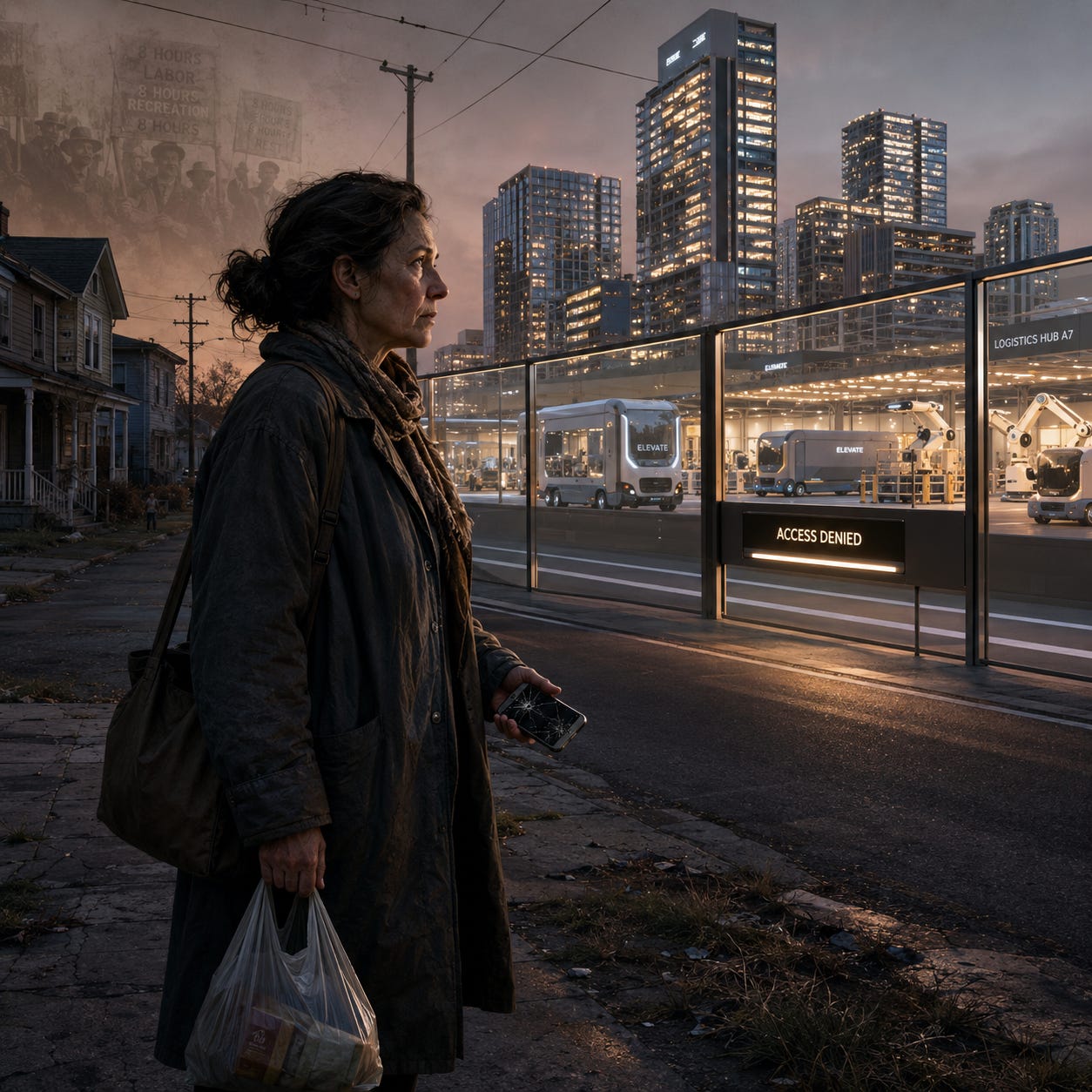
I. A Possible Tuesday
What follows is not a prediction. It is a possible Tuesday in a future we still have time not to build. Maya wakes at 6:17 because her body has not yet learned that there is nowhere she is expected to be. For twenty-three years, mornings had consequences. At twenty-four she was an analyst. At twenty-nine, a manager. At thirty-six, a director. At forty-two, she could walk into a room where five people were talking over one another, find the actual question beneath the noise, build a model around it, and tell an executive something he did not know before she entered. She was good at this. That matters to her. It matters more now than it did when people paid her for it. The clock beside her bed is not really a clock. It is an eleven-year-old phone whose battery lasts until noon if she keeps the screen dark. The glass is cracked diagonally through the upper-right corner, passing directly across the weather widget she no longer checks because she no longer commutes. She keeps the phone because replacing it would cost three weeks of food. The house is quiet. Not her house. Her mother’s house. Maya is fifty-one now. Her mother is seventy-eight. Her son sleeps in what used to be Maya’s childhood bedroom. Maya sleeps in the converted dining room because her younger brother and his wife moved into the basement after his accounting firm reduced its American staff by eighty-four percent. There are seven people living in a house built for four. Nobody calls this homelessness. That is one of the linguistic achievements of the new economy. There are mattresses. There is a roof. Therefore, according to the statistics, everybody is housed.
Maya walks into the kitchen. Her mother has left two eggs beside the stove. She eats one. The other is for her son. There is plenty of food in America. That is important too. The agricultural systems work beautifully. Autonomous harvesters move through fields at night. Machine vision catches disease before human eyes can see it. Logistics systems continuously reroute shipments around weather, demand, road congestion and spoilage. Warehouses lose almost nothing. The supermarket three miles away is full. Maya simply cannot afford much of what is inside it. She used to think scarcity meant absence. Now she understands that scarcity can mean a warehouse filled with food behind a price. She opens the refrigerator. Half a gallon of milk. Carrots. Rice from yesterday. A container marked COMMUNITY KITCHEN — WEDNESDAY. Her mother has learned to save coffee grounds and brew them twice. This bothers Maya more than hunger. Her mother worked forty years. Maya worked twenty-three. Her brother worked twenty-six. Between them, this household contains a master’s degree in statistics, a CPA, a retired nurse, two decades of software experience, five languages, three professional licenses, and enough accumulated knowledge to operate a small institution. None of it reliably converts into groceries. Maya checks her messages. A former colleague has sent a link to a contract. Human Verification Specialist — 6-week engagement. The work consists of checking decisions made by an autonomous financial system in the rare cases where regulatory rules still require a human signature. There are twelve openings. The listing says 18,431 people have applied. Compensation is $19.40 an hour. No benefits. Maya laughs. She does not mean to. Her mother hears from the kitchen. “Something funny?” “No.” She closes the listing.
Outside, the street looks simultaneously poorer and more technologically advanced than anything Maya remembers from childhood. Two houses across the street have plywood covering first-floor windows. Another has four families living in it. Someone has converted a garage into an electronics repair shop. The sign is hand-painted: WE FIX WHAT THEY SAY TO REPLACE. An autonomous delivery vehicle turns the corner. It is silent. It does not stop in Maya’s neighborhood. It is taking pharmaceuticals toward the secured medical district eleven miles north. For a moment, through the gaps between old houses, Maya can see one of the freight drones descending toward the distribution corridor. The corridor has its own power. Its own communications network. Its own security. Its own road maintenance. Its own autonomous repair systems. The public streets on either side have potholes deep enough that drivers remember their locations from memory. Two civilizations occupy the same geography. One is becoming more efficient every year. The other is learning how to repair washing machines manufactured before its children were born. Maya’s father would have understood part of this world. He had worked in a machine shop outside Cleveland. In 1998, the plant closed. For years afterward, he carried the closing as a private humiliation. He had known machines with his hands. He could hear when a bearing was wrong. He could feel a tolerance error through metal. He had possessed a form of knowledge that no university had taught him and no résumé could adequately explain. Then one day the market informed him that this knowledge was worth almost nothing. He told Maya something afterward that parents across the industrial Midwest had told their children for a generation. “Use your brain. Don’t end up like me.” So she did. She studied mathematics. Then economics. Then statistics. She learned SQL and Python when there was still money in knowing SQL and Python. She learned machine learning when machine learning still meant humans building models rather than models building almost everything else. She did exactly what America told the children of industrial decline to do. When the economy stopped valuing her father’s hands, she cultivated her mind. For two decades it worked. Then the market came for that too. There is a photograph of her father in the hallway. He died before the second transition. Sometimes Maya is grateful for that.
At nine, she walks to the old elementary school. The school district technically still owns the building, but there are no longer enough children enrolled in formal schools to justify operating all of them. One wing has been converted into a clinic. Another is a cooperative kitchen. The gym contains shelves of donated tools, batteries, old computers, medical equipment and replacement parts. People simply began doing things because the official institutions stopped doing them. Nobody announced a new society. It accumulated. A former emergency physician runs the clinic three mornings a week. Two displaced teachers operate classes in what used to be the music room. A mechanical engineer maintains the neighborhood’s battery bank. A twenty-eight-year-old former cybersecurity analyst manages a collection of community servers built from equipment salvaged from bankrupt offices. Maya helps with accounting, planning, statistics, procurement and whatever else needs doing. Nobody pays her much. But people need her. The first time somebody said, “Ask Maya, she’ll know what to do,” she went into the bathroom and cried. Not because she had become sentimental. Because after four years of being told by labor markets that her cognition was abundant, somebody had finally treated her mind as scarce again. This is how people begin rebuilding tribes. Not because they reject modernity. Because human beings cannot indefinitely survive as surplus inventory.
At noon, a boy in one of the classes asks Maya why the district beyond the river has clean streets. She knows which district he means. Everyone does. It is not officially a private city. There are still American flags. Still federal law. Still elections. But entrance is restricted by property ownership, employment contracts, service credentials or sponsorship. The district contains the regional headquarters of two infrastructure companies, a biomedical campus, automated manufacturing, several datacenters, private schools and residential towers whose lights stay on when the public grid fails. People there have new…