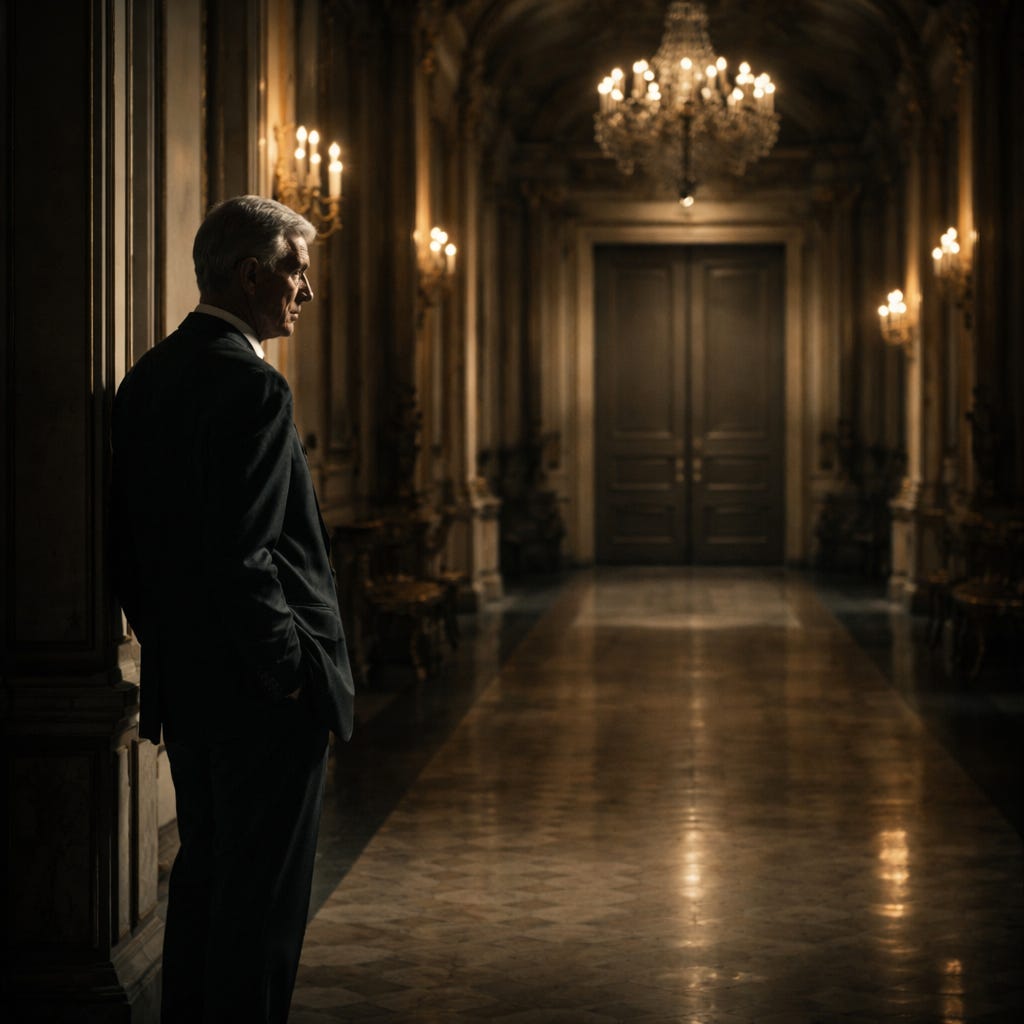
I. The Last Door
By the end they no longer refused me with insult. Insult would at least have conceded that I remained a person of consequence. No, they refused me with courtesy, which is the preferred cruelty of palaces that have begun to mistake order for dignity.
The young captain at the door, whom I had never seen before, put one gloved hand over the register and asked my name as though I were a tradesman who had lost his way among the cypresses. He was very clean. They were all very clean in those years. The uniforms had grown more exact as the souls inside them had grown less certain. His Persian was quick and polished; his French, when he recognized my accent, carried the brittle triumph of a man who has learned another language only to sharpen a refusal.
“His Majesty is occupied.”
They all say this with the same face. Occupied by what? By ministers, by generals, by maps, by the long frightened whisper of a state that has learned to suspect its own people. Occupied by those men who enter carrying folders and leave carrying larger shoulders. Occupied by women with lacquered smiles and soft knives. Occupied by a future that arrives wearing foreign shoes and calls itself necessity.
The palace itself had changed its breathing. Once it inhaled through corridors, through private rooms, through doors opened by habit, by memory, by affection. In those earlier years one could still move through it according to old laws: a shared glance, a known silence, a sentence begun in one season and completed in another. By the late 1950s it breathed through checkpoints. Doors no longer opened because one was expected. They opened because one had been cleared.
I stood in the reception hall beneath a chandelier whose glitter was meant to reassure everyone that permanence still existed. The generals passed without looking at me. They always pretended not to know who I was. That was their revenge against the years when they had known perfectly well who I was and hated me for it. One of them—wide in the chest, thinning at the crown, carrying his body like a threat he had repeated too often—paused only long enough to let his eyes take my measure. In his gaze there was no curiosity. I had ceased to be scandalous; I was simply obsolete.
Farther down the corridor two ladies of the court emerged from a receiving room in a cloud of perfume and intelligence. Women in palaces never merely walk; they announce the arrangement of power by the angle of a wrist, the refusal of a glance, the decision to laugh one beat too late. One of them, younger, with a neck too beautiful to trust, looked at me with a kind of bright amusement, as one looks at an old dog that still waits by the wrong gate. The older one knew better. She turned her face away. She understood that to notice me was to acknowledge an earlier court, a softer court, a court of dangerous informality. Such courts must be erased before the new ones can call themselves modern.
I asked whether His Majesty had been told I was there.
The captain lowered his gaze in the practiced way of men who wish to avoid lying by allowing the lie to become atmospheric.
“His Majesty is occupied.”
Again. The same sentence. A whole state summarized in four words.
I ought to have left at once. An aging man preserves his dignity only by recognizing the exact minute at which it begins to decay in public. But I remained. One remains in such moments not because one expects to be admitted, but because memory is a foolish servant. It still believes the house remembers its dead.
As I waited, I watched the doors at the end of the hall—double doors, walnut dark, guarded not by force but by procedure. How many times had I passed through doors on nothing more than a murmur, a nod, the familiarity of footsteps? How many times had no one thought to ask my name because my name had already been folded into the air of the place? Now the palace required that everything be spoken, stamped, sorted, denied.
There was a time when no one asked my name at the door.
II. Le Rosey
Snow makes even the proud appear provisional. That is what I remember first: not the boy, not yet, but the snow along the stone balustrades, the pale roofs, the Swiss morning so clean it seemed to have been laundered in silence. Le Rosey was a school for princes, or so the fathers called it, though princes are only boys with too many witnesses.
I did not belong there in the way the others did. I belonged by proximity, by labor, by the lesser routes through which one learns to read a world that would not seat one at its table. My father worked the grounds. I learned the seasons by the shape of branches and the moods of rich children by the violence with which they shut doors. Schools of that kind educate everybody: the heirs in entitlement, the servants in precision, the outsiders in observation.
The first time I noticed him, he was standing apart from a group of boys in winter coats, listening too carefully. There is a kind of loneliness that advertises itself through excess attention. He had already learned to behave as someone watched, and he was not yet old enough to know that such behavior becomes permanent. His clothes were excellent. His posture was nearly correct. But around him hung the unmistakable weather of exile: too far from home, too close to expectation, too young to understand the bargain being prepared in his name.
The other boys, especially the European ones who had been taught since birth that rank was vulgar unless worn casually, sensed his vulnerability. They sensed as well the vanity beneath it, the eagerness to belong, the mortification of failing naturally at what others performed without effort. Boys are merciless wherever institutions train them to become the guardians of future order.
He dropped a glove on the terrace steps. It is possible he dropped it accidentally. It is equally possible he let it fall because he wanted someone to notice him without requiring him to ask. I picked it up. His hand, when he took it back, was cold enough to seem ceremonial.
“Merci,” he said.
His French was careful. The accent amused some of the others. It did not amuse me. I had already learned that a man’s accent is often the truest evidence of what the world has demanded he become before he had time to consent.
“You are freezing,” I told him.
He gave the quick embarrassed smile of a boy uncertain whether he is being mocked. “In my country,” he said, “it is different.”
That is what people from important countries say when they are helpless in small climates.
“In every country,” I replied, “cold remains ambitious.”
He laughed then, and because he laughed, the whole arrangement shifted. It is astonishing how quickly certain destinies enter by the side door of a trivial remark.
Later I would know his silences, his hesitations, the small gestures by which shame announces itself before words can defend it. But first there was only the school: the stone hallways, the smell of wax and wool, the chapel where boys practiced reverence as they practiced pronunciation, the dining room full of dynasties chewing under supervision. Switzerland has perfected the art of making hierarchy appear hygienic.
He moved through that world as if wearing a costume tailored by anxious men. He was neither robust enough to dominate nor indifferent enough to disappear. He was watched from above and below: by teachers because he was a prince, by boys because he was uncertain, by history because it had already leased him a future.
I noticed his hands before I noticed his face properly. Hands reveal what families try to hide. His were delicate but restless, beautiful in the way of things already under discipline. One sensed that his father had not touched him with tenderness and that the absence had become architectural.
When one lives near power in its larval stages, one learns to distinguish between arrogance and fear. Arrogance expands; fear arranges itself. The boy was arranging himself.
III. The Boys Who Become Countries
I do not know at what point an attachment ceases to be incidental and begins to recruit the whole soul. Perhaps it is when another person’s humiliation wounds one as though it had occurred on one’s own skin. Perhaps it is when one begins to recognize their footsteps before one has heard them. Or perhaps it is simpler than that: some lives are not entered through reason but through repetition—one walk, then another, one confidence, one small rescue, one winter afternoon prolonged by the refusal to say goodnight.
He sought me because with me he did not have to be a crown prince in rehearsal. I sought him because in him I sensed the tragedy of those who are trained for elevation before they have first been allowed to become ordinary. We walked the grounds when the others had gone indoors, speaking in French because it belonged fully to neither of us. That is one advantage of a second language: it can make intimacy seem accidental.
He was vain, yes. Let no one tell you otherwise. There was always vanity in him, but it was the vanity of an uncertain person, which is the most exhausting kind. He wanted to be admired without knowing by what means admiration is naturally won. He wanted to move as the European boys moved, to answer lightly, to wear his rank as though it embarrassed him. Instead he seemed always to hear his father approaching through every corridor in Europe.
Sometimes he spoke of Iran, though not often. When he did, it arrived not as a country but as weather: heat, horses, distances, commands. His father occupied those recollections like a mountain occupies a valley—by the mere fact of mass. He did not criticize him directly. Boys destined for obedience seldom do. But now and then a sentence would pause in him, and I would hear beneath it that oldest cry: he was never gentle with me.
Once, after an especially brutal day in which a pair of older students had mocked his manner of speaking and then, more cruelly, his eagerness to please, I found him in the lower corridor near the laundry rooms where the stone held the cold in a deeper register. He was not crying. Princes learn quickly that tears are a form of evidence. But he was very near it, which is often more naked.
“They think I am ridiculous,” he said.
I answered too quickly. “They think only of themselves.”
“No,” he said. “They think correctly.”
There are moments when a life opens in a single sentence. He was not afraid merely of ridicule. He was afraid that ridicule was revelation.
I took him by the elbow then—not dramatically, not like a heroine in a cheap romance, but as one steadies someone stepping onto uncertain ground. He did not pull away. That was the beginning of many things. Touch, once permitted, writes arguments the mouth will spend years denying.
When he was ill one winter with fever, I sat with him longer than propriety advised. The room smelled of medicine and linen, with that faint metallic odor fever gives to the air around a beloved body. He drifted in and out, speaking sometimes in Persian, sometimes in French. Once he reached for my wrist without opening his eyes, as a child reaches for the edge of the known world before sinking again beneath pain. I let him hold on. That is all. History, I have discovered, is often built from moments no larger than a hand refusing to move away.
Did I desire him? It would be tedious to pretend otherwise. But desire is too small a word for certain attachments and too vulgar a word for others. I desired his beauty, yes, though beauty in the young is a dangerous thing to love because it is still being used as a promise by those around it. I desired also his dependence, which is the more shameful confession. To be needed by one who will one day be untouchable is a temptation almost theological in its corruption.
We developed the private habits by which all asymmetrical loves first disguise themselves as friendship. Shared books. Finished sentences. The right to mock others together. Long walks in which silence ceased to be emptiness and became a kind of furnished room. Once, while helping him dress for some school ceremony, I fastened the collar at his throat and felt him go still—not with revulsion, not with invitation, but with the heightened attention of someone who knows that a boundary has been approached and does not wish to know by whom.
He became handsome slowly. That is to say, he became aware of being watched and began to collaborate with it. A slight adjustment of chin, a more considered use of pause, an instinct for allowing light to fall where it should. Yet the loneliness remained. It made him, I think, more beautiful than confidence would have.
Before he became a country to millions, he was a boy trying not to be laughed at.
IV. Tehran, First Light
The first assault was not political but sensory. Iran entered through heat. Through brightness. Through distances arranged not by Swiss geometry but by older scales of sun and dust and inheritance. Even the light there seemed to possess memory. It did not merely illuminate surfaces; it judged them.
He brought me to Tehran with the bewildered authority of one who can summon a life for another without yet understanding the cost. To say he brought me is perhaps too passive. I allowed myself to be brought because youth mistakes proximity for destiny. Had I stayed in Switzerland, I might have become one more discreet failure among many. Instead I crossed into a kingdom through the narrow gate of one person’s regard.
At first it felt almost miraculous. Palaces are designed to intoxicate outsiders. Gardens that deny climate, halls in which footsteps are translated into significance, servants who appear before desire has fully formed itself—such arrangements persuade a foolish man that he has crossed not into a court but into an order of reality reserved for the favored. For some months, perhaps longer, I believed that.
Yet enchantment and foreignness arrived together. I knew no Persian worth mentioning. What I learned first were tones: amusement, suspicion, resentment. In royal houses one need not understand a language to grasp one’s position within it. My Frenchness gave me utility, my Europeanness a certain borrowed sheen, but my lack of lineage, office, or native rootedness made me impossible to classify except as an appendage. Men can forgive almost any sin before they forgive access without title.
He remained my country. That was the weakness from the start. Others belonged to Iran through family, command, bureaucracy, land, blood, old feuds, remembered humiliations. I belonged through one face turning toward me in a room. Nothing built on such a foundation remains stable once the room fills with history.
Still, in those early years there were hours that justify whole catastrophes. Mornings when he would call for me not because I was necessary but because habit had not yet been systematized out of his life. Evenings when conversation wandered without agenda. We spoke in French often, not to exclude others—though exclusion always pleases the insecure—but because French had become our climate of first truth. It carried the ghosts of Switzerland into the Persian heat. In it he could still be the boy before the throne had fully occupied him.
The palace staff observed everything. They knew which rooms I entered, how long I remained, whether laughter emerged, whether papers were present, whether voices rose or softened. One old servant, whose loyalty to the house predated all of us and whose contempt for me was almost honorable in its steadiness, once said to me in broken French: “Too much nearness to kings makes men without fathers.” I laughed at him then. Years later I understood he had offered me the nearest thing to prophecy.
The city itself remained mostly elsewhere from me. Tehran beyond the walls was hearsay, glimpsed from cars, from balconies, from the language of men who served and then disappeared into neighborhoods I never entered. This is one of the great corruptions of palace life: it allows a foreigner to live for years inside a country he never actually meets. One inhabits surfaces and mistakes them for knowledge.
And yet there was tenderness. I insist on this because courts later rewrite their own weather. There were still moments then when he was not yet fully arranged into majesty. A difficult audience ended, and he would remove his gloves with irritation and speak not as sovereign but as wounded son. A military briefing would exhaust him, and afterward he would want a book, a joke, a memory from school. Sometimes I thought I was preserving in him a corridor through which humanity might continue to reach the throne. At other times I suspected I was merely preserving my own vanity by giving it a noble name.
I knew already that others asked: who is this man? The correct answer was unbearable in its simplicity.
I was the person who had seen him before he was historical.
V. The Women and the Officers
Palaces produce two species more efficiently than monasteries produce piety: women who have learned to weaponize grace and officers who have learned to confuse stiffness with virtue. I misjudged both.
The women first. Let lesser minds sentimentalize queens and consorts into embodiments of national destiny. The women I knew at court were finer instruments than that. They understood before the men did that intimacy near a throne is never private, only unlicensed. They could smell unauthorized feeling the way certain dogs detect illness. Around me they were rarely openly hostile. Open hostility would have dignified me. No, their skill was more exact. They arranged rooms in which I became decorative, conversations in which I became anecdotal, occasions on which my presence acquired just enough absurdity to be self-punishing.
Perfume is the true language of courts. It speaks before words and lingers after verdicts. A woman would enter carrying jasmine or amber or some cold Parisian floral lie, and one knew instantly the political season of the room. There were women who hated me because they believed I occupied emotional territory properly belonging to wives. There were others who hated me because I represented weakness. Still others hated me because they sensed, correctly, that I saw through the theatrical innocence by which they disguised appetite as duty.
One of them—clever, raven-haired, with a voice soft enough to conceal iron filings—once asked me whether Switzerland had taught me all my loyalties or only the more interesting ones. She smiled as she said it, and the men around her smiled too, relieved that a woman had spoken what they lacked the style to imply. I replied that Europe had at least taught me the difference between devotion and strategy. This was witty enough to survive the hour and foolish enough to cost me years.
The officers were simpler and therefore more dangerous. They believed in rank because rank allowed mediocrity to inhabit structure and call itself civilization. Boots, files, briefings, salutes: these relieved them of the burden of inward complexity. They knew exactly what offended them about me, though they would not have put it elegantly. I possessed no command, no family, no title, no martial competence, no visible usefulness that they recognized as masculine. Yet I had what they most coveted and least understood: access acquired through history rather than hierarchy.
They called me effeminate with their eyes long before they ever trusted themselves to do so with words. The body is a text authoritarian men think they can read infallibly. A voice too inflected, a hand too deliberate, an aversion to brutality, an interest in books: they gather these signs the way theologians gather heresies. To men made secure by institutions, any masculinity not forged through command appears suspect. They did not merely think me weak. They thought me illegible.
They were not entirely wrong.
I had no place in the currencies by which the court increasingly measured value. I could not produce heirs. I could not lead divisions. I could not anchor a faction. I could not claim old Persian blood or new technocratic efficiency. I could only remember. And memory, near power, is either sanctified as myth or condemned as interference.
What made them truly dangerous was not their contempt but their coherence. Women at court fought one another with exquisite ferocity, but the officers fought history itself. They wanted a palace in which every relation could be named, every route of influence mapped, every affection subordinated to procedure. They understood instinctively that I represented a surviving irregularity—an intimacy not granted by office, a presence older than their promotions, a witness to versions of the king before the state had fully professionalized its embrace around him.
So they whispered. Of course they whispered. Some said I meddled in politics. Others that I trafficked in spiritual nonsense. Others that I was a foreign parasite living off sentiment. The coarser among them suggested what men like that always suggest when faced with attachment they cannot classify. Let them. The accusation mattered less than the function. Such rumors are never about truth. They are mechanisms for converting unease into policy.
I do not claim innocence. I was jealous, watchful, manipulative in the small desperate ways of dependent men. I monitored the moods of rooms. I noticed whose carriage waited longest in the drive, which aide had begun speaking too softly, which lady had been seen too often in the library, which general left with both papers and satisfaction. But my vice was attachment. Theirs was system.
In the end system always wins.
VI. A King Becomes a Regime
People speak of coups as if they alter only governments. This is childish. A coup alters posture, vocabulary, breathing, architecture, the quantity of silence required in a room before someone dares begin a sentence. Most of all, it alters access.
After 1953 the palace ceased gradually to be a residence with politics and became a machine with chandeliers. I do not mean that warmth vanished overnight. Human beings are not transformed so efficiently, not even by fear. But the terms of nearness changed. Every path toward him acquired an escort. Every conversation acquired an implicit audience. Every old habit had to present its papers.
He had nearly lost everything. That is the truth from which all later protocols descend. Men who have once fled a capital never again hear footsteps with innocence. Those who imagine the restoration of a throne restores its former soul have understood nothing. A restored order is a wounded order. It must seal itself or die.
So the generals multiplied. The ministers thickened. The intelligence men, who always look as if they have been constructed from a shortage of sleep and an excess of certainty, began to occupy the interstices between people. Reports proliferated. Timetables hardened. The very air seemed to fill with carbon copies.
He changed, yes, but not in the vulgar sense. He did not suddenly become another man. Rather, parts of him were recruited more heavily than before. The boy who had once lingered, listened, sought reassurance, asked a second question after the official one—this boy was not murdered. He was surrounded. That is a more modern form of killing.
I noticed it first in durations. Meetings shortened. Informal talks became appointments. Appointments became opportunities granted between obligations. His laughter survived longer than spontaneity did, but even laughter grew curated, arriving now with a slight delay as if awaiting clearance. The private hours, once gathered almost accidentally from the neglected corners of a day, became rare and then structurally improbable.
He had wanted strength. Of that I am sure. He had always wanted to inhabit authority as naturally as others accused him of failing to do. The experience of near-loss did not plant that desire in him; it weaponized it. At last he found himself in a position where the state would assist his self-construction. It would build around him the very architecture his uncertainty had long desired: deference, information, insulation, confirmation, the elimination of improvisational humiliations. What insecure man would not be tempted by such gifts?
But no one receives these gifts freely. The state that protects a monarch from vulnerability also protects him from unscripted human relation. Fear reorganizes the monarchy from within. The king remains in place, but increasingly as the sacred center of procedures designed to prevent surprise. Soon everyone near him begins to treat access not as memory but as clearance. This is how a sovereign stops belonging even to his own past.
There were still moments—always fewer—when he seemed to emerge from the machinery and become briefly available to old weather. A phrase in French. A remembered classmate. A complaint, almost boyish, about the pomp of some dreadful occasion. Yet even in these moments one felt the encroaching bureaucracy of self. He was not only protected by the regime; he was being interpreted to himself by it. He began to inhabit the version of strength it found legible.
Monarchies do not die only when crowns fall. They die when access becomes administrative.
What the officers wanted, and what history after the coup increasingly required, was not merely order. It was the sterilization of all routes toward the throne that had not been built by the state itself. They could tolerate family because family produces dynastic grammar. They could tolerate official advisers because offices can be documented. They could tolerate ceremonial women because ceremony is a public form of possession. What they could not tolerate was residue: a man from before the machine, a friend whose claim arose not from rank but from witness.
I do not mean that he betrayed me in some melodramatic manner. Betrayal is too intimate a word. It requires a scene, a choice, a deliberate act. What happened was worse, because it was historical. He became less available to every relation not mediated by power, and in that reduction my place became first awkward, then uncertain, then embarrassing.
The king did not turn from me so much as disappear behind his own survival.
VII. The Country I Never Entered
Toward the end I began to understand that my tragedy had never consisted solely in loving a man who belonged increasingly to the state. It consisted also in living for years inside a country I had never truly entered.
I knew the texture of palace draperies better than I knew the speech of the bazaar. I could recognize from a corridor the perfumes announcing a diplomatic luncheon, yet could not have bought bread without assistance in neighborhoods not shaded by state power. The city I inhabited was made of drives, compounds, anterooms, imported fabrics, guarded lawns, the half-knowledge one acquires by overhearing governance from the margins. This is not a country. It is a membrane stretched between those who think they rule and those who service the illusion.
Iran remained outside me in its essential forms. I glimpsed it through car windows, through servants’ silences, through sudden eruptions of grief or devotion at public occasions whose emotional logic I could feel but not fully decipher. There are lands one may love as landscape and still fail as civilization. To have spent so many years there and remained dependent on translation, on sponsorship, on the permissions radiating from one central figure—this now strikes me as not merely unfortunate but morally stunting.
It is possible that I preferred it this way. Dependency can masquerade as loyalty for decades if no one compels the truth. Had I entered Iran more honestly, I might have been forced to admit that my life there had no foundation beyond personal attachment. Easier instead to live in the suspended chamber of borrowed importance, to accept invitations in lieu of belonging, to let one’s biography become a corridor within someone else’s institution.
I cannot accuse the court entirely of excluding me from the country. I cooperated with the exclusion. I allowed the palace to become not just my livelihood but my ontology. I was neither fully European anymore nor ever Persian. A foreigner who remains too long in proximity to power without building another life becomes less a person than a climate of remembrance.
There were afternoons in those later years when I would sit in a room overlooking gardens too carefully maintained and hear distant city noises beyond the walls—traffic, vendors, some human disorder not yet processed into ceremony—and feel almost physically the existence of a nation from which I had been shielded. Shielded, yes, but also severed. Men at the center of courts imagine that information compensates for contact. It does not. One may hear daily of a people and never meet them.
Sometimes I wondered whether he too had begun to lose the country in similar ways. Not lose it politically—there are always statistics, officials, crowds arranged for viewing—but lose the living grammar of it. The difference is that he was protected from this realization by power. I was left alone with it.
Had I returned to Switzerland, what would I have been? An old servant of a vanished intimacy. A curiosity. A failure. And yet perhaps more real than the figure I remained in Tehran: tolerated residue from a youth the monarchy no longer wished to remember too vividly.
I had lived in Iran for years without entering Iran. I had lived near a king without securing a life. I had lived through history as if witness exempted me from structure.
It does not.
VIII. The Visit They Refused
Some humiliations ripen only after one understands their full context. That day at the door returned to me often, not because it was the first refusal, but because it was the first refusal so perfectly emptied of drama.
Again I see the hall. The polished stone. The captain whose face has already forgotten mine while I am still standing before him. Again I hear the corridor fill and empty with the low bureaucratic tides of a state administering its own proximity to the sacred. A general admitted. An aide-de-camp admitted. A cultural attaché, absurd in his imported confidence, admitted. And me—who had once crossed thresholds on a shared memory alone—preserved in waiting like an outdated ornament no one wishes to discard publicly.
At one point the younger of the two court ladies returned, now accompanied by a man from the ministry whose smile was so professionally harmless it ought to have been illegal. He greeted me with excessive warmth, which is the chosen style of institutions when they need to convert exclusion into etiquette.
“My dear Monsieur Perron,” he said. “You must understand. The schedule is impossible.”
Schedules are always impossible at the exact moment memory becomes inconvenient.
I said, “His Majesty knows I am here?”
The ministry man let the silence answer, which is the civilized method of making another person complicit in their own disappearance.
Near the far wall hung a portrait of the Shah, magnificent in that official manner which combines military cut with almost ecclesiastical self-regard. I looked from the portrait to the doors and thought, not without cruelty: the image enters where the witness waits outside. This is the essence of modern monarchy. Representation is admitted. Memory is screened.
I sat at last because standing too long in such spaces begins to look like pleading. Seated, one can at least pretend contemplation. An elderly servant brought tea. Not one of the old ones. A new man, trained in the cleanliness of depersonalized service. He set the tray down without meeting my eyes. To him I was only one more obsolete relation the palace had not yet found a discreet method of erasing.
As I waited, I listened to the palace speaking its new language. Telephones. Shoes striking certainty into floors. The muffled opening and closing of doors governed by interior staff charts. Not a house. A circulation system. Somewhere beyond those doors he moved between men who called caution realism, force stability, insulation modernization. Perhaps he believed them. Perhaps he needed to. There comes a stage in power when one must outsource spontaneity to preserve authority.
No one ever said I could not see him again. That would have preserved too much clarity. Instead the court learned the superior technique: to leave the possibility theoretically alive while making each attempt exhaust itself in procedure. A direct ban creates martyrs. Administrative delay creates shadows.
After an hour—or two; humiliation alters one’s mathematics—the captain returned and informed me with fresh politeness that His Majesty regretted he would be unable to receive visitors that afternoon.
Visitors.
I nearly laughed. There, in one word, lay the whole revolution within the palace. I had become a visitor in the history I had once inhabited.
As I rose, I caught my reflection in the glass of a cabinet: older than I had consented to become, impeccably dressed as if care could still negotiate with irrelevance. Behind me the corridor extended, beautiful and emptied of all permission.
I was not being denied by a man. I was being denied by a system that had replaced memory with management.
IX. What I Was to Him
This is the question to which scandal offers the stupidest answer and sentimentality the most dishonest one.
What was I to him?
A friend, certainly, though friendship is too republican a word for the arrangements of courts. A confidant, at times. A witness. An accomplice in youth against loneliness. A reminder of Europe before Europe became policy. A keeper of certain humiliations he could not share with those who knew him only as ruler. A weakness, perhaps. A relic. A comfort from the period before power had fully professionalized his solitude.
Was I loved? One can destroy oneself elegantly over this question if one has sufficient leisure. Better to ask instead: in what register was I necessary?
There are kinds of love that never return in equal measure because equality itself was never the medium. I loved him with the particular intensity available to the marginal person who has been permitted an unauthorized nearness to destiny. In such love desire and pity and vanity and loyalty become impossible to separate. I desired him, yes; I have already conceded this. His beauty, his uncertainty, the exquisitely trained surfaces under which fear still moved like a trapped bird. But desire alone would have sent me elsewhere. What held me was the conviction—perhaps delusional, perhaps half true—that I knew a version of him inaccessible to the world that would one day kneel or curse before his image.
Did he know this? Certainly. Did he exploit it? At times, perhaps unconsciously. Men who are starved of uncomplicated loyalty grow adept at accepting devotion without examining the cost to the devotee. It is one of the quieter corruptions of rank.
I do not think he loved me as I might have wished in the privacy of my most humiliating fantasies. He was too formed by shame, by dynastic expectation, by the terrible straightening hand of history. Yet I also do not believe I was merely convenient. Convenience does not survive so many years, so many shifts in climate, so much hostility from surrounding structures. Something in him wanted me near long after prudence would have advised otherwise.
What? Not my body, perhaps, though bodies write themselves into every prolonged attachment. Not openly, not in any story fit for gossip. But there are other forms of intimacy the vulgar always miss because they seek only evidence of beds. I knew the cadence of his fatigue. I could detect from the first sentence whether a briefing had frightened him, whether a woman had flattered him too effectively, whether some general had pressed too hard, whether a public triumph had left him oddly desolate. I knew how he held a glass when he was angry but concealing it, how he lengthened vowels in French when he wished to postpone an unpleasant truth, how silence gathered differently around him when he was ashamed than when he was merely bored.
There were moments—few, dangerous in memory—when I felt him turn toward me with something almost like unguarded need. An illness, a fright, a political wound before it had yet calcified into rhetoric. In such moments the old current returned. Then just as quickly it withdrew, and I was left wondering whether I had encountered the man or only the temporary failure of the king.
Was I a servant? In worldly terms, yes. Let us not romanticize dependence. A man without official standing who remains because he is wanted remains also because he is maintained. Yet servant is insufficient. Servants can be replaced without historical embarrassment. I could not be replaced in that way because what I carried was not a function but a past.
A past becomes intolerable near power when it remembers the sovereign before sovereignty.
Perhaps that is the truest answer. I was to him the surviving witness of his pre-regal self. Not the grand self of propaganda, not the martial self of portraits, not the developmental self of speeches, but the uncertain boy in Switzerland whose glove fell in the snow and who looked relieved when someone returned it without mockery.
It is possible to love a sovereign most truthfully at the moment he no longer has use for truth.
X. The Last Monarch Is a Locked Room
People misunderstand authoritarianism because they prefer to imagine it only in its louder forms: prisons, decrees, censors, men struck in public, newspapers corrected by fear. These are indeed among its methods. But authoritarianism begins earlier and in subtler chambers. It begins where thresholds multiply. Where the route to another human being is gradually replaced by layers of authorization. Where institutions begin to consider affection a security risk and memory an administrative irregularity.
By the late 1950s the palace had become a theology of the locked room.
Outside it stood the generals, with their files, their confidence, their permanent suspicion that history is best governed by men who can reduce complexity to discipline. Around it moved the women, not frivolous as the resentful like to imagine, but metabolized by the dynastic machinery into forms of elegance useful for legitimacy and cruelty alike. Through its walls flowed invisible foreign architectures: advice, expectation, strategy, the deep modern superstition that a state can compensate for moral fracture through technical competence and force.
At the center was the monarch, increasingly inaccessible not because he ceased to exist but because he had to be preserved. Preservation is the death mask worn by frightened power. To preserve a king is to remove from him all contacts that cannot be audited. To preserve a regime is to treat every unauthorized intimacy as contamination.
The locked room is never merely physical. It is epistemic, emotional, linguistic. Certain truths may no longer enter because they come bearing the wrong accent, the wrong memory, the wrong claim. In such systems even tenderness must either become ceremonial or perish. That which cannot be made visible in official grammar is classed as weakness, gossip, deviance, interference.
This is why men like the officers hated me beyond all rational proportion. Not because I held formal power—I did not. Not because I could command troops—I could not. They hated me because I embodied the fact that a human route to the monarch had once existed outside the state’s architecture. I was evidence that the throne had once been touchable by means other than protocol. Such evidence is intolerable once fear has built its ministry around the heart of rule.
The women understood this too, though differently. They saw that I represented not merely a rival attachment but a challenge to legibility. Wives, mothers of heirs, ceremonial companions, cultivated emblems of national elegance—these are all roles a monarchy can display and therefore manage. But a man from a prince’s youth, foreign, unnecessary, privately trusted, impossible to classify except through innuendo? Such a figure invites the one thing authoritarian courts cannot endure: unlicensed interpretation.
What is monarchy at its most frightened? A locked room mistaken for sovereignty.
I do not write this as accusation alone. There is pity in it also. For the sovereign himself becomes prisoner of the systems erected in his defense. He may move armies, sign decrees, summon ministers, but he can no longer easily recover the old unscripted encounters by which the self is revised in ordinary human relation. Every face near him has become contextualized by function. Every conversation bears the weight of consequence. At that point even memory must knock.
And history, which cares little for chandeliers, waits outside smiling.
XI. Before the Door Closed
What remains now is not scandal, not grievance, not even certainty. It is an image.
Snow against the windows at Le Rosey. Evening. The corridor quiet at last, the school having exhausted itself in hierarchy for the day. He is younger than all the portraits remember him. No medals, no sash, no men in waiting rooms converting fear into procedure. Only a boy seated at the edge of a narrow bed, one hand at the collar he cannot quite fasten because his fingers are numb from cold or clumsiness or that inward tremor he tried so hard to conceal.
I step behind him. He does not turn. I take the fabric lightly between my fingers and close the collar at his throat. He says nothing. Neither do I. Beyond the glass the snow continues falling over Switzerland with its old indifference to empires.
In that silence there is not yet a regime. Not yet a coup, not yet a court hardening around wounded legitimacy, not yet the women with their perfumes and knives, not yet the generals with their immaculate refusals, not yet the polished hall in Tehran where I would one day become a visitor to my own history.
Only the boy. Only the small trust of allowing another person’s hands near one’s neck. Only the unguarded second before power learns to fear every route by which it might still be reached.
History will keep the crown, the ceremonies, the speeches, the portraits arranged under perfect light. Let it. It has always preferred the official costume to the private shiver beneath it.
But I remember the boy before the doors learned to close.
—Elias WinterAuthor of Language Matters, a space for reflection on language, power, and decline.