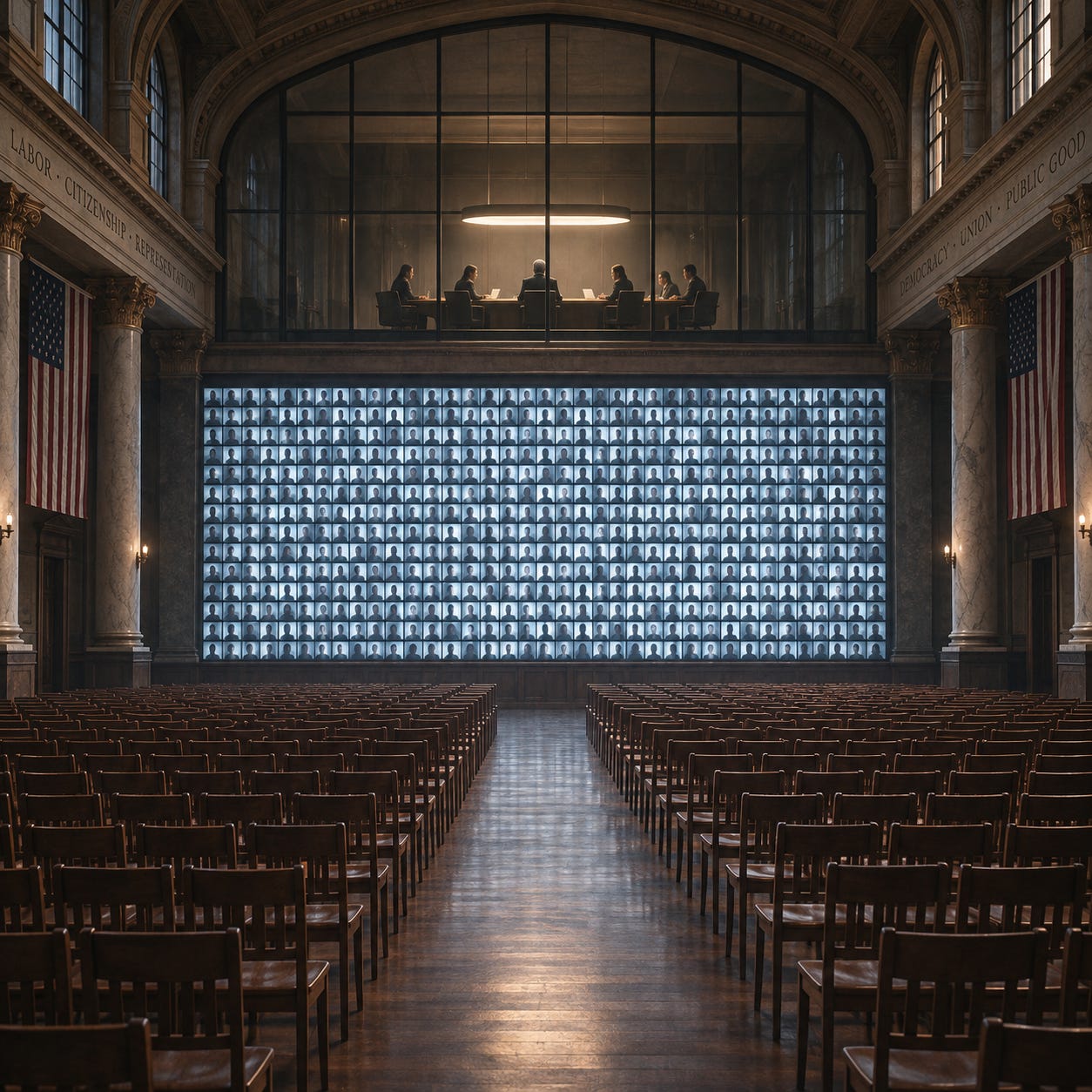
America has never been more connected. Millions can assemble around a grievance in minutes, denounce an injustice before breakfast, and spend the afternoon explaining why everyone else has misunderstood it. Everyone has an opinion, a platform, and a personal brand of moral superiority.
What Americans seem to have misplaced is the ability to organize.
Not everyone, of course. Corporations still organize beautifully. They maintain associations, employ lobbyists, finance research institutions, cultivate politicians, and coordinate legislative agendas. Their meetings have budgets, minutes, and deliverables.
Ordinary Americans have comment sections.
And somewhere along the way, we began confusing the two.
When Americans Knew How to Organize
The New Deal was not merely a collection of economic policies. It recognized that political freedom meant little when economic power remained concentrated beyond democratic reach.
The Wagner Act of 1935 strengthened collective bargaining. Workers who possessed little leverage individually could negotiate together. Unions became institutions of democratic practice: members elected representatives, debated decisions, contributed resources, and occasionally discovered that solidarity required tolerating people they disliked.
An extraordinary concept.
Churches, neighborhood associations, and civil rights organizations provided similar infrastructure. Political power emerged not merely from shared beliefs but from relationships, obligations, and sustained collective action.
These institutions were imperfect, often exclusionary, and sometimes deeply undemocratic themselves. Yet their achievements were substantial. Workers gained bargaining power, economic security expanded, and postwar American capitalism prospered.
The New Deal demonstrated that capitalism could survive organized labor.
Not everyone found this reassuring.
The Counterorganization
In 1947, Congress passed the Taft–Hartley Act over President Truman’s veto, restricting important forms of union activity. The rollback of labor power began long before Ronald Reagan entered the White House.
But the 1970s introduced something more systematic.
Facing growing pressure from labor, consumer advocates, environmentalists, and social movements, influential business leaders began developing stronger political institutions.
In 1971, corporate lawyer Lewis Powell prepared a confidential memorandum for the U.S. Chamber of Commerce, urging business leaders to coordinate their influence across universities, courts, media, and government.
Apparently, the problem with American democracy was that corporations had not yet been sufficiently organized.
The Business Roundtable emerged in 1972. Wealthy donors financed conservative institutions. Corporate lobbying expanded. Business coalitions helped defeat labor-law reform in 1978.
By Reagan’s election in 1980, conservative policy networks had developed an extensive governing agenda. The Heritage Foundation supplied Mandate for Leadership. Reagan implemented major tax reductions and regulatory changes, while his dismissal of striking federal air traffic controllers in 1981 became a symbol of labor’s diminishing political leverage.
This was not one secret conspiracy. Business interests differed, economic pressures were real, and labor’s decline had multiple causes.
But deliberate political coordination was unmistakable.
The great irony was that the champions of individualism understood collective organization better than almost anyone.
They simply preferred it in the boardroom.
The Disappearance of the Member
Meanwhile, American civic life was changing.
Suburbanization dispersed communities. Television brought entertainment indoors. Deindustrialization weakened union strongholds. Political campaigns became increasingly professionalized.
Robert Putnam documented declining civic participation. Theda Skocpol traced the shift from locally rooted membership associations toward professionally managed advocacy organizations.
The distinction was fundamental.
A member helps govern an institution. A donor finances one. A consumer chooses between offerings. An audience watches.
All may participate, but they do not possess equivalent authority.
The citizen gradually became something else.
A donor. A consumer. A voter. An audience.
This was wonderfully convenient. Democracy no longer required enduring a three-hour meeting with someone determined to discuss the previous meeting.
But something disappeared with those obligations: the everyday practice of collective self-government.
Ordinary Americans did not entirely abandon organization. Unions, tenant associations, and grassroots movements continued to organize. What weakened was the breadth of institutions through which ordinary people could exercise sustained, independent power.
And as the old membership structures declined, a new form of organization was approaching.
The Theater of Digital Solidarity
The internet promised to reconnect humanity.
It succeeded spectacularly at connecting people. Whether it restored their collective agency is another question.
Real organization requires individuals to subordinate some personal ambitions to collective objectives. Social media rewards individuals for distinguishing themselves from the collective.
Everyone is ostensibly fighting for justice. Everyone is also competing for attention.
Outrage becomes content. Solidarity becomes identity. Political commitment becomes personal exhibition.
The internet did not invent narcissism. It merely gave narcissism a distribution network.
But the deeper problem is not narcissism. It is authority.
An organized member accepts obligations and participates in collective decisions. A digital follower can experience belonging without either.
And the public is not entirely disorganized. It is increasingly organized by algorithms, platforms, and commercial institutions it does not democratically control.
The union once convened its members. The algorithm now convenes its users.
One was accountable, however imperfectly, to the people it assembled. The other answers primarily to those who own it.
Millions can share a grievance without possessing the capacity to make a single collective decision.
The platform aggregates their attention.
The people inherit the illusion of solidarity.
The Election Is Not the Revolution
Then Americans went to the polls.
In November 2026, Democrats won both chambers of Congress in a sweeping electoral victory.
The voters had spoken. Television panels could celebrate. Washington could congratulate itself on the resilience of democracy.
But what, exactly, had been rebuilt?
A congressional majority is not a labor movement. An electoral coalition is not a civic institution. Replacing the governing party does not automatically redistribute economic power.
The New Deal did not emerge from ballots alone. Nor did the Reagan revolution begin with Reagan. Its supporting institutions had spent years preparing to exercise power.
The Democratic victories will create opportunities for oversight and reform when the new Congress convenes. Whether those victories produce a durable reconstruction of collective economic power remains uncertain.
Elections determine who occupies institutions.
They do not, by themselves, determine who possesses the organized power to influence them.
The Last Bargaining Chip
Artificial intelligence now raises a more fundamental question.
Industrial capitalism depended on labor. Even when capital owned the factories, workers could withhold something employers needed: their participation in production.
That dependence gave collective bargaining much of its economic leverage.
AI may weaken it in certain sectors.
Automation will not eliminate every occupation or every source of worker power. But if productive systems increasingly substitute capital for human labor, ownership may become more decisive than employment in determining who receives economic value.
Then the question extends beyond wages.
If machines produce growing amounts of wealth, who owns that wea…