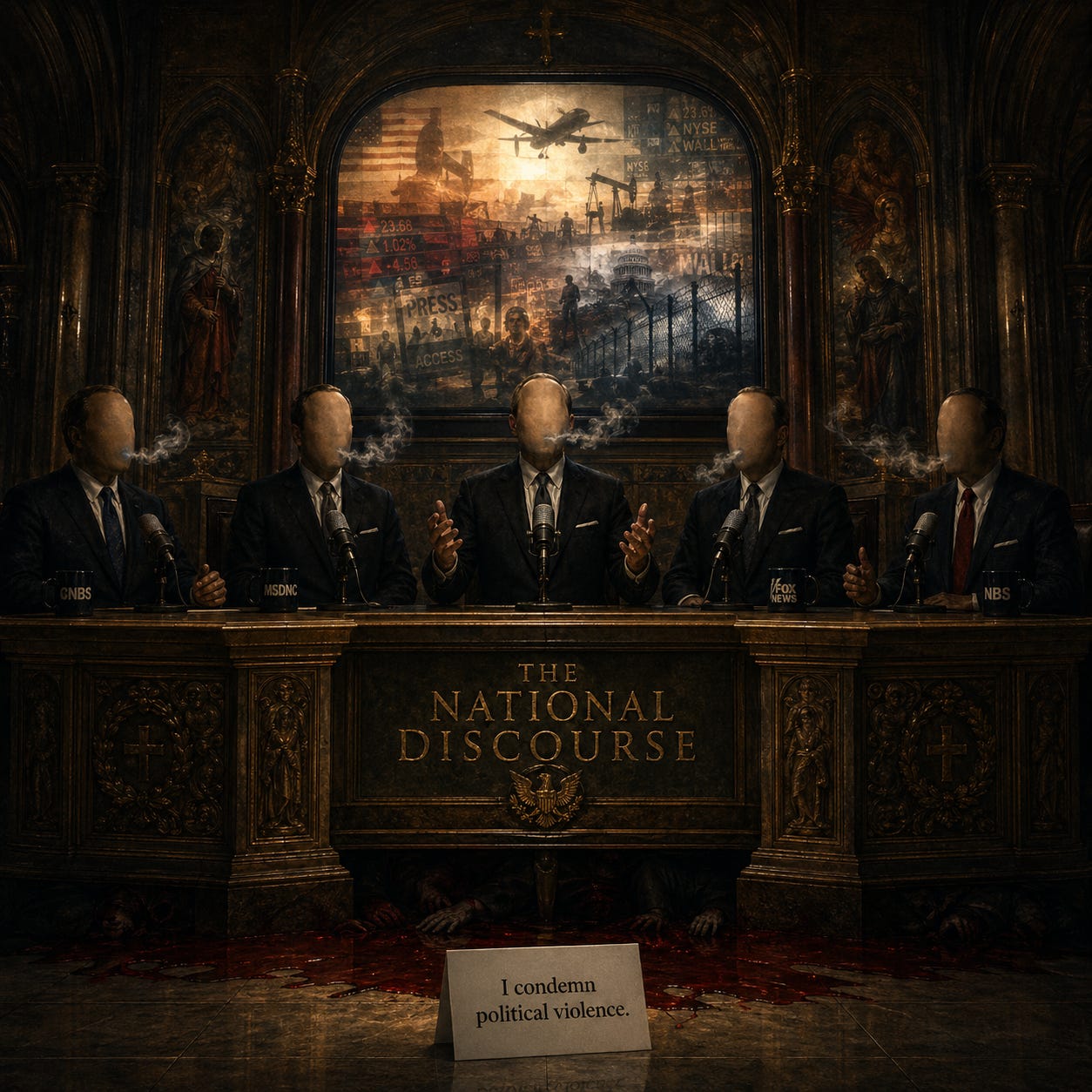
I. The Choir of Respectable Ghouls
They came quickly, as they always do.
Before the smoke had fully entered the archive, before the facts had hardened into sequence, before any human being had been permitted the privacy of an unprocessed reaction, they arrived with their grave little faces and their clean microphones and their moral sorrow already warmed to room temperature.
The respectable ghouls.
The podcast men. The democracy mourners. The former architects of catastrophe now employed as custodians of decency. The newspaper moralists whose sentences smell faintly of old mahogany, catered panels, and sanctioned blood. The men who have spent their lives near power and somehow mistaken that proximity for conscience.
They leaned toward the camera. They lowered their voices. They performed the sacrament.
“First, let me say, I condemn political violence.”
How brave.
How costly.
How astonishing to watch courage take such strenuous form: a man in a studio chair, speaking into a microphone, denouncing assassination between sponsor breaks while the empire he has spent his career defending continues its work with drones, prisons, sanctions, contractors, border camps, intelligence memos, and beautifully typeset euphemisms.
One almost wants to applaud the heroism.
There he is, the reasonable man, the moderate executioner of language, trembling before the possibility that violence has entered the room where important people gather. Not violence in the abstract, of course. Not violence as policy. Not violence as blockade, starvation, detention, bombing, extraction, regime discipline, or the slow crushing of foreign bodies beneath the vocabulary of strategic necessity.
No. That kind of violence requires nuance.
This violence had violated etiquette.
It had come too close to the podium.
And so the little priests emerged.
They spoke of norms. They spoke of democracy. They spoke of decency. They spoke of the republic as though it were a chapel and not a machine that has spent generations manufacturing graves abroad and euphemisms at home. They wore concern like vestments. Their faces tightened into the appropriate geometry of seriousness. They reminded the public, as priests must, that the first duty of the citizen is to recite the creed.
I condemn political violence.
Very good.
Now say it again.
Say it before thinking. Say it before grieving. Say it before asking why some violence becomes a crisis of civilization while other violence becomes a budget line. Say it so the gatekeepers know you are safe. Say it so the commentators can nod solemnly and allow you to continue.
The problem is not that they condemn violence.
The problem is that violence only becomes visible to them when it threatens the architecture that keeps them employed.
They are not horrified by blood. They are horrified by disorder. They are not guardians of human life. They are guardians of institutional tone. They do not object to the machinery of death. They object when death forgets its manners.
And so they speak.
The man from the respectable anti-populist chapel, forever wounded by vulgarity but rarely by empire, speaks. The column-writing heir of the old interventionist conscience, who summons dead philosophers like character witnesses for his own moral refinement, speaks. The newspaper that helped teach a generation how to call war prudence speaks. The panel guests speak. The democracy mourners speak. The bipartisan custodians of acceptable sorrow speak.
And beneath them, the machine continues.
Bombs become defense.
Sanctions become pressure.
Camps become enforcement.
Theft becomes strategy.
Domination becomes order.
But let a bullet move toward power, and suddenly the room fills with theologians.
II. The Ritual Disclaimer
“I condemn political violence” is not a sentence anymore.
It is a password.
It is the phrase one must recite before being permitted to think in public. It is the moral equivalent of removing one’s shoes before entering the temple of respectable discourse. It does not clarify. It does not deepen. It does not mourn. It certifies.
The phrase performs three tasks.
First, it marks the speaker as safe. Not good, not honest, not serious. Safe. It tells the gatekeepers that the speaker has no intention of disturbing the emotional architecture of the moment. He will not ask inconvenient questions too soon. He will not widen the frame prematurely. He will not compare visible violence to invisible violence. He will not bring the empire into the room.
Second, it protects the speaker from suspicion. In a degraded moral culture, explanation is treated as sympathy, context as endorsement, analysis as treason. To think beyond the immediate event is to risk being accused of secretly desiring it. So the ritual disclaimer functions as prophylaxis. It is a little moral raincoat worn before entering the contaminated weather of public interpretation.
Third, it narrows the field of concern. Once the correct sentence is spoken, the event is placed into the approved container: political violence, extremism, danger to democracy, rhetoric gone too far. All of which may be true. But the ritual does not invite thought. It limits it. It says: here is the boundary. Stay inside it.
What disappears is the surrounding world.
The ritual does not ask what kind of civilization produces men who seek meaning through violence. It does not ask why despair becomes theatrical. It does not ask why some people feel history only when they interrupt it with blood. It does not ask why the public has been trained to experience politics as apocalypse, entertainment, humiliation, vengeance, and tribal sacrament.
Most of all, it does not ask what kinds of violence are already authorized.
That is the central convenience.
To condemn an isolated act of violence requires almost nothing. It risks nothing. It costs nothing. It asks nothing of the speaker except a clean face and the correct tone. But to condemn the system of violence that feeds him, publishes him, protects him, flatters him, and rewards him—that would be something else entirely.
That would require exile from the dinner.
That would require losing invitations.
That would require naming friends.
That would require saying that the polite vocabulary of the powerful is often more dangerous than the obscenity of the deranged.
So the sentence remains useful.
“I condemn political violence.”
It means: I am not one of the dangerous people.
It means: I understand the rules.
It means: I will not confuse this incident with the larger order.
It means: I will not ask why violence committed by the state is processed as governance, while violence committed against the state is processed as metaphysical emergency.
The little priests do not condemn violence.
They manage the boundaries of permissible disgust.
III. The Geography of Moral Feeling
Their morality has a map.
It has borders, passports, preferred accents, strategic exceptions, and approved victims. It knows which dead deserve names and which dead deserve context. It knows which children are mourned and which are absorbed into the tragic complexity of regional affairs. It knows which blood stains the conscience and which blood stains only the paperwork.
A president hurried from danger becomes a crisis of the republic.
A child beneath rubble becomes a difficult situation.
A podium trembles, and civilization is in peril.
A city is starved, and experts gather to discuss proportionality.
A shot near power becomes evil.
A bomb dropped from power becomes policy.
This is not moral seriousness. It is geography.
The respectable commentators do not respond to violence as violence. They respond according to distance, narrative usefulness, and institutional allegiance. Domestic violence, especially when aimed upward, becomes sacred theater. It receives atmosphere. It receives solemn music. It receives the full cathedral treatment: democracy, decency, norms, the soul of the nation.
Imperial violence receives vocabulary.
Collateral damage.
Security concerns.
Regional stability.
Counterterrorism.
Strategic interes…