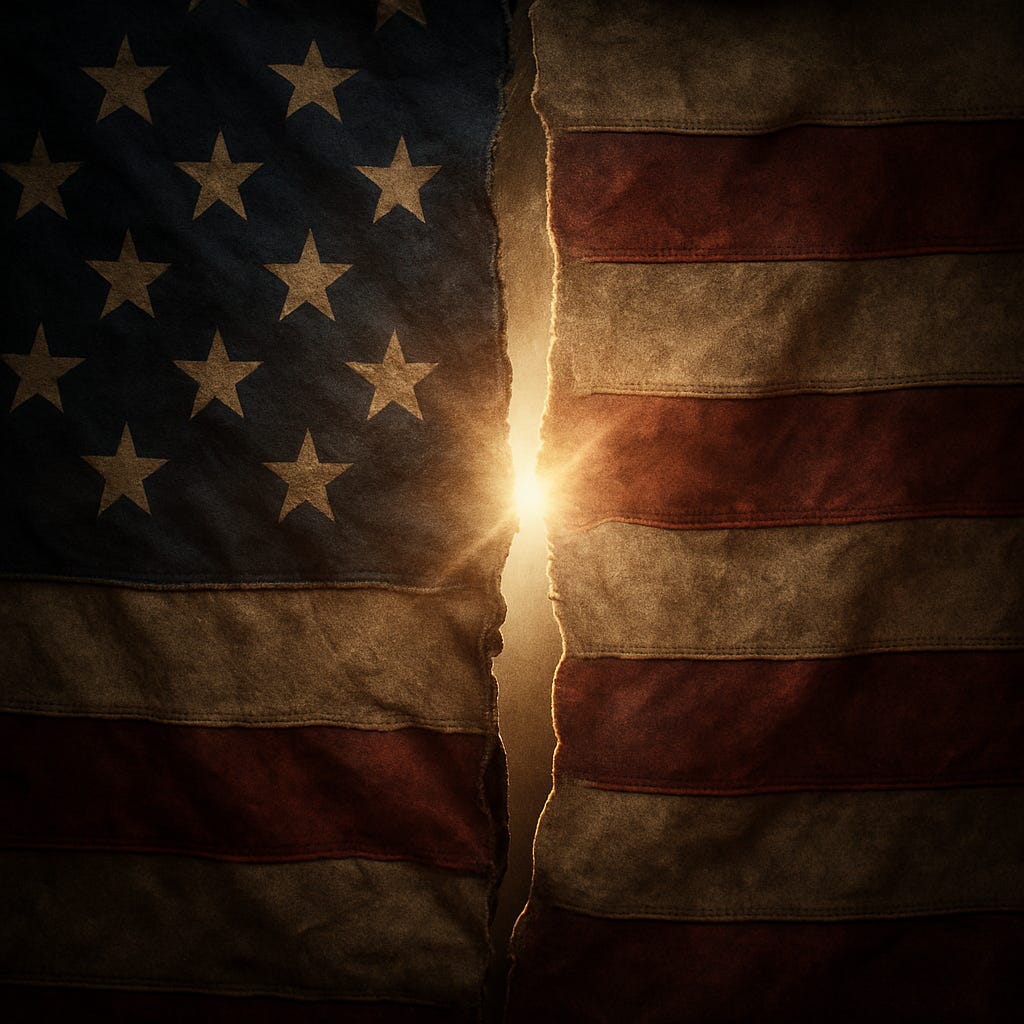
There comes a moment when a nation is not governed so much as performed. When the halves of its people are split so evenly that power itself becomes a coin flipped back and forth, heads for one tribe, tails for the other. In such an hour, the temptation is strong to feed the base—stoke the rawest instincts, flatter grievance, amplify resentment—because it is easier to rile half a people than to summon a whole nation. And so one path is paved in speed, intensity, and ruin. A government loved by its faithful but hated by its exiles is no government at all; it is a sect in power, brittle, besieged, already cracking. It rules over a landscape where half the citizens pray for its failure, where every success is met with suspicion, where every policy is interpreted as theft. Such a country has already surrendered the deeper contest, because unity is not an ornament of strength, it is its foundation.
This fragility is not abstract. It is something ordinary Americans feel in their lungs. It is as if the air itself has grown thinner, as if to live in the country today is to breathe through grief. To speak freely once gave relief, like opening a window. Now even silence feels heavy. This suffocation is not weakness; it is the testimony of millions who watch with heartbreak what the nation is becoming. Do not mistake their quiet for absence. They are here, watching, waiting, suffocating.
The danger is not only inward. For decades America could afford bickering and decadence in its discourse because it was the world’s uncontested superpower. But those days are gone. The world is shifting toward a multipolar order—China and Russia aligning, BRICS rising, the dollar’s dominance shaken, rivals thinking in decades while America stumbles from one partisan convulsion to the next. In such a moment, division is not just embarrassing; it is existential. A fractured people cannot withstand the slow, coordinated patience of rivals who act as one.
And yet the system seems determined to deepen the fracture. Authoritarianism does not begin with its ultimate cruelty; it begins with rehearsal. Freedoms stripped one by one, each step presented as necessary, each restriction as temporary, until the stage is set for the true performance. That is the deepest fear: that we are watching not just politics but a play in rehearsal, a society preparing its own sacrificial altar. Decline has its rituals. A nation that cannot renew itself begins to offer up its people instead, hoping appeasement will stay the gods of power. That is not renewal. That is surrender.
There is another path, but it is slower, lonelier, rarer. It asks leaders to refuse the intoxicant of polarization, to govern not by the gravity of resentment but by the fragile magnetism of shared hope. It is a harder art: appealing to the best instincts, not the worst; planting seeds that will not sprout before the next election; choosing the patience of builders over the applause of mobs. Such governance demands figures who are not swallowed by the fray, who are willing to be misunderstood, who carry within them a love that does not calculate. True patriots—men and women who will spend down their own futures so that the country might have one.
History remembers them with reverence precisely because they were so rare. Lincoln at the threshold of war, Mandela at the brink of vengeance—leaders who could have chosen the path of rage but instead chose the longer horizon of reconciliation. They did not win quickly, but they saved what could be saved.
The truth is stark. A polarized country that feeds on its divisions cannot outlast the century. Its people will be consumed by daily dread, its politics will become a theater of mutual sabotage, its rivals will wait patiently for the fruit to drop. Only the path of unity—difficult, unglamorous, sacrificial—offers endurance.
To govern a fractured people as one is not merely a political task; it is a spiritual calling. The call remains: resist the easier fire, walk the longer road, believe that a nation can still be bound together not by resentment but by its highest dream. The silent millions are not gone. They are waiting to breathe freely again.
—Elias WinterAuthor of Language Matters, a space for reflection on language, power, and decline.