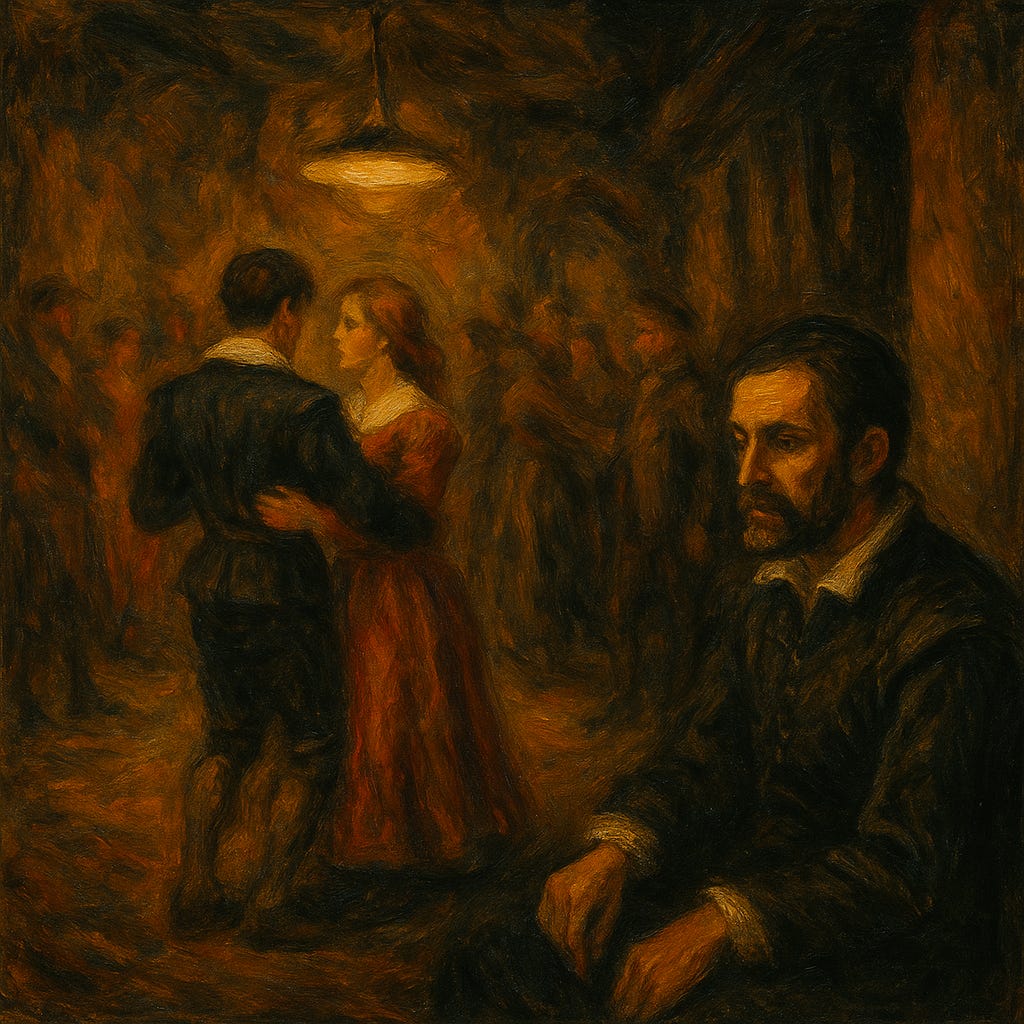
Part 1: The Floor
The room had its own kind of weather. Heat gathered low and rose in bursts when the strings carved a bright path through the noise. Bodies adjusted, fitting around each other. Shoulders learned the shape of strangers by touch. A boy who once believed he was invisible found himself seen—not because anyone knew his name, but because the night didn’t ask for one.
A circle opened and closed around a joke he missed. The air tasted of iron, citrus, and something old that burned clean. Light swung from a ceiling beam that kept its secrets. By the door, a woman laughed the way courage sounds before it knows it’s brave. Men answered with their hips. The floor answered with a thud—a second heartbeat under the feet.
In the far corner: a man who had come to listen. Not to the music exactly, but to what the music did to the room. He sat where he could see without being seen. He drank slowly. He didn’t dance. He watched the boy begin to live in his body again, like someone returning to a home they’d forgotten. He marked the moment, as if it were a line that might matter later.
If the law ever came, it would say nothing important happened here. And it would be right. Revolutions wear uniforms. This room wore sweat.
Part 2: The Noise
Before words, there’s how a room decides itself. Laughter draws the lines. Jeers smooth the edges. A pause becomes a treaty. The beat becomes a judge nobody chose. You know who belongs by how they land their vowels in time.
The boy steps in and feels the room answer back. A shoulder brushes his; a circle widens and forgets it did. A palm on his back isn’t a claim—it’s a bell: you’re here. And without trying, he stands a little taller.
Around him, people boast and joke in rhythm—sins forgiven by the beat. Desire shows up with manners, breaks them, then laughs at itself. The room keeps peace through glances and shifts—language without a choir.
In the corner, the listener is collecting something else. Not money—phrases. He repeats the last syllables people drop, tests how they break. If clean, he pockets them. If jagged, he files them down. He’s not chasing lines—he’s after hinges: places where the night swings between mockery and mercy.
People call this noise. He knows better. Noise is ore. Meaning is what happens after the heat and hammer.
Part 3: The Stranger
He was easy to overlook. The staff barely registered him—like a star you use for direction, not attention. If someone sketched the room, they’d leave out his chair, but it would feel wrong without that empty space.
He listened with his whole face. When someone threw out a line, he caught the last word, rolled it on his tongue, tested it for weight. If it rang, he kept it. If it clattered, he let it rest—failures deserve gentleness too.
A loud man tried to drag him into the dance, full of grin and dare. He rose just enough to be polite, then smiled: not tonight. not like this. The circle pulled the loud man back. The stranger returned to the art of not interrupting.
The boy, now lighter in his body, glanced at the corner. Their eyes met. No judgment, no purchase—only an inventory. Mercy in the gaze. The boy looked away first. The floor under him felt solid again.
The stranger drank without rushing. Watched without owning. If he took anything, it was with a thief’s courtesy: lift, polish, leave the room better than before. He looked like someone who keeps a promise with silence until words are ready to be true.
Part 4: The Law Arrives
Authority doesn’t enter. It interrupts. The door stutters, the beat trips, and a voice louder than its owner says: this joy is too much for the hour. Paper is held up like weather: unquestionable, unwelcome. The music stops midair. A held breath chooses between laughter and a fine.
Bodies shift into posture. Spines stretch as if truth were in standing tall. Smiles flatten to safe shapes. Circles loosen and pretend they were never circles. A prayer is muttered. Innocence is invented.
The listener watches the silence reveal everything: a joke surviving as an eyebrow, a hand hovering at the legal distance but still warm. He notices the loopholes the body hides under the tongue, the glances that rewrite the rules when paper grows teeth.
The inspectors leave with nothing. But they leave behind caution—a thin layer over the night. When music returns, it’s changed. Same tune, but narrower channels, reshaped by the rock that dropped in it. The floor accepts the edit, then slowly edits it back.
Order has a sound. So does relief. The room chooses both. Then chooses itself. The stranger marks where the law missed, and where it bruised. He pockets the difference and waits for the beat to remember itself.
Part 5: The Words
The stair was narrow—just wide enough for what mattered. He climbed, found an empty table, and made it his. From his coat he shook out a storm of scraps. Charcoal in hand, he listened again under better light.
He didn’t copy the night—he took it apart. Two drunks became one mouth with three moods. A woman’s laugh kept its blade but lost its liquor. The boy became a hinge—the moment of turning from ghost to guest. Once you name the hinge, you’ve named the door.
He tested words like coins. Some rang. Some thudded. He swapped endings for beginnings and watched meaning shift. Boasts softened in poor mouths. Insults turned honest when stripped of rhyme. He kept the broken lines, too. Everything returns somewhere—if you know how you stole it.
Below, the street rehearsed its future in wheels and hooves. On the page, a sentence found its breath, then another. He crossed out a pretty thought. Wrote a truer, uglier one that might last longer. This wasn’t inspiration. It was listening—again, and better.
When the room below swelled like a lung, he timed his lines to its breathing. Noise, relieved to be given a spine, settled onto the page.
Part 6: The Stage
Below, the room warmed up again. Heat rose. Sweat shimmered. The beat remembered its job. The boy—no longer a rumor—let his shoulder rest against another. Circles opened by a finger’s width—and didn’t close. Men, beautiful like scaffolding—useful, precise, proud—let him orbit closer. The night forgave him for once believing he had no gravity.
Above, the listener stayed with the page until it stopped arguing. He wrote like laying floorboards—testing for creaks, discarding the weak ones. He didn’t copy life. He built a place where life could speak without being arrested.
The floor below became a stage no one charged for: entries, exits, rhythm as choreography. A joke found its timing. Desire missed its cue but improvised beautifully. The bruise left by law learned how to dance.
A sentence drew another. A silence waited for applause that hadn’t happened yet. He shaped quarrels to fit bigger ones, tucked mercy into speeches, trimmed beauty so it could survive. Noise became chorus. Bodies became parts. The night agreed to pretend—so truth could tell itself clearly.
If you asked what he was making, he’d shrug: arrangements. He was a thief who returned things improved. He believed a city’s soul is a forgotten choir. His job was remembering. He folded the scraps, dried the ink, and listened—the room below was holding a long note. He could use that.
Part 7: The Name
The door pretended to resist. He pressed. The night let him through. Outside, the air carried ash, river, and the patience of scaffolding. He paused just long enough for the room to forget him, then stepped into an alley where the dark had its own grammar. The scraps in his pocket rustled like a private weather. He touched them, like checking a trusted pulse.
Behind the bar, a voice called—not a last name, just a name used when formality would be a lie. “Will!” He turned, the private smile keeping its promise to the future. Two fingers rose in a salute—farewell, or maybe a vow.
He walked on, past walls deciding whether to be a theater or a rumor. Past carpenters teaching wood the shape of listening. You could follow him with dates and kings and the math of plague years. You could list the speeches that make people braver for a night. You could trace how noise becomes chorus.
Or you could leave him here: a man who listened harder than he spoke, who arranged the night until it confessed, who returned what he stole improved. If you need the name, save it for the last line: William Shakespeare.