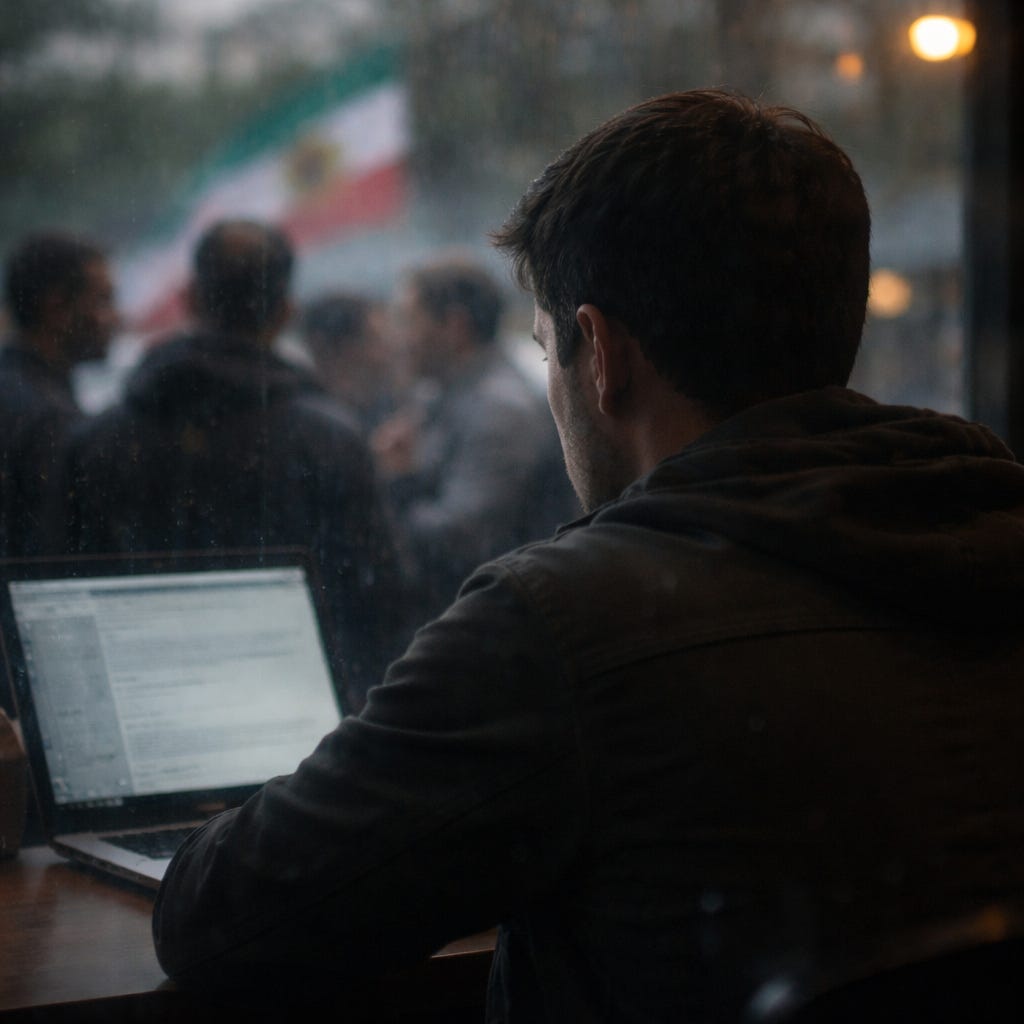
Prologue — The Voice Behind Him
It happens on a gray Saturday in Austin, in a café that takes coffee more seriously than most countries take elections.
Kian is doing what exiles do when they want to feel normal: pretending to work. A Jupyter notebook open, code cells half-finished, Slack blinking in another tab. He has almost convinced himself this is another weekend in another city when he hears it.
Persian.Loud Persian.Village-heavy Persian.
Two tables behind him.
“Didi Munich ro? Cheghadr crowd! Reza Pahlavi khodesh raft ro stage…”
He doesn’t turn around. The words draw the picture: a sea of Lion-and-Sun flags, a man on a stage in a winter coat, people chanting the name of the son of the king their parents overthrew. Someone filming vertically. Someone live-streaming for an audience of fifty.
The man behind him slips into broken English—“…you know, world is finally seeing…”—then slides back to Persian with the confidence of someone who has never had to read his accent in a stranger’s eyes.
They move on to Trump. They speak his name like a handle on a machine far above their heads. He hits, they say. He doesn’t play games. He will finally “finish this regime.” Their tone is half gossip, half liturgy—the way Iranians talk about foreign power when they are tired of their own.
Kian stares at his screen. The code blurs.
A sentence condenses in his mind, heavy and precise:
Neanderthals.
He doesn’t say it aloud. It pulses privately in his skull, a verdict with no right of appeal. He lowers his laptop volume to hear them better. If he is going to despise, he wants every detail.
I — The Country That Taught Him to Hate God
Kian is born in a country where God wears a uniform.
In school, Islam arrives as infrastructure. The day begins with prayer over the loudspeaker, recited in a tone that makes sacred words sound like a list of regulations.
His real instruction comes every Muharram.
Year after year, the same set: black banners, green flags, a man with a microphone on a plastic stage rehearsing Karbala like state-sponsored theater.
Husayn, righteous and outnumbered. Yazid, corrupt and victorious. Thirst, betrayal, martyrdom. The moral geometry is so clean it feels childish. We are the righteous. They are the wicked. We cry. We confirm the story. We repeat.
What he feels is not awe. It’s a crawling discomfort in his skin. He watches grown men whose faces twitch on cue, women whose wails sharpen when new people arrive, a reciter whose voice always cracks on the same syllable. The room smells of sweat and old speakers and forced feeling.
If he doesn’t cry, he is cold.If he doesn’t attend, he is suspect.If he questions the script, he is asking for attention from the wrong people.
He makes one serious attempt to feel what he is supposed to feel. He closes his eyes, pictures sand and tents and blood. His chest stays still. The only real sensation is the weight of the crowd’s gaze on his face, checking for tears.
The first time he sees the “guidance patrol” stop a woman for showing too much hair, he feels shame rise like heat, but it has nowhere to go. Shame for her. Shame for himself. Shame for living in a place where boys with badges can bark at his sister.
The Islam of his childhood is not a search. It is a schedule. Assemblies, sermons, uniforms, orders. The word “God” becomes tangled in the nerves that tighten his jaw and shoulders.
He learns early that whatever holiness is, it does not live in that tone of voice.
II — The First Constitution in the Desert
Years later, after airports, visas, and a new language, he tries something on a quiet night that would have been dangerous in his old life: he reads the story of Islam the way you read any other rise to power.
He has a mug beside him, a lamp, a laptop with too many tabs open. He scrolls through maps and timelines and feels something disturbing and familiar—like reading his own medical chart after years of being told to stop complaining.
Arabia in the seventh century is a patchwork of tribes. Blood debts, raids, local gods, caravan tolls. Far away, two great empires grind each other down: Byzantium and the Sasanians, worlds of tax codes and archives and road networks.
Muhammad appears first as a preacher in Mecca, a threat to the local economy of idols and shrines. Then he becomes the axis of a community in Medina. Authority gathers. Rules follow. Revelation expands from metaphysics into administration. Inheritance, contracts, war and peace—God starts speaking like a government.
Then the armies move.
Qadisiyyah, Nahavand—names he has seen in school as triumphs of faith, now read like symptoms of imperial exhaustion. The Sasanian army breaks. Ctesiphon falls. The king flees and dies on the run. An old state, with all its routes and ledgers and compromises, collapses in a handful of campaigns and bargains.
He feels a strange nausea reading it. He’d been taught it as destiny. On the screen in front of him it looks like what happens when a system has been fighting too long and somebody younger and hungrier shows up.
The conversion part is slower. Cities revolt. Garrisons are attacked. Local religion survives in pieces. Zoroastrians negotiate taxes, then slowly lose ground. Some leave for India. Some stay and watch their status erode, inch by inch.
Centuries later, the Safavids decide Iran will be Twelver Shia and hammer that choice into everyone’s calendar. Clerics gain rank. Shrines gain centrality. Borders are drawn in doctrine.
Beneath all of that, the language in Kian’s mouth still carries older roots.
Mādar, pedar, barādar—mother, father, brother. Sounds that have more in common with Sanskrit and French than with Arabic. He remembers his grandmother’s accent, the way she said these words, the way they felt safe in his throat. The realization lands: the sentence itself is older than the conquerors who used God’s name as a banner.
Nowruz reinforces the thought. Sabzeh, sib, sir, serkeh, sekkeh, samanu, somāq on the table every spring, the equinox arriving without consulting ministries. In his parents’ living room, a Qur’an sits next to a volume of Hafez on the Haft-Seen cloth like two reluctant coworkers forced to share a desk. The state can shout Islam through loudspeakers; the calendar shrugs and keeps its own time.
He sits back from the screen. The anger he feels is less about ancient battles than about continuity: a chain of men who used God and law to reorder other people’s lives, a chain that runs from deserts and courts into his own childhood classroom.
The realization doesn’t free him. It just makes his contempt older.
III — The Local God
Muhammad is the distant architect in Kian’s private indictment. Khomeini is the local contractor who brings the blueprints into his street.
The school version of the story paints in thick lines. Shah: tyrant. People: heroic. Exiled cleric: savior. The photographs are staged to feel inevitable—crowds, fists, flags, a plane landing with history on board.
In the apartment, the story looks smaller and meaner. Food lines. Quiet arguments that stop when a child walks in. Relatives who are suddenly “abroad” or “busy” and never fully reappear. News read between the lines because the lines themselves are lies.
The revolution was a broad front for a brief moment—Islamists, Marxists, students, nationalists, monarchists with better timing, all colliding. Then the clerical network, with its mosques and seminaries and habit of hierarchy, does what hierarchies do when power is loose on the floor.
Velayat-e faqih puts a jurist at the summit. Councils appear that can decide who may even approach a ballot. Courts inherit the language of sin and salvation. Friday sermons arrive through state channels. Islam sits on the country like a lid.
Kian feels the weight through his sister’s hair.
She grows up learning to map the city by risk. One street tolerates a loose scarf; another is patrolled by boys on motorbikes. Shop windows are mirrors and surveillance devices. The difference between a “good girl” and a “problem” is two fingers’ w…