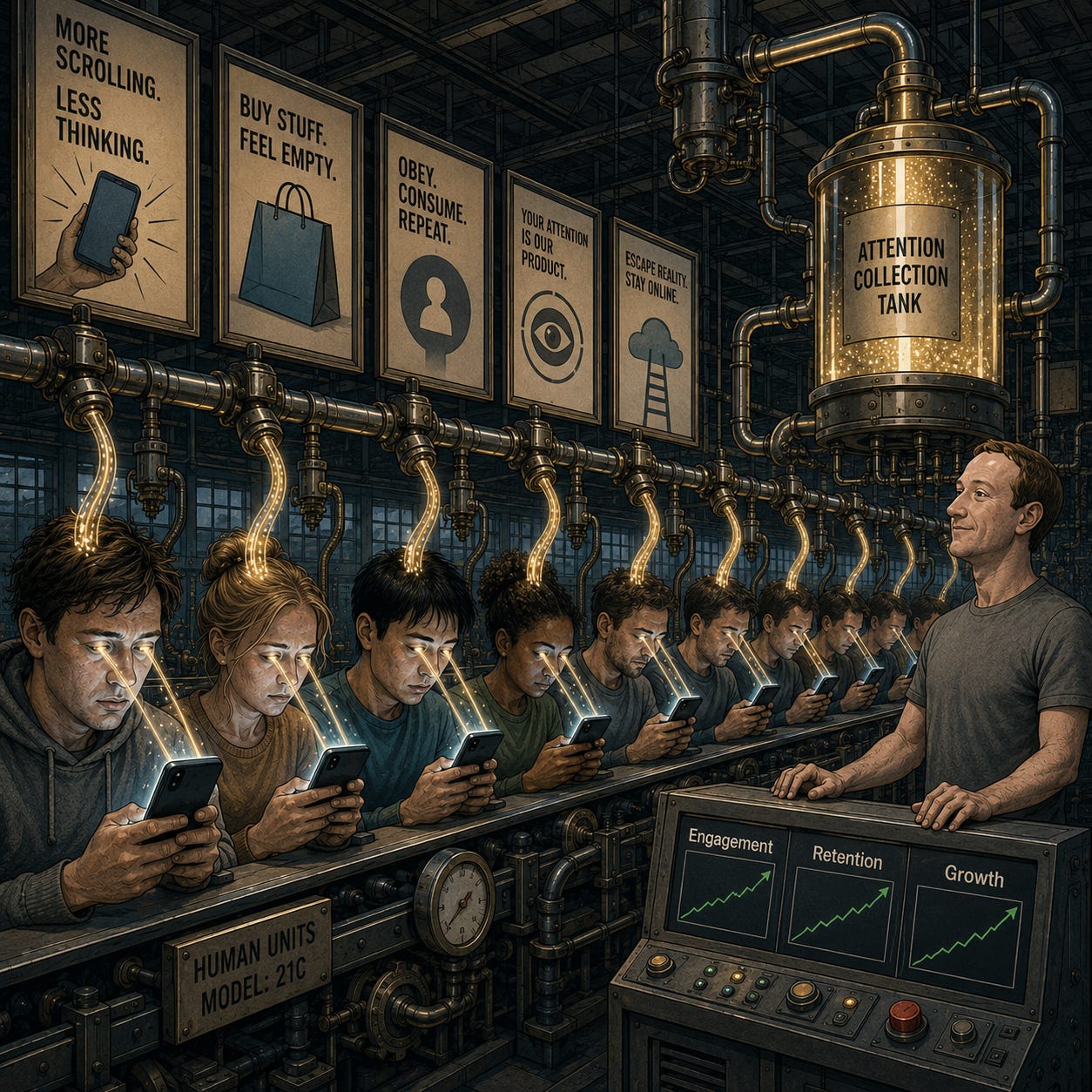
Opening: A Car, a Feed, and a Man in Pajamas
A car is not a saintly object.
It pollutes. It breaks down. It costs too much. It turns ordinary men into philosophers of parking. It gives suburban fathers an excuse to say things like “torque” while standing in driveways. And Henry Ford himself was, to put it with maximum charity, not exactly a walking retreat center of moral enlightenment.
Still, the car does something.
It takes a nurse to work. It takes groceries home. It takes children to school. It carries tools, luggage, medicine, grandmothers, dogs, plumbers, arguments, prayers, and the occasional bag of fast food whose smell will haunt the upholstery until the Second Coming.
The car has use. It moves a body through space. You can ask a simple question of it: does it start in the morning?
This is one version of capitalism: imperfect, often exploitative, sometimes brutal, but at least intelligible. Someone builds a thing. Someone buys the thing. The thing has a function. If the builder profits, we can argue about the profit, the labor, the wages, the factory, the supply chain, the pollution, and the grotesque tendency of rich men to believe that owning a factory makes them prophets. But the basic moral exchange remains visible.
Then there is the feed.
The feed does not take you to work. It prevents you from leaving for work.
The feed does not carry your groceries. It carries you, gently and invisibly, from one small humiliation to the next. It shows you your old classmate’s vacation, your cousin’s promotion, a stranger’s body, a celebrity’s apology, a war reduced to a graphic, a motivational quote from a person who appears to own seven bathrooms, and an advertisement for mushroom coffee that somehow knows you are spiritually tired.
No one wakes up in the morning and says, “Thank God Mark Zuckerberg has made it possible for me to see a man I barely knew in college standing beside an infinity pool with the caption ‘grateful for the journey.’”
And yet there we are.
Scrolling.
Not because the thing is useful in the ordinary sense. Not because it helps us finish a task. Not because we leave it with more dignity, attention, courage, or practical freedom. We scroll because the system has learned something about us that older capitalism could only dream of learning: our weakness is scalable.
That is the difference.
The old capitalist sold us machines.
The new oligarch made machines out of us.
1. The Old Capitalist at Least Had to Build the Damn Thing
There is no need to romanticize industrial capitalism. The old world of factories was not a village bakery run by cheerful elves. It was often dirty, violent, hierarchical, and cruel. It broke backs. It swallowed workers. It poisoned rivers. It produced fortunes large enough to deform politics and egos large enough to require their own weather systems.
But industrial capitalism had one important constraint: matter resisted it.
If Ford wanted to sell another car, Ford had to build another car. That meant steel, rubber, glass, engines, workers, machines, roads, rail, oil, distribution, dealerships, repairs, and all the unglamorous friction of the physical world. The car had to be assembled. It had to be shipped. It had to occupy space. It had to survive weather, gravity, and the terrifying moral battlefield known as the American commute.
The old capitalist could be greedy, but he still had to wrestle with matter.
He could dream of dominating the market, but the world pushed back. Every additional unit required resources. Every factory required labor. Every vehicle required parts. Scale was possible, but it was heavy. It was slow. It had mass.
Then came the digital platform, and capitalism discovered a lighter form of empire.
Once the platform exists, the same basic behavioral machine can be replicated across millions, then billions, at comparatively low marginal cost. The feed does not need a new engine for every user. It does not need a steering wheel, tires, seatbelts, or a catalytic converter. It needs servers, software, data centers, behavioral engineers, advertisers, and a sufficiently large population of lonely mammals willing to donate their attention in exchange for tiny electric feelings.
The car at least had the courtesy to require steel.
The feed only requires my weakness.
This is not a minor technical distinction. It is a moral one. Digital scale removes much of the friction that once tied profit to production. The old capitalist accumulated wealth by producing more of the thing. The new platform capitalist accumulates wealth by duplicating the same environment of capture across every available human nervous system.
That does not mean all digital scale is evil. Scaling useful software, medical infrastructure, search tools, education, logistics, or open knowledge can be a genuine social good. The problem is not scale by itself.
The problem is what gets scaled.
If you scale a tool, you may expand human agency.
If you scale a trap, you expand captivity.
And the modern internet oligarch, in his most profitable form, is not merely scaling technology. He is scaling the conditions under which human beings become easier to distract, measure, predict, agitate, and sell.
That is not ordinary entrepreneurship.
That is industrial psychology with a payment processor.
2. The Product Appears to Be Free, Which Is Usually When You Should Check Your Pockets
The first genius of the platform is that it appears to cost nothing.
No one hands over money to scroll. There is no cashier at the entrance of Instagram. No teenager enters a credit card before comparing her body to a stranger’s edited beach photo. No tired man pays three dollars to lose half an hour watching people argue about politics under a video of a dog.
The product is free.
This should make us suspicious.
When a thing is free, the question is not whether there is a price. The question is where the price has been hidden.
The user thinks the product is the app. Facebook. Instagram. TikTok. X. Whatever glowing rectangle currently has humanity tapping glass like lab pigeons with better shoes.
But the user is not the customer.
The advertiser is the customer.
The user is not buying the product. The user is being prepared.
He is being classified, softened, agitated, stimulated, sorted, measured, and delivered. His attention is packaged. His habits are studied. His insecurity is mapped. His social graph is analyzed. His desires become predictions. His pauses become signals. His boredom becomes inventory.
This is where the moral structure changes.
A useful product helps you complete a task and leave.
An engagement product wins when you cannot leave.
A hammer does not become more profitable because you compulsively hold it for six hours. A washing machine does not send you notifications asking whether you have considered washing just one more sock. A car company does not increase revenue because you sit in your driveway turning the ignition on and off while comparing yourself to your cousin.
But a platform becomes more valuable the longer you remain inside it.
Its business model is not satisfied by usefulness. It requires duration. It requires return. It requires compulsion dressed as participation. Its favorite user is not the one who arrives, accomplishes something, and leaves. Its favorite user is the one who forgets why he arrived.
This is the difference between use-value and engagement-value.
Use-value asks: did this thing help the person live?
Engagement-value asks: did this thing keep the person available?
That is the great moral reversal of the platform economy. The system does not need to make you better. It needs to keep you present. It does not need to strengthen your agency. It needs to occupy it. It does not need to serve your life. It needs to insert itself between you and your life, then sell the view to advertisers.
This is why the phrase “free product” is so obscene.
It is free the way a casino buffet is free. It is free the way the first taste is free. It is free the way the hook is free.
You are not payi…