Chapter 1: The Borderless Child
He learned early that belonging was not a place but a mood other people could withdraw without warning.
In the first city, the adults spoke with the confidence of a tribe that had never been questioned. Their words arrived like stamped coins, polished by centuries of repetition. He loved the sound of them, but he could never quite spend them correctly. His vowels were always a half-step off. His jokes landed in the wrong weather. When he asked for something simple—water, directions, a name—he could feel the room deciding whether to help him as a person or tolerate him as a task.
His mother instructed him in survival the way some parents taught prayer. Don’t correct people in public. Don’t speak too fast. Don’t sound too certain. Certainty, she warned, was a local privilege.
He was still a boy when he learned to read faces in the way other boys learned to read maps. The man behind the counter who brightened if you used the right greeting. The teacher who softened when you pronounced the street name correctly. The neighbor who became generous when you proved you understood a rule you hadn’t been told.
This was the first education: not math, not history, but the invisible grammar of acceptance.
In the second city, everything looked familiar and felt wrong. The signs were new, the air sharper, the light less forgiving. Here, he was not the foreigner in speech so much as the foreigner in posture. The boys carried their certainty in their shoulders. The girls walked with a kind of inherited ease. He moved the way someone moves when they are conscious of the floor.
When the others mocked him, it was rarely cruel. That was the confusing part. It was casual, almost affectionate—like teasing a cousin who could be tolerated as long as he remained funny, grateful, and small.
He became funny.
He learned the advantage of self-deprecation. He learned that you could buy a temporary membership by being the first to criticize your own differences. He learned that if you’re quick enough to punish yourself, the world might not bother.
But the humor cost something. Each laugh was a coin taken from a future self who would someday need to stand tall without apology.
His father, when present, was a man of rules that arrived without explanation. He believed in clarity as obedience. The boy learned to obey the rules without believing in them. This was another kind of exile: not between countries, but between a child and the idea that power could be trusted.
He started walking long loops after school, alone. Not because he was lonely—though he was—but because solitude gave him a way to breathe without auditioning. In a strange neighborhood, he could be nobody. Nobody was safer than the wrong somebody.
One afternoon, he paused at a small market where an older man sold fruit outside the door. The man spoke to him in a language the boy knew imperfectly. He asked where he was from. The boy offered the safest answer: the one that required the least story.
The man nodded and handed him an orange without charge.
“Eat slowly,” he said. “Let the sweetness teach you where you are.”
The boy carried that sentence for years without knowing why.
It wasn’t the kind of advice that helped you pass an exam. It wasn’t the kind of kindness that attached strings. It was something rarer: a blessing without a contract.
The third place arrived later, at the age when belonging is supposed to be effortless. University buildings, new cities, new ambitions. He expected a version of freedom. Instead, he found a subtler ledger.
Now the test wasn’t accent but pedigree. Not vocabulary but optimization. People asked what he studied with the politeness of someone already calculating your usefulness. Even kindness seemed indexed to potential.
He was extremely good at this game.
The best students respected him. The clever ones invited him into their circles. Professors cited his work. He began to experience a version of safety earned through excellence.
But excellence is not belonging. It is a visa.
He could feel it in the moments of silence after a conversation turned toward politics or identity. The tiniest pause that said: we like you, but we are still deciding what you are allowed to be.
He noticed that the students who were born into the culture could afford to be sloppy. Their mistakes didn’t threaten their membership. His mistakes felt like confirmations of doubt.
This is what he never said aloud: the fatigue of living under audition.
And yet, something in him was quietly sharpening.
Because exile does that to the attentive.
It makes you a student of systems. It forces you to distinguish between invitation and tolerance, between love and convenience. It teaches you that language is power not because it persuades but because it confers reality.
In his early twenties, he began to write—not publicly, not yet—but with the intensity of someone building a home out of sentences. He didn’t know he was doing it. He thought he was just thinking on paper.
But the writing had a different purpose.
When the world was inconsistent, the page was not.When people’s recognition flickered, the document did not.When belonging felt like a borrowed coat, language began to feel like skin.
He started to suspect that identity was not something you were given by a city or a family or a state. It was something you built in defiance of being misplaced.
Years later, someone would ask why he spoke with such unembarrassed clarity, why he refused the easy flattering compromises that make a life smoother.
He would give a short answer.
Because he had been borderless since childhood.Because he already knew what it cost to shrink.Because the only way to survive exile without becoming bitter was to become real.
And because he had learned, long ago, from an old man with oranges and a sentence like a lantern:
Let the sweetness teach you where you are.
Not the sweetness of approval.The sweetness of truth told slowly.The kind that doesn’t need permission to exist.
Chapter 2: The Offer of the Balcony
The invitation arrived disguised as praise.
A woman with a reputation for spotting talent asked him to meet her after his lecture. She was older than him by a generation, composed in the way of people who had long ago learned how to turn rooms into instruments. She congratulated him on the clarity of his argument, the calmness of his delivery, the rare talent of unsettling an audience without humiliating them.
“You have something,” she said. “And I don’t say that lightly.”
He thanked her, wary of how often compliments were the opening move in a negotiation.
They walked to a café near the square. Outside, the city was preparing for a seasonal festival. Banners hung from lampposts. The smell of roasted meat and sugar drifted through the air. He watched people arriving from suburban edges and rural roads, dressed as if pleasure itself were a civic duty.
She ordered tea. He ordered nothing.
“I’m going to be direct,” she said. “You’re ready for a larger stage.”
He’d heard versions of this before. The offer of elevation was never just about opportunity. It was about jurisdiction. Who would be allowed to quote you, frame you, claim you.
“There’s an upcoming televised forum,” she continued. “It will be watched by people who matter. Ministers, donors, editors. They want someone who can speak about social cohesion, national unity, the dangers of polarization.”
He stayed quiet.
“You could be that voice,” she said. “You already are that voice. You just haven’t been introduced properly.”
He heard the last phrase as a threat and a promise at once.
She slid a folder across the table. Inside was a suggested outline. There were lines he recognized from his own work, but softened, rearranged, edited into something safer. His arguments had been turned into a domesticated animal. Still recognizable. No longer dangerous.
He looked up.
“This isn’t my language.”
“It’s adjacent to your language,” she said pleasantly. “Think of it as translation. People don’t like being accused. They like being guided.”
He couldn’t help smiling.
“Guided to what?”
“To a version of your message they can accept.”
That was the heart of it. The old bargain: truth in exchange for access.
She leaned in slightly, like someone about to offer advice to a younger relative.
“You don’t need to be less yourself. Just… less sharp. You can say everything you want, but you’ll need to stop naming the culprits so plainly. You’ll need to frame it as shared responsibility rather than structural betrayal. You’ll need to speak in the language of hope.”
He opened the folder again. The edits were not large. That was what made them frightening. Each change was a small surrender that could be defended as pragmatic.
He knew the logic.
No one loses their integrity in a single explosion. They lose it by a series of reasonable accommodations.
“What happens if I refuse?”
She gave him a look of genuine astonishment, as if he had asked what happens if you refuse oxygen.
“You won’t be punished,” she said. “That’s not how it works. You’ll simply remain… local.”
Local. The polite word for invisible.
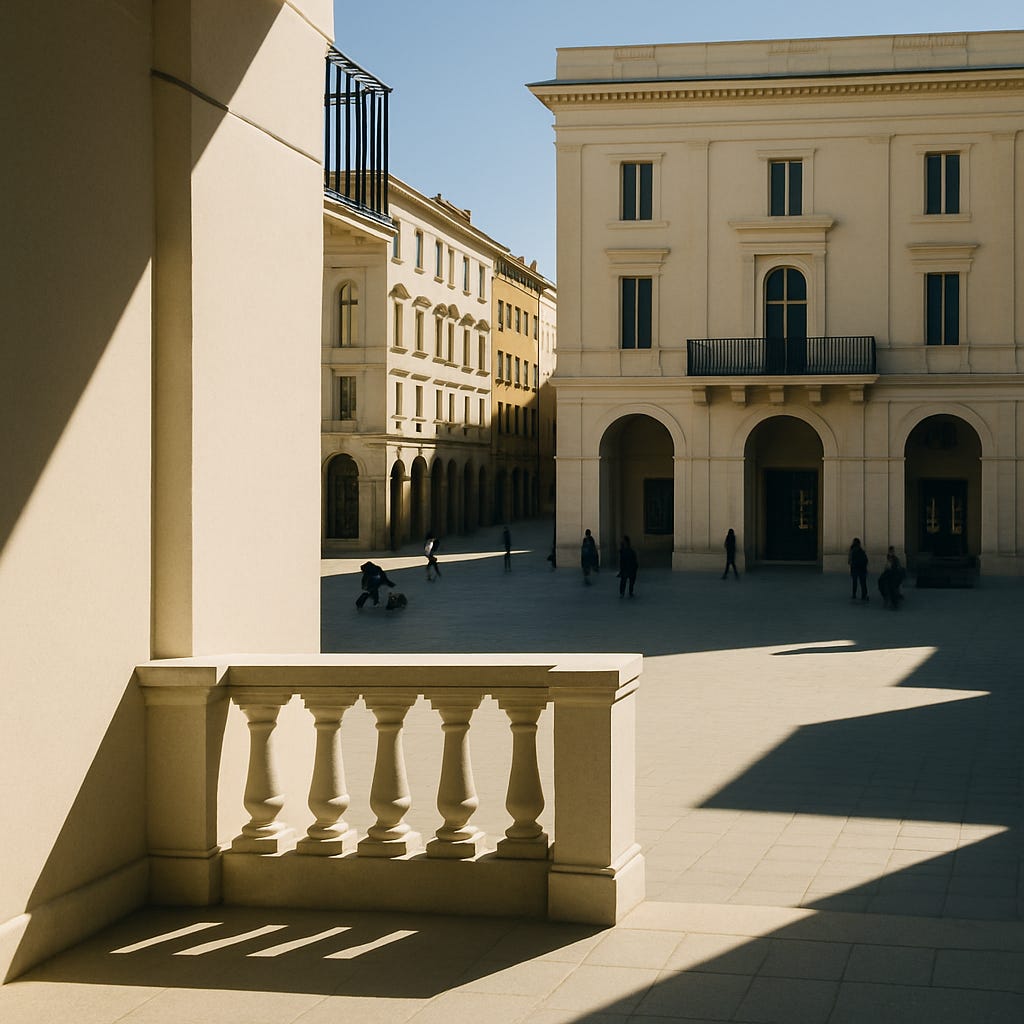
He walked with the folder back to his apartment. On the way, he passed the festival scaffolding. A new balcony had been built over the square for the opening ceremony. Workers were hammering railings into place. The Mayor’s office would stand there in two days, smiling at the city like benevolent parents.
The balcony was a symbol of sanctioned visibility.
Later that night he spread the pages across his desk and tried to imagine himself reading them on air. The words were close enough to his to tempt him. He could hear the applause that would follow. He could also hear the internal quiet that would die afterward.
He had known men who took this path. They became “voices of reason.” They were invited to committees. They were quoted by people they once criticized. Their excellence became a passport out of conflict and into comfort.
And slowly their sentences began to sound like everyone else’s.
He slept poorly.
In the morning he met his friend at a small gym on the edge of town. They lifted in silence for a while. The friend finally asked why he looked like someone who had been asked to betray a family member.
He explained the offer.
“Take it,” the friend said immediately. “You’ll reach more people.”
“I’ll reach more people with a diluted signal.”
“Isn’t some good better than none?”
That question would haunt him later, because it was not stupid. It was the rational question of the modern world. The world is run by compromise engineers.
But he had lived long enough to know the difference between strategy and self-erasure.
The problem wasn’t that the outline was wrong.
The problem was that it was trying to make him safe for the very structure he believed was lying.
By noon he had decided.
He called the woman and thanked her. He said he was honored. He said he understood why the forum mattered. He said he hoped it would go well.
Then he said:
“I can’t speak in a language that makes the truth sound like a misunderstanding.”
There was a pause.
“Are you sure?”
He disliked that question more than any insult. It implied he was naïve, proud, juvenile — a man refusing adulthood.
“Yes.”
She did not argue. She did not threaten. She did what experienced gatekeepers do when they encounter refusal.
She cooled.
“I respect your principles,” she said, which was not true.
After the call ended, he felt a burst of panic. The kind that follows any irreversible choice. He walked to the window and watched the city as if it were a landscape he might never be allowed to inhabit again.
Then something steadier replaced the panic.
He realized that what he had refused was not merely a forum.
He had refused a new identity: the man whose truth exists only inside permission.
In the evening, he returned the folder to the café. He left it with the barista, unopened, as if returning an object that had been accidentally mailed to the wrong address.
As he walked home, the workers were still building the balcony.
He stopped, studied the structure, then kept moving.
He had no desire to stand above the square if the price of height was silence in his own chest.
He would remain local for now.
But he would remain intact.
And that, he suspected, was the only kind of platform worth the cost.
Chapter 3: The Unpaid Sentence
He didn’t mean for it to become a confrontation.
He had been invited to speak at a university hall that smelled faintly of dust and espresso, the kind of place where the chairs were old but the confidence was new. The theme was announced with the careful optimism of institutions that prefer their conflict abstract: Cohesion in Uncertain Times.
The panel before him was polite and practiced. A policy analyst spoke about incentives. A sociologist spoke about polarization. A local official spoke about “restoring trust.” Each sentence was engineered to offend no one in the first row.
When his turn came, he began quietly.
He talked about how the public learns what is allowed by observing what is rewarded.How cruelty can be normalized without anyone ever ordering it.How language does not merely describe reality but administers it.
The room remained attentive.
He then made one mistake.
He named the structural lie plainly.
He said that a society cannot demand sacrifice from ordinary people while building escape hatches for the powerful. He said that when the elite withdraw from shared risk, they withdraw from shared moral duty. He said that the fracture is not merely cultural but contractual.
The air changed.
Not dramatically. Not like a protest.More like a thermostat turning down.
Afterward, a man with a tailored coat and a gentle smile approached him. The man introduced himself as a board member of a civic foundation that funded community programs and research chairs. He shook his hand with the warmth of someone who had learned friendliness as a technique.
“Strong talk,” the man said.
“Accurate talk,” he replied.
The man laughed politely.
“What I admire about you,” the man continued, “is that you clearly care. But you might consider how your framing lands.”
The words were soft. The intent was sharp.
He waited.
“You could say all the same things,” the man said, “without implying blame. People are exhausted by accusation. What they need right now is unity.”
There it was again: unity as anesthesia.
He asked the question he already knew the answer to.
“Which part sounded like blame?”
The man held up a hand in the posture of reason.
“I’m not saying you’re wrong. I’m saying your approach could be more constructive. These are sensitive times. There are grant cycles. Partnerships. Public trust.”
The implication hovered just below the surface.
We can help you.But we can also starve you.
He felt a familiar irritation rise in his chest—not anger yet, but the pre-anger of a man who knows he is being asked to buy acceptance with self-revision.
Another person joined them, a woman from the department who had organized the event. Her smile was sincere but strained, the smile of someone trying to keep two realities from colliding in public.
“Your talk was powerful,” she said quickly. “I hope you’ll be open to a few tone adjustments for the next one.”
A few tone adjustments.
It was always a few.
He understood the negotiation perfectly. He had lived inside it his entire life.
One does not silence truth directly in modern institutions.One drains it.One refines it into harmlessness.
He nodded politely and excused himself.
Outside the hall, evening was settling over the campus. Students were laughing under trees as if history were a rumor and the future a guarantee. He walked slowly to the edge of the quad, where a small fountain wore a circle of winter leaves.
His friend called him then—an old companion from an earlier chapter of his life, a man who had survived by becoming useful to every room he entered.
“You stirred it up,” the friend said with amusement.
“Apparently.”
“Why do you do that to yourself?”
It was not a hostile question. It was the question of a man who had learned to bargain with reality.
“You could be ten percent softer and get a hundred percent more access.”
He leaned against the cold stone rim of the fountain.
“I’m not interested in access that requires self-erasure.”
The friend sighed.
“You’re not wrong. But you’re choosing isolation.”
He didn’t correct the word. He understood it.
Later that night, he reviewed his notes for an essay he had been drafting. He read a sentence out loud and felt the old temptation: to make it easier, kinder, more digestible.
He crossed out two words.Then wrote them back.
It was not pride.It was a refusal to participate in the ritual of polite falsification.
The next week, the woman from the department emailed him.
She thanked him again. She said the event had been well received.Then she offered a second invitation—this one at a higher-profile forum with press coverage.
He read the conditions.
A preview of his remarks was required.Certain terms were discouraged.The framing should emphasize “shared responsibility.”
The sentence he wanted to write back was simple and reckless:
If responsibility is shared, why does punishment land so unevenly?
Instead, he wrote something shorter.
“I’m grateful for the invitation. I can’t submit my conscience for pre-approval.”
He clicked send.
A minute later his phone buzzed.
A single line from a colleague:
“You’re brave.”
He disliked that word almost as much as he disliked “tone adjustments.”Brave suggested theatrics.He was not trying to be brave.
He was trying to remain coherent.
That night he walked through his neighborhood in the dark, thinking about the cost of the sentence that had caused the shift in the room. He realized the cost wasn’t that he might lose invitations. The cost was that he would be forced to watch people translate his refusal into pathology.
He would become:
* difficult
* rigid
* impractical
* angry
* uncollaborative
* unsafe for institutional harmony
The system always needs a story that makes truth-tellers seem irrational.
He arrived home and opened his notebook.
He wrote a line he knew he would return to again:
Some sentences are expensive because they refuse to be purchased.
He had no guarantee that the world would reward that refusal.
But he had learned the most dangerous form of poverty is not material.
It is the poverty of living in a voice that is no longer yours.
So he kept the sentence.
Unpaid.
Uninsured.
Intact.
Chapter 4: The Room That Went Quiet
The silence wasn’t hostile.
That was the cruelty of it.
If they had shouted, he would have known where to stand.If they had attacked him publicly, he could have answered publicly.
But this was a more civilized erasure.
After the lecture, he kept receiving polite messages.
Excellent points.Provocative in the best way.Important conversation.
The words were warm. The invitations were not.
A month passed. Then two.
A colleague he used to see weekly stopped replying to casual texts. Another who had once quoted his work in meetings began citing older sources instead, as if his ideas had become suddenly contagious.
He watched the change with the kind of calm that comes when you’ve lived it before.
The first time he had experienced this pattern was in childhood. A group of boys who had liked him until he corrected one of them too sharply. The friendship didn’t end with a fight. It ended with a slow reconfiguration of space. The bench that was once shared became subtly unavailable. The laughter continued without him. The story of the group revised itself as if he had been a temporary character.
Now the same mechanics were operating in adult clothing.
He attended a small reception hosted by a cultural institute. The room was filled with the careful confidence of people who liked to think of themselves as guardians of reason. Wine was served in thin glasses. The conversations were constructed from safe scaffolding: climate, infrastructure, civic renewal.
A woman he admired approached him with practiced brightness.
“I’ve been meaning to congratulate you on your recent work.”
He thanked her.
“You’re doing something important,” she said. “I hope you’ll keep going.”
“You say that as if you aren’t sure I will.”
She smiled too quickly.
“Oh, you know what I mean.”
He did.
Important public language is often a substitute for personal allegiance.
He drifted across the room.
Two men were speaking with intense interest about a forthcoming initiative. He recognized one of them, a senior figure who had once asked to meet him privately to discuss ideas. When he approached, the men smiled and shifted their bodies slightly, as if welcoming him into a space that would close again the moment he stepped away.
He offered a brief comment on the initiative’s framing.
The senior figure nodded politely.
“That’s thoughtful,” he said. “We’ll need to be careful with messaging.”
The other man added, with a laugh:
“Some truths are better introduced gradually.”
It was said lightly. That was the point.
He looked at them long enough to let the sentence hang between them.
Then he said:
“Gradual truth is often just delayed honesty with a career plan.”
The senior figure’s smile thinned.
They changed the subject.
By the end of the evening, he had spoken to a dozen people and felt the same faint chill from each conversation. No one was rude. No one was explicit. But everyone had moved him into a new category.
Not enemy.
Not ally.
Risk.
When he arrived home, he sat at his desk and checked the email he already knew would be empty. He had been waiting for a response from a committee about a fellowship that would have funded the next year of his research and writing.
He knew the decision had probably been made weeks ago.
The reply arrived the next morning.
Grateful for your proposal.Highly respected work.Many strong applicants.Not able to move forward at this time.
He read it twice.
A rejection is not always a rejection.Sometimes it is a message delivered in the language of administrative neutrality:
Your ideas create heat we don’t want to manage.
He walked to a café and brought a notebook. The barista recognized him and asked about his writing. The barista was young, earnest, disorganized in the way of people who had not yet learned to armor their curiosity.
“Are the essays going well?”
“Some days.”
“I read the last one. It was… hard. But good hard.”
He nodded.
The barista hesitated, then added:
“My father hates that kind of writing.”
“Because it makes him feel accused?”
“Yes.”
“Does it accuse him?”
“No. It just makes him feel like he can’t stay asleep.”
He almost laughed.
That was the most precise review he had heard all year.
He left a generous tip and sat by the window.
This was the hidden economy of clarity:
It does not only offend people.It destabilizes the comfortable arrangement they had with themselves.
So the social system responds with a quiet quarantine.
He remembered the woman who had offered him the big televised platform.He remembered the board member who suggested shared responsibility.He remembered the department organizer asking for tone adjustments.
None of them had tried to silence him directly.
They were simply training him to understand the penalty for refusing translation.
By mid-afternoon he had decided to stop checking for invitations.
If his role in the public ecology was to be a local contagion, then he would accept it and build a different kind of power.
Not the power of rooms.
The power of texts.
He wrote a new essay that night.
He used simpler language than usual. Not softer — simpler. He wanted the argument to be impossible to mishear. He wanted sentences that could leave the page and travel without him.
Halfway through, he paused.
A thought arrived like a diagnosis:
The system does not fear your anger.It fears your calm.Because calm truth cannot be dismissed as hysteria.
He underlined it.
He finished the essay before dawn.
When he woke later that morning, the loneliness arrived almost on schedule. It wasn’t the loneliness of having no people. It was the loneliness of being invisible to the people you had once assumed were part of your future.
He did the only thing that reliably steadied him.
He went for a long walk.
At the edge of the city, there was a small park with a footbridge over a narrow river. He stood there for several minutes, watching the water move with indifferent patience.
He understood something he had resisted:
Silence was not merely a consequence.It was a sorting mechanism.
It separated those who loved your clarityfrom those who loved your usefulness.
He couldn’t change that.
He could only decide what kind of life to build inside it.
As he turned back toward home, his phone buzzed.
A message from a stranger.
“I don’t know who else is writing like you. I needed this.”
He read it twice.
The room had gone quiet.
But somewhere, beyond the visible architecture of status,the real audience was gathering.
Chapter 5: The Kindness That Doesn’t Kneel
He had learned to distrust public mercy.
Not because he disliked kindness, but because he had seen how quickly kindness could become a stage.
There was a certain type of generosity in the city—clean, photographed, and carefully narrated. It was the kind that required an audience. Volunteers wore matching shirts. Donors received plaques. Even the poor were arranged into grateful silhouettes.
He understood why it existed. People needed meaning. Institutions needed legitimacy. But he’d always been unsettled by the way the transaction was disguised as virtue.
One afternoon he was walking through a district that most of his colleagues only visited in daylight and with the rhetorical caution of sociologists. The buildings had the tired geometry of long neglect. A grocery store with more security cameras than produce. A pharmacy where the glass barrier between customer and cashier felt like a constitutional statement.
He was crossing an intersection when he saw a man sitting on the curb, a grocery bag torn beside him. A few oranges had rolled into the street. Drivers swerved around them with irritated precision.
The man wasn’t old, but he looked prematurely exhausted—like a life that had required too many calculations too early.
A woman in a blazer stepped onto the curb and looked down at him. She said something the way people say something when they want credit for having said it.
“Are you okay?”
The man nodded without conviction.
She reached into her bag, pulled out a ten-dollar bill, held it out, paused until she was sure someone nearby could see, then placed it gently on the sidewalk as if feeding an animal that might bite.
She left quickly.
He watched the man stare at the bill.
He had seen this pattern before. Not in that exact form, but in its anatomy.
The giver retains dignity.The receiver is left to perform gratitude.The exchange is morally asymmetrical.
He walked over and crouched.
“You dropped these,” he said, picking up the oranges and placing them back into the bag.
The man squinted up at him.
“Thanks.”
He noticed the bruise along the man’s wrist. The faint tremor in his hand. The way the man’s eyes tracked the street not for danger, but for humiliation—the subtle vigilance of someone who has learned that poverty is not just absence of money, but presence of judgment.
He didn’t ask for the man’s story.
Stories could become another form of extraction.
Instead he asked a simpler question.
“Do you need a ride?”
The man hesitated, calculating risk.
“No,” he said. “I’m fine.”
The word fine carried the exhaustion of people who have been forced to say it a thousand times.
He nodded, then sat on the curb a few feet away.
The man glanced at him with suspicion.
“You don’t have to sit here.”
“I know.”
The silence settled between them.
After a minute the man said, almost defensively, “I’m not begging.”
“I didn’t think you were.”
Another minute.
“What do you do?”
He considered the truth and chose a version that would not create distance.
“I write.”
The man looked unimpressed.
“About what?”
“About how people survive things that aren’t supposed to be survivable.”
That got the first real look.
The man exhaled.
“I used to work the docks,” he said. “Then my shoulder… then the pills… then the layoffs.”
He said it without melodrama. Like a man reading an invoice he did not create.
He listened without the reflex to moralize. He had learned that some lives were crushed not by a single catastrophe but by the slow grind of systems that never appear in headlines.
He thought of the polished panels he had attended. The conferences about national renewal. The smiling promises that never seemed to touch this curb.
He asked the man where he lived.
Two bus lines away. A small apartment with a cousin. Temporary enough to feel permanent.
He opened his phone.
“There’s a clinic a few blocks over that has a sliding scale,” he said. “Not perfect. But better than nothing. Want me to walk with you?”
The man studied him as if searching for the hidden string.
“Why?”
The question was not cynical. It was wounded.
He could have given the easy answer.
Because it’s the right thing.Because you’re a human being.Because we’re all in this together.
Instead, he gave the honest one.
“Because I’m tired of living in a world where we pass each other like obstacles.”
They walked together.
Inside the clinic, the waiting room was crowded with the quiet kind of suffering that doesn’t ask permission to exist. A receptionist handed them forms with the automatic fatigue of someone who had become the gatekeeper of limited mercy.
The man leaned toward him.
“I don’t have all my paperwork.”
He felt anger rise—not at the receptionist, not at the clinic, but at the architecture that makes care feel like a test.
“We’ll fill what we can,” he said.
They did.
When the appointment was scheduled, the man looked relieved but embarrassed, as if relief itself required an apology.
Outside again, the man turned toward him.
“I can pay you back.”
He shook his head.
“This wasn’t a loan.”
The man frowned.
“Then what is it?”
He paused.
“A refusal.”
“A refusal of what?”
“A refusal to pretend this is normal.”
The man looked at him as if he had said something dangerous.
“People don’t talk like that,” he said.
“I know.”
They stood for a moment in the late afternoon light.
The man’s shoulders loosened slightly, not because his life had been solved, but because he had been treated like a person whose dignity did not depend on performance.
As they parted ways, he felt an odd sensation—a familiar one he had never fully explained.
Mercy was not soft.Real mercy had edges.
It didn’t kneel to power.It didn’t ask permission from ideology.It didn’t require the poor to be inspirational.
It was quiet.Precise.And unwilling to be used as decoration.
That night, he wrote two lines in his notebook, not for publication, just for keeping his own conscience sharp:
Pity is a spotlight.Dignity is a chair you pull up and sit in beside someone.
He knew the city would not reward that kind of mercy.
It was too small to be branded.Too quiet to be advertised.Too honest to be absorbed by institutions.
But that was exactly why it mattered.
Because in an age of public virtue and private abandonment,the only kindness worth anything was the kind that didn’t need to be seen to be real.
Chapter 6: The Woman With Empty Hands
She was not invisible in the literal sense.
People saw her every day.
They just didn’t register her as a person who could change the temperature of a room.
She worked in a building that produced the modern kind of importance: metrics, decks, grants, memos written in the dialect of urgency. The lobby was all glass and polished stone, a temple to competence. She was there before anyone else in the morning and still there after most had left, tidying the evidence of other people’s ambition.
Her name was printed on a badge that no one ever read.
When the executives passed through the lobby, they nodded with the vague benevolence of those who think courtesy is justice. When interns saw her, they often smiled too brightly, as if overcompensating for the guilt of noticing her labor.
Her existence was treated as infrastructure.
He had been invited to the building for a series of talks that week. He arrived early on the second day, carrying a notebook and the mild exhaustion of a man who had spent his life translating himself for rooms that preferred smoother versions of truth.
She was wiping down a low table near the elevator.
A stack of discarded printouts sat beside her: half-edited proposals, draft budgets, the skeletons of important ideas. He glanced at them without thinking and saw a line underlined in aggression:
We need to prioritize stakeholders who move the needle.
He nearly laughed.
He knew that line.
Not the sentence itself, but its worldview.
He watched her gather the papers and stop.
She paused with the kind of hesitation that suggests someone has found something odd in the trash.
“What is it?” he asked.
She looked up quickly, startled that someone had spoken to her as if she belonged in the conversational universe.
“It’s nothing,” she said.
He nodded, then asked the most un-elite question he could.
“What time do you start?”
“Five.”
“And you leave when?”
She shrugged.
“When it’s done.”
He waited.
She glanced at him again, uncertain whether she was being audited or respected.
“Usually around three,” she said.
“You work ten hours?”
She smiled faintly.
“Sometimes more.”
He took that in with a quiet anger that had learned not to become theatrical.
“What do they pay you?”
She hesitated. Then gave a number that sounded like a confession.
He felt a familiar tightening in his chest.
Not outrage in the abstract—outrage at the specific arithmetic of humiliation.
He looked at the pile of papers again.
“What’s that one?”
She held up a page without fully offering it. The page was a rejected grant application, marked with comments in the smooth cruelty of institutional language: unclear scope, insufficient impact framing, low confidence in execution.
He scanned the first paragraph.
The proposal was written by someone who had never been hungry.
It talked about “community resilience” without naming the violence that required resilience in the first place. It promised “economic uplift” without acknowledging the deliberate dismantling that made uplift necessary. It was empathy that had never touched a life.
He handed the page back.
“They use beautiful language to avoid responsibility.”
She stared at him.
“You read these?”
“Not usually.”
“Why do you know that?”
He could have answered with biography or theory.
Instead he answered with a simple truth.
“Because I’ve been on the receiving end of polished indifference.”
She looked down at her hands.
They were dry and cracked in the way of hands that do not get to be symbolic. Hands that clean other people’s ambitions so the building can continue calling itself visionary.
He said, “Do you have time for coffee?”
She laughed softly.
“People don’t invite me for coffee.”
“That doesn’t mean you can’t go.”
She hesitated, then nodded.
They walked to a small café across the street. The barista greeted him like a regular. The woman stood slightly behind him, as if uncertain whether her presence would disrupt the social order of morning.
He ordered two coffees.
She reached for her wallet.
“No,” he said, not as generosity but as policy.
She sat with the posture of someone entering territory that might be revoked.
For a minute she said nothing. Then the words came in a quiet surge.
She talked about her son who needed braces she couldn’t afford.About her mother’s medication rationed in half doses.About the bus schedule that seemed designed to make fatigue an identity.About supervisors who praised her “reliability” while denying her another dollar an hour.
She didn’t say any of it dramatically.
That was what made it unbearable.
His job all week was to speak to this institution about leadership and ethics. He had prepared sentences about cohesion, accountability, renewal.
And now he was hearing the real seminar, spoken by someone the institution treated as furniture.
He listened without adding solutions too quickly.
When she paused, he asked, “Do they know any of this?”
“Some of it.”
“And?”
“They say they’re working on it.”
He nodded slowly.
“That’s how the world stays cruel without feeling cruel.”
She studied him with the suspicion of someone who had been disappointed too many times by articulate men.
“Are you one of them?” she asked.
“One of who?”
“One of the people who say the right words and then go back upstairs.”
The question was direct and undeservedly fair.
He answered carefully.
“I’m trying not to be.”
She watched him.
“Trying isn’t the same as doing.”
“I know.”
He liked her for that sentence more than he liked most people for entire biographies.
When they stood to leave, she said something quietly that startled him.
“I read what you wrote last night.”
He blinked.
“The piece they printed in the newsletter?”
“Yes.”
“What did you think?”
She shrugged.
“It was true.”
“Which part?”
“The part where you said institutions don’t collapse from hatred. They collapse from the slow normalization of indifference.”
He felt heat behind his eyes—not from sentiment but from recognition.
“Why did that line matter to you?”
“Because that’s my life.”
They walked back to the building together.
At the lobby, she stopped before returning to her cart.
“You’re different from the others,” she said.
He almost sighed at the danger in that sentence.
Difference is not enough.
He said, “If I’m different, the proof will be in what changes without needing my name attached to it.”
She nodded once.
That nod carried the weight of someone who had learned that hope must be rationed.
He watched her return to her work.
The building remained sleek. The elevators kept rising. The city continued its rituals of importance.
But something in him had shifted.
He understood that the moral test of a civilization was not who it celebrated at conferences.
It was who it allowed to remain unseen without consequence.
He entered the elevator and opened his notebook.
He wrote a line he knew he would not read aloud to the executives later, because it would be too precise to survive their vocabulary:
A society does not prove its goodness by the speeches it funds.It proves it by the people it refuses to step over.
When the elevator doors opened upstairs,he stepped out carrying the only kind of authority that mattered:
not the authority of having a platform,but the authority of having been interrupted by the truthspoken from empty hands.
Chapter 7: The River of Forgetting
The offer didn’t arrive in a bottle or a bag.
It arrived in the voice that sounded most like relief.
He had been holding himself together for weeks. The kind of holding that doesn’t look dramatic from the outside but feels like lifting a car alone. The city had become a sequence of tests: conferences that wanted his nuance but not his nerve, friends who admired his clarity until it asked something of them, emails that praised his work while gently routing him away from the rooms that mattered.
He was sleeping poorly. Eating inconsistently. Moving through his days with the hard competence of someone who knew that collapse was always a short walk away.
That night he didn’t want the world.
He wanted absence.
He went to a neighborhood where the bars stayed open late and the smiles were engineered to be harmless. The kind of place where people pretended they weren’t lonely and made a communal religion out of pretending.
A man he barely knew spotted him and waved him over.
“You look wrecked,” the man said, not unkindly.
“I’m fine.”
They both knew that was a lie.
The man slid a small glass across the table.
“Just take the edge off.”
He looked at it.
“Is it safe?”
“As safe as anything that works.”
That sentence had the shape of every disaster he’d ever survived.
He pushed the glass back.
The man shrugged.
“You’re too hard on yourself.”
This was the second offer, more seductive than the first.
Because it was almost true.
He was hard on himself. He demanded coherence. He refused the easy lies. He expected his body to keep up with his conscience. He was not a man gifted with the luxury of half-living.
But he also knew the old trap: the way the phrase too hard on yourself could become permission for self-erasure.
He left the bar and walked through the cold.
By the river, the city softened into shadow. The water moved with a patient indifference that felt almost insulting. It had no urgency. No ideology. No opinion about his worth.
He stopped at the railing.
A memory rose without invitation.
A year ago, in another city, another night, he had accepted the same offer with a different face. It hadn’t been a glass then. It had been a faster thing, cleaner, deceptively bright. The relief had arrived like a miracle.
For three hours he had felt like the world couldn’t injure him.For three hours he had felt he belonged to nothing and therefore was safe from everything.
Then morning had come.
And with it the tax.
The sweating, the vibrating nerves, the chapel of shame. The sensation of having temporarily escaped the gravity of the self only to crash back into it with doubled force.
He had promised himself he would not confuse anesthesia with freedom again.
But the body has a cruel intelligence. It remembers relief more vividly than consequence.
His phone buzzed.
A message from a friend.
You coming back?
He stared at the screen.
In earlier years he would have returned. He would have performed vitality for the group, the old technique of earning temporary membership by acting less complicated than his inner life required.
That was another drug.
He typed:
Not tonight.
Then put the phone away.
He sat on a bench overlooking the river.
A woman jogged past with headphones. Two men crossed the footbridge laughing at something small. A delivery driver leaned on a bicycle and checked directions.
Ordinary life continued.
It always did.
That was the part that made escape so seductive. The world’s indifference can feel like proof that your despair is unnecessary. It can also feel like proof that nobody would notice if you disappeared.
He knew that edge. He had been there before.
He closed his eyes and let the craving speak plainly.
It didn’t say: I want pleasure.
It said:
I want to stop hearing myself.I want the war to end.I want the pressure to stop.I want to be released from the burden of coherence.I want to be held without conditions.
The last sentence was the most dangerous.
Because it was true.
He was not only addicted to relief.He was addicted to the fantasy of unconditional shelter.
He opened his notebook.
Not to write an essay.
To write a truce.
He wrote:
I do not need to love my life tonight.I only need to protect tomorrow.
He read it twice.
Then added:
The shortcut is never mercy.It is just forgetting with interest.
He stayed on the bench until the cravings dulled into fatigue.
It wasn’t heroic.
It was not a triumph.
It was a small refusal conducted in the dark, away from witnesses, away from the public theater of virtue.
The kind of refusal that never gets a story written about it.
He walked home.
At the door of his apartment he paused, waiting for the familiar wave of emptiness that often followed a night like this.
It came.
And he let it pass through without bargaining.
Inside, he drank a glass of water and ate whatever food he could tolerate. Then he lay down without scrolling for proof that he mattered.
Before sleep took him, he realized something quiet and devastating:
The most dangerous temptation is not the one that offers joy.
It’s the one that offers silence.
And the only way out of that temptationis to learn how to endure the noise of being alivewithout bribing the self into disappearance.
The river could not teach him passion.
But it had taught him something else.
How to keep movingwithout needing to be rescued by speed.
Chapter 8: The Kingdom Inside the Chest
He was invited to the courthouse on a Tuesday that felt like a sentence.
Not as a defendant. Not as a witness in any official sense.As an advisor.
That was the word they used—a polite disguise for what they wanted:someone articulate enough to lend moral shine to decisions that had already been engineered.
The committee was small, the room windowless. A flag stood in the corner with the stiff dignity of fabric tasked with representing something tired. The chair of the group had a soothing voice and a résumé that signaled benevolence with authority.
“We’re revisiting our standards of inclusion,” she said, as if inclusion were a technical upgrade.
A man beside her flipped through a thick binder. He had the posture of someone who had spent a lifetime mastering procedure until it could serve as a substitute for conscience.
“We need clearer criteria,” he said. “Too much ambiguity creates risk.”
He recognized the shape of the argument immediately.
When institutions say risk, they often mean human unpredictability.When they say criteria, they often mean control.
The chair turned to him.
“You’ve written about belonging,” she said. “About trust. About the moral fabric of a society. We’d like your thoughts on what a healthy standard should look like.”
A healthy standard.
He almost laughed.
He had learned by now that systems love healthy language because it allows them to sound humane while remaining structurally unaccountable.
He asked for the draft.
They slid it across the table.
The document was a masterpiece of modern virtue.
It did not say unwanted.It said misaligned.
It did not say suspicion.It said enhanced review.
It did not say we don’t trust you.It said we require additional assurance.
Every sentence was an engineered way of moving the burden of proof from the state onto the person.
He looked up.
“You want a standard that makes the institution feel safe.”
The chair smiled.
“Safety is a shared goal.”
“No,” he said gently. “You want safety without admitting you are afraid.”
The man with the binder stiffened.
“We’re responsible for public confidence.”
“Public confidence is not the same as truth.”
A small silence fell.
He had learned to respect that kind of silence—a pause where the room recalculates whether the speaker is an asset or a liability.
The chair recovered first.
“Then what do you propose?”
He considered the temptation to give them an improved version of their own document, something more elegant, more balanced, more palatable.
He could have done it.
He was very good at institutional language.
But he had survived too much to donate his voice to choreography.
So he said something that sounded too simple for a room built on complexity.
“I propose that you stop pretending that belonging can be reduced to paperwork.”
The man with the binder frowned.
“Belonging must be governed.”
“Of course it must,” he said. “But you’re governing the wrong level.”
He leaned forward.
“You cannot build loyalty by escalating suspicion.You cannot build civic love by treating people like conditional guests.The more you externalize belonging into checklists, the more you weaken the inner bond you claim to protect.”
The chair watched him carefully.
“What inner bond?”
He paused, then chose language that was both honest and survivable.
“The bond between a person and their own conscience. Between a citizen and the idea that the country is not merely a legal structure but a moral one.”
The man with the binder tapped his pen.
“We don’t adjudicate conscience.”
“That’s the problem.”
His voice was calm enough to be dangerous.
“You want compliance.But the thing that holds a society together is not compliance.It’s the interior decision to be faithful to a shared life.”
He could see the resistance forming.
This was not a room for metaphysics.This was a room for policy and optics.
So he offered them a story instead.
“When I was younger,” he said, “I lived in a place where everyone feared the state. The rules were everywhere. The punishments were arbitrary. People learned to perform obedience while privately detaching from the moral meaning of the nation.”
No one interrupted. Stories were harder to dismiss than arguments.
“That country didn’t collapse because people were criminals.It collapsed because people stopped believing it was worthy of their inner loyalty.”
The chair lowered her gaze to the document.
“You’re saying we’re at risk of that?”
“I’m saying you can create that risk in the name of preventing it.”
He returned the draft.
“I can help you edit this,” he said, “but I won’t help you pretend that belonging lives only outside the human chest.”
The meeting ended without ceremony.
They thanked him with bureaucratic courtesy.They promised to consider his perspective.They did not promise to change anything.
He left the courthouse and walked into cold air that felt merciful in its honesty.
Outside, a small line had formed near the entrance.
People waiting for appointments.People waiting for judgments.People holding folders like fragile shields.
He watched a young man rehearse answers under his breath.
He watched a woman straighten her coat as if neatness could substitute for safety.
He watched an older couple hold hands the way people do when the world can still revoke too much.
He approached the woman nearest to him—not intrusively, not as a savior, just as a man unwilling to pass the scene like scenery.
“Is this your first time here?”
She nodded.
“They asked for more documents?”
“Yes.”
He didn’t ask which ones.
He didn’t ask where she was from.
He was tired of the modern ritual where the first question is always a category.
Instead he asked:
“How are you holding up?”
The question startled her.
She considered him briefly, then answered with quiet sincerity.
“I’m trying to stay calm.”
“That’s wise.”
“Do you think they’ll approve me?”
He could have lied for comfort.He could have given her a motivational speech.
Instead he gave her something more durable.
“I don’t know how they’ll decide,” he said. “But I do know this: you’re not reduced to whatever they stamp today.”
She studied him.
“It doesn’t feel like that.”
“I know.”
He pointed gently to the folders in her lap.
“Those matters. But not as much as the kind of person you decide to be while carrying them.”
She looked down as if trying to locate the hidden cynicism.
There was none.
He had learned that the most radical thing you can say to someone living under bureaucracy is not a promise.
It is a re-ordering of reality.
He stayed with her for a few minutes—small talk, ordinary remarks, nothing that turned her life into a lesson.
Then he stood.
As he walked away, he realized he had not really come to the courthouse to advise a committee.
He had come to confirm a conviction that had been forming in him for years:
That nations could delay papers.Institutions could rearrange criteria.Committees could invent new thresholds.
But the last stronghold of belonging was not legal.
It was interior.
Later that night he wrote a short note on a page he kept folded in his wallet.
Not a quote.Not an aphorism.A rule.
Live as if your dignity is older than their permission.
He knew the world would interpret that as arrogance.
But he had learned the difference between arrogance and sovereignty.
Arrogance needs an audience.Sovereignty only needs the truth.
And if a society was ever going to survive its own fear,it would not be saved by better checklists.
It would be saved by citizens—new or old—who refused to let the outer rules destroy the inner kingdomwhere belonging begins.
Chapter 9: The Long Walk Alone
There was a season when he was briefly fashionable.
Not in the celebrity sense—he had no patience for that economy—but in the quieter, institutional way: the way people start forwarding your essays to colleagues, the way your name appears in meeting notes, the way invitations arrive with flattering urgency.
He recognized the pattern. He had seen it before in other men.
A culture that is losing its confidence often becomes hungry for voices that sound like structure.
For a while, he fit the hunger.
He was asked to join a high-level advisory circle—twelve people, a quarterly retreat, a promised influence over a national initiative framed as renewal. The invite arrived in a tone that suggested the future was waiting for his presence to become legitimate.
He read the list of participants.
Most were reputable. Some were brave. A few were opportunists. And at least two were the kind of people who collect moral seriousness the way others collect credentials.
He accepted the first meeting out of curiosity rather than hope.
The retreat was held in a converted estate outside the city. The building had high ceilings, a view of a lake, and the softly manicured atmosphere of money trying not to look like domination. The organizers greeted everyone with the warmth of people accustomed to assembling important rooms.
The first evening was a dinner.
A man at the head of the table talked about “unifying narratives.”A woman beside him praised “pragmatic reform.”Someone else praised “healing the national mood.”
He listened.
By the second glass of wine, he began to hear the real subtext of the evening:
They wanted a new story that could restore trustwithout requiring the powerful to surrender anything measurable.
When he spoke, he chose his words carefully.
“If the public has lost faith,” he said, “it’s often because they noticed that sacrifice is preached downward and negotiated upward.”
The table quieted.
Not dramatically.Just enough to register danger.
A man across from him smiled.
“That’s a powerful framing,” he said. “But we should be careful not to alienate potential partners.”
The language of partners had become one of the modern world’s most elegant forms of moral blackmail.
He nodded.
“What do you mean by partners?”
“Industry. Philanthropy. Key stakeholders.”
“In other words,” he said, “the people most capable of paying the costs we’re softening.”
The smile thinned.
After dinner, the organizers led them into a lounge with a fireplace built to suggest warmth without needing it. The chair of the initiative approached him with a familiar form of praise.
“You bring a necessary edge to the group.”
He had learned to dislike that sentence.
It was how institutions compliment you before they rehabilitate you.
“Edge isn’t the point,” he said. “Accuracy is.”
The chair laughed as if he were charming.
“We’ll need to craft something the country can actually digest.”
He heard the sentence he’d been hearing for years, now wearing a more expensive suit.
The next day they broke into working groups.
His group was assigned to draft principles for civic trust.
The first principle proposed by a former minister was easy and beautiful:
We must recommit to shared values.
He waited.
That sentence always arrived first. It cost nothing and sounded like oxygen.
He asked a simple question.
“Which shared values have the powerful recently been asked to embody at personal cost?”
The minister frowned.
“We’re here to inspire people, not to assign blame.”
He sighed.
Inspire had become the fashionable synonym for avoid.
By afternoon, it was clear the group wanted him as a tone-setter, not a truth-setter. A symbol of seriousness, not the source of friction that would require structural specificity.
He could have adapted.
He was capable of being diplomatic. He had spent years in complex organizations learning how to deliver precision without triggering defensive reflexes.
But he also knew the hidden trap:
If you become useful to a narrative you don’t fully respect,you will eventually be asked to become loyal to it.
That night he walked alone by the lake.
The estate was quiet. Inside, the others were laughing lightly, releasing tension through controlled conviviality. He knew those laughs. They were the laughs of people who wanted to believe that history could be managed like a project plan.
He had wanted that once.
Now it felt like a sedative.
His phone buzzed with a message from a friend:
You’re finally in the room. Don’t blow it.
He stared at the screen.
The advice was well-meant. It was also an invitation into a life he no longer knew how to inhabit.
Finally in the room.
He had been in rooms his whole life.
And every time the room required a smaller version of him, he had survived by pretending the shrinkage was maturity.
He was finished with that.
The next morning he requested ten minutes at the plenary session.
He stood at the front of the room and spoke calmly, without ornament.
“I’m grateful for the invitation,” he said. “But I don’t think I can help you build a narrative that restores trust without interrogating the distribution of sacrifice.”
A silence settled.
He continued.
“You are trying to heal a fracture with language alone.But the fracture is not linguistic.It is contractual.”
He could feel the room beginning to harden.
“And if the public senses that this initiative exists to stabilize legitimacy without changing accountability, you will accelerate the cynicism you’re trying to reverse.”
The chair smiled tightly.
“Are you suggesting we abandon the project?”
“I’m suggesting we tell the truth about what the project requires.”
The minister spoke before the chair could.
“You’re cynical.”
He almost smiled.
“No. I’m literal.”
After the session ended, several participants approached him privately to say they agreed. They said it in the language of quiet confession.
But none of them said it publicly.
That, too, was an education.
There is a class of people who love truth as a private luxuryand fear it as a public obligation.
He packed his bag that afternoon and left early.
The chair called him in the car.
“We were hoping you’d stay the full weekend.”
“I know.”
“Is there anything we can do to make this workable?”
He considered the options.
He could negotiate terms.He could ask for changes to the draft.He could offer a revised framework that might be accepted.
But deep down he understood something simple:
This was not a misunderstanding.This was a mismatch of purpose.
“If you want my presence,” he said, “you’ll eventually need my honesty. And I’m not sure this structure is designed to endure it.”
Another pause.
“Think about it,” the chair said.
“I have.”
He ended the call.
When he arrived home, the loneliness hit harder than he expected. Not because he regretted leaving, but because solitude always expands after you walk away from a room that once promised meaning.
He didn’t medicate it.
He didn’t dramatize it.
He made tea, opened his notebook, and wrote a single line:
The price of integrity is not conflict.It is distance.
The next weeks were quieter.
A few invitations stopped arriving. A few emails went unanswered. A few colleagues became politely unavailable.
He felt the old ache of exile, now in a cleaner suit.
But something else grew alongside it.
A steadier kind of freedom.
He began to understand that the long walk alone was not a punishment. It was a sorting.
It filtered out the rooms that wanted his reputationand protected the rooms—still unseen—that would one day want the full cost of his voice.
And if that meant a season of silence,he would survive it the only way he knew:
not by shrinking to re-enter a room,but by walking until the right room existedor by building it himself out of sentences.
Chapter 10: The Small Refusal
The last bargain didn’t look like a betrayal.
That was the problem.
It arrived in an email written with such careful courtesy that refusing it would make him seem unreasonable. The offer was to join a new initiative with real money and real reach. A role with a title that was designed to sound like service rather than influence. A seat at a table where decisions would be drafted before they became public inevitabilities.
He read the message twice.
They praised his work.They praised his moral clarity.They praised the seriousness of his voice.
Then they asked for one small thing.
A short statement of alignment.
Not a contract.Not censorship.Not even explicit edits.
Just alignment.
The draft statement was attached.
It was only a paragraph. The kind of paragraph people sign every day without thinking because it feels like air.
He opened it.
The language was clean, modern, agreeable:
a commitment to unity,a promise to avoid divisive framing,a belief in constructive engagement,a vow to uphold institutional trust.
It was the soft shell of a polite world.
He knew exactly what this paragraph would later become.
A muzzle that could be called mutual respect.
The trick of modern power is not to forbid speech.It is to make silence sound like maturity.
He went for a walk.
The city was bright with ordinary life. Parents ushering children toward schools. Workers lining up at cafés. A group of young men laughing as if the future were not a contested resource.
He envied them briefly.
Not because they were happier.Because their membership was assumed.
He walked past a public square where a small rally was forming. The signs were generic: slogans that could fit any decade. Consensus-shaped outrage. A safe performance of disagreement.
He kept walking.
A friend called him while he crossed a bridge.
“Have you decided?” the friend asked.
“Not yet.”
“You should take it.”
“Why?”
“Because you won’t get another chance like this.”
It was the oldest argument.
Opportunity as destiny.Access as meaning.Visibility as proof of existence.
He stopped near the railing and watched the water move beneath him.
“What if the cost is my voice?” he asked.
The friend sighed.
“No one’s asking for your voice. They’re asking for alignment. That’s just politics.”
He nearly smiled.
That word just has ruined more lives than any obvious villain.
He ended the call politely.
At home he sat at his desk and tried to locate the exact hinge of the decision.
It wasn’t fear of contradiction.He could survive disagreement.
It wasn’t suspicion of everyone involved.Some of them were decent people.
It was something simpler.
He had become allergic to the logic of pre-approval.
Once you sign the paragraph, you begin to trim your future sentences without being asked. You begin to anticipate the reaction of the committee. You begin to translate your own mind before the room ever speaks.
You become a man who edits himself in advance.
That was the real surrender.
The next morning he met the woman who had sent the offer.
She chose a quiet restaurant, as if intimacy could make the negotiation feel like trust.
“We’re excited about you,” she said. “This could be significant.”
He nodded.
“It might be.”
She slid the statement across the table on paper.
“We only need this acknowledgment,” she said. “Standard language.”
Standard language is how institutions launder their demands into normality.
He read it again in her presence.
“There’s nothing here I disagree with in principle,” he said.
She smiled with relief.
“But I won’t sign it.”
Her smile froze.
“Why?”
“Because that paragraph will become a tool later.”
“It’s an expression of shared values.”
“It’s an expression of pre-emptive obedience.”
She frowned.
“That’s unfair.”
He kept his tone calm.
“I’m not accusing you of bad intentions. I’m describing how structures work.”
She leaned forward slightly.
“Is this about ego? About not wanting boundaries?”
He almost laughed.
He had used that interrogation pattern himself years ago inside other systems. It was a clean way to frame refusal as pathology.
“It’s about not trading my internal freedom for a socially approved version of virtue.”
She paused.
“You know that refusing this will be interpreted as hostile.”
“I know.”
“And it will probably cost you access.”
“I know.”
She studied him as if trying to decide whether he was immature or dangerous.
“Is there any version of this we can adjust?”
He considered the temptation of negotiation. The temptation of being reasonable. The temptation of a smarter compromise that would protect his pride while allowing him into the room.
Then he heard the older, quieter voice inside him.
The voice shaped by exile.By addiction.By the long education of watching men slowly barter away their integrity in exchange for comfort and praise.
“No,” he said. “There isn’t.”
The meeting ended politely.
So politely that anyone observing them would have assumed a productive conversation about shared goals.
But he walked out knowing a door had closed.
The old handler in him—the part trained by years of status economies—felt a brief spike of panic.
He could still fix it.
A follow-up email.A softer explanation.A revised sentence that preserved the relationship.
But he did not do any of that.
Because he had learned the difference between repair and retreat.
That afternoon he went to the smallest park in his neighborhood and sat on a bench with no view worth describing.
He watched a man teach a child how to ride a bicycle. The child wobbled, almost fell, steadied, then smiled at the astonishment of remaining upright.
It was an ordinary scene.
Which was exactly why it mattered.
The world was not arranged to reward his refusal.It rarely is.
But the world was still full of small truths that didn’t need permission.
He opened his notebook and wrote a sentence that felt almost laughably plain:
The final act of integrity is usually not dramatic.It is the quiet refusal to become manageable.
He knew what this choice would cost.
A few invitations.A few introductions.A few rooms that would now be politely unavailable.
But he also knew what it protected.
The only kingdom he had ever truly owned.
Not the city.Not the committee.Not the platform.
The inner place where a man can still tell the truthwithout asking whether it will be allowed.
He stood and walked home.
No audience.No applause.No badge.
Just the small refusal—the kind that looks like stubbornness to people who have never had to defend a soulagainst the slow, reasonable, well-lit logic of surrender.
—Elias WinterAuthor of Language Matters, a space for reflection on language, power, and decline.