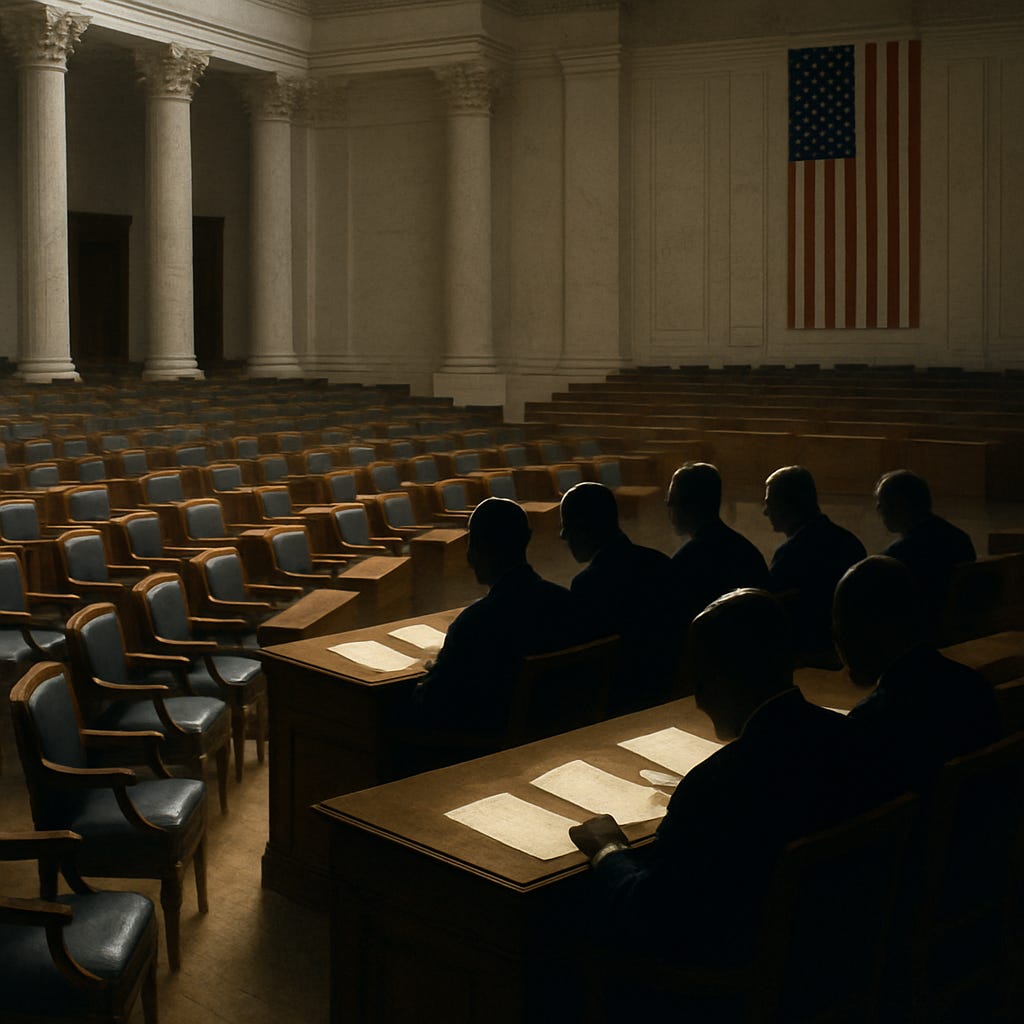
Chapter 1 — The Lie as Liturgy
There is a way a nation learns to pray without knowing it is praying. Not to God, but to power. The words repeat, the gestures repeat, the cadence repeats, until speech becomes ritual and ritual becomes truth. The old name for this was propaganda. The more accurate name, in our age of think tanks and donor routes and glossy PDFs, is liturgy.
The Heritage Foundation did not invent the liturgy; it professionalized it. It learned that policy is not merely a set of rules but a choreography of belief. You don’t just pass a bill; you catechize a public. You don’t simply deregulate; you narrate deregulation as emancipation. You don’t merely centralize executive power; you present it as the rescue of a nation from “unelected bureaucrats.” And you repeat it—on television hits, in op-eds, in Hill briefings, in breakfast roundtables—until the repetition does the believing for you.
Call the first movement naming. “Anti-communism” was the master key of the late twentieth century—not just an opposition to the Soviet Union, but a license to paint labor, social insurance, public investment, and regulatory constraint with the same brush. A word that once meant gulags and one-party states became the solvent poured over teachers’ unions, consumer protections, and progressive taxation. Naming rearranged the moral map: markets became freedom, government became threat, solidarity became suspect. Once the names were fixed, the facts would have to catch up or be discarded.
The second movement is laundering. Money that would be inflammatory in its naked form—oil fortunes, extraction profits, fortunes made by squeezing labor and privatizing the commons—gets purified as “philanthropy.” Donor-advised funds add a veil, a moral white coat. The check travels from the family office to a donor conduit to a policy shop; by the time it arrives, it is no longer a self-interested bet—it is civic virtue underwriting “research.” From that research come white papers, scorecards, bill templates, and “model” laws, all presented as nonpartisan expertise. The goal is not only to influence legislators; it is to cleanse the influence.
Then comes incarnation—the blueprint taking on flesh. The Reagan years were the first great embodiment: tax cuts marketed as growth miracles, deregulation sold as liberation, welfare reform as responsibility. The results—wealth concentration, financialization, weakened labor power—were not bugs; they were predictable outcomes of the liturgy. A generation later, Project 2025 offered the most explicit catechism yet: remake the executive branch, politicize the civil service, use grantmaking power as a lever, refashion education in “patriotic” terms, and accelerate an energy posture that subordinates climate and commons to immediate private gain. This time, the incarnation came with the candor of a manual: here is how to seize the levers quickly and make the changes hard to reverse.
But every liturgy needs absolution—a release valve for the conscience of the faithful. That is the work of the grand denial. “I’ve never heard of it.” “We have nothing to do with it.” “It’s just ideas floating around.” The disavowal is not an afterthought; it is an instrument. It provides plausible deniability for moderates uneasy with the speed and severity of the program, and it buys time. Meanwhile, agencies are reclassified, oversight is centralized, discretionary funds are routed through political filters, and the educational frame is adjusted to produce the citizens who will not resist the next round.
You can call these lies. They are. But the power of the lie is not only in the falsehood; it is in the flood. Say enough contradictory things, loudly enough, across enough channels, and the average person learns not to adjudicate claims but to withdraw from reality-testing. This is not censorship by force; it is censorship by excess. In the white noise, precision feels pedantic, expertise feels partisan, and exhaustion feels like wisdom. When exhaustion governs, governance follows.
If the lie is the hymn, fear is the organ beneath it. Fear of the foreigner, the protester, the regulator, the teacher, the bureaucrat. Every oligarchy requires a story about chaos: that without decisive rulers and unshackled capital, the nation will fall to disorder. The paradox is that the “order” advertised is a redistribution of disorder—away from markets and balance sheets and onto the bodies of workers, renters, students, and the poor. Social risk does not vanish; it is reassigned.
There is also a gentler instrument—admiration. Think tanks learned to wrap capture in merit: the philanthropist as benefactor, the donor as steward, the executive as “job creator,” the tax cut as a medal pinned to the chest of efficiency. What looks like withdrawal from civic obligation is reframed as investment genius; what looks like free-riding on public goods is reframed as “private solutions.” Admiration anesthetizes anger; you do not audit whom you idolize.
And then there is the loop—policy creating power that writes policy. Cut taxes at the top, and you increase the pool of private capital that can endow the institutions that justify further tax cuts. Deregulate finance, and you expand the war chest that can endow the legal projects that argue courts should be kept out of “innovation.” Politicize grants and civil service, and you tilt the machinery that will validate the politicization. Each turn strengthens the next, until the machinery feels natural and memory of a different arrangement feels naïve.
At this point a nation asks: was it fooled, or did it cooperate? The honest answer is both. The average voter did not read a 900-page mandate or trace a grant from a donor-advised fund to a university center to a bill markup. But the average voter did absorb the metaphors, the hero/villain casting, the ambient sense that government is incompetent, that public goods are indulgences, that organized labor is thuggish, that taxes are theft, that regulation is red tape, that expertise is arrogance. The liturgy worked not because people became cruel, but because they became tired—and in their tiredness, they wanted someone to promise relief. The promise came. The bill followed.
What, then, is the counter-liturgy? It begins by breaking the spell of naming. We say plainly: anti-communism, as deployed domestically, has meant anti-egalitarianism. “Small government” has meant large control by private power. “School choice” has meant public exit and private subsidy. “Patriotic education” has meant curated memory. None of this requires hating markets or scorning enterprise; it requires refusing the theology of inevitability that markets alone can sustain a nation’s moral life.
Next, we relight the ledger. Follow the money without flinching: who funds the paper, who staffs the panel, who writes the rule, who benefits in cash flows. Not to condemn automatically, but to name loyalties. There is no neutral center here; there are arranged interests. A mature democracy admits this and negotiates openly, with countervailing powers strong enough to bargain on behalf of the many.
Finally, we repair the faculty of attention. The lie as liturgy depends on exhaustion. It needs your doomscroll, your helpless shrug, your sense that it’s all too much. The antidote is not naïve optimism; it is disciplined seeing. We learn to hear the euphemism and translate it back into its budgetary, ecological, and human cost. We relearn the dull virtues—oversight, transparency, conflict of interest rules, slow governance—that protect the weak precisely because they frustrate the strong.
Heritage did not turn America into an oligarchy by sorcery. It taught a country to repeat the right words until the wrong world felt right. The response will not be a single revelation or a single election; it will be the patient unlearning of a ritual that mistook wealth for wisdom, speed for truth, and strategy for salvation.
A people can be catechized into forgetting their power. They can also be catechized back into it. The first lesson is simply this: stop mistaking the hymn for the law, the donor for the saint, the blueprint for the common good. The second lesson is to look, without blinking, at what the liturgy produced—and to call it by its name. Only then can Chapter Two begin.
Chapter 2 — The Mandate: Heritage’s Rise and the Reagan Arrangement
Every order begins with an institution that learns how to turn belief into paperwork.
In 1973, while the post-’60s state was still thick with New Deal memory, the Heritage Foundation arrived with a simple discovery: Congress doesn’t read treatises; it reads briefs. The old think tanks wrote careful monographs; Heritage learned to ship one-pagers before the vote. Speed wasn’t a tactic—it was a theory of power. If you could define a problem at 9 a.m., supply the language by noon, and hand a lawmaker a radio-ready sentence at 3, you could change the country more efficiently than a decade of op-eds.
Money noticed. Coors money first. Then the great conservative fortunes—the Scaife orbit, the Bradley network, later the Koch constellation—saw the leverage in a policy shop that spoke fluent television and committee markup. Philanthropy became architecture: endow the shop, seed the fellows, fund the media training, launch the “backgrounders,” build the Rolodex, and cultivate a farm team for the next administration. Heritage positioned itself as the hinge between donor will, movement energy, and government machinery.
Then came the book. Mandate for Leadership—a brick of instructions delivered on the eve of the Reagan years. Not just principles, but bureaus, positions, rules: who to appoint, which regulations to strike, where to move the budgets, how to narrate every cut as a moral rescue. The White House didn’t merely consult it; it operated from it. The “Reagan Revolution” was not a single act of genius; it was a supply chain—ideas manufactured upstream, shipped just-in-time to political retailers, and sold to a public rebranded as consumers of freedom.
What did the arrangement do? It reorganized obligation.
At the top, marginal tax rates fell—from the 70s down into the 20s within the decade—resetting the nation’s sense of who owed what to whom. Deregulation moved from sectoral tweaks to a moral doctrine: markets were presumed innocent, the state presumptively guilty unless it could prove necessity beyond a reasonable doubt. Antitrust went quiet, the financial sector learned a new swagger, and shareholder value slipped from slogan to sacrament. The famous airport showdown with PATCO signaled something deeper than toughness: it reset the weather pattern around labor. Unions became relics; bargaining became an eccentricity. The boom of financialization wasn’t an accident; it was policy with a soundtrack.
Heritage excelled at translation. A capital gains cut was “growth.” Environmental and consumer protections were “red tape.” Social insurance was “dependency.” Budget starvation for public goods was “discipline.” When the words hardened, the numbers followed. The center of political gravity shifted from “what do we owe each other?” to “how do we free capital to rescue us?” And when rescue didn’t arrive for the working class, the narrative supplied the culprit: the regulator, the immigrant, the bureaucrat, the out-of-touch expert. The country learned to punch down because no one funds a theology that punches up.
This is what I mean by the Reagan Arrangement: not just a presidency, but a settlement among donors, a policy factory, a party, and an electorate taught to equate prosperity with the liberty of capital. Heritage did not govern; it tuned the instrument on which others played. The foundation’s innovation was to make ideology feel like operations. You didn’t have to argue the virtues of “small government” in a seminar if you could reclassify an office, sunset a rule, and let the new equilibrium preach itself.
Critics sometimes say the 1980s were about “unleashing” the economy, as if a caged vitality were set free. A more honest diagram shows risk moved, not removed. It was diverted from balance sheets and tax bills toward neighborhoods, schools, bodies. Private wealth acquired insurance against the demands of the commons; public life absorbed the volatility that private life shed. Markets did not replace government; they captured its steering wheel and rewrote the road signs.
And yet, the arrangement would have frayed without a catechism to renew it each morning. Heritage supplied that too. It trained a generation of staffers in message discipline; it perfected the 30-second moral of the story; it learned to wrap concentration of power in the language of decentralization and wrap deference to wealth in the language of virtue. It didn’t just argue; it acculturated.
By the time the Cold War ended, a new normal had set in. Inequality wasn’t a scandal; it was an atmospheric condition. Philanthropy replaced tax as noblesse obligation, a discretionary kindness in lieu of civic duty. The public square became an afterthought unless it could be sponsored. When the 1990s arrived, even the opposition calibrated itself to the new weather: welfare “reform” in the name of responsibility, financial light-touch in the name of innovation. The arrangement had withstood alternation in power because it was deeper than a party; it lived in the plumbing.
Heritage’s genius was not simply to propose, but to pre-staff. Ideas arrived with résumés attached. A blueprint without people is a prayer. A blueprint with people is a plan. That pipeline—fellows into agencies, authors into offices, spokespeople into prime time—made the arrangement durable. It also made denial easy. You could say, in any given crisis, that nothing ideological was afoot—just “best practices,” just “efficiency,” just “making government work.” The catechism we met in Chapter One had now found its choir.
If you want a single line that names the era: Heritage professionalized the art of making private interest look like public sense. The Reagan years were its first great proof of concept. What began as a revolt against the New Deal’s obligations matured into a governing technique able to survive changes in administration and weather the embarrassment of outcomes. Rising inequality could be shrugged off as an unfortunate side effect of dynamism; collapsing labor power as the price of flexibility; underfunded schools and brittle infrastructure as temporary inconveniences on the road to prosperity always just ahead.
The point isn’t to romanticize the world that came before; it is to remove the magic from the world that followed. The “mandate” was always constructed, not revealed. It was built with donor dollars, editorial calendars, lunch briefings, and legislative muscle memory. Understanding this is not bitterness; it is competence. It teaches us that arrangements can be unarranged—that the same patience, discipline, and structure that established this order are the tools required to build another.
But first we must see the sinews: the money routes that kept the shop humming, the conduits that laundered motive into mission, the vehicles that turned fortunes into “thought.” Chapter Three turns to the ATM behind the altar.
Chapter 3 — The ATM Behind the Altar: Donor Networks and Dark Money
Every creed needs a collection plate. In our age, the plate has a routing number.
The modern counter-democratic machine is not a cigar-smoke conspiracy; it is a workflow. A fortune is harvested—in oil, finance, chemicals, logistics, private equity—then disciplined by attorneys and accountants into foundations, family offices, and donor-advised funds. From there, the river forks: into 501(c)(3) “education” and litigation shops; 501(c)(4) “social welfare” advocacy; and a thicket of pass-throughs designed to change the color and temperature of money without changing its destination. By the time a talking point lands on a teleprompter or a rule change hits the Federal Register, the money that made it possible has been laundered into virtue.
The device has a polite name: donor-advised funds (DAFs). The promise is convenience and privacy. Contribute today, take the deduction now, advise the grants later. The sponsor (a community foundation, a financial firm, or—on the right—specialized vehicles like Donors Trust and Donors Capital Fund) writes the public check. Your name does not. The check arrives at a think tank, litigation boutique, campus center, or media hub stamped with the sponsor’s seal, not yours. The public sees “philanthropy.” The recipients see you.
Privacy is not inherently corrupt; some gifts are nobly anonymous. But scale plus secrecy changes the physics of a republic. When hundreds of millions flow through a handful of ideologically curated conduits, we no longer have philanthropy in the old sense; we have a shadow appropriations process, privately directed, publicly binding. Legislatures argue over pennies while the donor pipeline funds the research that frames the debate, staffs the committees that draft the bills, and trains the surrogates who sell the story back to the people who will live under it.
Behind Heritage’s altar there has always been an ATM—reliably stocked by dynasties and boards that learned, over decades, how to convert capital into culture. The names change by generation, but the pattern holds: brewing, steel, banking, manufacturing, extraction fortunes; family foundations that declare neutrality while underwriting a very particular vision of the common good; corporate foundations that insist they do not fund politics while endowing the institutions that define the word “political.” Some donors sign their checks in full daylight. Others route them through the twin vaults of Donors Trust/Donors Capital, whose very sales pitch is ideological shelter: a home for gifts that want influence without attention.
The genius of the system is plausible innocence at every link. The family office says, “We do philanthropy.” The DAF sponsor says, “We follow donor intent.” The 501(c)(3) says, “We do education, not elections.” The 501(c)(4) says, “We do issues, not candidates.” The litigators say, “We defend constitutional rights.” The media shop says, “We inform the public.” And the elected official says, “I read a study.” The public hears a choir. Only the score shows it’s the same song.
Consider the feedback loop. Tax cuts at the top free additional capital. Part of that capital is captured in low-transparency vehicles. Those vehicles fund research and litigation to normalize further tax reductions, deregulation, and union weakening. The new policies increase after-tax returns again, replenishing the pool that finances the next round of “education.” Influence becomes self-financing. The republic slowly forgets what it feels like to deliberate without a ventriloquist.
This is not merely a funding mechanism; it is a personnel machine. The money does not just sponsor papers; it underwrites careers. Fellowships, visiting posts, endowed chairs, litigation apprenticeships, campus centers, training institutes, media fellowships, and Hill bootcamps—each a rung on the ladder from ideology to implementation. A blueprint is only as strong as the résumés attached to it. The ATM pays stipends while the altar confers authority. By the time a new administration arrives, the “talent pipeline” is a waiting government.
And yet, to treat this as a uniquely conservative invention would be a comfort and a dodge. The architecture of nonprofit law—the broad protection for 501(c)(3) “education,” the light touch on donor disclosure, the tax advantages of DAFs—exists for everyone. But on the right, specialized conduits embraced the structural opportunity with particular rigor and candor. They built an infrastructure of invisibility calibrated to a long project: shrink democratic counterweights, elevate executive control, immunize capital from reciprocal obligation, and train citizens to call the transfer of power a liberation.
Notice the vocabulary that does the lifting. A donor-advised fund is sold as “philanthropic freedom.” The pass-through is “privacy.” The policy shop is “nonpartisan.” The litigation boutique is “public interest.” The campus center is “viewpoint diversity.” The media arm is “fact-based.” Even the most aggressive centralization of federal power is renamed “accountability.” If Chapter 1 showed how lies become liturgy, Chapter 3 shows how euphemism becomes engineering.
If you follow a single dollar, here is what you see. It leaves a balance sheet swollen by favorable policy. It claims a charitable deduction—public revenue foregone—because it will serve the public good. It enters a DAF, where it is parked offstage. It is recommended—soon or years later—to entities that will argue for rules that further favor the balance sheet it left. When the argument prevails, the balance sheet grows again. The dollar has performed a trick: it converted public subsidy (the tax deduction) into private leverage (policy that yields more private gain). The law calls it charity. The people living downstream call it weather.
Investigative reporters have mapped pieces of this terrain—the climate denial ecosystem seeded through pass-throughs; the state-level bill mills; the judicial grooming pipelines; the “election integrity” scare factories; the higher-ed culture-war outfits that recruit outrage for the cameras. What matters, more than any single exposé, is the pattern: a republic governed by off-budget decisions, where what looks like an argument about ideas is often a supply chain managing permission.
Heritage sits near the mouth of that chain. It does not need to “own” the donors; the donors and the foundation share a civilization story. The donors do not need to “own” Heritage; they own the conditions in which Heritage thrives—conditions of anonymity, preferential tax treatment, weak disclosure, and a media environment trained to treat funded narrative as neutral expertise. The circle is tight enough that denial is always available. If the plan becomes unpopular, the architect can claim distance; if the architect is cornered, the funders can claim neutrality. Accountability dissolves into the fog between them.
Some will object: are we condemning generosity? No. The indictment is narrower and more serious: we built a legal and cultural apparatus that lets concentrated wealth act like a second legislature—quiet, durable, and largely immune from the slow frictions that protect the many from the few. When that apparatus underwrites a program to concentrate power further (over agencies, grants, curricula, the civil service), the republic is not being debated; it is being rerouted.
What repairs this? Not performative rage at “billionaires,” which flatters the problem. Repair begins with institutional daylight: real-time DAF transparency above meaningful thresholds; modernized 990s that trace pass-through chains; strict segregation of c(3) “education” from coordinated influence operations; clear conflict-of-interest rules for grantees producing “research” that directly shapes pending policy. It requires counter-infrastructure too: public funding for knowledge and legal capacity so the common good does not beg the rich to sponsor its defense. And it needs civic literacy—a people trained to read a footnote, follow a grant, and smell a euphemism.
The altar cannot be demolished; a nation will always have institutions that translate belief into action. But the ATM can be regulated, the liturgy named, the workflow made legible. The point is not to shame the existence of wealth; it is to end the practice of ruling through receipts while calling it generosity.
Heritage did not become powerful because its arguments were irresistible. It became powerful because a financing machine learned how to make arguments indestructible—transferrable across decades, personnel, and crises, immune to election cycles, and insulated by a veil that the law itself stitched. Pull back the veil and two truths appear at once: there is nothing mystical here, only structure; and there is nothing inevitable here, only choices.
The next chapter will show how those choices were refined into a manual for governing by decree. The money found its instrument. Now watch how the instrument seized the orchestra.
Chapter 4 — The Administrative Seizure: Project 2025 from Blueprint to Rule
A constitution sketches powers. An administration operationalizes them. The difference between a theory of government and the government you wake up inside is measured in memos, staffing charts, and the speed of signatures.
Project 2025 is not a philosophy; it is a workflow. It translates resentment into rulemaking, ideology into implementation. It understands that the modern state is a maze of gates, and that power belongs to the faction that knows which key fits which lock—and in what order to turn them.
First, Day One. The spectacle is the press conference. The substance is the Executive Order. Revive a lapsed classification, rename it, and the civil service becomes a field of reassignable loyalties: positions once buffered from political purge are recategorized as “policy-influencing,” newly removable, newly replaceable. It sounds procedural because it is; the revolution is an HR document. The point is not to fire everyone. The point is to make everyone fireable, and therefore quiet.
Second, the Guidance Cascade. Executive Orders are the drumbeat; agencies are the orchestra. The White House sends the rhythm through OMB and OPM, which ship “implementation guidance” to every bureau and service. Drafts morph into “interim” instructions that look temporary but behave permanent. Job descriptions are rewritten to widen the circle of political discretion. Review councils are created or repurposed so that loyal appointees sit at the valve where programs meet the public. A government becomes new not because Congress passed a thousand laws but because a thousand emails changed who must sign off.
Third, the Grant Switch. A modern state governs not just by rules, but by money with conditions. Shift the conditions; you shift the country. Require discretionary grants to pass through a political appointee’s review for “alignment with national priorities.” Call that alignment “patriotic” or “security-minded” or “anti-discrimination” or “anti-indoctrination,” and the label becomes the lever. Dollars take the path of least resistance; so do nonprofits, universities, clinics, cities. “We didn’t ban anything,” the official can say, and it is technically true. They merely rotated the faucet.
Fourth, the Pause. Declare a “top-to-bottom review” of foreign assistance, rulemaking agendas, enforcement priorities. Pause is the soft word for seizure. Programs frozen for ninety days can be starved in a year. Contracts expire; staff drift; momentum dies. The country looks up months later and discovers that a review never ended, or ended quietly with “realignments” that no headline could hold. You need not destroy an institution. You can wait it out and come back when the immune system is tired.
Fifth, the Curriculum. The blueprint learned that memory is infrastructure. Seed “patriotic” initiatives in education grants, rename civics, elevate “foundational documents” while narrowing which texts count as foundational. Investigations in higher ed carry funding threats; the point is not a single sanction but a climate of anticipatory compliance. Schools teach to the budget as much as to the test. If you can make a campus fear the loss of accreditation or a district fear the loss of its summer program, you can redraw the borders of the possible without passing a statute.
Sixth, the Energy Exception. Declare emergency-like priorities to keep old plants online, fast-track new capacity, rewrite cost-benefit assumptions, and treat environmental guardrails as obstacles to reliability. The blueprint’s genius is not to deny the grid’s strain; it is to weaponize it—to answer real pressures with a policy that hardens fossil dependence in the name of saving the system. You do not have to win the climate argument if you can own the breaker panel.
Seventh, the Legal Shield. In a post-Chevron world—where courts no longer reflexively defer to agencies’ readings of ambiguous statutes—the blueprint adapts. It narrows interpretations to hard text, frames discretion as faithful execution, and builds an in-house litigation phalanx: Office of Legal Counsel opinions, general counsel memos, prepackaged administrative records anticipating the lawsuit. The goal is not to avoid court; it is to arrive armed—to win enough, delay enough, or move enough money in the meantime that the policy becomes a fact before the ruling becomes a law.
Eighth, the Personnel Lattice. A plan without people is a pamphlet. The project arrives with résumés preloaded: assistant secretaries who wrote the white papers they are now empowered to enforce; counsels who drafted the memos they now cite; spokespeople trained in the message discipline that will round the edges of rupture. Mid-levels matter most: the deputy chief of staff who sets the calendar; the career-turned-convert who controls the docket; the acting director whose “acting” becomes indefinite. Continuity used to protect the republic. Now continuity has been captured.
Ninth, the Optics Firewall. As criticism mounts—over purges, politicized grants, academic probes, and the narrowing of the civic square—the public line is clean and repeatable: “We’re restoring accountability.” “We’re removing ideology from government.” “We’re ensuring taxpayer dollars serve the national interest.” If a policy draws blood, the denial hardens: “I’ve never heard of that plan.” The firewall is not meant to persuade the informed. It is built to give the exhausted a sentence to hold onto while the machinery turns.
Tenth, the Court as Metronome. Not every lever moves. Judges enjoin a litmus test here, freeze an overreach there. Injunctions appear, then narrow. But litigation calendars are calendars of time, and time is a governing instrument. Every week a program is paused is a week the alternative consolidates. Every remand back to the agency is a chance to rewrite the record. The seizure is not a charge across open ground; it is a pressure campaign that counts in months and staff attrition.
What makes this seizure different from old-fashioned patronage is its programmatic candor. The manual said the quiet parts loudly: remake the bureaucracy around presidential will; sort staff by loyalty; route public money through ideological gates; fuse culture war to administrative law. The disguise is not inside the playbook; it is in the rhetoric laid over it. “Efficiency.” “Neutrality.” “Security.” “Parental rights.” “Civics.” Words chosen not to match the policy but to mask its targets.
You might ask, Where is Congress? It is there, grandstanding over the largest controversies while the sub-federal levers do the work: guidance memoranda, grant notices, enforcement priorities, advisory panels, budget apportionments. Most members never see the map that matters: the one showing who approves what, on which floor, with which sign-off codes. The seizure is not dramatic. It is detailed.
And where is the public? Exactly where a liturgy of lies has trained it to be: suspicious of the civil service as a “deep state,” impatient with process, ready to mistake friction for failure and speed for competence. In that atmosphere, a program promising to bulldoze “red tape” feels like rescue—right up until the guardrails you needed were the ones the bulldozer removed.
The defenders will say this is merely a return to democratic control—elected leaders directing the bureaucracy the people never voted for. But democratic control is not the same as personal command. The founders feared a monarchy and built buffers—tenure protections, due process, staggered terms, dull procedures—to slow a single will. The seizure’s purpose is to dissolve those buffers and call the dissolution democracy.
There is a sentence that helps: what you can seize without deliberation, you can wield without consent. Project 2025 is an instruction manual for that sentence. It does not abolish the state. It captures it, retunes it, and then sells the new sound as the original score. By the time anyone notices the key has changed, the season is already programmed.
If this sounds final, it isn’t. The same banality that makes the seizure possible makes it reversible: personnel rules can be re-hardened, grant valves re-opened, review pauses sunsetted, guidance rescinded, budgets rewritten, litigation repurposed to defend the weak rather than the strong. But reversal requires a public that can still see—that can tell the difference between efficiency and control, between curriculum and catechism, between oversight and intimidation.
The next chapter names the destination toward which all this administration-by-memo has pointed for forty years: a polity where wealth doesn’t just buy a louder microphone—it writes the minutes. The seizure was the method. Oligarchic drift is the result.
Chapter 5 — Oligarchic Drift: When Wealth Writes the Law
Oligarchy does not arrive in a black limousine. It arrives in footnotes.
You wake up inside it when ordinary sentences—“the market will allocate,” “taxes distort,” “efficiency demands,” “parents deserve choice,” “accountability requires alignment”—have quietly rewritten the boundary between private advantage and public obligation. No guard announces the change. The clerk’s memo does.
The drift began as a wager: if you free capital from dense civic obligations, capital will reciprocate with prosperity. What we unshackled instead was political capacity—the ability of wealth to shape the very rules that govern wealth. The instruments were familiar enough to feel harmless: campaign finance innovations that turned speech into a commodities market; “independent” vehicles whose independence was a lawyer’s definition; a judiciary groomed to treat corporate prerogatives as constitutional virtue; preemption doctrines that let statehouses erase local courage; a withering of labor law so complete that “organizing” now reads like an antique verb. None of that sounds like seizure. All of it functions like rule.
Start with the tax code, that spiritual document disguised as arithmetic. We lowered top rates and created sanctuaries for capital income; we blessed step-ups and carried interests; we protected inheritances as if dynastic transfer were a civic right. The result was not just more money at the top; it was a surplus of steerable power. From that surplus came endowments, political vehicles, litigation factories, media shops, campus centers—an entire parallel state funded off-budget, tax-advantaged, and patient enough to outlast news cycles. When you subsidize private accumulation and then subsidize its conversion into influence, you are not neutral. You are underwriting a second legislature.
Then the labor bargain. The famous breaking of a single strike became a barometric shift. Unions shrank; fissured workplaces proliferated; the gig and the “contractor” replaced the employee wherever classification could be contested. Productivity and wages divorced; volatility moved downstream—to schedules, to rents, to bodies. A nation cannot be democratic at the ballot box when it is authoritarian at work. Oligarchy thrives where the majority spends most of its waking hours under orders.
Add the financialization of life. When housing is an asset class before it is shelter, zoning and credit become instruments of extraction. When pensions become 401(k)s, the citizen becomes a fund manager of their own precarity. When hospitals operate like private equity projects wrapped in mission statements, the co-pay becomes a toll booth at the edge of life. The rhetoric said empowerment; the ledger said fee.
Overlay the legal turn. As deference to expert agencies narrows, the advantage tilts toward parties with the lawyers to fight in the open text. “Major questions” doctrines are framed as democratic humility; in practice, they raise the price of governing and discount long-run harms that resist one-line statutes. The more the law demands explicitness, the more cash it takes to be explicit at scale. The rich can hire explicitness. Everyone else inherits ambiguity.
Meanwhile, the court of culture is colonized by euphemism. A denial-of-service attack on the public sphere is marketed as “choice”: choose your school, your doctor network, your news channel, your gated community, your private police. Each exit drains the commons and then cites the weakness of the commons to justify the next exit. What looks like freedom from the public is often dependence on the private—on terms written by those who own the gate.
We call the aggregate drift because no single moment feels like a coup. It is accretion: one board vote, one model bill, one advisory opinion, one guidance memo, one litigation settlement at a time. It is also a mood: impatience with the “mess” of democracy; a reflex that treats friction as failure; the romance of the decisive executive and the optimized enterprise; the suspicion that slow processes harbor “ideology” while speed is neutral. The gospel of efficiency ended up as a theology of permission for those who could afford to move fast.
Heritage’s role in this is less puppet master than choreographer. It curated the vocabulary that lets drift look like governance. It normalized the unitary leader as the apex of accountability. It wrote the pamphlets that taught legislators to hear “regulation” and picture dead factories; to hear “union” and picture thugs; to hear “tax” and picture confiscation; to hear “public” and picture incompetence; to hear “equity” and picture indoctrination. When the words harden like that, oligarchy is not a conspiracy; it is a language.
What does a polity look like after forty years in that language?
It looks like wealth piled high and wide, defended as merit and anonymized when it moves into politics. It looks like public budgets thin where the many meet the state—schools, transit, housing, public health—while surveillance and carceral budgets stay robust. It looks like grant valves that route money through ideological filters and call it stewardship. It looks like universities styled as marketplaces, where inquiry is tolerated until it embarrasses a donor’s portfolio. It looks like cities twinned with foundations because the tax base was peeled, and now the ambulance runs in the livery of beneficence. It looks like journalism on a subscription IV while funded narratives debut in polished reports with executive summaries designed for your representative’s staffer. It looks like courts that can say “No” to democratic experiments and “Yes” to the private veto dressed as contract.
And it feels—this is crucial—like exhaustion. Not just economic fatigue, but civic depletion: the sense that nothing you do scales, that procedures are booby-trapped, that the costs of attention exceed the returns. Oligarchy does not need your love; it needs your discouragement. It survives on the conversion of anger into private hustle, on the rebranding of solidarity as nostalgia, on the isolation of the decent into curated lives. When the majority retreats into the work of staying afloat, a minority can govern with a minority’s patience.
Still, drift is not destiny. The same record that indicts also maps the exits. Every instrument in this book—tax code, labor law, administrative procedure, grant architecture, judicial philosophy, donor transparency, media finance—was chosen. It can be chosen again. But repair will not come from catharsis or a viral clip. It will come from replacing a theology with a craft: the craft of building countervailing power, of funding the commons openly, of re-weighting the law toward long horizons and shared risks, of making it cheaper to govern for the many than to obstruct for the few.
If the oligarchic age has a signature lie, it is that complexity excuses capture. The counter-truth is simpler: complexity requires more democracy, not less—more eyes, slower money, smarter friction, institutions that can metabolize disagreement without selling the floor to the highest bidder.
We have named the drift. The final chapter turns from diagnosis to obligation—not a sentimental vow, but a practical liturgy for the unsexy work of repair. The oligarch wrote the minutes. The people still hold the quorum.
Chapter 6 — Judgment and Repair: What We Owe Each Other Now
Judgment is not only a scene at the end of time. It is also a ledger opened in public, a remembering that refuses to be hurried past. If hell is the perfected absence of obligation, then oligarchy is its rehearsal: a life arranged so that power never has to return to the people from whom it was taken. The counter to that is not rage alone. It is repair—the slow art of tying power back to responsibility, money back to daylight, administration back to consent.
Begin with the simplest judgment: to call things by their names. Name the pass-through a pass-through. Name a purge a purge, even when it arrives dressed as “efficiency.” Name “patriotic education” what it is: curriculum as custody. Name “alignment” what it does: it teaches every grantee to anticipate the politics of the hand that feeds. Naming is not poetry here; it is jurisdiction. It tells each institution which harms it is responsible to prevent.
Repair is the opposite of spectacle. It is boring on purpose. What follows is not a wish list but a working liturgy—practices that return a captured state to a public one.
Repair the language. A republic needs a style guide. “Accountability” means answerability to the public, not ideological conformity to appointees. “Efficiency” means accomplishing publicly debated ends at justified cost, not skipping deliberation. “Neutrality” means fair process and transparent criteria, not invisibility for power. Write the definitions into guidance and law; make them administrable, not aspirational.
Repair the ledger. Daylight is a power. Modernize nonprofit filings so pass-through chains are visible above meaningful thresholds. Require donor-advised funds to disclose large grants and maintain payout clocks so warehouse philanthropy cannot function as a permanent shadow treasury. Publish machine-readable money maps for federal contracts and grants—who applied, who scored, who decided, who appealed. Sunlight that arrives three years late is theater; make it timely and searchable.
Repair the civil service. Codify protections that bar any future Schedule-F-by-another-name. Tie policy discretion to offices, not persons. Strengthen inspectors general, protect whistleblowers, and require public posting of implementation guidance that changes the terms of employment or review. Boredom is a constitutional virtue; re-dignify the procedures designed to slow a single will.
Repair the grant valve. Build a legal firewall between discretionary awards and partisan preclearance. If “alignment with national priorities” is invoked, the priorities must be published in advance, debated in public, and audited by an independent ombuds. Randomized audits should test for viewpoint discrimination. The point is not to de-politicize money—that is impossible—but to make the politics contestable in the open.
Repair congressional capacity. Oligarchy loves a weak legislature. Raise staff pay, rebuild nonpartisan expertise, fund modern oversight tools, and end the performative starvation that leaves committees at the mercy of lobbyist memos. A Congress that cannot read the map will be governed by those who drew it.
Repair labor law. Democracy fails where the workplace is feudal. Update organizing rules so workers do not need miracles to form unions; experiment with sector-wide bargaining in fissured industries; enforce misclassification laws; set predictable scheduling as a baseline for dignity. When labor has a voice, the country hears itself again.
Repair the tax code. Stop subsidizing private rule. Close the step-up and carried-interest games. Bring capital and labor income into conversation with each other. If society grants charitable deductions, require that philanthropic capital flow—payout clocks for DAFs, caps on indefinite warehousing, and a modest public-interest tithe that routes a slice of large tax-advantaged gifts into independent civic infrastructure: local news, public research, legal aid.
Repair antitrust and administrative law. Treat concentration as a political problem, not just a pricing problem. Revive the habit of asking what happens to self-government when a few firms can veto the future. In the courts, if deference is narrowed, supply the specificity—write statutes that name harms plainly, define long horizons, and authorize agencies to count the costs the market externalizes onto air, water, bodies.
Repair memory. Make civics a literacy in power, not a nostalgia unit. Teach how rules are made, where money moves, how grants are scored, how courts time policies to death. Insist on philanthropic independence covenants at universities: gifts without strings to research and teaching; strings disclosed when they exist. A nation that cannot remember how capture works will consent to it again.
Repair the press. Fund a durable public and local news endowment. Build ad-archive and recommender transparency into platform law. Update freedom-of-information statutes with teeth and timelines. Without shared facts, repair collapses into performance.
None of this is glamorous. That is exactly why it works. The liturgy that built the now was patient and procedural; the liturgy that undoes it must be the same. Do not wait for the headline that saves you. Write the calendar that does.
There is also a judgment more intimate than law: the judgment of attention. The machine we have mapped feasts on exhaustion. It wants citizens who outsource discernment to slogans, who confuse speed with competence, who accept the serenity of not-knowing as a lifestyle. Refusal begins small: read one layer deeper than the press release; ask who wrote the memo; follow one dollar to its end; sit through the meeting where the valve actually turns. The oligarch cannot monetize what he cannot exhaust.
Some will ask for absolutes: Are the authors of this age doomed to hell? The question mistakes theater for verdict. The only hell we can prove is the one we keep building: neighborhoods stripped of bargaining power; schools that teach caution first; courts that raise the price of governing for the many; a climate ledger written in denial. If divine judgment is real, it will not be improved by our guessing. What we can do is withhold complicity here and now, and make repentance concrete: return stolen obligations to the public square; turn private exemptions back into public duties; build systems where mercy is not charity’s whim but law’s design.
You will be told this is naïve. That nothing big changes. That the donors will route around every rule. Perhaps. But the country we live in was not conjured. It was organized—by calendars and trainings, by legal tweaks and personnel charts, by budgets written to outlast your attention. The answer to organization is not inspiration. It is counter-organization.
So we end where we began: with liturgy. If lies can be prayed until they feel like truth, then truth can be practiced until it becomes a power. Practice it in the words we choose, in the ledgers we light, in the protections we restore, in the frictions we honor, in the solidarities we rebuild. Let judgment be this: that we refused to call capture freedom, refusal chaos, or repair a fantasy. Let hope be this: that the quorum remained, and the people used it.
The mandate for the few was never destiny. It was a plan. Plans can be unmade.
—Elias WinterAuthor of Language Matters, a space for reflection on language, power, and decline.