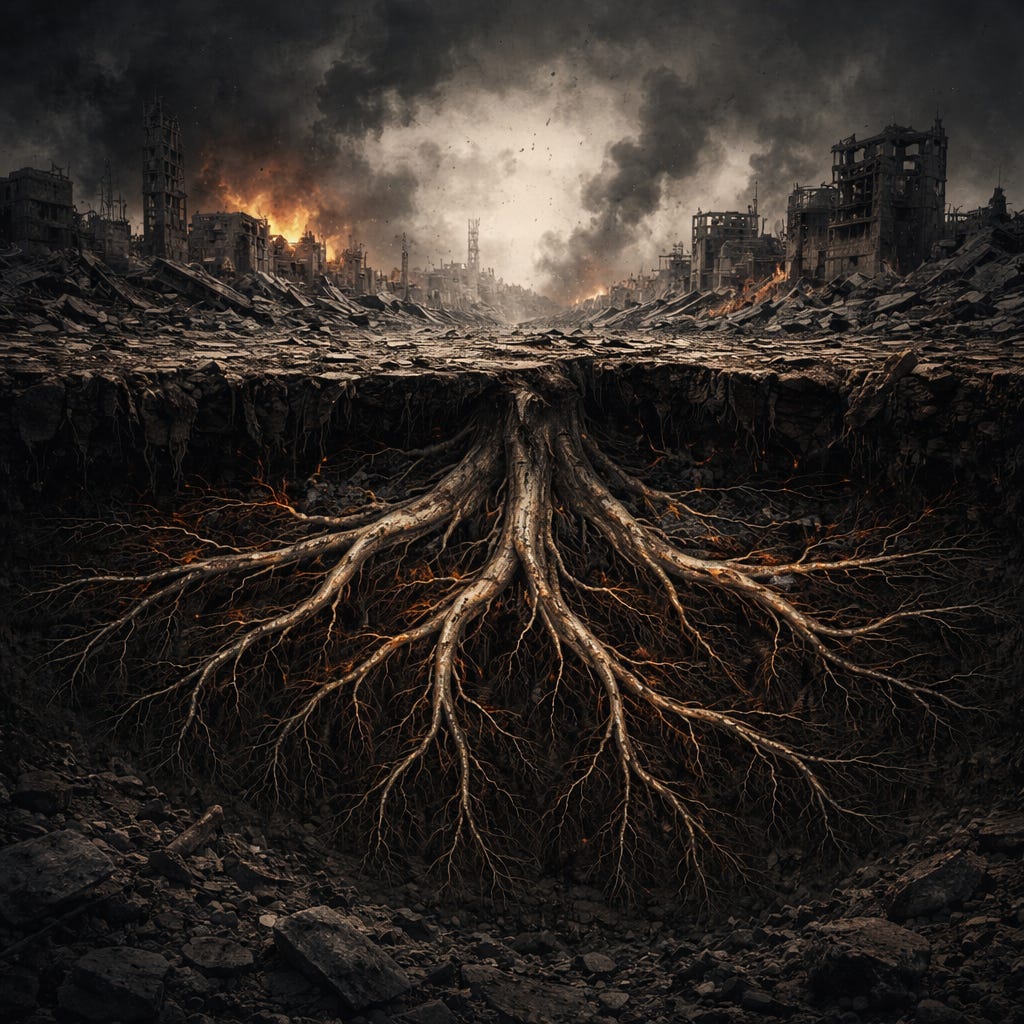
There is a recurring simplification in the way nations speak about war. Not childish in its consequences, which are monstrous, but childish in its imagination. The fantasy is always some version of the same thing: if one hits hard enough, long enough, with enough steel, enough fire, enough repetition, the problem will go away. America often behaves as though a dangerous regime can be managed through sanctions, covert pressure, targeted killing, and periodic strikes. Iran often behaves as though the ability to hold distant cities at risk can restore sovereignty and annul humiliation. Israel often behaves as though every surrounding threat can be neutralized before it matures, and that safety can therefore be manufactured through supremacy. Armed movements often believe that endurance itself is victory, that retaliation is dignity, and that resistance remains justified so long as it survives.
All of them, in different ways, mistake force for resolution.
Military force can delay, disrupt, and deter. It can destroy runways, missile sites, command structures, tunnels, laboratories, power stations, and homes. It can prevent an imminent massacre. It can buy time. Sometimes it is necessary. But force cannot resolve conflicts whose real engines are memory, humiliation, sovereignty, and the struggle for recognition. It can damage the visible machinery of war while leaving untouched the deeper reasons men and states return to it.
That is the central error of modern conflict. Nations keep treating political and historical crises as though they were only technical problems of capability. They ask bombs to do the work of legitimacy. They ask coercion to do the work of recognition. They ask military pressure to settle questions that are, at root, about who may stand upright in history and on what terms.
It is easier to bomb than to recognize. Easier to threaten than to remember. Easier to say the other side understands only force than to admit that what it wants may not be destroyable from the air.
This is why modern wars recur even after astonishing displays of military power. The bombs fall, the funerals end, the headlines move on, and yet the core of the conflict remains. The core was never located exactly where the bomb landed. It was located in older fears, inherited humiliations, unmet claims, and rival stories about dignity and survival. Nations return, again and again, to the same misunderstanding: they imagine that what is deepest in political life can be subdued by what is loudest in the machinery of death.
It cannot.
What Force Can Do — and What It Cannot
A serious argument must begin with a concession. Force has real uses. Armies can deter invasion, blunt offensives, intercept missiles, kill commanders, degrade weapons programs, and alter the tactical balance of war. Allied force helped destroy Nazi Germany. Military action has sometimes prevented or interrupted mass killing. A state facing an immediate attack cannot be expected to answer with seminars on mutual recognition.
The point is not that force is useless. The point is that its genuine usefulness tempts states to ask more of it than it can deliver.
Force can reduce capacity. It cannot create legitimacy. It can impose obedience under duress. It cannot produce consent. It can delay a nuclear program, destroy a rocket stockpile, or decapitate a militia leadership. It cannot settle the meaning of the conflict from which those capabilities emerged. It can kill a commander, but not the humiliation that made him persuasive. It can break an organization, but not the memory that recruits its successor.
States repeatedly confuse military success with political settlement. They see the enemy weakened and imagine the problem diminished. But weakness and resolution are not the same thing. A humiliated actor may be militarily weaker and politically more dangerous. A population may be too exhausted to fight and more certain than ever that peace, under current terms, is only another name for submission.
This is where military thinking becomes strategically blind. It tracks what it can count and neglects what it cannot. Destroyed launchers are visible. Inherited humiliation is not. Cratered runways are visible. A father explaining defeat to his son is not. A munitions report is visible. A people’s changing theory of history is not.
And yet it is often the latter that determines whether the conflict ends or regenerates.
Military logic is linear. It seeks targets and effects, means and ends. But conflicts rooted in history are not linear. The same strike that restores deterrence in one register may radicalize identity in another. The same campaign that weakens armed capacity may strengthen political myth. A tactic can succeed while the larger strategy fails.
This is the recurring category error of modern power: states keep trying to solve political problems with military tools.
The Memory Beneath the Battlefield
No serious conflict begins on the day the first missile is launched. That is only the day the cameras arrive. The real beginning lies elsewhere, often in some older act of domination that remains psychologically active long after diplomats have renamed it history.
In Iran’s case, the language of threat cannot be separated from the memory of subordination. The 1953 overthrow of Prime Minister Mohammad Mossadegh, after he moved to nationalize Iranian oil, remains more than an episode in a textbook. It forms part of a durable national memory that outside powers treated Iranian sovereignty as negotiable when strategic interests required it. The Iran-Iraq War of the 1980s, with its mass casualties and chemical attacks, deepened the sense that survival could not be entrusted to an international order administered by others. None of this absolves the Iranian state of repression, corruption, or regional manipulation. But it helps explain why external coercion often confirms rather than dissolves the regime’s narrative. What outsiders call pressure, the regime can translate into evidence that humiliation remains the intended order of things.
The same is true, differently, for Palestinians. The conflict is not only about rockets, checkpoints, negotiations, or ceasefire lines. It is also about the memory of dispossession in 1948, the occupation that began in 1967, the expansion of settlement, the fragmentation of land and authority, the blockade of Gaza, and the lived experience of statelessness. For generations, Palestinians have been told that their deepest political claims must wait for a future that never fully arrives. Under those conditions, radicalization does not appear only as doctrine. It appears as proof that disappearance is not complete.
For Israelis, military doctrine rests atop another historical terror: the fear that weakness invites annihilation, that delay can be fatal, that hostile intent must be taken literally. This fear is not imaginary. It is shaped by centuries of persecution culminating in the Holocaust, and by wars in 1948, 1967, and 1973 in which state survival was not theoretical. The October 7 attacks renewed this fear in an especially intimate form. But fear, when sacralized, becomes distorting. It can make every enemy feel like an echo of absolute catastrophe. It can collapse the difference between legitimate self-defense and the fantasy that no surrounding grievance can ever be politically real if it is experienced as threatening.
America also carries memory, though it prefers to imagine itself above such things. Its memory is one of successful intervention, of global reach, of industrial wars won and distant enemies punished. But it is also a memory others experience differently: coups renamed stability, sanctions renamed leverage, wars renamed order. Iraq in 2003 is the clearest example. The United States removed a regime with speed and overwhelming force, yet the military victory did not produce a legitimate political settlement. It destabilized a region, empowered militias, deepened sectarian confli…