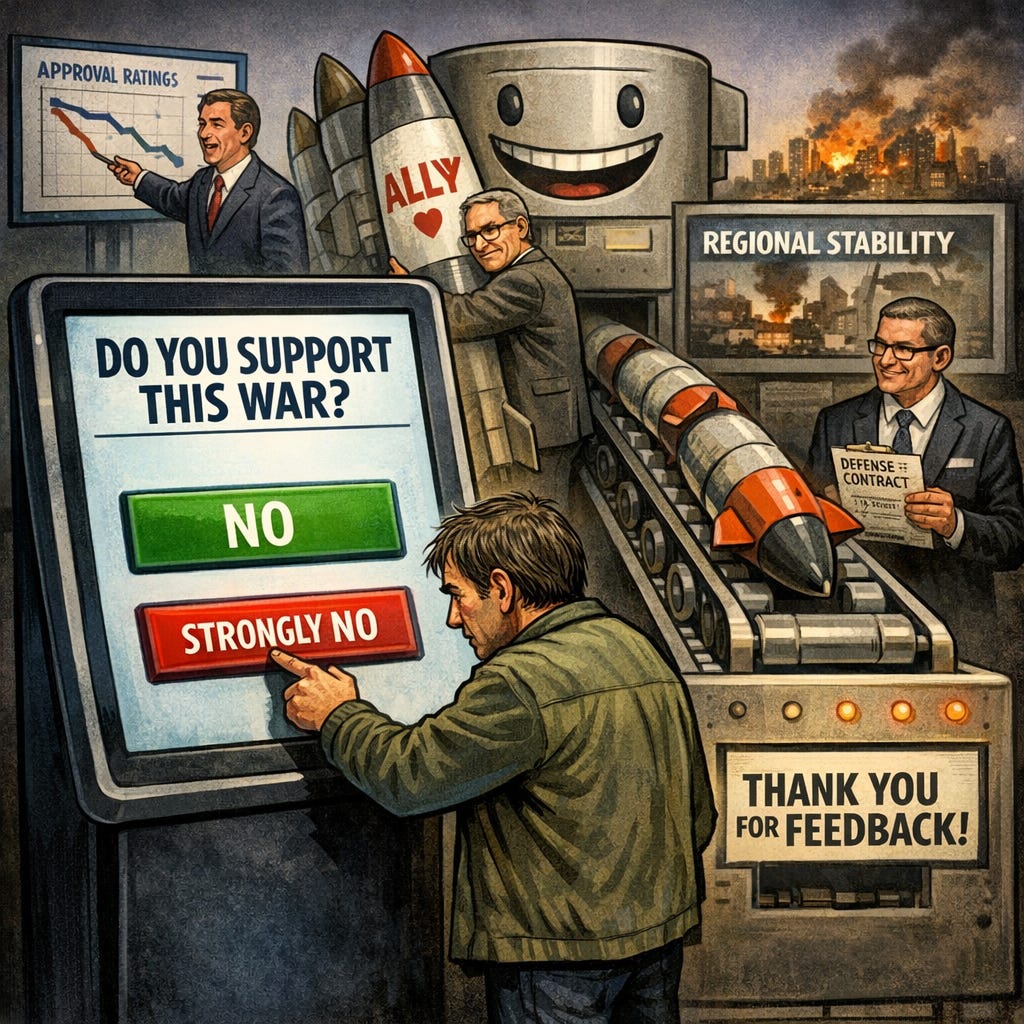
It is one of the great achievements of modern democracy that the public is now permitted to express its will in crisp percentages immediately before being ignored with historic efficiency.
This is called legitimacy.
First, a poll arrives.
Do you want war?No, says the country.Are you sure?Yes, says the country.What if we bring on a retired colonel with a jawline like a granite countertop and let him say “kinetic options” three times?Still no.What if we call it a “limited response”?No.What if we tell you it is necessary to preserve peace?Ah, says Washington, there we are.
For the average American, foreign policy now works like a surprise birthday party planned by alcoholics. You are told it is for your safety, everyone is yelling in the kitchen, someone is crying in the bathroom, and by midnight a small country is on fire.
Meanwhile the experts are hard at work, which is to say they are on television using words that sound like they were invented by men who have never once in their lives had to bury a cousin.
“Escalation management.”“Strategic signaling.”“Regional deterrence architecture.”“Deconfliction channel.”
Translated into English, this means: we are about to do something deranged, but in a PowerPoint.
The public, naturally, is upset. Not because the public is allowed to matter, but because it still suffers from the quaint religious belief that if enough citizens oppose a war, perhaps the war machine will pause to reflect.
This is adorable.
The war machine does not pause to reflect. It pauses only to invoice.
Somewhere in Northern Virginia, a consultant has already billed 1.7 million dollars to explain that bombing one place may reduce tensions by increasing them in a more disciplined manner. Somewhere in Washington, a senator has said the word “ally” with the solemn tenderness other men reserve for their dying mother. Somewhere in Manhattan, a think tank fellow is writing a thread about “the difficult but necessary choices of statecraft,” which is what cowardice looks like when it learns to conjugate.
And then, right on cue, the internet opens its giant cursed mouth.
One faction says this is all because of the lobby.Another says that saying “the lobby” is itself the real war crime.A third says both sides are bad, which is the opinion of a man who watches a house fire and wonders whether flame has been given enough credit for its warmth.
Nobody can simply say: this is what empires do when they are old, armed, and spiritually uninsured.
An empire cannot admit it is addicted to force. It must call force “credibility.” It must call compulsion “stability.” It must call every fresh humiliation a “message.” It must speak like a husband punching drywall and explaining that the family needs to understand boundaries.
And because no modern obscenity is complete without a dashboard, the public is then shown charts.
Look: support is low.Look: trust is collapsing.Look: most people do not want this.Look: none of that will make the slightest difference unless something becomes expensive enough to disturb the donor class at brunch.
This, of course, is where the citizens become confused. They were told they lived in a government of the people. They did not realize the phrase was descriptive in the same way “family-owned” is descriptive on a jar of pasta sauce now manufactured by a conglomerate in New Jersey.
Yes, technically there was once a family.
And then there is the moral pageant.
The same men who could not locate half these countries on a map two weeks ago are suddenly overcome with civilizational concern. They post flags. They post maps. They post photos of children they did not know existed until an algorithm decided grief was trending. They speak of red lines and sovereignty and the rules-based order, which in practice means: there are rules, and some people are based.
The rest of us are expected to perform our assigned role, which is citizen-as-audience. We may gasp on cue. We may choose between Team Necessary and Team Unhelpful. We may decorate our despair with analytics. But under no circumstances are we to notice that a nation can poll its people like a customer satisfaction survey while conducting itself like a hereditary court.
You may fill out the questionnaire.You may circle “strongly oppose.”You may press submit.
Then the screen will thank you for your feedback and load the next missile.
The deeper insult is not even the war. It is the pantomime of consent.
At least a real tyrant has the decency not to ask whether you approve.
But late empire is a more sophisticated animal. It wants your disapproval neatly tabulated. It wants your rage quantified, segmented, and cross-referenced by age cohort. It wants to know exactly how little you support the thing it has already decided to do. This data is very valuable. Not for changing policy, of course. For messaging.
Your outrage is not a veto. It is a metric.
And so the republic limps onward, draped in polling data like a drunk man wrapped in a constitution he keeps mistaking for a blanket.
The citizens speak.The state nods.The contractors smile.The television glows.The experts explain.The allies insist.The markets twitch.The children die.And somewhere, in a room with excellent lighting and no moral oxygen, a man says:
“We should be prepared for some public blowback.”
Prepared.Not persuaded.
That is the whole system in one word.
—Elias WinterAuthor of Language Matters, a space for reflection on language, power, and decline.