Section 1. Opening
Nassau Street, mid-morning, a wind that snaps the flags and makes the coffee steam look theatrical. I was late enough to be annoyed and early enough to pretend I wasn’t, walking fast the way people do when they want to look busy rather than hurried.
At the corner by the church a small scene arranged itself without my permission: an old man, hair like thistle, coat too thin for the cold, paper bag tucked in his elbow. The bag sagged a little, bright with oranges the color of traffic cones. He had a white smear on his sleeve, as if he’d leaned into a chalkboard nobody uses anymore.
He glanced up. Our eyes met for the brief half-second strangers owe one another. I paid with the exact coin I always pay with: a look that says, I already know your kind. Professor type, or the town’s gentle oddball. Harmless. Possibly talkative. The kind who will keep you at the curb with a story when you have a deadline and a coffee cooling in your hand. I broke the gaze first, filed him under Don’t Engage, and stepped off the curb with the light.
The small betrayals we make add no weight to our pockets. They just keep the day light enough to carry.
At the next block, one of his oranges slipped the bag and rolled into the street, hitting the painted crosswalk stripe and settling against the heel of my shoe. I could have bent and handed it back. I didn’t. Not out of cruelty; out of habit. I nudged it toward him with the side of my shoe like a soccer pass, half-smiling, and he gave a small nod of thanks. He was busy too—busy drawing a little figure on his palm with his thumb, as if tracing a daydream he didn’t want to lose. I registered it and gave it a category: eccentricity, probably harmless. The light changed; the crowd broke apart; I kept moving.
Two blocks later I ducked into the café with the mismatched stools and the wall of black-and-white photos. The barista knew my order and had already begun it, the small mercy of routine. While the espresso dripped, I let my eyes climb the wall like everyone does when their phone is not enough. Musicians. A women’s rowing team in the nineteen-forties. A parade I never attended. And then a photograph I’d seen before without ever really seeing it: an old man in a rumpled coat, hair blown sideways, crossing this same street in winter with a paper bag cradled like something precious. The caption under the frame was a single name. You know it already.
The picture didn’t shout; it didn’t need to. The famous ones never do. It was just a man in a town on a day with wind. He looked like every other old person you pass and decide about in three steps. The chalk on his sleeve was faint but visible if you were looking for it.
“Crazy, right?” the barista said, seeing me frozen there. “He used to walk everywhere. People would complain he never wore socks. Legend says he forgot them. I think he didn’t care.”
I made a joke about the sock budget of geniuses and took my cup to the window. Outside, traffic braided itself. Students dragged rolling bags. A delivery truck kissed the curb and shrugged. On the glass, the café’s gold letters floated backwards: SMALL WORLD.
A reflection caught me—the door opening—and there he was again, the old man with oranges and chalk, this time on my side of the street, pausing to re-grip the bag. He was not the man in the photograph; of course he wasn’t. Time is a one-way street, even in towns that pretend to bend it. But the resemblance was enough to make the little motor in my chest skip a tooth. For a moment the photo and the sidewalk overlaid—two thin transparencies finding register.
Here is the part in a story where something happens. A hand goes up; a question is asked; a thread is tugged and unspools. I even rehearsed an opening: Are those Seville oranges? Or—Is that chalk from a class, or a habit? Something small enough not to scare him, human enough not to feel like an interview.
Instead I watched. I watched him rest his paper bag on the brass rail of the window and massage his palm, slow, the way you work stiffness out of a hinge. I watched him pick a bit of chalk from his sleeve with care, as if preserving it. He looked into the café. Our eyes met a second time—longer now, because glass makes courage for both sides. He smiled in that absent way people smile when their mind is somewhere else. I lifted my cup a fraction in a gesture that could be hello or thanks for letting me watch your life for ten seconds. He nodded, the way you nod to a lamppost you’ve known a long time, affection without surprise. Then he set the bag against his hip and moved on, not slowly, not fast, exactly the pace of somebody whose thoughts have a metronome you can’t hear.
I sat with it. The picture on the wall, the oranges at the curb, the chalk on sleeves old and new. The brain likes patterns; it likes to solve; it likes to be right. I thought about all the faces I file under a single word before they can hand me a better one. Busy. Angry. Safe. A problem. A type. The word “type” is a little fence we keep in our pocket. We can set it up in a second, and once it’s up, there’s no pasture beyond it, just the fence itself.
Years ago, the town walked past a man who bent light with math. They passed him in slippers, hair a weather report all its own, and they had groceries to carry and babies to soothe and a stubborn bill at the laundromat that ate quarters. Some knew who he was. Some didn’t. Most had a day to finish. The miracle and the errands shared the sidewalk and learned not to bump shoulders.
I don’t romanticize what happens when you stop. Sometimes strangers do keep you twenty minutes to sell you a meditation app. Sometimes the story really is just a story nobody asked to hear. But every once in a while the world holds out an orange and says, Here, try again.
The door opened. The old man returned. One orange had split its skin; he cupped it like a soft egg. He stood right by my table, catching his breath, and I could smell the citrus—sharp, clean, the way a room changes when you open a window. He was closer than memory now. The chalk on his sleeve was not an accident; it powdered his cuff like a habit. I saw an equation ghosted in the air between his hands as he explained something to himself. Not numbers, exactly—more like the shape of a thought circling for a place to land.
“Those look heavy,” I said in my head. “Can I help?” I said in my head. “Do you teach?” I said in my head.
“Good coffee,” I said out loud, to no one at all.
He glanced at the espresso machine as if I’d spoken to it. The tiny window of opening closed without fuss. He tapped the split orange with a fingertip, as if checking a bruise, and carried on.
There are decisions you make publicly and decisions you make with your eyes. Mine, that morning, was the decision I always make when the day is crowded: keep the world narrow and manageable. Put everything in a container you recognize. Save your questions for something with a deadline. The price is small each time you pay it. You don’t notice you’re down to coins until you need cash.
I finished the coffee and stood. At the door I let myself look again at the photograph. Same sidewalk. Same wind. Same posture of a man who is somewhere both here and not here. The caption’s single name felt less like a fact than a dare. Not a dare to find celebrities in the wild, but a dare to assume that nobody is ordinary just because you’ve decided to be bored first.
Outside, the street had warmed by a few degrees, or maybe I had. The old man was halfway down the block, talking to the bus driver through the open door. The driver laughed, that easy laugh people save for customers they see every day. He took one of the oranges and rolled it across his knuckles like a coin trick before setting it on the dashboard, a small altar to whatever the morning brings. The old man boarded without hurry, found a seat, and looked out the window past his own reflection. For a moment he seemed to notice the café photo behind the glass, or perhaps he was just following some other line across the street—one I couldn’t see and didn’t ask about.
The bus sighed, pulled away, and the corner returned to its usual occupations: emails, errands, steps gathered by the health app, the practiced art of not being late. I stood there longer than necessary, chastened by nothing dramatic, only by the arithmetic of my reflex: look, sort, pass. The town had given me a parable with produce and public transit, and I had almost missed it twice.
I walked on, hands empty, thinking about second looks. How cheap they are. How expensive they feel. How a life can be nothing but first looks if you’re not careful. And how a photograph on a café wall is not a shrine to genius so much as a sign at a trailhead: You are here. Look again.
Section 2. Tonguework: Where “Jaded” Comes From
The next day I went back to the café, not for the photo this time but for the words. Across the street there’s a used bookstore with a bell on the door that takes offense at everyone who enters. I bought a pocket dictionary with a coffee ring printed into the cover, as if language had been warming someone’s table for years.
“Jaded,” it said, first line, the old sense: a horse worn out by being ridden too hard. No psychology, no attitude—just a body past its miles. A few entries down: “a jaded appetite,” meaning dulled by excess. That’s how the word walked from barn to dining room to the place behind our eyes. It started concrete and practical: not wicked, not wise—just spent.
On the next page the dictionary sent me sideways to cousins. Cynical: suspicious of motives. Blasé: unimpressed because of too much familiarity. World-weary: tired from experience, the sigh that comes after the second act when you already know the ending. They’re all neighbors, but they live in different houses. The jaded one doesn’t despise you; he’s just sure you won’t do anything new. It’s not a knife. It’s a glove that doesn’t feel anymore.
A friend from Paris texted back when I asked about the word you gave me: biaisé / biaisée. “Slanted,” he wrote. “Leaning without falling.” He sent a photo of a café table with a sugar packet tucked under one leg so the cups wouldn’t slide. That’s the feeling, isn’t it? The surface looks level until the tea spoon begins its slow migration. The tilt is small, ordinary, everywhere. Biaisé isn’t exhausted; it’s angled—a judgment that starts before the facts arrive. Jaded and biaisé shake hands in the hallway: one says “I’ve had too much of this,” the other says “I already know how this ends.”
Language does more than describe; it trains the hand. Once you start calling yourself jaded, your mind obliges by packing lighter and looking shorter. You stop waiting that extra breath to see what someone brings. You file early. It’s efficient, the way a label maker is efficient: tidy shelves, fast retrieval, a room that looks organized. The trouble is that labels multiply. After a month, everything you own is clearly named and harder to touch.
Back at the café I tested the old dictionary sense against the living world. The chalk-sleeved man from yesterday—if “jaded” began as overuse, whose overuse am I confessing when I refuse him a question? Not his. Mine. My attention has done too many miles on the same route. I’m the worn animal, not the stranger on the sidewalk.
There’s a quieter cousin to all of this that never gets an entry: guarded. It looks sensible—helmets are smart—but it behaves like biaisé in slow motion. Guarded doesn’t tilt the table. It lowers the ceiling. You can live indoors like that for years and forget the sky is higher.
“Jaded,” the dictionary repeats like a wooden sign on a fence. “Worn by overwork or overuse.” In older newspapers the word sits next to food and travel: a jaded palate, a jaded tourist. Now it sits next to hearts. We took a term for tired legs and gave it to the parts of us that make promises.
There’s also jaundiced—a medical word that wandered over the border. It means the eyes have taken on a color that stains what they see. That one is honest about its mechanism: something inside you has tinted the view. Biaisé tells you there’s a lean. Jaundiced tells you there’s a tint. Jaded tells you there’s a limit.
None of these words is a crime. They’re shorthand for injuries and habits. But shorthands grow into stories, and stories grow into policies. You can feel the policy operating in a day: no more unscheduled conversations, no more strangers with oranges, no more pauses at the wall of photos. Efficiency looks like a virtue until you notice what it trims.
Before I left, I penciled a small é over the last e in biaisée on the napkin where I’d been making notes—just to get the shape right. The accent doesn’t change the sound much in my mouth, but it reminds me the word comes from somewhere with its own weather and customs, where tables are leveled with sugar packets and people argue about angles the way we argue about facts. That’s what a good word does: it brings a place with it.
I folded the napkin and slipped the dictionary into my coat. At the door I watched the sidewalk the way you look at a word you’ve just learned, waiting for it to appear in a sentence. A woman in a navy coat laughed into her scarf. A delivery driver rubbed his wrist after a stack of boxes. The bus driver from yesterday had the orange on his dashboard like a small sun. The town kept speaking. My labels kept wanting to interrupt. I tried, for half a block, to let them sit without doing their job.
If “jaded” began in the body and moved to the mind, then any cure worth trying will have to move the other way—back through the body to attention, back through attention to a day shaped differently. But that comes later. The first repair is smaller and grubbier: to admit the tilt, and to look again long enough that the spoon stops sliding.
Section 3. The Long Drift: How Civilizations Grow Tired
I. Late Rome
The senator’s villa had a view of cranes building what no one would finish. He wrote in a clean hand, not to history but to a nephew who kept asking for advice. The advice was always the same: keep your circle small, count what you can control, don’t be surprised by men. Couriers arrived with two kinds of news—border trouble and theater schedules—and both were discussed with the same calm. At dinner, a friend told the old joke about barbarians and tax collectors and everyone laughed because it kept working.
Afterward he walked the colonnade, hands behind his back, repeating to himself the exercise he’d learned from a philosopher: what harms your name does not harm your soul. The words steadied him; they also lowered the volume on everything else. A servant hurried across the mosaic with a lamp and nearly slipped. The senator did not look up.
People later called it Stoic wisdom. Up close it looked like endurance that had hardened into manner. A good manner, maybe the only one left. The nephew read the letters, underlined the lines about composure, and learned not to flinch. He also learned not to look twice.
II. Choir in Winter
Centuries turn, and a stone church opens before dawn. The brothers file into the choir stalls with the grace of men who have done the same movement for years. It is cold enough that your breath has shape. The first note wobbles, then steadies—the kind of steady that comes from muscle remembering for you.
A young novice hates himself for yawning during the psalm. He stares at a knot in the wood and thinks about bread. Acedia—the noon demon—arrives early, wearing a hood. He knows he is supposed to feel something. He feels obligation, which is honest but thin. Then an old brother misses the entrance and laughs, a soft accident that warms the row. The harmony bends and recovers. The novice hears it—the way the human part of the chant holds the divine part up—and for a bar or two he is awake without trying.
Liturgy can become a metronome that puts you to sleep. It can also be a handrail in the dark. The difference is not in the words; it is in whether anyone in the room still expects them to land.
III. Paris, Under Glass
Now a city of glass roofs and polished tile. The flâneur walks the arcades with a newspaper under his arm he will not read. He has trained his face to be immune to displays: mechanical birds, silk umbrellas, a new perfume that promises thunder in a bottle. He is hunting a shock and guarding against it at the same time.
A boy in a smudged apron wipes the window from the outside, making a circle clear enough to frame the flâneur’s eye. For a second they see each other seeing. The boy grins. The man moves on, already composing a line about the boredom of spectacle. When he gets home, he writes the line and two more about spleen, the spleen behaves, he is pleased with the craft, less pleased with the day. He sleeps poorly and blames the lamps.
Modern taste is born in those walkways: sharp, selective, honest about kitsch. Also born there is the habit of standing just far enough back that nothing can claim you. When wonder gets priced and shelved, the safest position is appraisal.
IV. Bedroom, Blue Light
The room could be anywhere. The only local thing is the body in the bed. Midnight slides toward one, and the thumb does its thousand-year-old job of looking for fruit, except the tree is a phone and the fruit is always almost sweet. Headlines flare and dim. A friend’s baby, a war clip, a joke, a wildfire map, another war, a running shoe, a petition, a wedding. The mind keeps saluting and nothing enters the heart.
He scrolls past a grainy photo of a white-haired man on a sidewalk carrying oranges. For a second he chills, as if the café wall has followed him home. The caption is nothing; the comments are nothing; the feeling is not nothing and fades anyway. In the next clip a man lectures a camera about corruption. He is probably right. The thumb says yes, the face says nothing, the night goes on.
The trick of this century is not tragedy. People survived worse. The trick is saturation. You cannot be present to everything, so you learn to be present to nothing in particular. The word for it changes with the decade. The posture does not.
V. The Thread
Across these rooms—the colonnade, the choir, the arcade, the bed—the same economy runs: to stay intact we ration attention. Sometimes that is wisdom. Sometimes it is a slow leak that empties the day. Rome teaches composure and quietly trains indifference. The abbey teaches repetition and sometimes forgets expectation. Paris teaches taste and makes tenderness look unwise. The phone teaches reach and makes reality feel optional.
Every age tries a repair. The senator writes letters about virtue. The choir sings until the notes become muscle. The flâneur writes with ruthless clarity. The insomniac installs a timer and calls it hygiene. Some of it works. None of it works by itself.
On my way home from the café the bus idled at the curb. The driver had moved the orange to the left of the steering wheel where the light could hit it. It was starting to spot. The old man wasn’t on the route; maybe he had gotten off; maybe I’d made him up and the town was polite enough to play along. I stood there, half in the crosswalk, while cars negotiated around me, and felt the pull of the trick I keep falling for: to know the pattern and forget the point.
Civilizations don’t wake up one day and decide to be bored. They get good at surviving and let the skill run the whole show. You save your reactions for when it matters. After a while, it never matters enough. The cure, when it comes, will look small and local and beneath your dignity: a wrong note that makes a boy laugh, a window wiped in a circle, a bus driver turning fruit into a tiny sun, a second look you give because there’s no reason not to.
History rolls forward; the habit is the same. The cost is the same. The repair will be too.
Section 4. The Closed Gate: Why We Become Jaded
Morning starts with a calendar that looks like a game board—colored squares pressed edge to edge, each with a title that promises resolution. A notification stack sits on the lock screen like unopened mail. Before I leave the apartment I brush past three headlines, two messages, and one thread where people I respect are busy correcting strangers. The phone offers a neat version of the day: Here is what you will see, who you will see, what they will say. It is not wrong often enough to be distrusted.
On the sidewalk a neighbor lifts a hand the way people do when they’re not sure you’ll remember their name. I give him the safe nod that means I know you belong to this street but not to my morning. He’s carrying a small plant, soil wrapped in paper. It wouldn’t take long to ask where it’s headed. I file him under “chatty, later” and keep moving.
The first meeting is the weekly one that promises to be different and never is. The deck clicks forward through bullets everyone could recite. A colleague says “just to build on that” and builds exactly nothing, because the point of that sentence is not building, it’s cover. The chat pings with compliments on phrasing. The silence after honest questions is long and awkward; the jokes land fast. I watch myself in the tiny square, nodding at the right times, rationing eye contact like a scarce resource. When the real concern finally gets airtime, we appoint it a parking lot. It will live there until the tires go flat.
This sounds like scorn. It isn’t—not at first. It is conservation. You learn which rooms reward sincerity and which punish it. You learn the dialect of each table—the words that signal you’re not a problem. You learn to close the gate early because opening it costs follow-up, and follow-up costs hours no one gave you.
At noon I stand in line for a sandwich behind a couple mid-argument in whispers. The man says “ calm down” without moving his mouth; the woman looks at the laminated menu like it contains answers. I make a private call on their chances, a lazy wager based on posture. It’s mean, and it feels like analysis. The line advances. I am buying food with contempt and calling it time management.
There was a time I didn’t do this. I remember, because the day it began had paperwork attached. Years ago, I told a friend something I should have kept for a smaller circle, and he used it later at a table where it gave him an advantage. He said he didn’t mean harm. He didn’t mean anything. He was doing what people in that room had taught him to do—convert story into leverage. I had a week of not sleeping well and then I updated the rulebook: some doors stay shut. Protection feels like wisdom when it’s new. If you’re not careful it becomes policy for everything.
In the afternoon I walk into a room that loves performance. The table is the kind where people put their hands on the wood to look grounded. We do the usual theater: quick win, quick laugh, the humblebrag about being “so grateful to the team.” A junior person tries something too clear, and there’s a temperature drop only she seems not to notice. The seasoned ones put a warm hand on it: “Great energy. Let’s circle back.” The room returns to its preferred mood—competent, gelled, a little boring. On the way out someone makes a joke with my name in it, friendly enough to read as welcome and sharp enough to warn me where the furniture is. I laugh. I am grateful to know where the furniture is.
This is where the gate clicks shut for good: when the safe move feels like relief. Sarcasm is a relief. Polished detachment is a relief. The days become a series of practiced exits—out of topics, out of risks, out of the chance to be wrong in public—until you can move through twelve hours without allowing anything to touch the internal dials. You have not lied. You have optimized.
On the way home I duck into the bookstore. I pick up a thin novel everyone is posting and put it down because everyone is posting it. Then I pick up a quiet book with a plain cover and put it down because no one is posting it. Taste is doing laps around tenderness. I can feel the loop and still not step out of it. Near the register a postcard rack includes the café photograph—the white-haired man mid-stride, winter jacket open to the wind. I consider buying it for the desk and don’t, allergic to the person I might become if I decorate myself with reminders to be better.
Evening is a small dinner with people who could go deeper and don’t. The table is bright; the food is good. A story with an edge gets told, someone carefully teases the edge, we hit the part where a straight sentence could change the mood, and—like a tide—it rolls back to a quip. Everyone is talented at this, the way people who live near water are talented at reading waves. No one is to blame. No one owns the appetite for honesty long enough to offer it first.
On the walk back, I try to name the mechanics instead of swimming in them.
First: predict-before-encounter. The brain loves to spend less. If it can label, it can move on. Hungry mornings make hungrier labels. Every “I already know” saves a few seconds and bills the day later.
Second: contempt-as-armor. It is not always loud. Most days it’s just a steady posture of “I won’t be taken in.” The cost is that nothing takes you in—no person, no line of music, no small miracle that doesn’t look like one yet.
Third: taste outrunning tenderness. Precision becomes a way to avoid being claimed. You can admire indefinitely without belonging. It feels like excellence because it is a kind of excellence. It is also a refusal to be interrupted.
Fourth: strategy becoming self. You start by protecting your mornings, your inbox, your bandwidth. A month later you are protecting yourself from anyone who might matter.
None of this requires a villain. Workplaces reward early closure. Feeds reward certainty. Past harms reward caution. A joke is a small bridge over a real gap—useful, sometimes the only way across. But a city built of only bridges never lands.
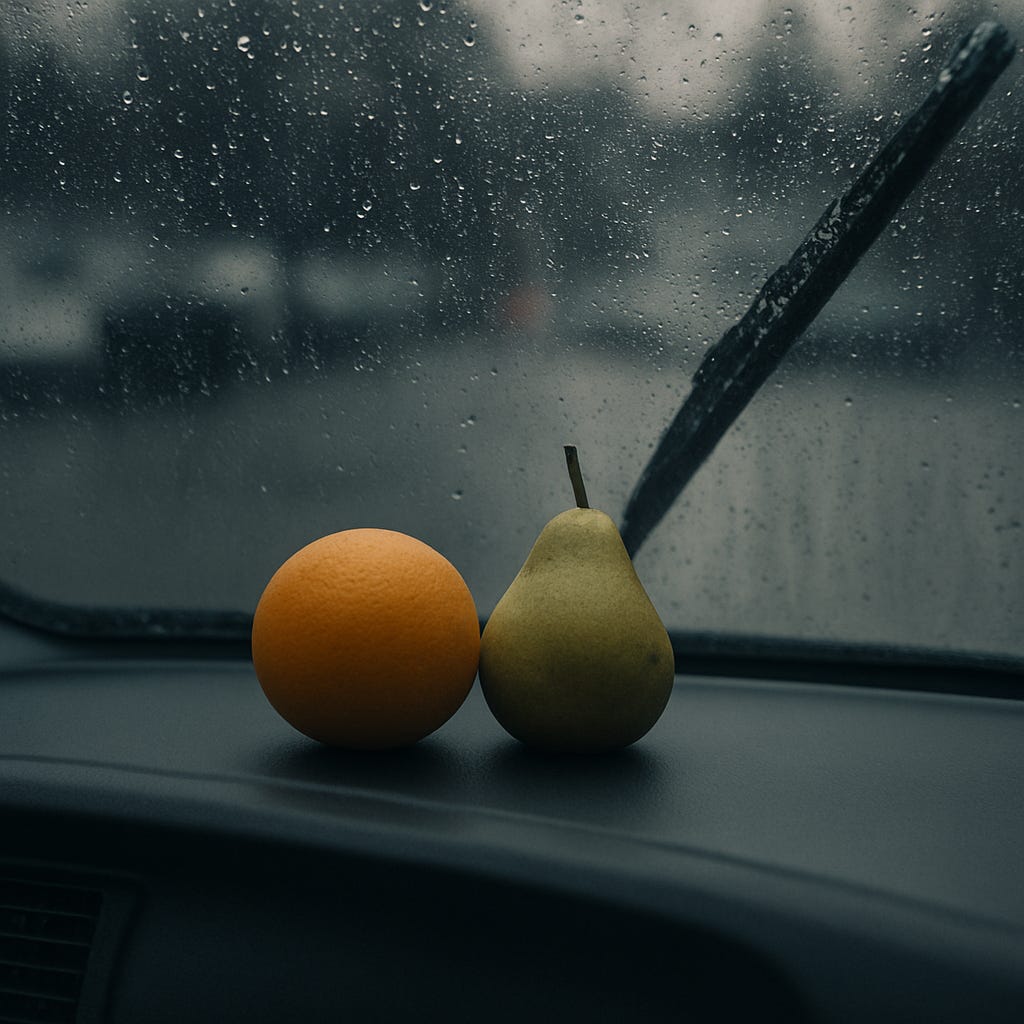
At the corner near my apartment a bus idles, lights warm in the blue. The driver has a piece of fruit on the dash; it’s not the orange anymore, it’s a pear, but the point rhymes. He’s talking to a kid through the open door, showing him how the turn signal sounds from the inside. The kid’s father looks embarrassed about standing there too long. They both leave with a wave and the father’s apology to nobody: “Sorry, we’re in your way.” The driver says, “You’re not.”
I stand there longer than I intended, listening to the click of the signal, feeling the small broadcast of that sentence: you’re not in the way. It lands like an unlicensed repair. For a moment the day’s policy loosens. I can almost say hello to the neighbor with the plant; I can almost send the text I owe; I can almost go home and write the better thing instead of the clever one.
Then the crosswalk counts down, and habit returns wearing common sense. There is dinner to make, emails to ignore, a tomorrow that will fill itself. The gate shuts with its soft little sound—the one I told myself I’ll open later, when there’s time, when the room is different, when I’m rested, when I’ve earned the right mood.
We don’t become jaded because we dislike people or art or mornings. We become jaded because the math keeps working. The quick prediction is often right. The guarded joke often prevents trouble. The narrow day is easier to carry. The cost is not loud enough to trigger alarms. It’s the kind of cost that shows up as a life you can describe accurately and remember vaguely.
Upstairs, I set my keys in the bowl and look at the plant the neighbor left earlier by my door, a polite hostage of my earlier nod. There’s a note under it: “Extra basil—needs sun.” I put it by the window, say nothing to anyone, and watch the leaves settle. The room is quiet in the old way. I stand in it, counting reasons. Then I stop counting, just for a minute, and let the room count me. It is not a cure. It is not even a plan. It is a small delay in the reflex to close—the sort of delay from which better days are built, if you can bear the discomfort of leaving the hinge unlatched.
Section 5. Repair Manual for Wonder
I didn’t start with a manifesto. I started with a postcard. The café had a stack of the Einstein photo near the register, and I finally bought one, not to display but to write on the back. Three lines with a dull pencil:
* One day a week: no feeds.
* Learn one hard thing with my hands.
* Spend one evening helping someone who can’t thank me online.
I propped the card inside my cupboard where the mugs hide, so the rules had to look at me before the coffee did.
Monday — Off the grid, on the sidewalk
I chose Monday for the tech fast, not Sunday, because Monday has a way of explaining itself as urgent. After work I turned the phone off, not “Do Not Disturb”—off—and put it in the mixing bowl like it might leak. I walked the long way to the grocery store without headphones. The street was louder than I remembered: truck brakes, a basketball, a couple arguing about whose turn it was to send the email. No miracles, just life without commentary.
In the produce aisle I bought three oranges, because apparently that’s a motif now. At the register an older woman fumbled for change and apologized to everyone behind her as if she had ruined the season. “You’re fine,” the cashier said, which is what cashiers say when they mean it. On the way home I peeled one of the oranges with my fingers and ate it over the sink. The juice ran down my wrists and made a small sun on the cutting board. It felt juvenile and correct.
Tuesday — A craft that answers back
I picked drawing because it’s the opposite of my job and because paper is cheap. I set an orange on a saucer and tried to put it on the page. No music, no video in the corner, no “learn to draw in 10 easy…” Just a soft pencil and an object that refused to sit still, because light moves even when fruit does not. Ten minutes in, I realized the outline wasn’t the orange; the light was. Twenty minutes in, I hated my hand. Thirty minutes in, I saw the tiny flat at the top where the skin dips and thought, That is new. I wasn’t making anything good. I was practicing a way of paying attention that has consequences.
I went to bed with smudges on my thumb and the feeling I try to buy with equipment: that something is worth doing again tomorrow.
Wednesday — The evening that doesn’t post
There’s a community center two stops away that runs a weekly supper for whoever comes in. I chopped onions until my eyes were bright and tried not to narrate it for an imaginary audience. The director said “Hand me that knife, friend,” which is how you make people belong without name tags. A man at the end of the line wanted to talk about the weather maps; a teenager at the sink wanted to talk about a science teacher who gave her back an essay with “Tell me more” written in the margin. None of it was content. It was the sort of time that turns into memory without a camera.
On the walk home I realized I wasn’t proud; I was tired in a way that made sleep legal.
Thursday — The small commons
I texted three people I trust for the right reasons—their seriousness, not their skill at parties—and asked them to read one short thing with me after work. We met in my living room. Phones stayed in shoes by the door. We sat with a single poem for forty minutes and did not pretend to be clever. When someone spoke, they had to restate the last person’s point well enough to earn a nod before adding anything. We were clumsy at first. Then something unlocked. We discovered that disagreement is a better conversation than agreement when everyone wants to understand rather than win.
At the end we sat in silence for two minutes, which felt like a joke until the second minute. The room thickened. We left the chairs where they were and didn’t clean the coffee cups as if tidiness might erase what happened.
Friday — Music without volume
I found a notice about a high school quartet playing in the church hall for anyone who wanted to sit on metal chairs and listen. No mics, no merch, no lighting cues. The violist’s A string was a fraction sharp at the start and then wasn’t. I watched bow hair fray and land, watched a girl count six bars of rest by biting the inside of her cheek. At one point the second violinist lost the road and his friend handed it back with the barest tilt of a wrist. I forgot to breathe and then remembered.
Outside, the bus idled by the curb with its door open. The driver still had fruit on the dash, now a pear with a bruise turning handsome. “How long you been keeping a produce altar?” I asked. He laughed. “Since a man brought me an orange once and told me the bus was a better temple than most buildings.” “Was he a professor?” I said, immediately embarrassed by the category. “He was a widower,” the driver said, like that answered a better question.
Saturday — The second look drill
I made errands take longer than they needed to. At the hardware store I asked the clerk how to choose sandpaper and learned more about grit than a person should. At the park I sat on a bench without a book and watched a little league coach explain failure to a kid in a way that made failure not feel like the headline. On the way back, near the café, I saw the chalk-sleeved man from the first day. He was kneeling by a tree box, rubbing a small note on paper with the side of a pencil—rubbing up the impression of a plaque like people do in graveyards. I stood there, undecided for the length of a breath.
“Does that work?” I asked, finally. He looked up, surprised and not alarmed. “Sometimes,” he said. He held it up: a ghost of letters, incomplete but legible. “You collect them?” I said. “I keep them,” he said, which is not the same. He slid the paper into his coat pocket like a child hides a treasure. We stood in the easy space where strangers don’t owe a next line. Then he asked, “Do you draw?” I said I was trying. “Keep failing,” he said, kindly, as if he were handing me a tool.
Sunday — A rule, not a mood
I wrote the week down in short lines so I wouldn’t confuse memory with intention. The craft goes on the calendar like a meeting. The supper is Wednesdays at six, no RSVP. The small commons will rotate houses; the poem will be chosen by whoever hosted last. The tech fast stays on Mondays because it hurts less when practice hurts, and Mondays already hurt.
None of this makes the world glow on cue. The bus is still a bus and the inbox will not apologize. But the week felt different—less like I was grazing a display, more like I was chewing food. When the reflex to sort someone arrived, it met enough friction that it had to slow down and explain itself.
That evening I taped the postcard to the inside of the kitchen cabinet for good. The handwriting looked like a note from someone who meant well and forgot often. Which is what I am. The rules were not heroic. They were just weight-bearing: a little pressure where attention collapses, a little room where kindness can land.
I washed the orange smell from the cutting board and left the window open. Down on the street a bus chuffed and clicked. The turn signal went on—left, left, left—and then it didn’t. The quiet that followed wasn’t profound; it was available. Which, after a week of trying, felt like the right word for the life I want: not dramatic, not optimized. Available.
Epilogue: The Second Look
A week later the town was rinsed clean. Overnight rain had pushed the heat down into the pavement; leaves were still dripping, wires humming with leftover water. I walked out without headphones. Monday rules had spilled into other days.
At the café the postcard rack was empty. The wall with the photographs had been rearranged—same frames, new order. Einstein’s picture had moved to the far corner where the glare makes you work to see it. In its old spot hung a bus on a winter morning, the windshield fogged around a circle someone had wiped clear with a sleeve.
I bought a coffee and stepped back onto the sidewalk. The bus idled at the light. On the dash: the pear, now shriveled into a small green fist. The driver saw me and tapped the horn twice, a hello you could miss if you wanted to.
The old man was across the street by the tree box again, kneeling the way knees remember youth when the ground calls. He was doing the rubbing thing—paper, pencil on its side, patient strokes across a metal plaque. The paper took the letters slowly, as if copying with respect. I crossed on the red and got away with it.
“Does it come out better after the rain?” I asked.
He looked up, mid-stroke. “You see more when the grooves are wet,” he said. He held the page toward me. TREE DEDICATED TO MIRA V. The rest was still ghosted. He went back to it without fuss, filling the missing bits until the name stood whole.
“Mira was…?”
“My wife,” he said. “Her bench is further along.” He folded the paper into his coat with the old care of people who trust pockets. The oranges were in the bag again. Their color looked loud against the gray morning.
“Do you always carry them?” I said.
“Neighbors,” he said, like that was a complete sentence. He lifted the bag a little. “It makes me stop.” Then, after a beat: “And people take them.”
We stood there while the light cycled. He didn’t rush to turn this into a larger thought. I liked him for that. The bus hissed and the door opened; the driver leaned out. “Professor,” he called, easy. “You riding or walking?”
“Walking,” the old man called back.
“Pear’s retired,” the driver said, tapping the dash. “Bring me a lemon next time. I’m building a collection.”
The old man smiled in the way people smile when they’ve been given a small, unserious job to do. He turned to me. “You draw,” he said, not as a question. Maybe he’d read it on my hands; graphite takes a while to wash out.
“I’m trying,” I said.
“Good. Draw your hands,” he said. “People start with faces. Hands tell the truth faster.”
He began to stand; I took his elbow without ceremony. He let me, which felt like a kind of permission. At full height he was taller than I’d expected. He tugged his sleeve down over the chalk. “I can never keep this off me,” he said. “It makes a mess.”
“It helps me find you,” I said.
We started down the block together. He walked at the pace of someone who has never written “ASAP” on anything. At the corner he stopped where the bus driver kept a smoker’s ashtray filled with sand, the kind you smooth with your finger when you’re thinking. The old man set the bag on the lid and took out another sheet of paper.
“Do one,” he said, passing me the pencil.
“What am I rubbing?”
“Whatever holds,” he said. He pointed to the iron base of the streetlight, its manufacturer’s stamp almost worn flat. I knelt and made a charcoal rectangle until the letters appeared like a caption under a film. Not beautiful. Legible. He nodded as if I’d passed a small test I didn’t know I was taking.
“You keep them all?” I said.
“Just the names,” he said. “I don’t need the dates.”
We reached the bus stop. The driver had his door open again, as if the bus were a porch and we were neighbors who might or might not come up. He had put a fresh orange where the pear had been, bright as a warning light. “Look at that,” he said. “Somebody’s got my back.”
The old man took one from his bag, rolled it on his palm, and handed it up like he was paying a fare. The driver made a show of inspecting it for dents and set it beside the other. “I’ll be scurvy-proof by September,” he said.
We laughed, three people at a curb with nothing urgent to prove. The light changed; a car honked politely; the town resumed. The old man turned to go. I almost asked him his last name and didn’t, sensing that anonymity was part of the arrangement—like a rule spoken without being written.
“Thank you,” I said instead, and wasn’t sure for what.
“For looking,” he said.
I watched him walk until he was just a coat among other coats, the bag of oranges moving like a metronome at his side. The driver closed the door and checked his mirrors. “You good?” he said.
“I’m good,” I said.
He pulled away. I crossed back to the café. The photos on the wall looked ordinary again, which is to say they were working. You can’t live on the excitement of recognition; you live on the discipline of it. The basil at my window had put out two new leaves overnight and pretended not to care.
At home, I turned the postcard over and added a fourth line in the same blunt pencil: Ask one small question before you sort. I taped it back where it belonged and stood there, cupboard open, reading my own handwriting like it had been left by someone else.
Out the window a bus stopped and started. The wipers flicked once and rested. On the dash, two circles of color sat calmly in the sun that had fought its way through the clouds—a tiny, ridiculous still life moving through town. Not a symbol, not a sermon. Just proof that something had been noticed and kept.
I locked the door behind me and left the hinge on the habit a little loose. The day wasn’t different. I was. Enough to stop once, to ask a plain question, to let an answer rearrange a small corner of the map. The rest can take its time.
—Elias WinterAuthor of Language Matters, a space for reflection on language, power, and decline.