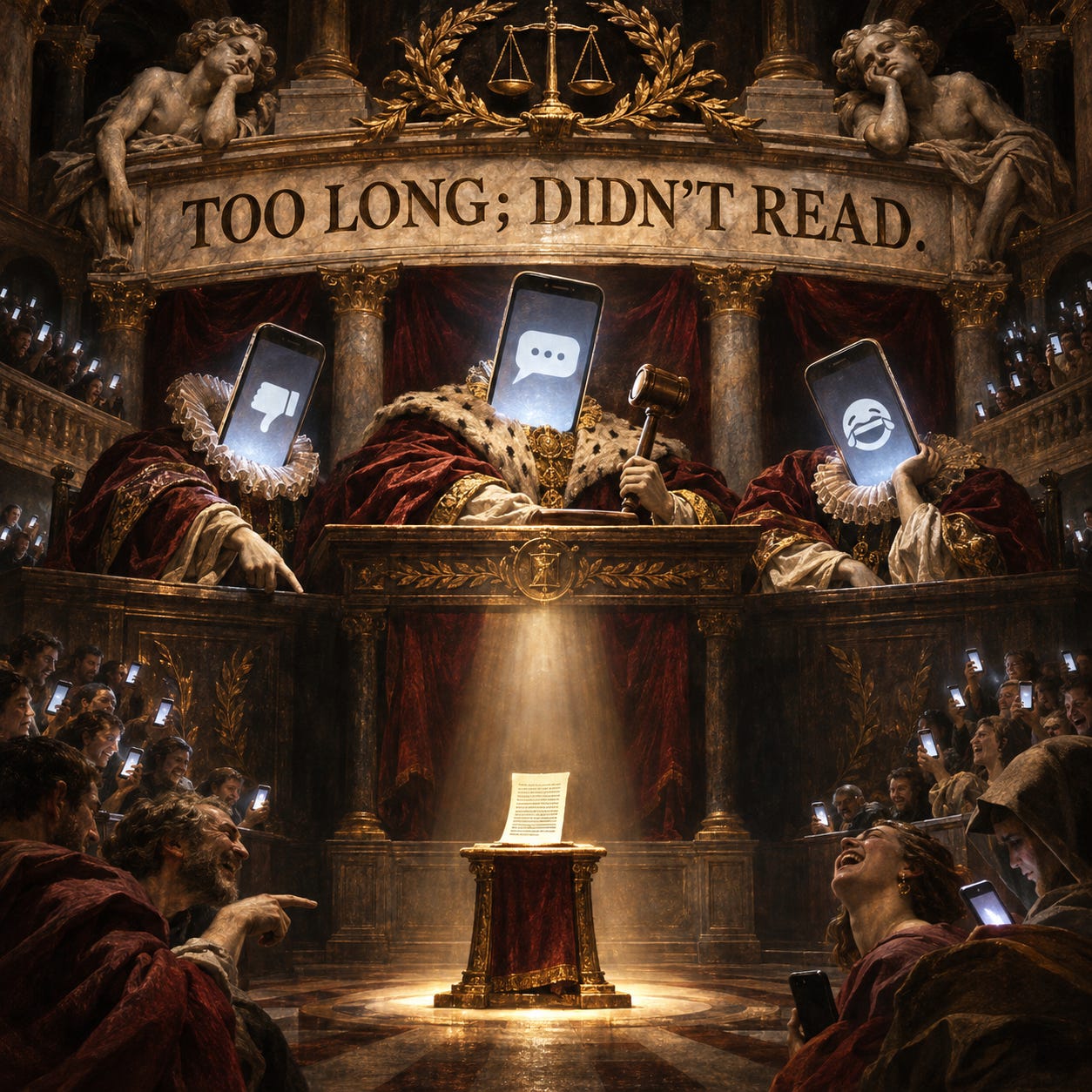
A man committed a serious offense on the internet the other day. He wrote several paragraphs.
Not threatening paragraphs. Not particularly offensive ones. He simply attempted to explain something complicated. He introduced a distinction, considered an alternative explanation, acknowledged a contradiction, and, in a moment of extraordinary recklessness, provided historical context.
The response arrived almost immediately.
“Bro wrote a novel.”
The crowd was delighted. The prosecution rested. No further evidence was required.
Somewhere between the invention of the printing press and the arrival of the smartphone, humanity decided that reading four paragraphs constituted unpaid labor.
The remarkable thing about this exchange is that nobody had to demonstrate that the argument was wrong. Its length was sufficient evidence of intellectual misconduct. The writer had violated an unwritten rule of contemporary discourse: if an idea cannot fit inside the reader’s remaining attention span, the idea must be defective.
We have entered the age of performative impatience.
The Prestige of Not Understanding
There was a time when intellectual authority required at least the appearance of knowledge. A person might establish credibility by demonstrating familiarity with history, philosophy, science, or literature. Occasionally, this involved reading books.
Today, a more efficient method is available.
One simply announces that the argument does not deserve one’s attention.
“Too long.”
“Touch grass.”
“AI slop.”
“Not reading all that.”
These are not necessarily responses to an argument. They are declarations of social position. The speaker establishes superiority by demonstrating that the subject is beneath the inconvenience of consideration.
It is a magnificent arrangement. One person spends an hour developing an argument. Another spends four seconds announcing that the argument is too long. The second person may receive more applause.
We have discovered a method of producing intellectual prestige without the unpleasant intermediate step of exercising the intellect.
Of course, long writing is not automatically good writing. There are essays that could be reduced to a sentence without losing anything except the author’s pleasure in hearing himself think. Anyone who has attended an academic conference knows that verbosity can be a form of hostage-taking.
But brevity is not intelligence either.
A short argument may represent the culmination of years of thought. It may also represent the absence of any thought whatsoever.
The difficulty is that both look equally impressive on a smartphone.
The Great Compression
This would be merely amusing if our civilization were becoming simpler.
Unfortunately, it is doing precisely the opposite.
Our economies depend on global networks of production, finance, labor, and technology. Our political decisions produce consequences across generations. Algorithms influence what billions of people see, purchase, believe, and fear. Scientific discoveries transform institutions faster than those institutions can understand what has happened.
To explain almost anything important now requires examining multiple causes, unintended consequences, historical conditions, and competing interests.
Reality has become extraordinarily complicated.
Our preferred explanations have become extraordinarily short.
We have built a civilization requiring systems thinking and then handed its inhabitants a character limit.
Consider the difference between simplicity and simplification.
Simplicity is often the achievement of profound understanding. A scientist spends decades investigating a phenomenon and eventually expresses its underlying structure in an elegant equation. A philosopher wrestles with contradictions until a complicated idea becomes clear.
Simplification reverses this process. It begins with the elegant conclusion and dispenses with the troublesome investigation.
One is the reward of intellectual labor.
The other is a way of avoiding it.
Yet our digital culture frequently rewards both in exactly the same way. The sentence that condenses twenty years of research competes with the sentence someone invented while waiting for a sandwich.
Both receive a like.
The Democracy of Instant Expertise
The internet accomplished something genuinely extraordinary. It democratized publication.
For much of history, the ability to address a large audience required access to institutions: newspapers, universities, publishing houses, political organizations. Today, almost anyone can participate in public discourse.
This was an enormous expansion of human possibility.
It also created a small administrative problem.
We democratized the microphone without necessarily democratizing the intellectual preparation that once justified speaking into one.
A person encounters an unfamiliar argument. Rather than examining its premises, he recognizes a familiar political category. He retrieves the appropriate opinion, adds a little moral certainty, and presses send.
The intellectual transaction is complete.
Imagine Socrates attempting to conduct a dialogue on a modern social platform.
“What is justice?” he asks.
“Define justice? Seriously? Touch grass.”
Socrates attempts to distinguish justice from obedience.
“Bro is writing a dissertation.”
Plato arrives to defend his teacher.
“Clearly AI-generated.”
The moderator closes the discussion. Community standards have been restored.
Human beings, of course, have always been impatient, tribal, and susceptible to slogans. Ancient Athens did not consist entirely of philosophers exchanging careful qualifications over olives.
The difference is that we have constructed an industrial distribution system for these tendencies.
A platform can reward the appearance of certainty thousands of times before a careful argument has finished explaining its first premise.
And because attention is scarce, contempt becomes economical.
Why demonstrate that someone is mistaken when you can demonstrate that you are unimpressed?
The Machine That Made Thinking Cheaper
Then something unexpected happened.
Humanity invented a machine capable of helping people reason through complicated questions.
Artificial intelligence.
For centuries, writing a serious essay required substantial intellectual resources. One needed education, books, time, revision, and the patience to discover that one’s original argument was considerably less intelligent than it sounded inside one’s head.
Writing is difficult because it exposes the inadequacies of thinking.
You begin with a conviction. Then you attempt to explain it. Suddenly, you discover that three premises are missing, two examples contradict your conclusion, and the historical analogy you found irresistible is not particularly analogous.
This is not a failure of writing.
It is one of writing’s greatest achievements.
Writing is not simply how we communicate thoughts we have already completed. It is one of the ways we discover what we think.
And now a machine can participate in that process.
It can question assumptions, propose counterarguments, identify contradictions, clarify distinctions, and help organize scattered intuitions into coherent explanations.
It can serve as an editor, a research assistant, a philosophical adversary, or an extraordinarily patient companion in the unpleasant business of discovering that one might be wrong.
It does not follow that the machine is always correct. Quite the contrary. AI can produce confident nonsense with a fluency that would embarrass even the most accomplished political commentator.
But used critically, it can lower the practical barriers to sustained reasoning.
A person who might never have attempted a serious essay can now explore an argument, test its structure, revise its premises, and produce something more thoughtful than the slogan with which he began.
This is a remarkable historical possibility.
Naturally, humanity responded by declaring that anyone using the machine was cheating at thinking.
The Great Slop Inquisition
There is a legitimate objection here.
AI can…