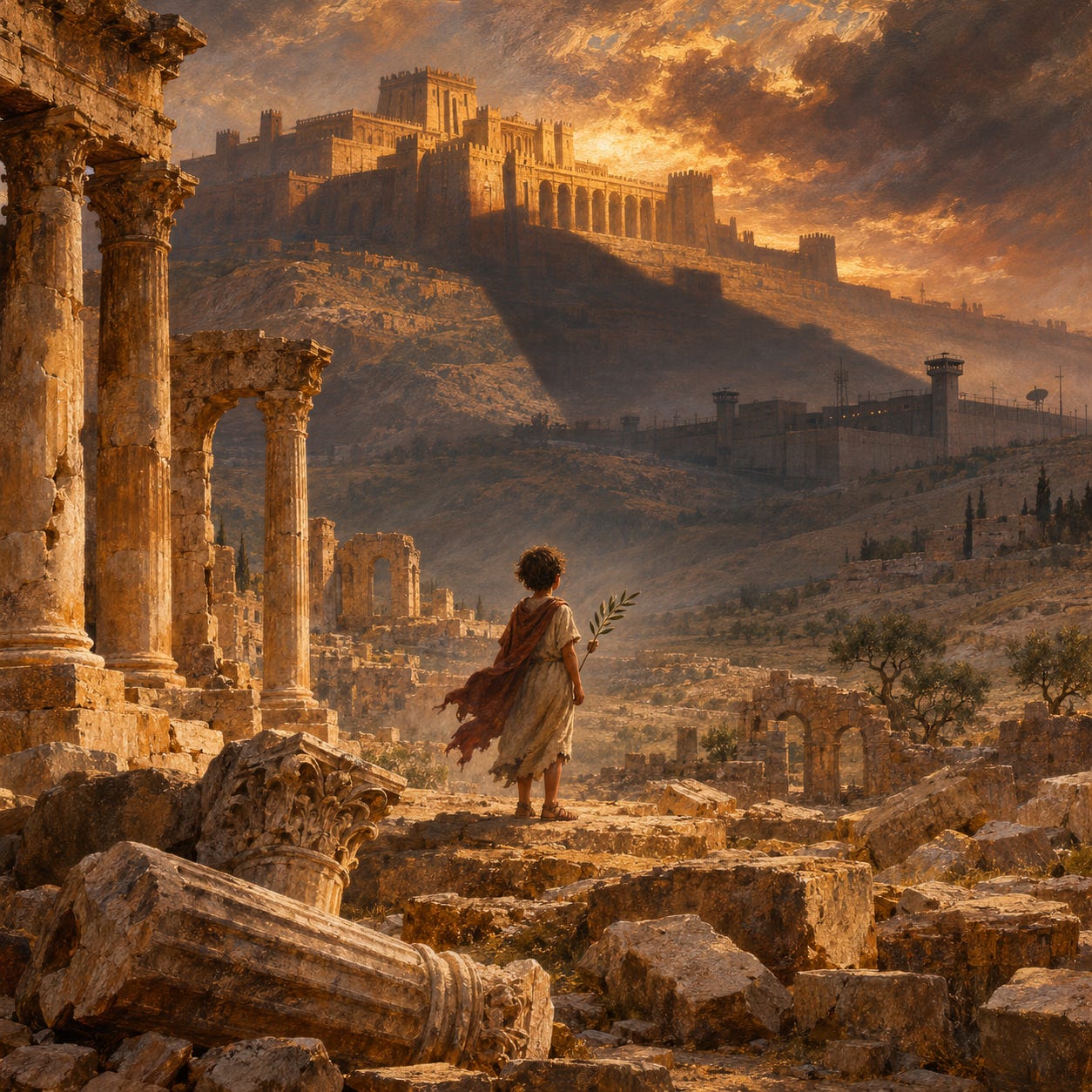
I. The Dinner Guests Have Returned
I have spent much of the past week investigating the remarkable ability of certain American gentlemen to remain influential long after the rest of us might reasonably have expected them to retire, repent, or at least stop attending one another’s fundraising dinners. In The Children of the Covenant and Trump’s War on Iran, I reconstructed the relationships connecting Roy Cohn, Donald Trump, Rupert Murdoch, the Kushners, the Adelsons, and the political networks surrounding America’s confrontation with Iran. In The Epstein Class and the Illusion of Rebellion, I asked whether Trump’s supposed uprising against the establishment was merely a transfer of authority between competing factions of the establishment. And in The Corruption That Went to War, I asked whether the American electorate would ever be permitted to investigate the relationships that helped bring the country into another Middle Eastern war.
The names were familiar. The money was considerable. The dinner invitations had survived. But a more difficult question remained. Why? Why would political networks claiming to defend the security of Israel support policies that risk producing more hostility toward Israel? Why would the memory of persecution become entangled with strategies of territorial domination? Why would people who know the history of exile appear so willing to contemplate the displacement of others? And why, after thousands of years of human beings explaining that their latest war was necessary to prevent the next one, do we still find ourselves listening? I began looking for an answer in contemporary politics. I eventually found myself in Babylon.
II. Two Temples, Two Empires, and One Very Long Memory
In 586 BCE, the Babylonian king Nebuchadnezzar II destroyed Jerusalem’s First Temple. The destruction was not merely architectural. For the people of Judah, the Temple stood at the center of religious and communal life. Its destruction accompanied conquest, the loss of political independence, and the deportation of part of the population into exile. An empire had entered somebody else’s country, destroyed its sacred institutions, and carried away its people. The Babylonians presumably had strategic explanations. Empires generally do. They seldom announce that they intend to devastate another society because they have developed an unhealthy affection for devastating societies. They speak instead of security, rebellion, stability, and the unfortunate necessity of teaching neighboring populations the benefits of obedience.
Centuries later, in 70 CE, Rome destroyed the Second Temple. Different empire. Familiar outcome. By then, Jewish communities were already dispersed across the Mediterranean and the Near East. The Roman destruction intensified an experience that would become central to Jewish historical consciousness: the preservation of identity without dependable political sovereignty. The Jews were not humanity’s first migrants. Human beings had been moving, fleeing, conquering, and being expelled long before Babylon existed. But Jewish history became one of the world’s most enduring examples of a dispersed people maintaining a recognizable religious and cultural identity across centuries. They survived without possessing the sort of territorial power that had destroyed their institutions. And survival became an inheritance.
The destruction of the Temples remained present in religious observance, collective memory, and the understanding of history. Babylon and Rome became more than ancient empires. They became reminders of what happens when somebody else possesses overwhelming power over your future. Yet the history contains an extraordinary interruption. Between Babylon and Rome, another empire arrived. It came from Persia. And it behaved differently. We will return to that.
III. The Religion That Inherited the House
The Jewish diaspora eventually encountered a particularly complicated European development. Christianity. Christianity emerged from Judaism. Jesus was Jewish. His earliest followers were Jewish. The Hebrew scriptures became indispensable to Christian theology. Through the teachings of Paul and the developing Church, Christianity also opened itself to Gentiles without requiring the full observance of Jewish religious law. Circumcision ceased to be a universal requirement. Dietary restrictions lost their authority for many Christian communities. The religion became capable of expanding across peoples whose ancestors had never encountered the God of Israel. It was a remarkable theological transformation.
The Roman world eventually adopted a religion born among a people whose Temple Roman soldiers had destroyed. One might have expected this development to produce a certain historical embarrassment. Instead, Christian theology developed traditions asserting that the Church had fulfilled or superseded the covenant associated with Israel. The older religion remained indispensable to the new religion’s legitimacy. Yet Jews who continued practicing their own faith could be portrayed as refusing the truth of the very scriptures Christianity had inherited. It was an unusual inheritance dispute. Christianity had moved into the house, embraced much of the family history, rearranged the furniture, and occasionally treated the original inhabitants as trespassers. Over centuries, theological hostility contributed to discriminatory laws, forced conversions, expulsions, massacres, and recurring campaigns of persecution.
Then came economics. Medieval Christian restrictions on usury complicated the provision of credit. Meanwhile, Jews in many European societies faced restrictions on landownership, occupations, residence, and membership in professional associations. Some entered commerce and moneylending. A small number became prominent financiers. Many others remained poor. This distinction was apparently too complicated for societies searching for convenient explanations of their economic difficulties. European rulers could restrict Jewish opportunities, depend upon Jewish creditors, borrow from them, and then encourage hostility toward the same communities when repayment became unpleasant. The creditor became a villain. The debtor occasionally became a patriot. And an entire population acquired a reputation for wealth that most of its members did not possess.
Economic envy, religious prejudice, and political opportunism reinforced one another. The pattern persisted because it served powerful interests. A society could exploit a minority’s labor or financial services while continuing to portray that minority as an alien presence. There is something recognizable about this arrangement in contemporary attitudes toward migrants. The outsider is useful until the outsider becomes inconvenient. Then the outsider becomes responsible for the condition of the society that used him.
I reject that logic, whether directed toward Jews, Muslims, immigrants, or wealthy people whose individual conduct has never been examined. Wealth itself is not a crime. Nor is poverty a certificate of virtue. The relevant questions concern how wealth is acquired, how power is exercised, and whether public institutions remain accountable to the people they govern. But Europe spent centuries treating Jewish difference as a political problem. And the accumulation of persecution eventually reached its most terrible expression.
IV. When Survival Becomes a Political Doctrine
Six million Jews were murdered in the Holocaust. There is no historical analogy that can make this fact smaller. The Holocaust was not merely another episode of discrimination. It was an industrial project of extermination, conducted by a modern state with the assistance of institutions, professionals, bureaucracies, and collaborators. It demonstrated that a society possessing universities, orchestras, sophisticated engineering, and an impressive vocabulary of civilization could organize the systematic murder of its neighbors. C…