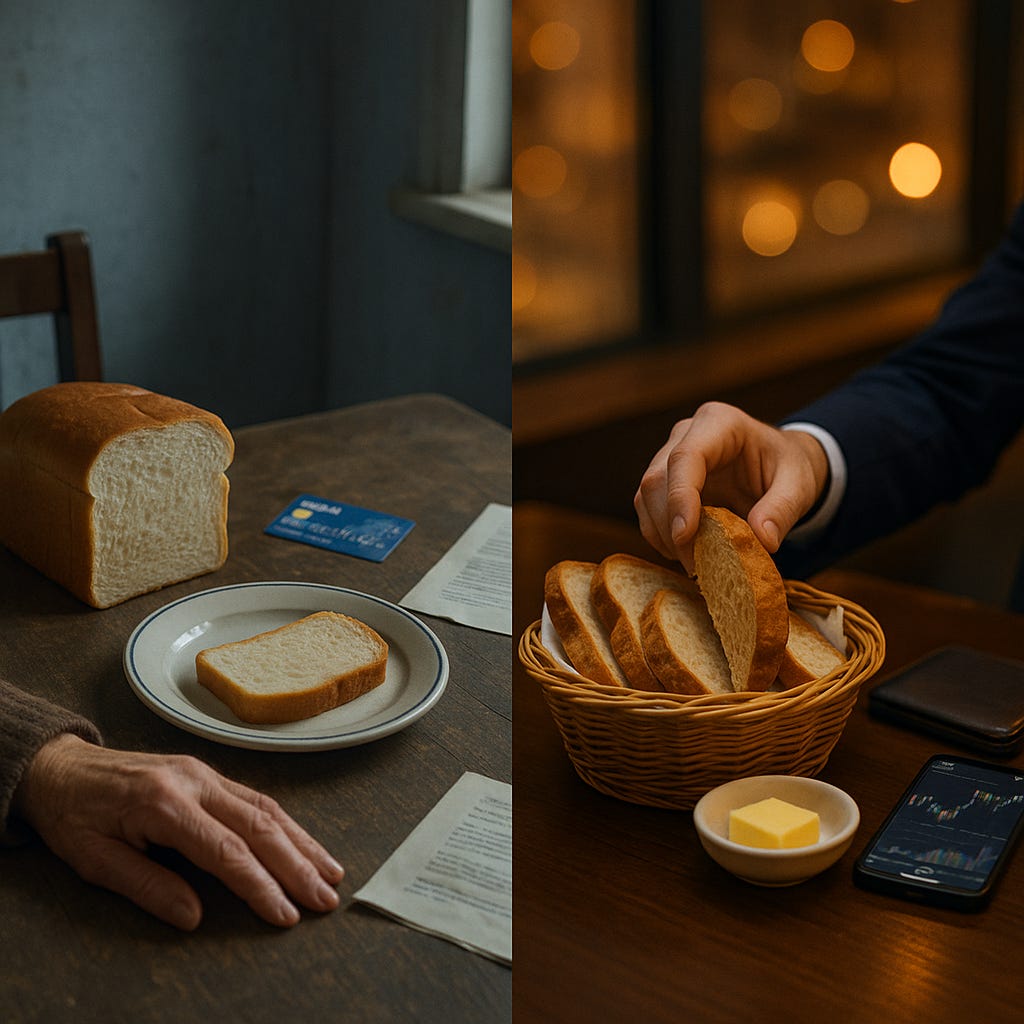
Chapter 1 – Bread Day
Julia woke up hungry.
It wasn’t dramatic hunger, not yet. It was the dull, familiar kind: a hollow under the ribs and a faint metallic taste in her mouth that made coffee sound better than food. She swung her legs over the side of the bed and waited for her joints to remember how to be knees.
The trailer was cold. The cheap vinyl floor held the night like a grudge. Outside, January light was trying to decide whether it wanted to bother with this part of rural America at all. Frost feathered the edges of the single-pane window above her sink, where a plant used to live before last winter’s electric bill killed it.
Bread Day, she thought. At least there’s that.
On the calendar pinned to the wall beside the fridge, she’d written it in blue pen:First Thursday – Food Bank, 11 a.m.The words were underlined twice, as if underlining could guarantee there’d be enough to go around.
She shuffled to the bathroom, brushed her teeth with a careful, rationed stripe of toothpaste—no more big, careless squeezes; everything had a measured size now—and then filled the coffeemaker with water. The machine sputtered a sound like an old man clearing his throat. The smell of cheap grounds joined the lingering scent of last night’s fried potatoes.
The fridge answered when she opened it: light, cold, and nearly empty.
Half an onion wrapped in plastic. A jar of generic peanut butter. Three eggs in a gray carton. A Tupperware of pinto beans. The leftover potatoes, soaked in oil she’d already strained and reused twice. A single bruised apple, its soft brown spot spreading like rust.
On the door sat the carton of milk she’d stretched past its date, and behind it, the orange prescription bottle that did not belong there but lived there anyway because the food cupboard was no longer separate from the medicine cupboard. Everything was just survival now; no need for categories.
She poured the coffee and stared at the prescription bottle.
Lisinopril. Blood pressure. Take one daily.
It had been “one daily” for nine years. Then, around the same time the letters about “benefit adjustments” started coming, it became “one most days.” Last month, it had quietly turned into “every other day,” like a secret pact between her and the pills not to say anything to Dr. Henson.
That man had a framed degree and a waiting room full of people who still believed the system was more or less holding. He didn’t need to know that her math now was:electric bill + propane + gas to town + food.
There wasn’t a line item for “obedience.”
She took the pill. Even on the days she thought about skipping, she usually didn’t. It felt like crossing a line she wasn’t ready to cross. Hunger, you could stretch. Blood vessels, not so much.
The SNAP card lay on the counter like a scolded child: blue plastic, scuffed edges, the state seal worn faint under years of swiping. The last receipt was still folded next to it, the fresher ink overlaying the ghosts of prior trips.
She unfolded it.
Her eyes scanned the numbers quickly; she’d memorized the bottom line days ago.
SNAP Balance: $7.18
Seven dollars and eighteen cents to last until the next deposit. Four days. She could make it if the food bank had potatoes, beans, maybe some canned vegetables. She could pretend this was just a lean week, like the bad winters when the factory cut hours back in ’82.
Except it wasn’t just a week, and she knew it.
The first time she noticed it—not in the news, not in the speeches, but in the way her life scraped—it was summer. The deposit hit her card and came up light. Not by much; just enough that she thought she’d misremembered. Then the food bank line started getting longer. Boxes got smaller. The good stuff—the fresh produce, the meat that wasn’t all bone and gristle—came less often.
“They cut something,” her neighbor Doris had said in the food bank line two months ago, tugging her cardigan tighter against an early frost. “They’re always cuttin’ something. Said it’s to ‘save’ money. Ain’t saving me none.”
Julia had nodded but said nothing. She still felt, in some stubborn bone-deep place, that she wasn’t supposed to complain. She’d been raised on phrases like “Don’t take charity if you can help it” and “We don’t ask the government for handouts.”
Except she had asked, now. Or rather, she had stood quietly in line while a system she never helped design stamped something next to her name that meant poor enough.
She poured herself a cup of coffee and dropped in the last sugar packet from the glove compartment of her car. Years ago, she would have laughed at herself for scavenging restaurant sugar. Years ago, she would have been the one leaving a tip on the table without counting the coins.
She didn’t fry any potatoes. She cracked one egg into the pan, watched the white bloom and the yolk settle into its sunny center, then spooned a few beans alongside it. The plate looked sparse. She added a slice of bread from the loaf she’d bought on sale—the kind with more air than grain.
The bread was thinner now, too. Not literally, but that’s how it felt around here: bread that had been asked to cover more sin than it could.
She ate slowly, stretching each bite, listening to the local AM station murmur about “entitlement reform” and “fiscal responsibility.” The host’s voice slid easily over the words, smooth as melted butter.
“They say they’ve got to rein in spending,” the man said. “We can’t keep shelling out billions for these programs without asking tough questions. There are cuts, sure, but sometimes that’s just good stewardship.”
Julia chewed.
She wondered if “good stewardship” ever meant the people who made decisions would try living on seven dollars and eighteen cents of food for four days.
Probably not.
By ten-thirty, she’d washed her single plate and fork, pulled on her thickest sweater, and shrugged into the winter coat she’d bought the year her husband, Ray, still had steady work at the plant. The zipper stuck halfway up, and she coaxed it gently like a stubborn child.
She picked up her purse—soft nylon, the color long faded from black to charcoal—and slid in the SNAP card, her driver’s license, and a folded twenty-dollar bill she pretended she might never need.
The twenty wasn’t for food. It was for emergencies: the car breaking down on the way to the food bank, a co-pay at the clinic that insurance mysteriously didn’t “fully cover,” or a prescription the doctor insisted she start right away. It was her last buffer between “barely managing” and “calling one of the kids to admit she couldn’t.”
She locked the trailer door, even though there wasn’t much inside worth stealing, and walked slowly down the three wooden steps Ray had built himself. Frost cracked under her shoes. Across the gravel lot, the neighbor’s dog barked once, then lay back down in its patch of winter sun.
The drive to town was twenty-two miles of fields and faded billboards. The corn was long cut down, leaving only stalks like broken bones sticking out of the ground. Here and there a “Trump 2024” sign still listed in the wind, corners chewed by weather. Julia didn’t look at them. She’d voted the way she’d always voted, almost out of muscle memory, then watched after each election as nothing much changed except the phrases used on television to explain why.
The food bank lived in the basement of what used to be a Methodist church. The steeple was still there, but the sanctuary upstairs was mostly empty now except for weddings and funerals. The real congregation came on Thursdays: the line of cars snaking around the gravel lot, old sedans and pickup trucks, a few rusted SUVs with mismatched doors.
Julia parked in her usual spot, not too close to the entrance—she didn’t want to seem eager—and joined the small group of people already waiting outside the double doors.
“Morning, Julia,” Doris said, her cheeks red from the cold. “You hear they might have some fresh stuff today? Lettuce, maybe. Heard the farm up by Route 9 had a surplus.”
“Lettuce,” Julia said, smiling. “Haven’t had a salad in a while. Be nice.”
They shuffled forward as volunteers propped the doors open. The air that escaped was warm, full of the smell of cardboard and coffee and something starchy boiling in a big pot in the back.
Inside, folding tables made aisles: canned goods on one, bread and pastries on another, boxes of produce at the far end, if you were early or lucky enough. A chalkboard near the entrance listed the day’s rules:
ONE BAG PER FAMILYONE BREAD PER PERSONLIMIT 2 CANS MEAT, 4 CANS VEGPLEASE BE PATIENT – WE HAVE LESS TODAY
The “less” was new. They used to write “Please be patient – We’ll get to everyone.”
Julia eyed the board, then the tables. The bread selection was thinner than last month. More white loaves, fewer of the sturdy whole wheat ones that stayed with you. The canned aisle had lots of corn and green beans, not much else. She saw no peanut butter, no tuna.
A young volunteer with purple hair and a church t-shirt handed her a cloth bag.
“How many in your household?” the girl asked.
“Just me,” Julia said.
“Alright, ma’am. One bread, four veg, two fruit if there’s any left at the end. Sorry, we had some deliveries cut this month.”
Julia nodded. She’d learned to accept apologies for things that weren’t the speaker’s fault.
At the bread table, she picked a loaf that seemed a touch heavier. A woman next to her squeezed one and frowned.
“They’re smaller,” the woman said, loud enough for the room to hear. “Feels like they’re shrinking everything on purpose. Like those candy bars at the gas station.”
“Shrinkflation,” someone else muttered. The word sounded like a joke and a diagnosis at once.
Julia passed the canned goods, choosing methodically: two green beans, two corn, two diced tomatoes. She skipped the canned ravioli, even though she liked it. It was expensive in sodium, her doctor had said. She couldn’t afford to stretch her pills and then soak herself in salt.
At the far table, the produce was already picked over. No lettuce. A few onions rolling in a cardboard box, some spotted apples, a pile of carrots that looked like they’d been rejected for being the wrong shape.
She selected three onions and four carrots, tucking them carefully into the bag. Soup, she thought. She could make soup with potatoes if the SNAP balance could manage a five-pound bag at the store.
Soup was good. Soup made you feel like you had more than you did.
As she moved toward the exit, a man in a faded veterans’ cap held the door open for her.
“Ladies first,” he said with a little bow.
“Thank you,” she answered, automatic. Old habits of politeness didn’t shrink with age.
Outside, she and Doris compared bags.
“Not so bad,” Doris said, trying to sound bright. “Could be worse.”
“Always could,” Julia replied. “Could be better, too.”
They both laughed, but there wasn’t much humor in it.
On the way back to the car, the wind cut through her coat. She felt suddenly, sharply tired—not just in her legs, but in the place where hope used to live.
She thought of all the years she’d worked: the diner in her twenties, the factory in her thirties, the grocery store in her forties when the plant closed and Ray’s back went bad, the motel laundry in her fifties after he died. She had punched clocks and smiled at customers and stood on concrete until her feet ached. She had clipped coupons, packed lunches from leftovers, skipped vacations, saved what little she could in a coffee can and later in an account that seemed to vanish into the black hole of medical bills.
She had believed—because her parents had believed—that if you did all that, the country would meet you halfway at the end.
Not with luxury. Just with enough.
Enough had turned out to be a food bank in the basement of a church and a blue plastic card that now arrived with less on it.
She opened her purse to tuck in the bag claim ticket the volunteers had given her in case they did a second round later in the day. Her fingers brushed the folded letter from two months ago, the one she still carried even though she’d read it enough times to know every phrase.
Dear Ms. Whitaker,We are writing to inform you of changes in your Supplemental Nutrition Assistance Program (SNAP) benefits…As part of ongoing efforts to ensure program sustainability and fiscal responsibility…Your monthly benefit amount will be adjusted from $162 to $134…
The numbers were burned into her memory like a brand. Twenty-eight dollars may not have sounded like much to whoever typed the letter, but here it was a week’s worth of bread and beans. Here it was the difference between buying fresh apples or choosing the cheapest box of store-brand crackers.
“Fiscal responsibility,” she whispered. “Funny way to say ‘we’re taking bread off your table, Julia.’”
In the distance, a semi roared past on the highway, transporting goods to somewhere that still felt included in the country’s idea of itself.
She started the car. The engine coughed, then caught.
On the drive home, she passed a billboard advertising a new housing development an hour away in the city: smiling families, green lawns, the words “Luxury Homes from the 700s” in large, pleased font. She tried to imagine a house that cost seven hundred thousand dollars. She tried to imagine what it would be like to open your fridge and never think in terms of “this needs to last until Thursday.”
She pictured some man in such a house—suit jacket, crisp shirt, kitchen island bigger than her entire living room. Maybe he was worried today, too. Not about bread, but about something she’d heard on the news: talk of “raising taxes on high earners.” They’d interviewed a businessman who said it was “punishing success.”
Julia had turned the volume down then. She’d been seasoning beans and didn’t want to get mad at the stove.
Still, the phrase clung: punishing success.
No one called this punishing failure, she thought now, glancing at the food bank bag on the passenger seat. They called it belt-tightening, shared sacrifice, making hard choices. Somehow those hard choices kept landing in the laps of people who didn’t have belts left to tighten.
At home, she carried the bag inside and arranged her haul on the counter. It looked better spread out: the illusion of abundance. She put the bread in the breadbox her mother had given her as a wedding present fifty years ago. The hinge squeaked a protest.
She filled a pot with water, dropped in the beans and an onion, and set it to simmer for later. While the stove clicked and the flame caught, she took the SNAP card in her hand and turned it over.
Tomorrow she would go to the store and buy potatoes, maybe rice, if the balance and prices cooperated. She would stand under the fluorescent lights and pretend not to notice the people who pretended not to notice her.
Somewhere, she knew, someone could change one line in a law, one number in a code, and the card in her hand would hold enough to make this week feel less like a narrowing tunnel. Somewhere, somebody thought cutting that number was “saving.”
To her, it was the thickness of soup, the size of a slice of bread, the decision to cut a pill in half.
She set the card down gently, like a fragile thing.
Outside, the sky had finally committed to daylight. It came in thin but steady through the kitchen window, washing over the onions and the carrots and the bread that would have to be enough, again.
On the stove, the beans began to boil. Julia turned the heat down and watched the bubbles slow, thinking—as she did most days now—not about the country as a whole, but about the small part of it that could fit in her cupboard.
She did not know that, a few hundred miles away, a man she would one day pass in a hospital waiting room was on the phone with his tax attorney, worrying out loud about the possibility of paying five percent more on the part of his income that lived so far above her world it had no weather.
All she knew was that bread was getting thinner. And that someone, somewhere, had decided that was responsible.
Chapter 2 – The Marginal Rate
Jonathan woke up annoyed.
The alarm hadn’t gone off yet. His body had done what it always did: surfaced at 5:42 a.m., six minutes before the phone on the nightstand would chirp its gentle synthetic birdsong. For a moment he lay still in the dimness, listening to the faint hum of the HVAC and the almost-silence of the city thirty stories below.
He was not annoyed at the sleep—he’d slept fine, as he almost always did—but at the thought that had been waiting for him at the edge of consciousness like a pop-up window.
Five percent.
It wasn’t even a sentence, just a number with teeth.
He reached for the phone, silenced the alarm before it could crow, and checked his email. The subject line that had been haunting him since yesterday’s news alert was still near the top:
Policy Brief: Proposed 5-Point Increase on Top Marginal Rate
He didn’t open it. He knew the contents already: charts, projections, reassurances that it was “just a proposal” and might die in committee. He knew the talking points about “asking the wealthiest to pay a little more” for “programs that help struggling families.”
He also knew the part his advisor had underlined when they’d spoken: “applies only to income above the top-bracket threshold.”
Only, Jonathan thought. That word did a lot of work for people who’d never seen the view from his window.
He swung his feet out of bed, padded across the warm hardwood floor to the bathroom, and turned on the shower. Steam rose, fogging the mirror that reflected a lean, still-handsome man in his early fifties: the softened jawline, the silver at his temples that people kept telling him looked “distinguished.” He ran a hand through his hair and tried not to start the math again.
It didn’t work.
Last year, his taxable income had landed just under twelve million. Some of that was salary, some bonus, some vested stock. Not all of it hit the top bracket, of course, but enough did that a five-point hike would bite.
He let the water pound against his shoulders and did the calculation he’d done three times already.
Suppose half of it is above the threshold. Six million, taxed at five percent more. That’s an extra three hundred thousand.
Three hundred thousand dollars. A house in most of the country. A rounding error in his portfolio.
He could afford it. He knew that. But “afford” and “deserve” were not the same word.
“I’m not a villain for wanting to keep what I earn,” he muttered, surprising himself by saying it out loud. The shower hissed in response.
Downstairs, the kitchen lights turned on automatically at six. By the time he walked in, towel around his waist, the coffee machine had already ground and brewed a precise number of grams into a precise volume of water, yielding the perfect cup. The fridge, when opened, was the opposite of Julia’s: full, cold, and arranged like a lifestyle magazine spread. Greek yogurt, berries, pre-washed greens, a carton of egg whites, a drawer of high-end cheeses he barely touched.
He cracked three eggs into a pan, added a scoop of egg whites for protein, and slid a slice of seeded sourdough into the toaster. The bread was thick, artisanal, the kind that came from a bakery that posted its grain sources on Instagram.
On the mounted TV above the counter, a financial news channel murmured about global markets and Washington maneuvering. A chyron at the bottom read: ADMINISTRATION FLOATS TAX HIKE ON TOP EARNERS; OPPONENTS WARN OF GROWTH HIT.
Jonathan watched with the detached attentiveness of someone whose life was always somewhere in the underlying story.
“Critics say the proposal is modest,” the anchor intoned. “A five percentage-point increase on the top marginal rate would impact only the highest earners. Supporters argue it could raise tens of billions a year to fund programs like health care and nutrition assistance. Opponents say it punishes success and could drive investment offshore.”
A policy analyst appeared in a split screen, talking about “redistribution” and “elasticity of taxable income.” Jonathan tuned out the jargon and heard instead the quieter indictment in the background: we know where the money is.
He plated his breakfast, wiped a faint smear off the edge with a paper towel, and sat at the kitchen island. The marble was cool under his forearms.
He loved this apartment. The view, the quiet, the way the glass walls made the city feel like his without ever requiring him to step into its mess unless he chose to. He had bought it three years ago, after the company’s Series D, when the board had agreed his “contribution to shareholder value” justified a compensation package that still made him a little giddy to think about.
He had grown up middle-class in a Midwestern suburb: two teachers for parents, a mortgage that always seemed a little too large, a secondhand station wagon with a rust spot on the rear door. Money had been something you watched carefully, not something you rearranged. To build this life out of that background felt like proof of something—competence, maybe. Worth.
He forked egg and toast into his mouth and pulled up the briefing his CFO had sent last night.
We’ll walk through scenarios with Nate this morning, the email said.Need your decision by end of week on shifting more comp into deferred stock. Also: Foundation’s rural health initiative wants a quote from you about “giving back.” They’re drafting something but you might want to look it over.
He sighed, half amused, half irritated. Giving back. The phrase suggested a debt he had never agreed to.
At eight he was in his office, the one with the glass wall that looked over the open-plan floor full of hot desks and engineers and product managers. He liked the hum down there, the easy concentration of people who still believed that lines of code could change the world in uncomplicated ways.
His own world was more complicated. The door behind him closed with a click that meant decisions.
“Nate on line one,” his assistant said over the intercom.
“Put him through.”
“Morning, Jonathan,” came the lawyer’s voice, smooth as ever. “I assume you’ve seen the circus in D.C.”
“I have,” Jonathan said. “Tell me I don’t need to worry about it.”
“Well,” Nate replied, “that depends on your definition of ‘need.’ As written, it’s a five percentage-point increase on income over the top bracket threshold. So it’s not touching your first chunk at all, only what spills over. But we both know you have a fair bit spilling over.”
“Spare me the metaphors and give me the damage.”
“Ballpark? Based on last year, if you change nothing, you’re looking at an extra… call it four hundred thousand in federal. We can get that down, of course, with some adjustments.”
“Adjustments.”
Nate chuckled. “Nothing nefarious. Move more of your bonus into deferred comp. Lean into equity grants with longer vesting. We can also look at channeling more through the family partnership. And the foundation, frankly, gives us good optics if they start making noise about ‘the wealthy paying their fair share.’”
“That foundation already costs me real money.”
“And saves you some, too. Philanthropy is tax-efficient, remember? We’ll do a full modeling. My team’s putting together scenarios. But high level: this doesn’t have to hit you nearly as hard as the headlines suggest.”
Jonathan leaned back in his chair, letting his eyes rest on the office across the street where someone in a gray suit was pacing on their own phone call. It was reassuring, in a petty way, to remember he wasn’t the only one being hunted by those five percentage points.
“What are the odds this actually passes?” he asked.
Nate made a thinking noise. “In this exact form? Low. But some version of it? Higher than I’d like. There’s a lot of public anger out there, and this is an easy narrative: ‘small increase on the richest to fund food stamps, rural clinics, that sort of thing.’”
Food stamps. Rural clinics.
The words passed through Jonathan’s mind like background music, heard but not quite listened to. Somewhere out there, he knew, there were people using government cards at grocery stores, and there were hospitals struggling to keep their doors open in places the company’s products would never reach. He supported rural health in the abstract. The foundation had a whole initiative around it.
“It’s not my job to fix their budget,” he said, more to himself than to Nate. “I pay what I owe. More than most.”
“I know,” Nate said soothingly. “And, look, you’re not the villain here. You employ hundreds of people. You pay a lot in taxes as it is. No shame in wanting to keep the government from grabbing more than it needs.”
Jonathan liked that: more than it needs. It framed the state as a kind of overeager relative at Thanksgiving, always asking for “just a little bit more” from the dish closest to his plate.
“What about the argument that this money would go to, you know, feeding kids or whatever?” he asked, the question coming out flatter than he intended.
“Well,” Nate said, “that’s the story they’ll tell, sure. But you and I both know it’s not that simple. A lot gets lost in bureaucracy. And higher rates can dampen investment, which hurts everyone in the long run. There are better ways to help the poor than punishing success.”
Punishing success. Jonathan had used that phrase himself in conversations, but it sounded especially good in someone else’s mouth.
“Okay,” he said. “Run your models. Send me options. I want to see what it looks like if we cap my taxable income at the current top threshold and push everything else into deferral or equity.”
“On it,” Nate replied. “Oh, and one more thing—the foundation’s board wants you at the site visit next month. The rural hospital in… what is it, Pine Ridge County? They’ve got a telehealth wing we helped fund. Great photo op. Politically smart right now.”
“Put it on my calendar,” Jonathan said.
After the call, he sat for a moment with his fingers steepled under his chin. Pine Ridge County. He couldn’t have found it on a map if you’d paid him, but he had seen the glossy deck: a struggling regional medical center, miles from the nearest big city, now boasting a state-of-the-art telemedicine program thanks to his foundation’s grant.
He would fly in on a private jet, drive out in an SUV, tour the facility, shake hands with administrators and maybe a carefully selected patient. He would say something in front of a banner about “closing the rural health gap.” There would be pictures of him next to nurses and local officials. It would play well. It always did.
He did care, he told himself. He wouldn’t have set up the foundation if he didn’t. He wrote checks—real ones, with real zeros. He funded scholarships, too, and a coding boot camp for kids in a part of the city most of his employees only drove past.
It wasn’t as if he hoarded everything. The idea that the government had a moral claim on an additional five percent of his top bracket felt, frankly, insulting.
In the afternoon, there was a product review, a meeting with the VP of Sales, a quick stand-up with the AI team. He could lose himself in that rhythm: metrics, roadmaps, churn, conversion, the language of building and growth. Here, effort translated—imperfectly but measurably—into results.
At four, the CFO came in with a printout.
“I sat with Nate’s team,” she said. “We can cut the projected hit by about two-thirds if you’re willing to shift most of next year’s bonus into deferred stock and increase the foundation’s annual disbursement.”
“Two-thirds,” Jonathan repeated, scanning the numbers. “So what does that look like in actual dollars?”
“Instead of, say, a four-hundred-thousand increase, we could get it down closer to one-fifty. Maybe a little less.”
He exhaled slowly. One hundred and fifty thousand. On paper, an enormous sum. In his life, the difference between one more or one less indulgent project: a car he didn’t need, a kitchen remodel he’d already postponed twice. He could live without it.
But that wasn’t the point.
“It’s not that I can’t pay it,” he said. “It’s the principle. They talk about ‘fair share’ like I haven’t been paying it all along.”
“I get it,” she said. “And you do pay a lot. Top one percent pays about forty percent of income taxes, last I checked. You’re carrying a big chunk already.”
He liked that fact; he repeated it often. It made him feel both burdened and noble.
“Fine,” he said. “Move forward on the adjustments. And have Comms draft something about how additional tax burdens on high-growth companies jeopardize innovation. We might need that line ready if this gets serious.”
After she left, he stood at the window and watched the early dark move in over the city. Headlights threaded between buildings. Somewhere down there were people who would be grateful for the programs his tax dollars already funded. Somewhere, too, were the ones who’d game those programs, the stories he heard at country clubs and on talk radio: the guy with the fancy sneakers using food stamps, the woman who “just keeps having kids for the benefits.”
He knew those stories were cherry-picked, exaggerated. He also knew they worked. They made it easier to keep people like him from feeling obligated.
There was a world, he believed, where he could keep his incentives aligned and still be a good person. Where his refusal to pay more was a stand for efficiency, for personal responsibility, for a lean, disciplined state. In that world, the cuts to “entitlements” were unfortunate but necessary trims to a bloated system, not knives at the throats of people whose names he did not know.
In the evening, he took a car home, changed into gym clothes, and spent forty-five minutes on the Peloton, legs pumping as an instructor shouted encouragement from a screen. Sweat blurred the edges of his thoughts. For the length of the workout, there was only cadence and heart rate and leaderboard position.
Afterwards, showered and dressed in soft cotton, he ate dinner—grilled salmon, roasted vegetables, a glass of good wine—and answered a few last emails. One from the foundation director included a draft quote for the Pine Ridge visit:
“In a country as wealthy as ours, no one should have to choose between distance and health. We’re proud to partner with this community to bring quality care closer to home.”
He stared at the sentence for a long time. In a country as wealthy as ours. It was the kind of line that sounded unquestionable, as long as you didn’t ask who exactly “we” meant, or how far “ours” extended.
He made a small edit, changing “no one” to “no family,” because it sounded more human, and clicked approve.
In bed, the city was a low glow beyond the curtains. He tried to read a novel but found himself rereading the same paragraph. His mind kept circling back to the same loop.
Five percent. If they raise it now, what stops them from raising it again in five years? Ten? At what point does the productive class just shrug and move their money somewhere else?
The phrase “productive class” didn’t feel great when he heard it from certain commentators on TV, but in his own thoughts it felt descriptive rather than arrogant. He did produce things. Jobs. Products. Value. He wasn’t a speculator sitting on idle capital. He was building something.
He also knew, if he looked too closely, that the system had given him more than he could ever repay: the roads his trucks used, the public schools that had educated his employees, the research his AI models were built on, much of it originally funded by grants and agencies whose acronyms he barely knew. But looking that closely made the ground under his certainties feel less solid. So he didn’t, not for long.
He set the book down and turned off the light. In the darkness, the number floated back up, luminous.
If the proposal passed, if the lawyers did their best and the accountants their tricks, he might end up effectively paying one hundred, maybe two hundred thousand more a year. Over a decade, that was a couple million redirected from his personal accounts into the maw of the federal budget.
He thought of it in terms he understood: opportunity cost.
That’s a house on the coast. That’s the seed funding for a side venture. That’s the capital I could allocate far more efficiently than they will.
Far away, in a county he had yet to visit, an older woman he would one day pass without recognition was rinsing beans in a dimly lit kitchen, planning how to make them last until her next food bank day. Somewhere in between them, in a ledger he had never seen, someone had written that the country could not afford to feed everyone like her without asking more from people like him.
Jonathan lay awake longer than usual, staring at the ceiling, tracing numbers in his mind. He did not think of himself as greedy. He did not think of himself as cruel.
He thought of himself as prudent.
And prudence, in his vocabulary, meant this: assume the state will always want more, and plan accordingly.
Chapter 3 – The Ledger of a Country
The country keeps two kinds of books.
One is the visible kind: the official numbers, the graphs that appear on the evening news, the figures a politician cites with a practiced smile. The other book is quieter. It is written in cupboards and bank accounts, in the length of food bank lines and the thickness of soup.
Julia lives in the second book. Jonathan lives in the first. Both are real. Only one is allowed to call itself reality.
Let’s open the books side by side.
1. How much it actually costs to keep Julia fed
Start with something simple: groceries.
The program Julia depends on is not exotic. It does not involve luxury. It is a plastic card that lets low-income people buy food at ordinary stores. On paper, in Washington, it has a long, serious name: the Supplemental Nutrition Assistance Program.
In a given year, the country spends about 100 billion dollars on this program.
Write that out slowly:
* $100,000,000,000
Most of that—more than 90 billion—does not go to offices or administrators. It goes straight onto cards like the one on Julia’s counter, which then turn into bread, beans, apples, milk.
If you imagine the federal budget as a town of one hundred dollars, SNAP is roughly one dollar of that. One. Not fifty, not twenty, not ten. One.
That one dollar is what stands between Julia and the kind of hunger we pretend doesn’t happen here.
When the government “saves money” by trimming Julia’s benefit from, say, $162 a month to $134, it does not show up as a dramatic line on a national chart. It shows up as:
* a smaller bag at the food bank
* one fewer apple in the cart
* a pill cut in half
The numbers are invisible from thirty stories up. They are heavy in a sixty-nine-year-old woman’s hands.
2. Where the money is
Now turn the other book around. Look at Jonathan’s side.
In a recent year, the federal government collected about 2.2 trillion dollars in individual income taxes.
Again, written out:
* $2,200,000,000,000
That is the river all the arguments are about.
Not everyone contributes equally to that river. Roughly, the top 1 percent of earners—the people with incomes so large they almost stop feeling like salaries and become weather systems—pay around 40 percent of that total.
Forty percent of $2.2 trillion is about $880 billion.
Think about that for a moment. A very small group of people pay nearly nine hundred billion dollars in income taxes. It is not wrong to say they carry a lot. It is also not wrong to notice that they carry it while standing on a floor made of everyone else’s labor, roads, schools, laws.
Jonathan is somewhere in that group. He does not know the exact percentage, but he knows the feeling: the story he likes to tell himself that sounds like, “People like me already fund most of this thing.”
He is not entirely wrong. He is also not as right as he thinks.
3. What “five percent more on the top bracket” actually means
When the news talks about “raising taxes on the rich,” it does not mean every dollar Jonathan earns will suddenly be docked by five percent.
The tax code is not a flat wall. It is a staircase.
Each step is a bracket. You pay one rate on the first chunk of income, a higher rate on the next chunk, and so on. The “top marginal rate” is just the percentage charged on the last, highest step.
So when the government proposes adding five percentage points to the top marginal rate, it is saying:
“On the dollars you earn above this very high line, we want another nickel for every dollar.”
If Jonathan earns twelve million, only the portion above the top-bracket threshold—say, the part above six or seven hundred thousand—would face that extra nickel.
Run a rough number:
* Imagine $6 million of Jonathan’s income sits on that top step.
* Five percent of $6 million is $300,000.
Three hundred thousand dollars is an almost unthinkable sum to someone like Julia. To Jonathan, it is not nothing. He is not faking when he feels the sting. But it is the kind of sting that changes the configuration of his comfort, not the fact of it.
He might keep one less house. He will not stand in a church basement for bread.
4. What that five percent could buy
Now put the two ledgers side by side:
* Annual cost to keep programs like Julia’s SNAP running at current levels: ~$100 billion.
* Potential extra revenue from adding five percentage points to only the top step of the staircase for people like Jonathan: somewhere in the rough range of $80–150 billion a year, depending on how many Jonathans there are, how much of their income sits on that top step, and how many tricks their lawyers play.
Even if you shave those numbers down—assume rich people move money around, assume not all of the theoretical total shows up as actual collected tax—you are left with something that should lodge in the mind like a stone:
A modest change at the very top could, on its own, cover nearly all of what it costs to keep tens of millions of people from going hungry.
If the numbers were people in a room, it would look like this:
* On one side: a handful of people, each with twenty plates of food in front of them, arguing about whether someone is trying to take half a plate away.
* On the other: a crowd of people, each with one plate that keeps getting a little smaller every year, being told the kitchen is bare.
The kitchen is not bare. It is just behind a door only a few have the key to.
5. The stories that blur the math
So why does the five percent feel so much larger to Jonathan than the hundred billion feels to Julia’s Congress?
Because the human brain was not designed for trillions. It was designed for the size of a village.
Jonathan does not sit and contemplate the fact that a hike on his top step could fully fund the cards in millions of wallets like Julia’s. He thinks about:
* what the additional tax bill looks like when his accountant slides the paper across the desk
* the house he won’t buy, the investment he might not make
* the fear that “if they can do five now, they’ll do ten later”
He is primed—by his class, his media, his peers—to see the government as a clumsy hand reaching into his pocket, not as the sum of the roads he drives on to work, the public universities that trained his engineers, the federal research his product depends on.
Julia, for her part, does not lie awake thinking, “If only they’d adjust the marginal rate on high earners by five percentage points, the program’s solvency would improve.” She thinks:
* whether she can afford fresh fruit this week
* how to stretch pills without having a stroke
* why the letter used the phrase “fiscal responsibility” to describe the feeling of slicing bread thinner
The stories they are given are not written in the same language.
Jonathan hears: “You are being punished for success.”Julia reads: “Your benefit is being adjusted to ensure sustainability.”
He pictures a punishing parent. She pictures a tightening belt.
In the ledger, both sentences translate to the same line: We will take less from him and therefore give less to you.
6. What it costs Jonathan to see this clearly
Here is the part the charts do not show.
If Jonathan allowed himself to see the numbers as they are—not in abstract percentages, but in lived equivalence—he would have to admit something unbearable:
For him, the extra five percent is the difference between one level of luxury and another.For Julia, the missing equivalent is the difference between enough and not enough.
He would have to accept that the country is not “too poor” to keep her fed. It is too unwilling to ask people like him for what the math says they can give.
That admission has a price.
It would crack the tidy story that says, “I earned this, I deserve this, the rest is just envy and bad policy.” It would contaminate every glass of good wine with the knowledge that, somewhere in a town whose name appears only as a line item in a foundation report, a woman his mother’s age is skipping meals because the ledger he helps defend has no line for mercy.
So he keeps his world partitioned.
There is Jonathan the taxpayer, who fights the five percent hike as an attack on productivity. There is Jonathan the philanthropist, who funds a telehealth wing in a rural hospital and says, on camera, that “no family should have to choose between distance and care in a country as wealthy as ours.”
In one ledger, he resists giving. In the other, he is celebrated for giving.
Julia’s life sits in the space between those two selves, in the gap between what the top one percent could pay without pain and what the country chooses to collect.
The books balance, in the technical sense. The numbers line up. The budget is passed. The cut is made. The bond rating stays high.
What does not balance is something harder to measure.
In the richest nation in history, a woman like Julia counts beans and halves pills while a man like Jonathan moves income into different boxes so that the five percent barely finds him.
The question is not whether he can afford it. The country’s ledger has answered that already.
The question, which the next chapter will begin to press against his carefully walled-off mind, is whether he can afford to see what it means.
Chapter 4 – Crossing Lines
The day Julia went to the hospital, she woke up with a ringing in her ears.
It wasn’t the high, shrill tone she sometimes heard after a loud TV, but a deeper hum, like someone had left a refrigerator running inside her skull. When she sat up, the room tilted for a moment and then reluctantly settled.
“Damn,” she whispered, pressing her fingers to the side of her neck the way the nurse had shown her. Her pulse felt jumpy, like a bird tapping at the inside of a window.
She’d been putting this off. The last time she saw Dr. Henson, he’d frowned at her numbers, clucked at the blood pressure reading, and said, “We really need you taking the Lisinopril every day, Julia. Consistency matters.”
She had nodded and lied. “I know, Doc. I will.”
That had been three months and two SNAP deposits ago, just after the letter. Since then, the food bank lines were longer, the grocery prices higher, the card balance lower. She’d stretched what she could stretch: smaller portions, more beans, fewer apples, more bread. It was working, if by working you meant she was still here and the bills weren’t in collections.
Her body, however, seemed to have noticed the margins.
When the ringing didn’t fade after coffee and a piece of toast, she sighed and took the old flip phone from the kitchen counter. The clinic’s number was on a Post-it under the magnet shaped like a peach.
“Pine Ridge Regional, how can I direct your call?” a tired voice said.
“Dr. Henson’s nurse, please. This is Julia Whitaker. I’m… not feelin’ too steady this morning.”
They squeezed her in at two-thirty. “If you feel worse, you come sooner,” the nurse said firmly. “Don’t wait.”
Pine Ridge Regional sat at the edge of town, a flat, sprawling building with an earnest sign out front: Your Community, Your Care. The paint was peeling around the edges. One wing had a row of dark windows where they’d closed beds two years back. Another wing, newer, gleamed under a banner that read: Telehealth Center – In Partnership with the Jonathan Hale Foundation.
Julia didn’t know who Jonathan Hale was. She only noticed that the parking lot was fuller than usual.
By the time she navigated the twenty-two miles of highway and surface road, her hands trembled on the steering wheel. In the waiting room, she checked in at the desk, repeating her date of birth and spelling her last name twice over. The clerk gave her a clipboard with forms she’d filled out so many times she could have written them blind.
“Have you experienced any of the following in the last thirty days?” the first page asked, in small, unfriendly print. Dizziness. Chest pain. Shortness of breath.
She checked boxes, feeling like she was confessing sins.
Across the room, local news played on a wall-mounted TV. A blonde anchor talked over footage of a ribbon-cutting ceremony somewhere—big scissors, a line of smiling people in suits.
Julia’s eyes drifted, unfocused. The ringing in her ears had faded to a whisper, but her chest felt tight, not with pain exactly, but with a pressure she’d begun to think of as simply “life.”
“Ms. Whitaker?” the nurse called. “Right this way.”
They weighed her, checked her blood pressure (too high, again), listened to her heart. Dr. Henson’s eyebrows rose slightly at the numbers.
“Have you been taking your medication every day?” he asked.
She stared at the wall behind him, where a faded poster urged patients to “Eat Five Servings of Fruits and Vegetables Daily.”
“Most days,” she said. “I had to… stretch them a little. Things are tight.”
He sighed, not unkindly. “They’re tight for everyone,” he said. “But your heart doesn’t know about budgets, Julia. We can look at samples, patient assistance programs. Let’s not play fast and loose with your arteries, okay?”
She nodded, embarrassed, as if she’d been caught cheating on a test.
In another part of the building, three floors up, someone had set out a tray of coffee and pastries for donors.
Jonathan stepped off the elevator into a hallway that smelled faintly of disinfectant and coffee. A laminated sign pointed toward the “Telehealth Center – Third Floor East.” The walls here were newly painted, the art framed and abstract. The kind of art that signaled, without saying it, that this part of the hospital had recently been blessed with outside money.
He was in his foundation suit: dark blue, not too sharp; no tie, to seem approachable. A small pin on his lapel bore the foundation’s logo. It had taken a branding agency six months to design that logo. He tried not to think about how many clinic visits that budget could have paid for.
“Mr. Hale, so good to have you here,” said the hospital administrator, a woman in her fifties with careful hair and exhaustion around her eyes. “We can’t thank you enough for what your support has meant to this community.”
“Please,” he said, summoning his practiced humility. “We’re just glad to play a small part.”
He knew the numbers behind the phrase. The foundation’s grant had covered about 40 percent of the telehealth wing’s cost. Federal money, a state program, and a desperate fundraising campaign had scraped together the rest. His contribution had bought naming rights, a plaque, and the ability to say “we” in sentences like the one he’d just spoken.
They walked past a row of small rooms, each with a chair, a monitor, a blood pressure cuff. A nurse sat in one, talking someone through a video visit with a cardiologist eighty miles away. On a screen in another, a pediatrician smiled at a young mother and a coughing toddler.
“It’s amazing what we can do now,” the administrator said. “Before this, people had to drive an hour and a half for specialist care. A lot of them just didn’t go.”
“It’s important work,” Jonathan said, and he meant it. He felt a small thrum of satisfaction. This was the part that always landed best when he spoke at conferences. Rural health. Access. The phrase “in the richest country in the world” dropped into the middle of a paragraph like a moral anchor.
A photographer trailed them, snapping shots of him leaning over consoles, shaking hands, nodding gravely. They would later choose the one where his face looked most sincere and pair it with the quote he’d approved. His media team understood that an image of him in a hospital played differently when the news was full of talk about tax hikes. It rounded out the story.
Downstairs, in an exam room with peeling baseboards, Julia sat on the paper-covered table and tried not to feel like a problem.
“So,” Dr. Henson said, tapping the chart with his pen. “We’re seeing a pattern here. Blood pressure creeping up. Weight down a bit, but not in a good way. How’s your eating?”
“I’m eatin’,” she said defensively. “Just… maybe not as much fresh stuff as you want. It’s expensive.”
“You still on SNAP?” he asked.
“Yes,” she said. “But they cut it. And prices…” She let the sentence trail off. The doctor knew. Everyone here knew. The waiting room was full of people whose bodies were footnotes in budgets they’d never see.
He leaned back, eyes narrowing. “You ever skip meals, Julia?”
She hesitated. Something in her bristled at the idea of saying yes. Skipping meals sounded like a failure, like not managing. “Sometimes I just eat later,” she said lightly.
“That’s a yes,” he said gently. “Listen. Food matters for this stuff. High blood pressure, blood sugar, all of it. We can tweak meds, but if you’re not getting enough, it’s like bailing water out of a boat with a hole in it.”
“I’m doing my best,” she said, the words sharper than she intended. “They cut what they cut. I stretch what I stretch.”
He rubbed his forehead. “I know. I’m not blaming you. I’m just… frustrated. We see more of this every month. Older folks on less support, more complications. It’s like someone decided to save money on the front end and send the bill to us instead.”
“Who’d that be?” she asked. It came out almost bitter.
He shrugged, shoulders heavy. “Above my pay grade.”
Above his pay grade, in another part of the same building, Jonathan sat at a conference table, nodding as a nurse practitioner presented slides.
“Since the telehealth center opened,” she said, pointing at a bar chart, “we’ve seen a twenty percent increase in kept appointments and a significant reduction in time-to-consult for cardiology and endocrinology. Especially among older patients on fixed incomes who can’t afford the drive.”
“Older patients on fixed incomes,” Jonathan repeated thoughtfully. “That’s great work.”
He meant it. The chart made him feel efficient, like the money had turned cleanly into outcomes. He liked things that could be measured: twenty percent this, thirty percent that. It reassured him that the world was still subject to effort and design.
“If I may ask,” the administrator said, “what made you choose rural health as a focus?”
Jonathan had a story for this question. He had told it enough times that it almost felt true, not because it was false, but because it had hardened into script.
“I grew up in a small town,” he said. “We were lucky enough to have a clinic, but when someone needed serious care, it was a long drive. I’ve seen what distance does. And frankly, in a country as wealthy as ours, geography shouldn’t decide who lives and who doesn’t.”
Someone murmured agreement. The photographer snapped another photo.
There was a truth inside the polished answer. His father had driven his mother an hour for specialist visits when she’d gotten sick. He remembered the worry, the gas money counted carefully, the way an unexpected medical bill had turned the kitchen table into a battlefield.
What he did not dwell on was the difference between then and now. His parents’ generation had believed, not entirely wrongly, that the system would catch them if they fell too hard. Medicare had arrived, unions had bargained, programs had expanded. Safety nets had been stitched while they were still relatively young.
Since then, some of those nets had quietly frayed.
“Do you see a lot of patients on public programs?” he asked, gesturing vaguely, as if Medicare and SNAP and disability were all one big thing.
“Oh, sure,” the nurse practitioner said. “Lots of Medicare, Medicaid. And more people relying on food programs now. We’ve been working with the local food bank. A lot of our seniors are… struggling.”
She chose the last word carefully, smoothing over the jaggedness underneath.
Something inside Jonathan bristled. Here it was again, the edge of the narrative he didn’t like: the implied equivalence between his taxes and their groceries, between the five percent that kept visiting him in the night and the beans and bread in someone else’s pantry.
He nodded sympathetically. “It’s tough out there,” he said. “That’s why we need innovative solutions. Partnerships like this.”
Innovative solutions. Partnerships. He heard himself and wondered, briefly, what Julia would make of those phrases if someone read them aloud in her kitchen.
She was, at that moment, walking slowly across the lobby toward the lab, clutching the paper slip for her blood work. A volunteer pointed her toward the right door. They passed each other in the hallway without contact: an older woman in a worn coat, a middle-aged man in an expensive one.
For a second, as he glanced down at his phone, Jonathan stepped aside to let her through. She muttered, “’Scuse me,” and he said, “No problem,” without looking up.
Their shoulders were two feet apart. Their lives were a national budget apart.
He did not see the plastic bag from the food bank folded neatly in her purse. She did not see the foundation pin on his lapel. Neither of them saw the invisible line that connected the missing dollars on her SNAP card to the lobbying efforts of people who hosted fundraisers he sometimes attended.
In the lab, Julia sat in a chair with a worn armrest while a phlebotomist tied a blue tourniquet around her forearm.
“Little pinch,” the woman said. “You okay with needles?”
“Oh, I’ve had worse,” Julia replied. “Had three kids and a husband who thought he could fix anything with duct tape. This is nothin’.”
They both laughed. The humor made the room feel briefly less tight.
Back upstairs, Jonathan posed with a giant ceremonial check, the kind that existed only for cameras. The amount printed on it—$1,500,000—was both enormous and, in the scale of his life, manageable. The five percentage points, if fully applied, could cost him that much and more over a handful of years. He framed it, privately, as a choice: this donation, on his terms, or that tax bill, on theirs.
The administrator gave a short speech about partnership and impact. Jonathan delivered his approved line about no family choosing between distance and care. A local reporter scribbled, nodded, and later would write a piece about generosity in a tough time.
No one in that conference room mentioned the letter Julia carried folded in her purse, the one that had informed her that “ongoing efforts to ensure fiscal responsibility” required trimming her monthly SNAP benefit. No one said, out loud, that some of the same voices arguing for that trim also argued, on cable channels Jonathan sometimes watched, that a five percentage-point hike on his top bracket would be “class warfare.”
The hospital, caught in the middle, did what institutions do: it smiled gratefully at money from any direction and tried to keep the lights on.
On her way out, Julia stopped at the cashier’s window to settle the co-pay for the visit. The amount was more than she’d hoped, less than she’d feared. She handed over the twenty from her purse and watched most of it vanish.
“That leaves you with a small balance,” the clerk said apologetically. “We can bill you, or you can pay the rest next time.”
“Next time,” Julia said. “If I’m still here.”
The clerk laughed, assuming it was a joke. Julia wasn’t entirely sure.
In the parking lot, she lowered herself into the driver’s seat, closed the door, and let the silence sit for a moment. The ringing in her ears had eased. The pressure in her chest was still there, but softer.
She thought about the doctor’s words: boat, hole, water. She thought about beans and bread and blood pressure. She thought, not for the first time, that it was a strange kind of country where you could visit a hospital with gleaming screens and distant specialists and still go home worrying about whether you could afford decent food.
Jonathan, on his way to the waiting SUV, checked his phone. An alert flashed across the screen from a financial news app.
TAX HIKE ON TOP BRACKET GAINS MOMENTUM IN SENATE
He felt his jaw tighten. For a moment, the goodwill of the visit, the uplift of the nurse’s gratitude, the sense of having done something tangible, all dimmed under that headline.
“Everything alright, sir?” his driver asked as he slid into the back seat.
“Yeah,” Jonathan said. “Just D.C. being D.C.”
As the car pulled away from Pine Ridge Regional, he glanced back once at the building: the brick, the windows, the banner with his name on it fluttering lightly in the wind.
It looked, from this angle, like proof that his way of helping was working. It did not look like a place where the cost of his victories in other rooms was being quietly tallied in systolic numbers and missed meals.
Inside, Julia turned the key in the ignition. The engine caught. On the radio, a talk show host was complaining about “entitlement spending” and “people living off the government.” She reached forward and switched it off.
For a few seconds, in the parking lot of a hospital partly kept alive by the generosity of a man she would never recognize, the only sound was the idle of her car and the faint echo of a number Jonathan could not stop circling around in his mind.
Five percent. On one side of the building, it threatened to nick the edge of luxury. On the other, its absence had already started to carve into bone.
Chapter 5 – Inheritance
The letter stayed in Julia’s purse.
She carried it the way some people carried photographs of grandchildren: folded, worn at the creases, always near at hand. She did not take it out often anymore. She didn’t need to. The numbers and phrases had moved into her.
Your monthly benefit amount will be adjusted…Sustainability…Fiscal responsibility…
There was a particular cruelty in that last phrase. It sounded virtuous, like something a careful housewife would say as she chose the store brand over the good butter. But what it meant, in practice, was that somewhere far away, someone had decided that the country could not be responsible for feeding her as it once had.
Responsibility had been redefined upward. It now lived in charts, not in kitchens.
Her days settled into their narrowed rhythm. On good mornings, she woke with only the ordinary aches. On bad ones, the world took a second to right itself and her heart beat too loudly in her ears. She ate what she could afford to eat, took her pills as often as she could afford to refill them, and drove to the food bank on Thursdays when the calendar and the gas tank cooperated.
She did not think of herself as a victim. She thought of herself as someone whose life had been quietly re-priced.
The week after the hospital visit, there was mail again.
One envelope was from the utility company, reminding her that winter was not over and neither were rates. Another was from the state office that handled benefits, announcing a new change in the way recertification would work. She read that one twice, lips moving silently, trying to make sure there wasn’t another cut hidden in some paragraph about “eligibility adjustments.”
Her eyes skipped over one line without registering it:
These changes follow recent federal reforms designed to reduce long-term program costs and encourage work among able-bodied adults.
She was not in that category. She had done her decades of work already. But the reform had not passed through lives with such precision. It had come like weather, indiscriminate and chill.
Jonathan did not keep letters in his pocket. He kept dashboards.
On his laptop, there were tabs for everything: quarterly growth, churn by segment, ad attribution, foundation impact metrics. He liked the feeling of moving between them, a conductor flicking his wrist at sections of an invisible orchestra.
After the Pine Ridge visit, another tab appeared: Policy Risk – Tax Scenarios.
Nate’s team had produced a deck. It had all the professional reassurance money could buy. Lines of blue and gray showed how much the five percentage-point hike would really bite under different configurations of income and deferral. There were bullet points about “optimized compensation structures” and “jurisdictional diversification opportunities.”
Near the end, a single slide broke the pattern. Someone—maybe a junior associate who still felt the edge of the outside world—had included a chart from a public policy report.
It showed two lines over time. One was “SNAP Average Monthly Benefits per Recipient.” The other was “Hospital Admissions for Nutrition-Related Complications (65+).”
The lines moved like a pair of jaws. As average benefits dipped, admissions rose.
The caption beneath was dry: “Preliminary evidence suggests that reductions in nutrition assistance increase downstream health costs among seniors.”
Jonathan stared at it longer than he meant to.
“In other words,” Nate said on the call, “cuts here just show up as costs somewhere else. You know how it is. Budget silos, political tradeoffs. Not your problem, obviously, but interesting.”
Not your problem.
It was a familiar phrase. He used it himself for things that pricked his conscience but not enough to rearrange anything.
He clicked to the next slide, where the numbers went back to centering on him. There was comfort there: a world in which the primary variable worth thinking about was his marginal rate.
Still, the image lingered. Two lines, opening. One with dollars. One with hospital beds.
He had been in one of those hospitals a week ago. He remembered the fluorescent light, the soft beep of machines, the nurse’s matter-of-fact voice. He remembered, vaguely, an older woman in a worn coat in the hallway, the way she’d apologized as they passed each other as if space itself belonged more to him than to her.
It was absurd, he thought, to imagine that specific woman had anything to do with this chart. He did not believe in coincidences with moral lesson attached. That was the stuff of novels, not budgets.
But the mind has its own way of drawing lines between things.
He closed the deck and opened his email. There was a message from the foundation director, forwarding a thank-you note from the hospital administrator.
We are already seeing increased capacity and improved outcomes thanks to your generosity. In a time of cutbacks to federal support, your leadership truly makes a difference.
“In a time of cutbacks.” The phrase caught.
There it was again, in someone else’s language: the quiet admission that what he was being praised for helping to patch was a hole opened elsewhere by people whose efforts he privately supported.
He believed in lean government. He believed in incentives. He believed, sincerely, that too much “dependency” was bad for a society. He also believed, if he made himself look, that the hole he was patching with philanthropic grants was one that had been widened by the very kind of “fiscal discipline” he applauded on television.
This was the beginning of his cost.
There is a temptation, when telling stories like these, to go for the simple ending: the epiphany, the repentance, the check that finally arrives with the right number of zeros and is labeled not as charity but as overdue tax.
Life is smaller and more stubborn than that.
Jonathan did not wake one morning and endorse a wealth tax. He did not call his senator and demand that his own bracket be raised. He did not fire Nate and say, “No more tricks. I want to feel every cent the law says I owe.”
What happened instead was more ordinary, and therefore more dangerous: the dissonance between the ledgers grew and he learned to live with it.
At a dinner one night, a friend made a joke about “those people on food stamps buying steak.” Jonathan laughed. The joke fit into a well-greased groove. And yet, for a second, it misfired. Some neuron, still carrying the faint afterimage of that hospital chart and the older woman in the waiting room, refused to participate fully.
“Most of it doesn’t look like that,” he said lightly. “It’s mostly just… grocery money.”
His friend shrugged. “Sure. Still, the system’s out of control. You give them an inch…”
The sentence trailed into the familiar shapes. Jonathan let it. He took a sip of wine. It was easier not to push. The table was full of people whose houses and portfolios looked like his. They were not villains either. They were, in their own stories, prudent.
Prudence was the virtue that told them not to be taken advantage of. It did not often ask who, on the other side, was being taken from.
Julia’s prudence was different. It was the habit of making do with less.
When the next SNAP deposit came—smaller now, but still something—she stood in the supermarket aisle under the buzzing lights and ran her finger down a handwritten list.
Potatoes. Rice. Oats. Milk. Maybe bananas if they were on sale.
She moved slowly, calculating as she went, subtracting prices in her head, adjusting the cart as numbers shifted. A box of cereal went back on the shelf. A jar of peanut butter—name brand, the one she liked—gave way to the store label.
She did not know that the total value of all such cards in all such hands was that neat number—about a hundred billion—that had appeared earlier in the country’s book. She did not know that part of the reason it was lower this year than last was because some of the people who thought like Jonathan had convinced enough congressional staffers that the line needed trimming.
She just knew that the cashier read the total, she swiped her card, and for one more week the cupboard would not be entirely bare.
That night, after putting away her groceries, she sat at her small kitchen table with the pill bottle and a glass of water. She lined them up: thirty tablets, each one a day of lower risk.
She did the math. Insurance had covered part of the cost. The co-pay had taken the place of meat in this week’s basket. If she took them every day, she’d be out before the next refill. If she stretched them—one every other day, with a bit of luck—she could maybe avoid another trip to the cashier’s window too soon.
Her body did not care about her logic. It would respond to the chemistry, not the budgeting. But it was not offered any other kind of mercy.
She swallowed one and slid the bottle back into its place in the fridge, next to the milk and the carton of eggs. Food and medicine on the same shelf, both governed by a decision made hundreds of miles away about what the country could “afford.”
There is a way to tell this story that ends in accusation so pure it relieves the reader of thinking. The rich are monsters, the poor are saints, the solution is obvious. That story is satisfying. It is also false.
Jonathan is not a monster. He is a man whose life has been arranged so that the consequences of his preferences fall mostly on people he does not meet. The country has made it very easy for him to live that way. It has given him accountants and lawyers and rhetoric and charity galas. It has given him every tool to keep the books split: one ledger full of abstract obligations, another full of concrete acts of generosity that feel good and look better.
Julia is not a saint. She is a woman who worked hard, who believed what she was told, who carries her own share of mistrust and half-understood opinions about “people taking advantage.” The country has made it very easy for her to blame sideways instead of up.
Between them, in the space their lives never quite share, is the truth of what we have built:
* A nation that spends about $100 billion a year making sure people like Julia can buy food, and more than twenty times that on everything else.
* A tax system that collects about $2.2 trillion from individuals and lets the very top slice of that population pay almost $880 billion of it while still leaving them with more money than they can meaningfully use.
* A political imagination that treats a five percentage-point increase on the last, highest slice of earnings as a threat to freedom, but treats a twenty-eight dollar monthly cut to a senior’s food budget as a responsible compromise.
The numbers are simple. The stories we tell to avoid them are not.
Inheritance is not just money. It is also the stories we pass down about who deserves what.
Jonathan inherited, from his class and culture, a story that said: “What I have is primarily the result of my effort and talent. The things I use and depend on that I did not build are background noise, not a bill.” It is a story that makes it possible to see tax as a kind of theft and philanthropy as a kind of heroism.
Julia inherited a different story: “If you work hard and don’t complain, the country will not let you fall too far.” That story once had enough truth in it to function. Now, it cracks every time she opens a letter that uses the word “adjustment” where her life feels the word “loss.”
The true inheritance of this era may be something colder: a shared, quiet understanding that we live in a place where it is easier to imagine trimming the plate of a seventy-year-old than asking the man with twelve million in income to give one more slice of his top dollar.
We will not all pay for this in the same way.
Julia will pay in missed meals and accelerated disease. She will pay in ambulance rides that could have been prevented and nights spent choosing between heat and groceries.
Jonathan will pay in a different currency. He will pay in the gradual narrowing of his moral world, in the dulling of his capacity to be disturbed by the fact that his comfort is insulated by suffering he does not see. He will pay, if he ever allows the ledger to come into full view, with the sharp, belated grief of realizing that the thing he was so afraid of losing—a little more money, a little more control—was far less precious than the personhood he had been trading away.
A country, too, pays. It pays in anger, in atomization, in trust that erodes like an old receipt left in a pocket. It pays when people like Julia begin to understand, clearly, that the distance between their cupboards and the marble countertops in cities they will never visit is not an accident but a choice.
One evening, months after the cuts, Julia went out to dinner with her church group. They did this once in a while when someone’s birthday lined up with a coupon. She ordered the cheapest thing on the menu and watched, with a mix of pleasure and unease, as baskets of warm bread appeared at the table.
Thick slices, soft inside, crust crackling at the edges. More than they could finish.
At a corner table across the room, Jonathan sat with colleagues after a conference, half-listening to talk of deals and valuations. Their server set down a bread basket his table hardly touched.
At some point, his eyes drifted, and he noticed the older woman at the other table carefully wrapping a piece of bread in a napkin and slipping it into her purse when she thought no one was looking.
He felt, briefly, something like embarrassment on her behalf, then just as quickly on his own. It was a small, human reflex—nothing like a policy shift, nothing that would show up in any budget.
He did not recognize her. She did not know him. Tomorrow, their lives would return to their separate ledgers: one measured in percentages at the top, one measured in slices of bread.
But for a moment, in the ordinary light of a chain restaurant, the books lay open on the same table.
The check came. On one side of the room, it was divided carefully, with someone doing math on a smartphone to make sure the tip was fair. On the other side, it was signed quickly, handed back without a glance at the exact amount.
The numbers, as ever, added up. That has never been the problem.
What remains unsettled is what we are willing to see when we look at them—and what kind of country we are content to inherit if we decide, again, that the cost of other people’s bread is too high a price to ask of our comfort.
—Elias WinterAuthor of Language Matters, a space for reflection on language, power, and decline.