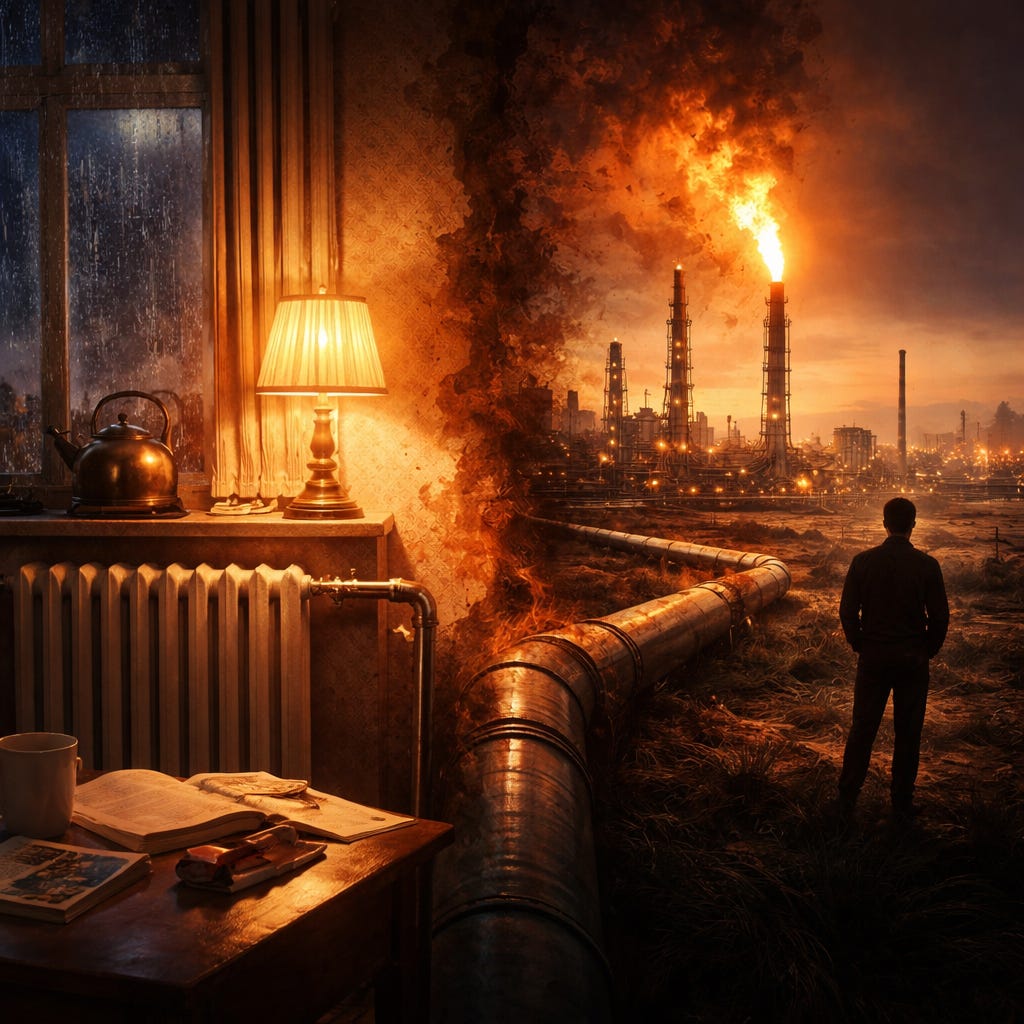
Opening
The question of comfort
There are many ways a civilization hides from itself. One is by teaching its people to experience history as weather. The house is warm. The road is paved. The shelves are full. The supermarket glows. The car starts on the first turn. Plastic wraps the fruit, the toy, the bread, the medicine. The plane rises from the runway as if flight were ordinary. The radiator clicks in winter. The kettle boils. The lawn is trimmed. The child sleeps in a heated room.
These things do not feel political. They feel normal.
This essay is concerned mainly with Britain and the United States in the age of postwar mass consumption, and with Iran as one of the clearest producer societies through which the hidden terms of that comfort can be seen.
The modern Atlantic world did not build comfort out of oil alone. It built on industry, science, coal, empire, finance, engineering, war, and institutional power accumulated over centuries. Middle Eastern oil did not create British or American prosperity by itself. But it materially enlarged the scale, affordability, and ease of twentieth-century mass comfort in societies that enjoyed structural advantages in access, pricing, and security, while producer sovereignty in places like Iran was often constrained.
This is not the claim that every British radiator, every American refrigerator, every suburban driveway was directly stolen from an Iranian household. History is more exact than that. Consumer powers did not need to seize every barrel in order to benefit disproportionately. It was enough that they often enjoyed underpriced access, favorable bargaining positions, geopolitical leverage, and the ability to build entire ways of life around the assumption that energy would remain cheap.
To understand that, it is better not to begin with charts.
It is better to begin with two lives.
Part I — Two Lives
1. A Western home, 1957
In 1957, on a narrow street in Birmingham, a man named Thomas Reed wakes before dawn and stands in the kitchen in his socks while the kettle warms. The house is not large, but it is solid, and the cold that once ruled houses like this no longer enters with the same authority. His father had known a harder England: rationing, privation, narrow rooms, war pressed into every household object. Thomas belongs to another phase of the century. Not rich. Not important. Simply placed, by timing and nation, on the rising side of history.
His wife sets out bread and jam. The children are still asleep upstairs. In the driveway stands a modest car that would have seemed extravagant a generation earlier and now feels natural. The house contains objects that no longer announce themselves as miracles because they have already crossed into habit: a refrigerator, electric light, plastic containers, a vacuum cleaner, the promise of domestic ease. He leaves for work under a sky the color of damp wool. Petrol is affordable enough that mobility has begun to detach itself from class in ways his father would have found astonishing. Goods that once arrived wrapped in scarcity now appear increasingly in packages, tins, and molded shapes.
He is not a capitalist. He does not own shares in an oil company. No minister phones him. No intelligence service briefs him on the Persian Gulf. He is not profiting in the vulgar sense. He is doing what history asks of ordinary men in stable countries: working, buying, commuting, and forming the quiet expectation that his children will live more easily than he did.
That expectation is the point.
When he returns home in the evening, the streetlamps glow. His daughter sits at the table doing homework under electric light. The house holds warmth without struggle. He eats, listens to the radio, and hears the soft sounds of family life: cups on saucers, a child laughing upstairs, footsteps overhead, the hush of a radiator settling into the room.
He does not know what keeps the room warm.
Not really.
He knows, in the vague way people know many things, that oil exists. He has heard of the Middle East. He may even have opinions about it supplied by newspapers and empire’s aftertaste. But he does not know how low energy prices quietly lower the cost of transport, fertilizer, plastics, heating, packaging, and the innumerable motions that make a society feel frictionless. He does not know that part of what he experiences as progress and recovery is also a geopolitical achievement whose costs have been made invisible to him.
His innocence is sincere. That is why it matters.
The house is warm. The child sleeps. The kettle will boil again in the morning. He believes this is what peace feels like.
2. Iran, same century, same oil
In the same decade, hundreds of miles to the southeast, a man named Reza stands at the edge of Abadan at dusk and watches a flare stain the horizon red.
Abadan is not incidental to this story. By mid-century it was home to one of the largest refineries in the world, a place where Iranian oil entered the industrial bloodstream of the twentieth century. The town organized life around an industry that had transformed the strategic value of the land beneath its feet while leaving the question of command unresolved.
Reza works as a clerk near the orbit of the refinery economy, close enough to smell oil and hear about salaries, production, and foreigners, yet far enough from power to know that proximity is not possession. He lives not in destitution but in contradiction.
Everything here testifies to magnitude. Pipes. Tanks. Heat. Machinery. Foreign compounds with their own hierarchy, their own insulation from local life. Oil leaves. Wealth appears elsewhere. Authority is exercised by others, then justified in the language of order, expertise, and stability.
His father remembers another Iran, poorer in industry perhaps, but less invaded by this peculiar humiliation: to sit on a resource the world desires and still feel, at decisive moments, like a guest in one’s own inheritance. Their family does not speak of economics in technical terms. They speak of insult. Of how much leaves and how little remains. Of the difference between seeing development and possessing sovereignty.
Yet Iran is not merely passive in this story. Reza lives in a society arguing intensely with itself about modernity, ownership, and national dignity. Students, workers, officials, merchants, intellectuals, clergy, nationalists, and courtiers do not imagine the future in the same way. Some want stronger bargaining within the existing order. Some want national command. Some fear chaos more than dependence. Some fear dependence more than chaos. The struggle is active, not symbolic.
He walks home through heat that lingers after sunset. In the market one hears politics not as abstraction but as pressure in the chest. Britain. The Shah. Nationalization. Mossadegh. Pride. Fear. Each word carries more than information; it carries the emotional structure of a people beginning to understand that oil is not only about revenue. It is about whether a nation may command the terms of its own existence.
His sister wants books. His mother worries about prices. His uncle says that nothing good comes to small countries when great powers discover necessity. Reza has seen the compounds where some foreigners live, the difference in housing, amenities, security, air, expectation. It is not simply that they have more. It is that they inhabit the future while he inhabits the source.
This is the wound.
The West often imagines extraction too crudely, as if the only injustice that counts is a thief carrying a sack from a house. But nations can be emptied more elegantly than that. They can be bound by contracts made in weakness. They can be outmaneuvered in diplomacy. They can be told that technical complexity is a reason for dependency. They can watch their resource enter the bloodstream of global industry while they themselves remain subject to the politics of permission.
One night his younger brother asks whether oil will make Iran rich.
Reza does not a…