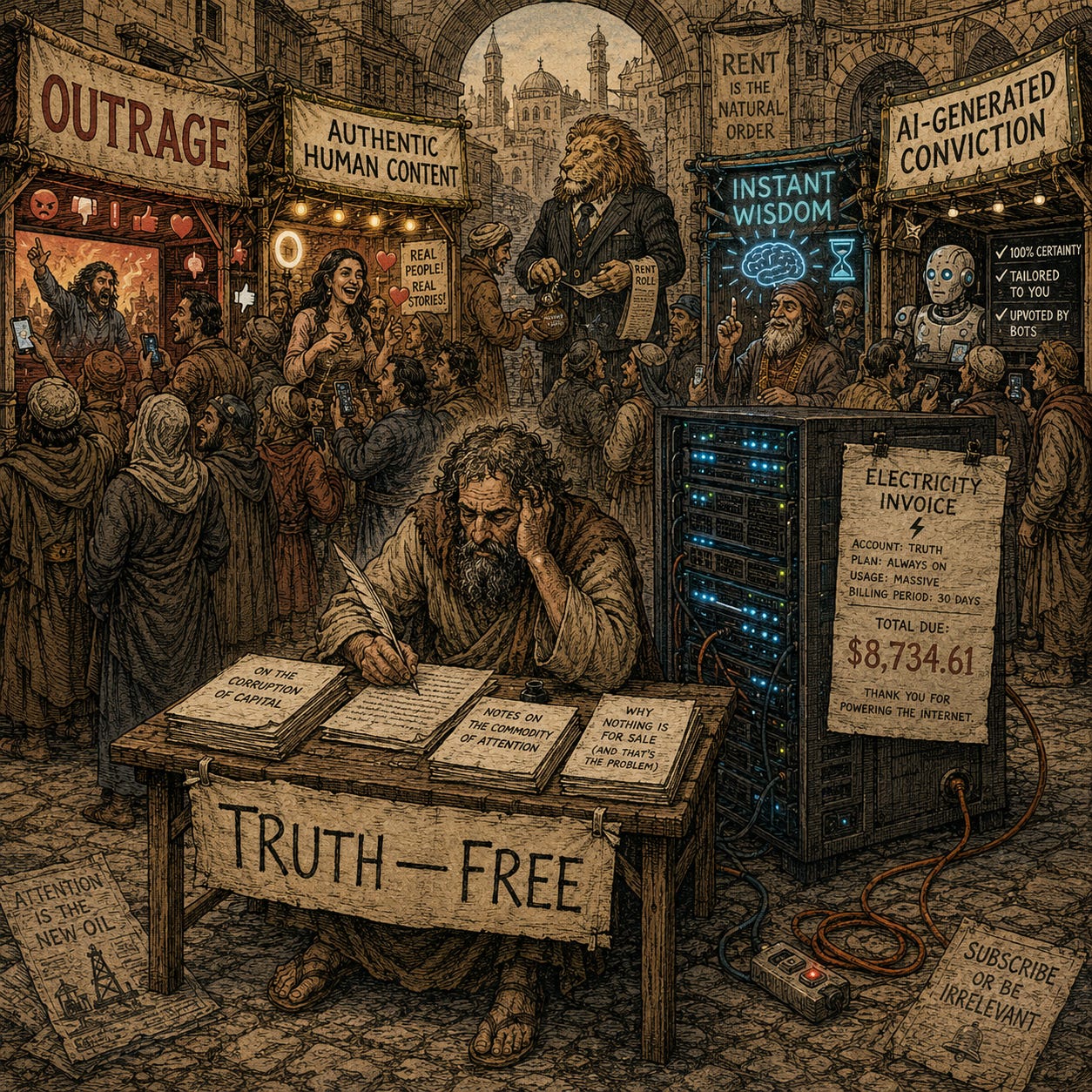
I. Two Things My Father Told Me
My father once told me he wanted to leave me with two thoughts.
The first was reassuring.
“Elias,” he said, “do not underestimate your assets and your skills. You may leave one job and still be employable by a thousand other employers. Never doubt your strengths. You are talented.”
This was excellent advice. I received it immediately, preserved it carefully and have replayed it during every professional crisis since.
Then he gave me the second thought.
“You are not a prophet. You are not that special. Yes, you are talented, but you are one among many talented people. Do not imagine you are a genius who has come to save everything.”
I found this part less useful.
For years, I treated the two statements as unrelated. The first was my father’s wisdom. The second was an unfortunate lapse in paternal judgment.
But recently I have begun to suspect that they were one thought.
I do have strengths. I have survived institutions that tried to make me doubt them. I have seen patterns that others missed. I have sometimes recognized a lie before the room was prepared to name it.
But seeing a lie does not make me incapable of telling myself one.
My particular danger begins with injustice. When I think a situation is fair, I am generous. I defend the weak. I make room for uncertainty. But once I decide that someone powerful is behaving unfairly, my tenderness vanishes. I become prosecutorial. Their moral failure starts to feel like evidence of my intellectual perfection.
The powerful may be wrong. They may even be dishonest. But neither fact automatically makes every part of my argument correct.
This matters because I have spent much of the past year thinking about artificial intelligence, writing, capitalism and truth. These subjects have begun to merge in my mind into one large animal, possibly a dragon, though I concede that describing one’s intellectual concerns as a dragon is already evidence that my father had a point.
Beneath all of them sits a question I cannot escape:
Why should anyone serve truth when survival usually pays better?
II. The Lion Has No Epistemology
A lion does not care about truth.
This is not because the lion has embraced postmodernism. It has not read Foucault. It does not believe that every deer constructs its own reality.
The lion is hungry.
It watches the herd. It identifies the weak animal. It waits for separation. Then it attacks.
At no point does the lion ask whether its interpretation of the deer is epistemically sound. It does not publish a methodology. It does not disclose a conflict of interest. It does not consult the deer about whether being eaten aligns with its lived experience.
The lion has perception, appetite, strategy and force.
That is enough.
Evolution does not reward organisms for possessing beautiful theories of reality. It rewards organisms for surviving long enough to reproduce. Accurate perception helps, of course. The lion must correctly identify which moving object is edible and which is another lion. But accuracy is subordinate to survival. Truth is useful only when it serves life.
Human beings like to imagine we have escaped this arrangement.
We have not.
We have merely converted survival into money.
Money is stored food, stored shelter, stored medical care, stored mobility, stored deference and stored time. A person with money can survive mistakes that would destroy someone without it. He can purchase distance from danger. He can hire another person to absorb inconvenience.
Status and money are therefore closely related. Status determines who is believed, who is protected, who receives opportunities and who gets the larger share when resources become scarce.
The jungle did not disappear. It acquired payroll software.
Modern professionals are lions who have replaced teeth with calendar invitations. They isolate the vulnerable member of the herd through a performance review, place the kill inside a reorganization and announce that the decision was difficult for everyone.
By my private and completely unlicensed estimate, perhaps ninety-nine percent of human beings are primarily occupied with survival.
I do not mean that they are wicked. Most people are trying to keep a job, protect a family, maintain social standing, avoid humiliation, accumulate security and preserve a future. My friends do this. My relatives do this. My mother does this. I do this more often than I admit.
Very few people will sacrifice money, belonging or safety merely to know what is true.
And yet some do.
Why?
If truth-seeking is so badly rewarded, why has evolution not removed it?
III. Why the Village Keeps Producing Prophets
The answer may be that human beings do not survive like solitary lions.
We survive in groups.
A group requires a shared reality.
It needs to know where the water is. It needs to remember which path led to disaster. It needs some agreement about who belongs, what happened yesterday, what counts as a promise and why the harvest failed.
A village of one hundred people cannot function through one hundred completely private universes.
Someone must help construct the common world.
This may be why every community produces a minority of people who are unusually drawn toward truth. They are not necessarily kinder, wiser or easier to invite to dinner. They simply experience contradiction as pressure. They cannot leave certain questions alone.
The scientist tests the shared reality.
The engineer makes it operational.
The historian preserves it against convenient forgetting.
The poet makes an invisible experience perceptible.
The comedian notices the contradiction everyone else has agreed to ignore.
The prophet tells the king that God is not impressed by the quarterly results.
These people appear throughout my writing because I recognize them as members of the same extended family. Their methods differ, but their function is similar. They repair the common world.
Of course, storytellers do not always serve truth.
A king needs a historian, but he may prefer one who remembers selectively. A corporation needs analysts, but it may reward the analyst who discovers that the desired conclusion is statistically significant. A nation needs poets, but it may offer grants to those whose metaphors improve recruitment.
A shared reality can be discovered, or it can be manufactured.
Power has always employed storytellers.
Still, truth has one advantage over lies: reality itself provides some of the evidence.
A lie must be maintained. Documents must disappear. Contradictions must be explained. Witnesses must be discredited. Language must be continually revised so that yesterday’s falsehood remains compatible with today’s necessity.
Truth can be rediscovered by strangers.
Two people may approach the same physical problem from different cultures and eventually converge on the same equation. Engineers who do not share a religion can still agree that a bridge has collapsed. Communities can disagree about the meaning of suffering while still recognizing that the body is bleeding.
This does not mean human beings possess truth perfectly. It means reality constrains the number of frameworks that can survive prolonged contact with it.
So the truth-seeking temperament persists because communities need people who test the stories by which they live.
But here is the humiliating part.
The community may need truth-seekers.
It does not need every truth-seeker.
IV. One Percent Is Still a Very Crowded Room
Suppose my estimate is correct.
Suppose one percent of human beings are unusually driven by truth.
One percent sounds lonely until one remembers how many human beings there are.
One percent of eight billion is eighty million.
That is not a remnant. That is a nation.
The lonely prophet eventually discovers that the wilderness has a conference center. Every ballroom is occupied by another lonely prophet giving a keynote called Why No One Else Can See What Is Happening.
There are millions of people who believe themselves unusually alert to falsehood. Some are correct. Some are mad. Many are both before …