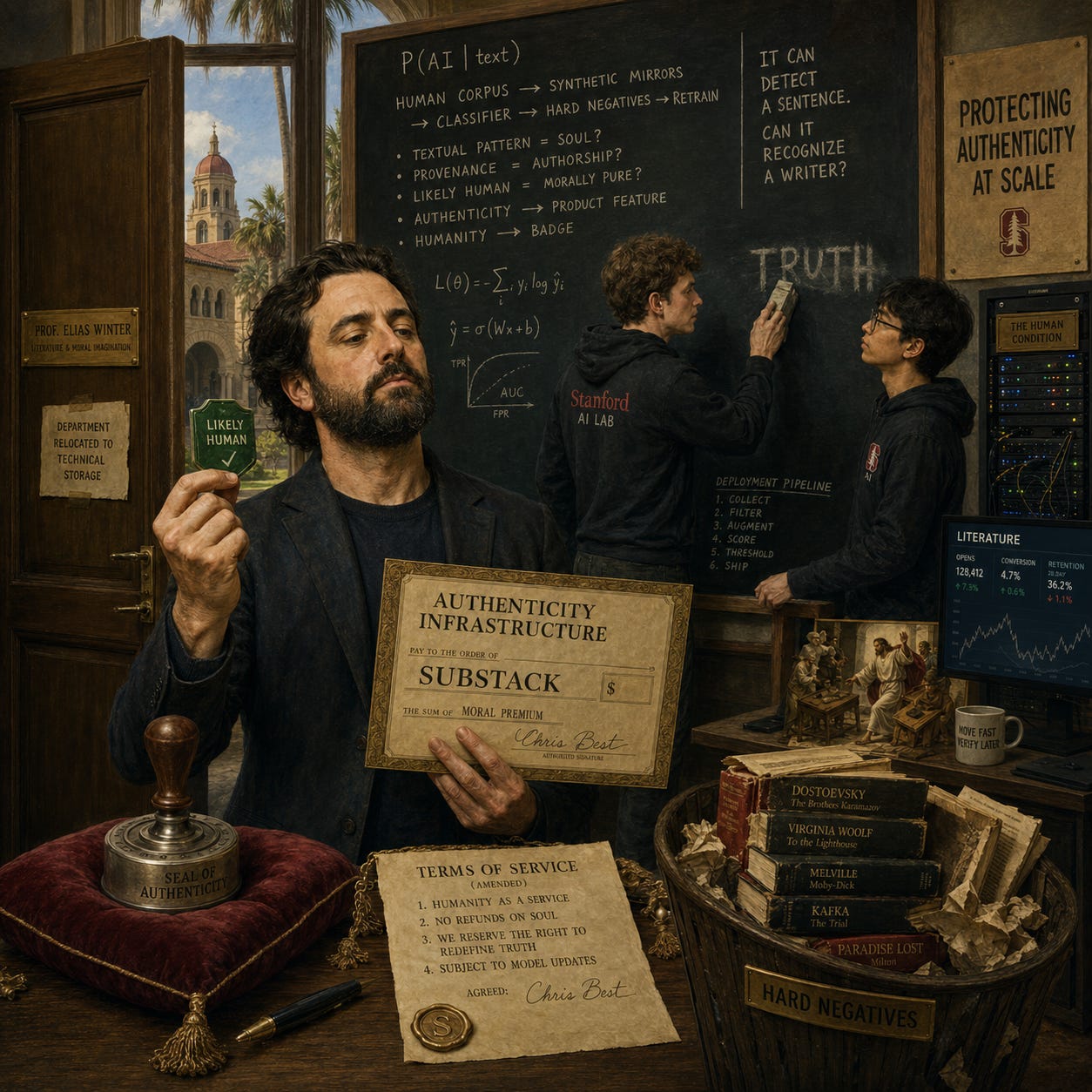
I. The Temple Has a Gift Shop
Stanford University lay beneath the California sun with the relaxed confidence of an institution that had already won history.
Its sandstone arches glowed. Its palm trees swayed. Young men in fleece vests bicycled between laboratories where the future was being invented for people who had not been consulted. The names of dead industrialists appeared above doors in letters large enough to survive the moral fashions of several centuries.
At the center of the campus stood the new Stanford Institute for Computational Humanity, a glass-and-steel building shaped like a venture-capital pitch deck. Inside, several hundred engineers were working to solve loneliness, democracy, education, sex, friendship, literature and grief by converting them into classification problems.
The Department of Comparative Literature occupied a former electrical closet beside the loading dock.
Professor Elias Winter sat inside it, surrounded by books that had not yet been transformed into training data. His office had no window. The university had removed it during a renovation intended to promote transparency.
Through the wall came the squeak of a blackboard.
Two young men were writing equations next door.
A third man entered the building carrying the solemn expression of someone who had been informed that civilization was in danger and that civilization might therefore require a new product feature.
It was Chris Best, chief executive officer of Substack.
“I’m here,” he announced, “to protect human writing.”
Professor Winter looked up from Augustine.
“Human writing survived Nero,” he said to the wall. “I suspect it can survive autocomplete.”
No one heard him.
The walls had been optimized for collaboration.
II. The Boys Who Had Not Yet Met a Sentence
Max Spero and Bradley Emi stood before the blackboard in matching company hoodies.
They were the founders of Pangram, an artificial-intelligence detection company. Both were intelligent, credentialed and young enough to regard the year 2008 as part of the medieval period.
On the board was a paragraph:
After my father died, I began to understand that grief was not an emotion but an architecture. It rearranged the rooms of memory so that every door opened into absence.
Max studied it.
“Claude,” he said.
Bradley frowned.
“Human.”
“Claude.”
“Human.”
Max typed the paragraph into Pangram.
A wheel spun.
The machine returned its verdict:
94% AI-GENERATED
“Excellent,” Bradley said. “We are ninety-four percent certain that no soul was present.”
Max nodded and wrote on the board:
Chris Best stepped closer.
“So it can detect whether writing is authentic?”
“It can estimate whether a passage statistically resembles text produced by language models,” Max said.
Chris considered this.
“Right. Whether it’s authentic.”
“That isn’t exactly—”
“Could the percentage be larger?”
“The percentage?”
“On the screen. Readers trust large numbers.”
Bradley adjusted his glasses. “The model is a transformer-based binary classifier trained on human and machine-generated text.”
Chris’s eyes brightened with reverence.
“So it reads.”
“No,” Max said. “It classifies.”
“But it understands?”
“It detects patterns.”
Chris nodded. “Understanding through patterns.”
From behind the wall came the sound of a book being closed with unnecessary force.
Professor Winter appeared in the doorway.
He was sixty-seven, badly shaved and dressed in a brown jacket polished at the elbows by decades of disappointment. His hair rose in several directions, as if each strand had independently rejected institutional authority.
“What is the paragraph about?” he asked.
The boys looked at the board.
“Grief,” Bradley said.
“Is it any good?”
They looked at one another.
“That’s outside the model’s scope,” Max said.
Winter turned to Chris.
“And you have come to purchase its scope?”
“I’ve come to defend writers.”
“From grief?”
“From AI.”
Winter looked again at the board.
“The sentence may be synthetic,” he said. “The stupidity in the room is entirely organic.”
III. A Brief History of the Human Being, Rendered as Training Data
Max decided that the misunderstanding could be resolved through technical explanation, as misunderstandings always could.
He erased the paragraph and drew two boxes.
On the left he wrote HUMAN.
On the right he wrote AI.
“We collect human writing from many domains,” he began. “Books, essays, emails, academic papers, reviews, journalism, creative writing, online discussions—”
“Love letters?” Winter asked.
“Potentially.”
“Funeral speeches?”
“Yes.”
“Confessions?”
“If available.”
“Last words?”
Bradley hesitated. “Depending on licensing.”
Max continued. “Then we generate synthetic counterparts that mirror the human material in subject and format.”
Winter stepped toward the blackboard.
“You feed a machine a widow’s letter and ask it to produce another widow?”
“A synthetic mirror,” Max said.
“An imitation.”
“It’s not necessarily imitating the individual author.”
“Then it is imitating bereavement in the abstract. Much cleaner.”
Max drew an arrow between the boxes.
“We train the classifier to distinguish the distributions.”
“The distributions of what?” Chris asked.
“Human-generated and model-generated language.”
“Humanity and artificiality,” Chris translated.
“No,” Max said. “Textual distributions.”
“Same basic thing.”
Professor Winter picked up a piece of chalk.
“No,” he said. “It is not the same basic thing.”
He wrote beneath the boxes:
LANGUAGE IS EVIDENCE OF A MIND. IT IS NOT THE MIND.
Bradley politely erased it.
“The important innovation,” he said, “is hard-negative mining.”
Chris leaned forward. “Good. That sounds defensible.”
“We run the detector on material known to be human. Some human passages are misclassified as AI. Those are hard negatives.”
“A false positive,” Winter said, “is what human beings once called an accusation.”
“We add those difficult examples back into the training process,” Bradley continued, “along with synthetic mirrors. The model becomes better at distinguishing borderline cases.”
Max wrote:
* Collect human writing.
* Generate synthetic mirrors.
* Train classifier.
* Identify hard negatives.
* Retrain.
Chris admired the sequence.
“It’s like teaching the machine to recognize the human voice.”
“No,” Winter said.
Max sighed. “It learns statistical features associated with different production processes.”
“Exactly,” Chris said. “The human voice.”
Winter turned to the boys.
“Can it tell who originated the idea?”
“No.”
“Can it tell whether a person dictated the argument?”
“No.”
“Can it tell whether the writer rejected fifty drafts?”
“No.”
“Can it tell whether the argument is original?”
“No.”
“Can it tell whether the author believes it?”
“No.”
“Can it tell whether the text is true?”
“No.”
“Can it tell whether it is literature?”
Max lowered the chalk.
“That’s not what it was designed to do.”
Chris Best smiled.
“Perfect,” he said. “How soon can we put it on Substack?”
IV. Chris Best Arrives to Defend Literature
Chris paced before the blackboard.
“You have to understand the crisis,” he said. “The internet is being flooded with AI slop. Readers believe they are encountering a person, but sometimes they are encountering a machine. That damages trust.”
Professor Winter returned to his doorway.
“Trust in what?”
“The writer.”
“What aspect of the writer?”
“Their humanity.”
“Which aspect?”
“The part that writes.”
Winter smiled unhappily.
Chris continued. “Substack is built on the relationship between writers and readers. People subscribe because they want a direct connection to a human voice.”
“Sometimes,” Winter said.
“They want perspective. Conviction. Something a person genuinely believes.”
“Good.”
“And we need to protect that.”
“Also good.”
“With a button.”
Winter’s smile disappeared.
Chris approached the board and began drawing a user interface.
At the top was a post. Beneath it was a small badge:
LIKELY HUMAN
He added a green halo around it.
“Readers click here,” he explained, “and Pangram scans the text.”
“What happens when the machine is uncertain?” Bradley asked.
“We show nuance.”
Chris added two more labels:
POSSIBLY ASSISTED
MOSTLY SYNTHETIC
Winter examined them.
“Can you include ‘Spiritually Vacant but Ma…