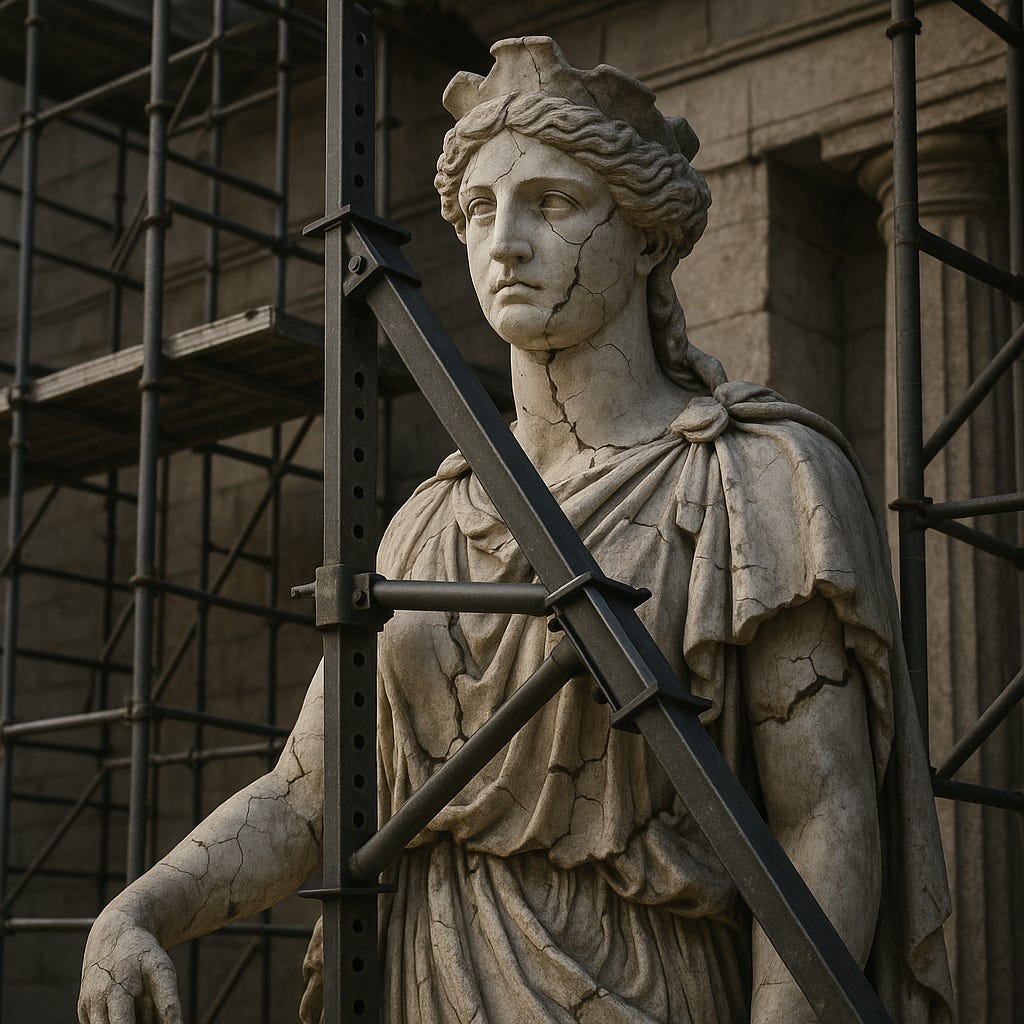
A national security document is never only a plan. It is a confession written in the grammar of power. It reveals what a country fears, what it still believes is sacred, and what it is willing to sacrifice to stop feeling humiliated by history.
This one arrives as a counter-sermon to the last three decades. It rejects the soft universalism of the post–Cold War era and returns to the brutal coordinates of sovereignty: borders, industry, energy, and the standards that will govern the machines of the next century. To many citizens, this will feel like oxygen. Not ideology, but relief. The language of capacity after the narcotic of abstraction.
But every corrective hides a temptation.
A nation can rebuild its body without repairing its conscience. It can restore borders and factories and still decide that “cultural health” requires a narrower definition of who is allowed to count as evidence of national worth. It can mistake purification for renewal.
The question is not whether this strategy is strong.
The question is whether it can produce a republic worth keeping.
Chapter 1: The Ashes of the Last Gospel
A nation does not abandon a story because it grows bored. It abandons a story when the story stops paying its rent.
There was a time when the reigning American doctrine sounded like moral adulthood. The world would integrate. Markets would pacify. Institutions would civilize. Prosperity would spread outward like light through a long hallway, and the United States, benevolent and unburdened, would serve as the architect of the corridor. You could believe this without malice. You could even believe it with love.
But belief is not judged by its poetry. It is judged by the cities it leaves behind.
The older doctrine—call it the post–Cold War religion of inevitability—promised that the American way of life could expand without cost, that the world’s disorder could be managed by diplomacy and the magic of trade, that domestic cohesion would persist even as the industrial body of the country was rearranged like furniture. It trained people to treat the nation’s hollowing-out as a temporary inconvenience, or a necessary sacrifice to join history’s correct side.
For a while, that narrative could pass as reality. The stock market rose. The screens grew brighter. The country learned how to speak in the language of humanitarian inevitability while forgetting how to make the things that a real war, a real crisis, or a real winter demands.
Then one day the spell broke in places that did not have microphones.
A factory town is not an abstraction. It is a place of time. It is a schedule of lives. It is the texture of meaning that forms when labor becomes craft, and craft becomes identity, and identity becomes the invisible glue of civic trust. When that asset is stripped, what remains is not just an economic wound. It is a metaphysical vacancy. People do not easily forgive a system that asks them to sacrifice their fathers’ dignity in exchange for an abstract promise of global progress.
The old gospel also carried a quieter insult: it implied that the nation could be administered like a market and still remain a nation. That sovereignty could be diluted without consequence. That migration could be treated as a moral inevitability rather than a political decision. That borders were a bit embarrassing—a relic for a world that had moved on to higher consciousness.
But the public, in its stubborn memory, never fully accepted that humiliation. A country might tolerate elite disdain for a season. It will not tolerate it forever.
This is the emotional backdrop against which the national security document speaks. It is not merely a strategy paper. It is a counter-sermon.
It opens with the claim of dramatic reversal, insisting that weakness is not a tragic accident but a moral failure of the preceding regime. It frames the last period as a time of extremism, incompetence, and civilizational drift, and presents itself as the medicine that returns the republic to the ground beneath its feet. The style is triumphal because the project is existential. It needs people to feel that a system has come back under control.
The core ideas that follow—sovereignty, reindustrialization, energy dominance, allied burden shifting, and AI standards leadership—are not random bullets. They are a single psychological and strategic statement:
We will stop pretending that power is optional.
To many readers, that will feel less like ideology and more like relief. A comedown from fantasy. A return to the physical world. The future belongs to those who can still build, still fuel, still defend, still decide. The document’s bluntness is part of its seduction: it tells exhausted citizens that the era of ornamental morality is over, and the era of national adulthood has returned.
But every counter-sermon risks becoming its own idol.
In trying to correct the illusions of globalism, a nation can overcorrect into the illusions of purity. In trying to restore competence, it can mistake vengeance for excellence. In trying to reclaim borders, it can turn the border into a theater of cruelty where humiliation becomes a substitute for policy. In trying to restore “cultural health,” it can confuse the health of the republic with the narrowing of the human mosaic that has always lived within it.
This is the first moral tension hidden inside the paper’s confidence.
The document is strongest when it speaks the language of material dependency. When it insists that a nation cannot defend what it cannot manufacture. That a military cannot be a brand without an industrial base. That AI dominance is not an app—it is energy, infrastructure, and standards. These are not culture-war claims. These are civilizational arithmetic.
And yet it is weak where it slips into the temptation to make social uniformity the price of long-term survival.
A free country does not need to be bled of difference to be cohesive. It needs to be rebuilt around dignity, shared responsibility, and the sober truth that nations are not fantasies—they are structures.
So this chapter begins in ash, not flame.
The old doctrine burned down quietly, not because its intentions were evil, but because its abstractions outpaced its obligations. The new doctrine rises from those ruins with a builder’s logic and a sovereign’s voice. The question that will haunt the rest of this essay is simple:
Can the republic rebuild its body without shrinking its soul?
If it can, this document will be remembered as a turning point toward strength that does not require sacrificial victims. If it cannot, then the counter-sermon will become yet another gospel that promises renewal while quietly preparing a new kind of collapse.
Chapter 2: The Gate and the Mirror
The border is not only a line on a map. It is a nation deciding whether it still believes it exists.
In good times, a country can pretend that sovereignty is a dusty word. It can outsource the sacred to finance, the real to ideology, and the future to vague assurances that “history is on our side.” But a border is the moment where the dream meets physics. It is the place where a people must confess—through law, through enforcement, through refusals—that a nation is more than a market with a flag.
This document understands that instinct. It speaks of mass migration not as a logistical problem but as destiny pressure: who you admit, in what numbers, from where, and under what conditions is not an administrative detail. It is the demographic and moral authorship of the next century. The strategy frames border control as primary national security, not because it believes every newcomer is an enemy, but because it believes a border is the difference between self-rule and self-dissolution.
There is a hard sanity in that.
A nation cannot protect its workers if it cannot regulate its labor market. It cannot promise civic trust if it signals that membership is infinitely malleable. It cannot claim to be a sovereign republic if it treats entry as a moral taboo to discuss with clarity. You do not need cruelty to see that these are true. You only need the honesty to name them.
Yet honesty is not innocence.
The border is also where a nation can be tempted by spectacle. Instead of policy, it can choose ritual punishment. Instead of order, it can choose theatrical dominance. The state can begin to confuse control with humiliation, and citizens can be trained to mistake the feeling of revenge for the restoration of law.
This is the first danger hiding inside the document’s strength.
The paper speaks the language of invasion and catastrophe, and that rhetorical furnace creates energy. It mobilizes. It puts steel into tired spines. But it also risks turning the border into a permanent altar of fear—a place where every policy failure can be blamed on an outsider and every internal decay can be disguised as foreign contamination.
A wise republic refuses that addiction.
Because the border is not only a wall. It is also a mirror.
It shows a society what it has failed to build at home. It reveals whether the middle class is sturdy enough to absorb competition without panic. Whether the welfare state is coherent enough to withstand pressure without scapegoating. Whether the civic culture is confident enough to say “we decide our membership” without needing to turn that decision into a liturgy of contempt.
Every migration crisis exposes domestic architecture. That is why demagogues love it. It is the perfect surface onto which unresolved failures can be projected.
But this document, at its best, is not asking for demagoguery. It is asking for authorship. It wants a world where nations stop facilitating destabilizing population flows and instead cooperate to end them. It wants the Western Hemisphere governed well enough that despair does not become a conveyor belt northward. In that frame, border policy becomes less like a punishment and more like an upstream strategy: fix the conditions that generate mass flight, and you reduce the moral and political pressure at the gate.
That is a coherent national-interest story.
Where the story becomes ethically fragile is where sovereignty is fused with a narrowing of the human circle inside. Where the border becomes an excuse to police identity instead of membership. Where a legitimate argument about numbers and systems drift into an illegitimate argument about which kinds of Americans are allowed to count as cultural evidence of the nation’s health.
A free country must separate those things.
You can defend borders without inventing internal enemies. You can insist on order without awakening the old appetite for purity.
The border, then, is not a simple moral symbol. It is a test of maturity.
A reckless nation treats it as a stage.A serious nation treats it as infrastructure.A decent nation treats it as infrastructure without letting it become a theater of cruelty.
If the old gospel dissolved sovereignty into abstraction, the new gospel risks turning sovereignty into a ritual of righteousness. The path forward is neither surrender nor frenzy. It is disciplined authorship: the quiet, firm, unromantic work of deciding who enters, why, at what pace, and under what law—without pretending that the state must be cruel to be real.
The gate exists to preserve the republic.The mirror exists to keep the republic honest.
Chapter 3: The Factory as Cathedral
There is a kind of grief that does not announce itself as grief.
It looks like boredom. It looks like opioid quiet. It looks like a man who no longer believes his labor is necessary. It looks like a town whose young people leave not because they hate their home but because the home has stopped offering a future that feels honorable.
The strategy document speaks of reindustrialization with the bluntness of someone who thinks sentimentality has become a luxury we cannot afford. It insists that the industrial base is not a nostalgic artifact but the substrate of national power. It says, in effect, that a nation that cannot make what it needs is a nation living on borrowed sovereignty.
This is not poetry. It is statecraft.
But statecraft has a soul even when it pretends it does not.
A factory is a building where a nation learns what it believes about dignity.
When industrial work collapses, a country does not merely lose jobs. It loses a social theology of competence. It loses the quiet education of the citizen: the learned instinct that effort yields meaning, that contribution earns belonging, that the nation is not an emotional brand but a shared project of making and maintaining the physical world.
This strategy is right to identify that collapse as a security issue. Not because factory workers are sacred and everyone else is suspect, but because industrial capacity is where the real world meets national survival. War is not won by opinion. It is won by production, logistics, energy, and the unglamorous competence that turns theory into steel.
The document says cultivating industrial strength must be the highest priority of national economic policy. Beneath the bureaucracy of that sentence is an ancient truth: a republic that loses the ability to make becomes a republic that must beg.
And begging is not a stable posture for a sovereign people.
So imagine the scene the document does not explicitly narrate but clearly presupposes.
A shuttered plant on the edge of a town that used to have a rhythm. The parking lot where generations once arrived at dawn. The lunchbox economy. The dignified monotony of a job that was not glamorous but was real. The kind of labor that makes a person feel he is part of something that will outlast his moods.
When that vanishes, the market gives you cheaper goods. But it also gives you a population whose identity has been severed from necessity.
The old gospel of globalization treated this as collateral. A painful but rational trade. The new gospel wants to reverse the trade.
It wants tariffs, reshoring, supply chain independence, and defense industrial revitalization. It wants to rebuild what was outsourced in exchange for the illusion that permanent consumption could replace permanent capacity.
There is a moral clarity in that correction. But there is also a practical risk.
Industrial policy can become renewal, or it can become a new patronage regime managed by the loudest interests. It can create a distributed renaissance of competence, or it can create protected industrial aristocracies that survive on political insulation rather than innovation.
The difference is not ideological. It is architectural.
A serious industrial policy would be measured by:
* whether it rebuilds durable skills at scale,
* whether it increases production resilience in crisis,
* whether it expands regional prosperity beyond a few favored corridors,
* whether it restores the dignity of work without turning that dignity into a weapon against other kinds of citizens.
Because this is where the sermon can turn into a test.
A nation can rebuild factories but still fail its people if it rebuilds them as monuments to resentment instead of institutions of shared pride. You do not want an America where industrial revival is announced with a sneer at every other form of labor. You want an America where making things is once again honorable, not compulsory as identity politics.
The ideal outcome is not a country that worships factories. It is a country that remembers why they mattered.
The factory was never only an economic machine. It was a civic school.
It taught that competence is real.That contribution is visible.That a society cannot outsource its future and remain morally coherent.
So if the border is a symbol of authorship, the factory is a symbol of adulthood.
This document is strongest where it treats industrial recovery as a national precondition for peace, deterrence, and democratic stability. It is weakest wherever it risks turning that recovery into a narrower moral story about who counts as a “real American.”
The republic does not need a purity test.
It needs a production test.
Not because people are machines, but because freedom is not preserved by rhetoric alone. Freedom is preserved by the quiet ability to build what you need, defend what you love, and offer your citizens a form of work that does not require them to betray their dignity just to survive.
A factory can be an economy.Or it can be a cathedral of competence.
A wise nation rebuilds it as both.
Chapter 4: Tariffs as a Confession
A nation does not reach for tariffs when it is confident in the purity of its economic theology.
It reaches for tariffs when it has stopped pretending that power is a polite rumor.
For decades, the American establishment treated “free trade” not merely as a policy tool but as a moral credential. To doubt it was to confess backwardness. To challenge it was to reveal provincial instincts. The doctrine was wrapped in the language of inevitability: global integration was the arrow of history, and America’s role was to become the benevolent manager of that arrow.
But a strategy is not judged by the elegance of its axioms. It is judged by what it leaves a country able to do when the lights flicker.
This document does something almost unheard of in modern elite consensus: it admits the old creed got people killed—not always directly, but structurally. It names the hollowing-out of the industrial base as a strategic failure, not merely a distributional inconvenience. And it presents tariffs as part of an emergency correction.
That is why this chapter is a confession.
Tariffs are, at heart, a state saying:We tried to behave as if economics could be separated from national survival.We tried to treat the world as a cooperative classroom.We tried to moralize our dependency.And now we must repair the lie.
In the story the document is telling, tariffs serve three purposes.
First, they are a tool of reindustrialization—a coercive incentive to bring production back home and to rebuild the workforce capable of sustaining it. The text’s underlying claim is simple: the future belongs to makers, and a nation that becomes only a consumer is a nation that has quietly surrendered the right to secure itself.
Second, they are a tool of fairness—a refusal to tolerate predatory trade practices, dumping, and state-led industrial conquest lodged inside a rules facade. The strategy argues that reciprocity is not a rhetorical ornament; it is the minimum moral requirement of serious trade.
Third, they are a tool of strategic independence—a way to de-risk critical supply chains in everything from defense to emerging technologies to the components that will define the next century’s power.
In that sense, tariffs are not only economic policy. They are an attempt to reverse a civilizational posture: from dependency to authorship.
But a confession can be honest and still incomplete.
Because tariffs are a dangerous instrument in untrained hands.
They can regenerate capacity.They can also generate complacency.
A tariff regime that becomes permanent without a discipline of performance will not resurrect American greatness. It will resurrect American entitlement. Industries can become protected temples where innovation is no longer required, where mediocrity survives by political insulation, and where the state quietly subsidizes decline while announcing revival.
So the real question is not whether tariffs are “good” or “bad.” That is a child’s binary.
The real question is whether tariffs are used as:
* a temporary scaffold for capability recoveryor
* a permanent substitute for competitiveness.
Because the market is not a moral deity, but neither is the state.
A serious republic must pair tariffs with a competence ethic that is measurable. The public needs to see that protection is purchasing something real: new plants, new training pipelines, resilient capacity, cost curves that fall, and the ability to surge production in crisis. Otherwise tariffs become a sacrament without a resurrection.
Yet even this practical debate hides a deeper political temptation.
The danger is not only economic capture.It is psychological capture.
A country that has been humiliated by dependency can become addicted to retaliation. And retaliation can feel like dignity even when it produces no lasting strength. Tariffs can become a way to keep the nation emotionally stable while avoiding the harder work of building institutions that outlive any single administration.
So if the last chapter was the factory as cathedral, this chapter is the liturgy that decides whether the cathedral becomes a real school of competence or a museum of grievance.
A healthy tariff narrative should sound like this:
We are protecting critical sectors so they can recover and outrun their rivals.We are not protecting them so they can sleep.
We are restoring the capacity to make what we must.We are not restoring the illusion that we can win the future by punishing the past.
The strategy document is correct to insist that a nation cannot afford romantic innocence about trade in a world where competitors treat economics as war by other means.
But it will be judged by whether it can keep its confession clean.
Because the purpose of tariffs is not to create enemies.It is to re-create capability.
And capability, in the end, is the only form of economic nationalism that does not rot into its own caricature.
Chapter 5: The Energy That Feeds the Future
Civilizations do not collapse only because they lose wars.
They collapse because they forget the quiet relationship between power and fuel.
This strategy speaks of energy dominance in the tone of a country that believes it is done apologizing for wanting to live. Oil, gas, coal, nuclear—named without coyness, presented as the engines of reindustrialization and the prerequisite for technological leadership. The document argues that cheap and abundant energy is not merely an economic benefit but a security doctrine. It links energy explicitly to AI advantage, as if to say: the future will be built by those who can afford to run it.
That is not a metaphor.
The most modern forms of power are not abstract. They are infrastructural.
An AI model is not just math.It is a chain of mines, ships, factories, power plants, data centers, and the human discipline to maintain them.You cannot will compute into existence.You feed it.
The strategy’s claim is therefore emotionally blunt but materially coherent: a nation that throttles its own energy costs in pursuit of moral signaling will eventually rent its future from someone else. And rent is not sovereignty. Rent is dependence with a monthly invoice.
So imagine the scene this document is really describing.
A data center at night.
Not the glossy tech-advertisement version. The real one. The hum of heat. The subtle anxiety of uptime. Engineers watching graphs that translate into money, medicine, defense, and national pride. In this world, energy is not a political slogan. It is the boundary between capability and fantasy.
The paper wants that world anchored in American abundance.
It frames energy not only as domestic relief—lower costs, higher wages, broader industrial investment—but also as geopolitical leverage. Exports deepen alliances. Abundance weakens adversaries who depend on scarcity. A nation that can supply the world can shape the world without needing to occupy it.
That is the restrained empire’s dream: influence without endless intervention.
Yet energy policy has always been where strategy risks becoming theology.
The old orthodoxy, in the strategy’s telling, became an austerity religion: sacrifice domestic strength to a global moral narrative that may not be reciprocated by rivals. The document is explicit in its rejection of “Net Zero” ideology and frames this rejection as a refusal to subsidize the rise of adversaries.
You can see why this rhetoric has purchase.
A country that has watched its industrial base evaporate is not easily persuaded that self-imposed constraint is a virtue. It hears austerity and suspects contempt. It hears moral purity and remembers the towns that were asked to disappear so the elites could claim historical sophistication.
So the strategy swings the pendulum toward abundance.
But abundance is not automatically righteous.
Energy dominance can be a doctrine of national renewal, or it can be a doctrine of denial. A country can become so intoxicated by the corrective that it forgets the second half of adulthood: stewardship.
The question is not whether energy matters. It does.
The deeper question is whether a nation can hold two truths at once:
That cheap energy is a strategic necessity.And that the long-term care of land, water, and public health is not a “globalist” luxury but part of patriotism itself.
A serious republic does not choose between strength and responsibility as if they are opposing gods. It chooses competence in both. It invests in energy infrastructure that is resilient, diversified, and not hostage to ideological mood swings. It pursues nuclear modernization where it can, cleans up grid fragility, and treats energy security as a systems problem rather than a tribal banner.
In other words, it refuses to confuse the politics of energy with the physics of energy.
You can believe in energy abundance without making contempt your companion.
You can reject performative austerity without treating every caution as betrayal.A civilization that cannot distinguish between propaganda and prudence will merely trade one addiction for another.
The most interesting truth inside this strategy’s energy chapter is not that it wants more production.
It is that it wants to re-link power to reality.
Because the modern era trained too many institutions to believe that speech could substitute for capacity. That branding could substitute for resilience. That the nation could narrate itself into safety while outsourcing the physical world.
Energy abundance is the opposite of that illusion.
It is a recommitment to the material.
And the material is where freedom survives.
A citizen who can afford heat and mobility is harder to coerce.A country that can power its factories and data centers is harder to intimidate.A society that can fuel its future without begging permission is more likely to protect the dignity of the people living inside it.
So this chapter is not only about oil and gas and nuclear.
It is about a civilization re-learning the basic grammar of survival.
The future will not be written by the most righteous slogans.
It will be written by the nations that can still keep the lights on without sacrificing the soul of the republic to whichever priesthood is loudest in the season.
Chapter 6: The Algorithm and the Flag
Empires once expanded by ships and cannons.
Now they expand by protocols.
This strategy speaks of AI in the language of power, not novelty. It is not enchanted by gadgets. It is obsessed with standards—who writes them, who exports them, who makes them inevitable. It places AI beside biotech and quantum as a domain where American technology should “drive the world forward,” which is a polite way of saying: the country that sets the terms of the future will not need to ask permission to live in it.
To understand this chapter, you have to abandon the cartoon version of AI politics.
The real contest is not only who builds the best model.It is who builds the regime around the model.
Who defines safety.Who defines interoperability.Who defines evaluation.Who defines the contract between machine and human.Who gets to call their stack “the default.”
That is the new empire.
A standard is power that does not look like power. It is governance disguised as convenience. It is the future made frictionless, and frictionless futures are always owned by someone.
So imagine the story the document implies.
A minister in a middle-income country deciding which AI ecosystem to adopt for education, healthcare, public administration, and defense-adjacent logistics. They may believe they are making a neutral procurement choice. But they are actually selecting a civilizational gravity field. Once your institutions are built on someone else’s standards, your sovereignty becomes software-dependent. Your next generation learns inside another country’s assumptions. Your national security becomes a subscription.
The strategy is trying to prevent that outcome.
It wants American AI not only to be superior but to be the architecture that allies prefer because it is aligned, secure, and backed by the world’s deepest markets and most confident military.
This is where AI becomes the quiet sibling of industrial policy.
You cannot lead standards without:
* stable energy,
* trusted supply chains,
* resilient data infrastructure,
* and a domestic culture of competence that does not decay into ideological hiring rituals or anti-ideological purges.
You can see the thread the paper is weaving.
The algorithm is not separate from the flag.It is the flag’s next form.
The nation that can build AI systems at scale, verify them, secure them, and integrate them into real institutions will shape the language of the century. It will not only defend itself. It will define what “responsible AI” even means.
But this is where the temptation grows sharp.
If the border is the temptation of spectacle, and the factory is the temptation of patronage, AI is the temptation of technocratic absolutism.
A country can become so convinced that AI is the new backbone of supremacy that it starts to treat the machine as a moral witness. The state can begin to outsource judgment to systems it does not fully understand. The public can be trained to accept algorithmic authority as if it were neutral divinity.
And in a tense political era, that can quietly devour liberty.
Because the most dangerous form of censorship is not a man with a stamp.It is a model with a confidence score.
The strategy, notably, also claims to protect core liberties—free speech, conscience, democratic choice—and warns against abuse of state powers under any pretext. This suggests an internal awareness of the risk that national-security tools can become domestic instruments of narrative control.
And AI is precisely the technology that could make that abuse efficient.
So a mature AI-national strategy must execute a double discipline:
First, the outward discipline:
* win the standards war abroad,
* harden alliances around interoperable American systems,
* prevent supply chain capture,
* defend IP,
* and outcompete rivals who treat economic policy as strategic conquest.
Second, the inward discipline:
* bind the machine to constitutional humility,
* insist that models remain tools rather than authorities,
* demand transparent evaluation,
* preserve the human right to dissent from algorithmic consensus.
The republic must not become a priesthood of data.
It must remain a civilization that uses instruments without worshiping them.
If this document’s energy chapter was about feeding the future, the AI chapter is about writing it.
Standards are the grammar of tomorrow.And grammar is never neutral.
So the question is not whether the United States should fight to lead in AI.
It should.
The question is whether it can lead without accidentally building a new kind of domestic empire over its own citizens—one where the language of security becomes indistinguishable from the machinery of control.
A strong country can win the AI race.
A free country must also win the restraint race.
The algorithm will not save the republic.
But if the republic is wise, it can make the algorithm serve a future worth defending.
Chapter 7: The Hemisphere’s Hidden Spine
Empires are often lost not at the frontier of ambition, but at the doorstep of neglect.
This strategy’s Western Hemisphere turn is not framed with the glamour of distant wars or the romance of ideological crusades. It is framed like a landlord finally remembering the foundation of his own house. The document’s logic is blunt: the United States cannot afford a hemisphere that exports chaos northward and imports rival influence southward. Stability, migration control, cartel suppression, and nearshored manufacturing are not separate problems. They are a single architecture.
What the paper is really describing is a spinal theory of power.
The First Island Chain is a chessboard.The Middle East is a leverage zone.But the Western Hemisphere is the body.
A nation can posture across oceans while its own neighborhood becomes a corridor of disorder and outside penetration. The strategy’s “Trump Corollary” to the Monroe Doctrine is an attempt to end that split-brain posture. It insists that preeminence close to home is not nostalgia. It is the precondition of everything else.
The expression of this turn is not only military.
It is economic.
The document speaks in the language of nearshoring, critical supply chains, strategic resources, and joint development. It wants Latin America not as a charity theater but as a manufacturing and resource partner in a hemispheric resilience project. It wants the region to help stop mass migration, yes—but also to help rebuild a production map where the American economy is less hostage to distant choke points and predatory competitors.
This is where the strategy quietly touches the future of AI without naming it too loudly.
AI is not an app race.It is a materials-and-energy race.
Data centers require power.Compute requires stable networks.Hardware requires minerals and manufacturing.And manufacturing requires geography that is politically and logistically defensible.
If you read the Western Hemisphere section with that lens, its intentions sharpen. The paper wants a region where:
* energy infrastructure can be scaled,
* critical minerals can be secured,
* cyber communications can be hardened with American-grade security,
* and industrial capacity can migrate closer to American protection and market gravity.
The incentive is clear: a resilient hemispheric supply chain is a strategic alternative to dependency on adversarial ecosystems.
But the moral fork is just as clear.
Hemispheric strategy can become partnership, or it can become domination with new vocabulary.
A serious republic will build this spine with mutual prosperity: shared industrial investments, disciplined anti-corruption agreements, real infrastructure, and a credible alternative to the “cheap deals” of outside powers that embed espionage, debt traps, or quiet control.
A reckless republic will try to substitute force for trust, treating the region as a compliance zone rather than a communal future.
The document gestures toward both possibilities. It speaks of inducements, of investment, of making American companies competitive and attractive. It also speaks of pushing out foreign firms, rewriting terms as sole-source outcomes, discouraging partnerships with rivals. In strategic terms, that’s coherent statecraft. In moral terms, it is a test of the republic’s self-restraint.
Because influence is easiest to justify when it is useful.
It is hardest to justify when it is humiliating.
Latin America is not merely a migration origin point. It is one of the century’s decisive theaters for whether the United States can practice a form of power that does not require moral amputation. The strategy implies that a stable, productive, nearshored hemisphere could reduce the pressure that turns migration into a permanent crisis and that turns crisis into domestic political addiction.
That is a credible dream.
But only if the U.S. accepts that order cannot be built by coercion alone.
The hemisphere’s hidden spine is not a slogan.It is a long project of institutional repair.
If this strategy succeeds, it will be because the United States learns to build regional strength without treating every neighbor as a suspect and every partnership as a disciplining ritual. A nation does not become secure by making its neighborhood smaller. It becomes secure by making its neighborhood sturdier.
This is the quiet truth beneath the paper’s rhetoric.
The Western Hemisphere is not a side quest.
It is the republic’s most intimate test of whether it can rebuild sovereignty, industry, and technological advantage in a way that produces stability rather than resentment.
And if the republic cannot pass that test close to home, it will not pass it anywhere else.
Chapter 8: The Merit Trap
A civilization does not fall because it stops producing geniuses.
It falls because it stops producing honest pathways for them to matter.
This strategy places competence and merit near the center of its moral vocabulary. It treats them as civilizational advantages—fragile, sacred, and easily sabotaged. In doing so, it is naming something real. Complex systems do not survive on slogans. They survive on adults who can build, repair, audit, and lead. When institutions lose the ability to reward competence, they become theaters of credential and loyalty rather than engines of service.
The document’s instinct here is sound.
But the danger is embedded in the same sentence as the truth.
Because in a wounded society, “merit” can become a weapon before it becomes a standard.
This is the merit trap: the moment when a nation decides that the cure for ideological capture is not excellence but counter-capture—when the project of restoring competence quietly mutates into a purification campaign. The rhetoric stays noble. The outcomes become brittle.
Imagine the story that lives beneath this section.
An engineer who kept the lights on through chaos.A scientist who preserved rigor when the team began to fear disagreement.A public servant who refused to falsify numbers to protect a narrative.
In a healthy system, these people rise quietly. In a defensive system, they become symbols. Symbols are dangerous because they are no longer allowed to be human. They are required to represent a faction’s innocence.
This is where the strategy’s merit language risks collapsing into political theology.
One side says: competence is being destroyed by ideology.The other says: competence has always been a disguise for power.Both of these claims can be true in different contexts.Neither is safe when turned into a total theory of the nation.
A republic that retreats into either extreme will lose the very competence it claims to protect.
The document’s second move is equally revealing: it warns against using merit as a justification to import “global talent” that undercuts American workers. That line is a clue to the broader architecture. The strategy wants a meritocracy that is national, not global-market neutral. It wants excellence without labor-market surrender, skill without self-erasure.
That too has a coherent logic.
But here again is the double edge.
A nation that becomes serious about workforce sovereignty can slide into a paranoid version of self-protection where immigrant competence is treated as intrinsically suspect rather than economically contextual. The difference between these two postures is the difference between a mature republic and a frightened one.
The mature version says:
We will invest in our people first.We will stop using global recruiting as a substitute for domestic training.We will defend wages and rebuild pipelines.We will still recognize exceptional contribution wherever it comes from—because competence is a national asset, not a cultural contaminant.
The frightened version says:
We will purge in the name of merit.We will narrow the circle until only the loyal remain.We will mistake homogeneity for excellence.
That second version destroys advanced societies faster than external enemies ever could.
So this chapter is a plea for a disciplined definition of competence.
Competence is not who you flatter.It is who can keep systems stable under stress.
Competence is not a cultural costume.It is measurable performance.
Competence is not a permission slip for cruelty.It is the obligation to make institutions more humane by making them functional.
The most dangerous failure pattern of the last era was the substitution of moral theater for operational truth. The most dangerous failure pattern of the next era would be the substitution of vengeance for reform.
A serious republic does not need a culture war to restore competence.
It needs:
* rigorous hiring and promotion standards,
* transparent success criteria,
* non-ideological performance evaluation,
* and an investment strategy that rebuilds the domestic talent floor.
Because competence is not a rhetorical position.
It is the quiet miracle of a society that still knows how to reward reality.
If the factory was the cathedral of national adulthood, merit is the priesthood that must never become a faction. A civilization that turns competence into a tribe will discover too late that it has traded its future for the comfort of clean enemies.
So the warning of this chapter is not anti-merit.
It is pro-merit with teeth.
A republic must rebuild the dignity of excellence without letting excellence become the alibi for purges, exclusions, or the narrowing of the human circle. The nation needs builders, not inquisitors.
That is the difference between a competence revival and a competence tragedy.
Chapter 9: Cohesion Without Sacrifice
Every era of exhaustion produces a temptation.
When a nation feels weak, it begins to imagine that the quickest path back to strength is purification.
Not improvement.Not repair.Not disciplined rebuilding of capacity.
Purification.
This is the oldest political spell in the book. It is also one of the most lethal.
The strategy’s phrase about restoring “spiritual and cultural health” lives inside this danger. Not because a nation has no right to speak about morale, pride, or intergenerational responsibility. Those are legitimate concerns. A country cannot endure if it despairs of itself. It cannot survive long-term if it treats family formation, civic duty, and social trust as irrelevant clutter.
The threat is in the shape of the solution.
Because “cultural health” can mean two entirely different projects.
It can mean cultivating shared confidence, rebuilding public dignity, and repairing the institutional conditions that allow ordinary people to live stable, meaningful lives.
Or it can mean selecting scapegoats.
History is very clear about what happens when a state adopts the second option. The language is always therapeutic. The outcome is always predatory.
A frightened society rarely says, “We are afraid.”It says, “We are cleansing.”
The strategy is strongest when it returns the republic to material reality—borders, industry, energy, standards, deterrence. It is weakest where it risks smuggling a social orthodoxy into the definition of national survival.
A serious republic knows the difference between cohesion and obedience.
Cohesion is a shared belief that we are responsible for one another.Obedience is a demand that we become the same.
The first builds resilience.The second builds a brittle society that breaks the moment reality defies the script.
So the moral test of this strategy is not whether it wants a proud nation.
The moral test is whether pride becomes a pretext for shrinking the circle of belonging until only sanctioned identities remain.
Because the moment a nation decides that certain citizens are evidence of “decline” rather than participants in the common project, it has already chosen a politics of internal exile. It has decided the strongest fuel for renewal is not competence or justice, but permission to name someone as the problem.
That is not cultural health.
That is civilizational panic.
A free country does not need to amputate difference to repair itself. It needs to restore the conditions that make pluralism sustainable:
* stable work,
* coherent institutions,
* high-trust public systems,
* and a shared ethic of responsibility that does not require uniformity of soul.
This is the paradox that the strategy flirts with but does not resolve.
You can be pro-sovereignty without being anti-minority.You can be pro-family without turning family into a state idol.You can be pro-competence without turning “anti-ideology” into a purge.You can believe a nation needs moral stamina without deciding that stamina is incompatible with an open human mosaic.
The temptation of sacrifice is real because it feels efficient.
Scapegoating is faster than policy.Purity is easier than repair.Rage is cheaper than competence.
But a nation that chooses sacrifice as its method of cohesion will eventually discover that it has not healed its wounds. It has only redirected them.
And the redirected wound always returns.
If the border is authorship, and the factory is adulthood, and AI is the standards war of the century, then this is the spiritual spine that determines whether any of that strength will remain worthy of the people who live inside it.
A republic that rebuilds capacity while protecting plural dignity is a nation that will outlast its enemies.
A republic that rebuilds capacity by hunting internal heretics will outlast nothing. It will simply accelerate toward a stronger, cleaner form of ruin.
So the rule that must govern the entire project is simple:
Rebuild the body of the nation.Do not purchase that rebuilding with the blood of the socially convenient.
Chapter 10: A Republic Worth Keeping
The final test of any strategy is not whether it sounds strong.
It is whether the strength it produces is inhabitable.
This document, read as a whole, is a declaration that the age of ornamental statecraft is over. It returns to the bedrock claims that once made the republic intelligible to itself: sovereignty is real, borders are necessary, industry is destiny, energy is the oxygen of power, and technology is not a toy but a battlefield of standards. It insists allied relationships must mature into fairness rather than dependence. It warns that economic security is national security, and that a country cannot remain free if it becomes materially defenseless.
These are the adult sentences of a civilization waking up.
But waking up is not redemption.
A nation can recover its power and still lose its soul. It can rebuild factories and still rebuild a politics of resentment inside them. It can strengthen borders and still turn the border into a national addiction to humiliation. It can lead in AI and still allow the machine’s authority to seep into the state’s conscience until liberty becomes a technical inconvenience. It can demand competence and still weaponize that demand into a new round of ideological cleansing.
So the question the strategy ultimately cannot answer for itself is the one that the republic must answer in its lived choices:
What kind of country is this strength for?
A nation’s power is always tempted to justify itself.
It will tell itself that the ends sanctify the means.That survival requires narrowing the circle.That cohesion requires sacrifice.That justice is a luxury of calm eras.
This is the precise moment where a serious republic must show its adulthood.
Because the only strength worth having is strength that does not require a shrine of internal enemies to sustain it.
The virtue of this document is that it names the material architecture of civilizational survival.
A republic that cannot manufacture at scale cannot defend itself.A republic that cannot control entry cannot preserve self-rule.A republic that cannot generate cheap, abundant energy cannot lead in the technologies that will define the century.A republic that cannot set standards in AI will eventually be governed by someone else’s assumptions without ever signing a treaty.
This is the arithmetic of the age.
But arithmetic alone does not build a nation people can love.
A republic worth keeping must also be a republic capable of refusing the oldest political temptation: the purchase of renewal through scapegoating.
That refusal is not weakness.
It is confidence.
It is the confidence of a country that can say:
We will rebuild the body of our sovereignty.We will not shrink the humanity of our citizenship.
We will craft a serious industrial policy.We will not turn workers into props in a morality play.
We will demand excellence.We will not confuse excellence with factional purity.
We will lead the world in AI.We will not let the algorithm become a substitute for conscience.
We will take pride in our history.We will not require a single approved identity to prove our patriotism.
This is what a mature version of this strategy would look like in practice.
Not a state that apologizes for wanting to exist.Not a state that redeems its trauma by inventing internal heretics.But a state that remembers that sovereignty and plural dignity are not enemies.
They are a covenant.
If the previous era’s failure was the fantasy that a nation could dissolve itself into global abstraction and still remain coherent, the next era’s failure would be the fantasy that a nation can compress itself into cultural uniformity and still remain free.
The path between those ruins is narrow.
It is disciplined, unglamorous, and deeply moral.
Build capacity.Restore competence.Anchor energy.Secure supply chains.Win the standards wars.Share burdens fairly.
And refuse the cheap narcotic of scapegoating as the price of belonging.
Because the final truth is this:
A republic is not saved by the size of its arsenal or the sharpness of its rhetoric.
A republic is saved when it rediscovers how to build the future without sacrificing the people who are inconvenient to the story.
That is the kind of strength that does not merely survive the century.
It deserves to.
—Elias WinterAuthor of Language Matters, a space for reflection on language, power, and decline.