Chapter One: The Price of Glass
The first window broke at nine seventeen.
It belonged to a shop on Avenue Montaigne where a handbag cost more than Nassim Belkacem’s mother earned in six months. Nassim knew this because his friend Kévin, who had never owned anything more expensive than a stolen iPhone, announced the price before throwing the brick.
“Four thousand euros!” he shouted.
The glass shattered.
“Congratulations,” Nassim said. “You’ve liberated the handbag.”
There were six of them, all between nineteen and twenty-two, all born in France, and none particularly interested in the French Revolution despite having spent the afternoon invoking it.
Nassim had come because his younger sister’s lycée in Sevran had gone three weeks without a mathematics teacher. Kévin had come because there would be police. Ibrahim had come because Kévin had come. The others had less developed political theories.
A few hours earlier, the demonstration had been peaceful. Teachers, students, and trade unionists had marched beneath banners demanding more funding for public education. Nassim had carried a placard reading Liberté, Égalité, Prof de Maths.
His sister Inès had made it.
Then the evening arrived, and the people who had organized the demonstration went home. Others remained. Smoke drifted between the elegant buildings. Someone overturned a rubbish bin. A young man climbed a bus shelter and announced the death of capitalism before falling through its roof.
Now Kévin was reaching for another brick.
“Don’t,” Nassim said.
“What’s wrong with you?”
“Nothing. I just think the revolution has enough handbags.”
Across the avenue, a line of riot police appeared.
Someone shouted. A bottle flew. Then came the familiar sound of shields advancing over pavement.
The group scattered.
Nassim ran.
He heard Kévin laughing behind him, then swearing, then nothing. He ran past shuttered boutiques and a restaurant where three customers continued eating oysters behind reinforced glass. A waiter watched him pass without expression.
Nassim was not especially afraid of the police. He was afraid of explaining himself to them.
He possessed the exact combination of characteristics that made explanations difficult: he was 19, wore a black hoodie, had Algerian parents, and had been running away from a riot.
He stopped beneath a doorway, breathing hard.
His phone showed fourteen messages from his mother.
The most recent said:
Inès says you’re in Paris. Don’t be stupid.
He considered replying that the stupid people had been elsewhere, but it seemed insufficiently reassuring.
Another explosion sounded down the avenue.
He opened Grindr.
It was not, under ordinary circumstances, an emergency service. But Nassim had discovered that in Paris there were men willing to open their doors to strangers with considerably less information than the police required.
A profile appeared nearby.
ADRIEN, 34.
No shirtless photograph. Just a handsome man with dark blond hair, an expensive-looking apartment behind him, and the expression of someone who had never been required to wait for a bus.
Discreet. Alone. No drama.
Nassim typed:
Can I come over?
The answer arrived immediately.
Now?
Yes.
There’s a riot outside.
I’ve noticed.
A pause.
How old are you? Are you involved?
I’m 19, running away from it.
Another pause.
That’s rather exciting.
Nassim stared at the screen.
It’s not exciting. It’s tear gas.
The man sent an address near the Trocadéro.
Twenty minutes later, Nassim stood before an enormous Haussmannian building whose front door was taller than his family’s living room.
A brass plaque listed the residents’ names. Several contained particles—de, du, d’. Nassim wondered whether wealthy French people were allowed to have ordinary surnames.
The concierge opened the door cautiously.
“Monsieur de Vauclerc?”
Nassim nodded.
The concierge examined his trainers, his hoodie, and his face.
“Sixième étage.”
There was an elevator lined with polished wood.
Nassim had never seen an elevator in which he felt underdressed.
On the sixth floor, the door opened before he knocked.
The man from the photograph stood wearing dark trousers and a white linen shirt.
“You’re late,” he said.
“There are police everywhere.”
“Yes,” the man replied. “Paris has become terribly inconvenient.”
He stepped aside.
Nassim entered.
The apartment extended through a sequence of enormous rooms filled with paintings, books, pale furniture, and objects apparently selected for their inability to perform any practical function.
A bronze sculpture stood in the entrance.
Nassim looked at it.
“What is that?”
“An early work by a Belgian conceptual artist.”
“What’s it supposed to be?”
“An interrogation of absence.”
“It looks like a broken radiator.”
Adrien smiled.
For the first time that evening, Nassim felt that he had done something right.
They drank water. Adrien offered wine; Nassim refused. Somewhere in the apartment a television was discussing the riots.
“Were you protesting?” Adrien asked.
“Yes.”
“What about?”
“School.”
“University fees?”
“No. Actual school. The kind where children go.”
Adrien leaned against the kitchen counter.
“I’m a great believer in public education.”
“Which school did you go to?”
“Stanislas.”
“Is that public?”
“No,” Adrien said. “But my convictions are.”
Nassim laughed despite himself.
Later, the conversation became quieter. Adrien put away his phone. Nassim stopped checking the street. There was an intimacy neither had planned and neither needed to explain.
In the morning, Nassim woke beneath sheets so soft they seemed politically objectionable.
Adrien was making coffee.
“Would you like breakfast?”
“No.”
“Are you sure?”
“I’m not an orphan.”
“I didn’t suggest you were.”
“You were looking at me like you were about to sponsor me.”
Adrien laughed.
Nassim dressed and left.
On the way out, he passed the bronze sculpture again.
He still thought it was a radiator.
Chapter Two: The Swimming Pool of the Republic
Adrien de Vauclerc belonged to a generation of wealthy Frenchmen who had inherited sufficient money to despise capitalism without suffering any consequences from their opinions.
His grandfather had owned factories. His father managed investments. Adrien managed a cultural foundation, which meant that three days a week he sent emails about contemporary art and the remaining four he attended events where people congratulated one another for supporting it.
His most serious professional achievement was an exhibition entitled The Materiality of Absence.
It had cost €280,000.
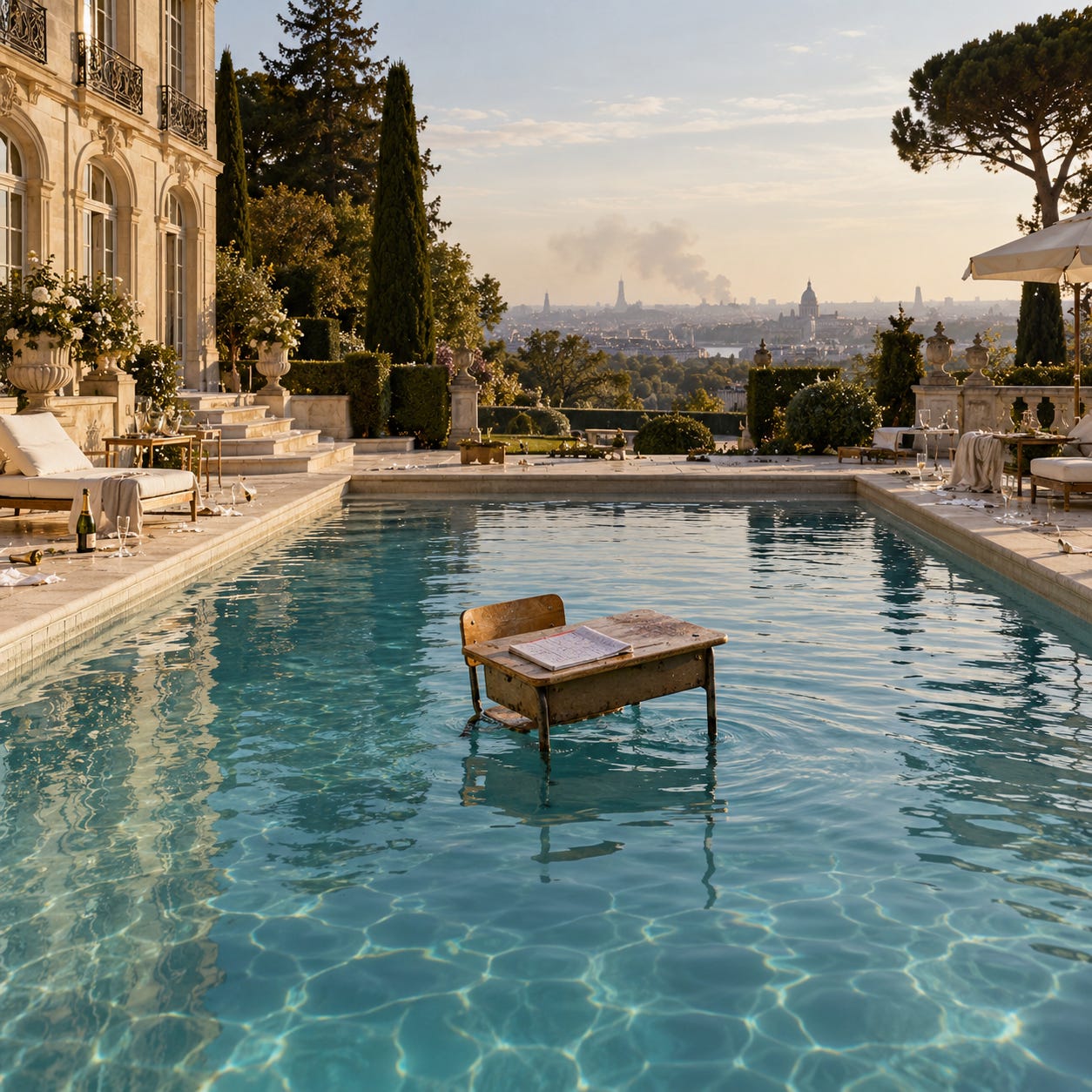
The following Saturday, he attended a pool party at a villa in Saint-Cloud.
There were twenty-seven men, two women, a Ukrainian DJ, four waiters, and a Labrador named Voltaire.
Nobody knew who owned the Labrador.
The guests were almost entirely gay, which gave the gathering an atmosphere of extraordinary physical discipline combined with intellectual chaos. Men who had spent their mornings measuring their protein intake were now explaining the decline of Western civilization over champagne.
A television beside the pool was tuned to CNews.
A bearded commentator named Philippe Pradeau was speaking. Pradeau had developed a successful career by asking questions so loudly that answers became impossible.
“WHERE IS THE REPUBLIC?” he demanded.
His guest attempted to respond.
“NO, NO, I’M ASKING A SIMPLE QUESTION!”
A man in swimming trunks applauded.
“Finally, someone says it.”
His name was Charles-Édouard. His father owned several logistics companies. He had recently announced that France was becoming unrecognizable, despite spending eleven months each year between Paris, London, and Mykonos.
“Immigration is the problem,” he declared.
His Portuguese personal trainer brought him another drink.
“Merci, Miguel.”
“It’s Manuel.”
“Of course.”
Adrien watched in silence.
His friend Laurent, who worked in television production, approached wearing sunglasses that cost more than a month’s rent in Sevran.
“You seem distracted.”
“I met someone.”
“Good-looking?”
“Yes.”
“Rich?”
“No.”
“Artist?”
“No.”
Laurent removed his glasses.
“How poor?”
“Why does that matter?”
“I’m trying to understand the degree of adventure.”
Adrien said …