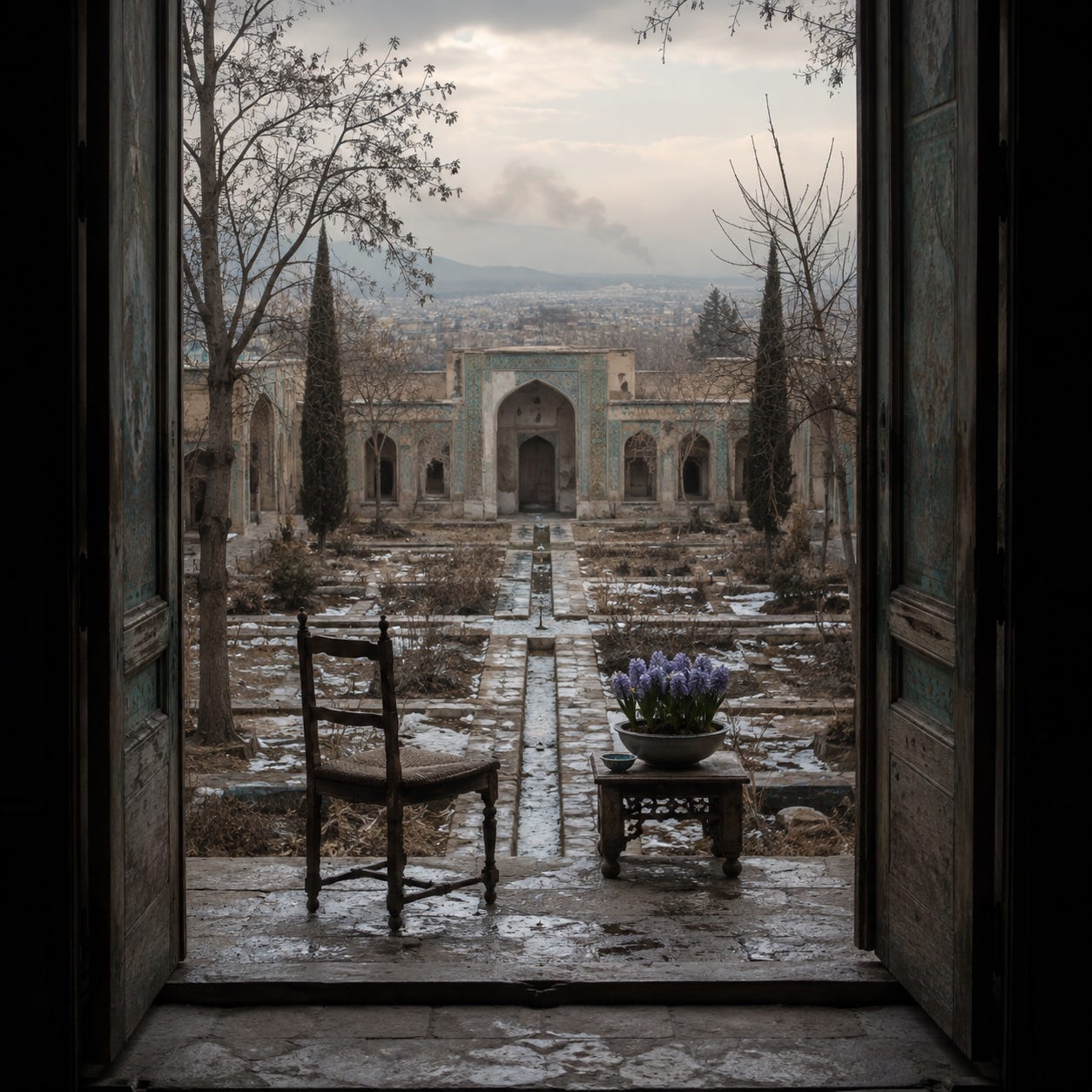
There is something about the faces of Iran’s rulers that has always bothered me. I do not mean that as physiognomy. I do not believe evil announces itself through the arrangement of a man’s eyebrows, nor that cruelty can be diagnosed from a photograph. History has given us smiling murderers and severe-looking saints. But watch enough footage of Ruhollah Khomeini speaking, and then Ali Khamenei, and a certain emotional register becomes difficult to ignore: the tightened mouth, the suspicion, the grievance, the sense that the man addressing the country is somehow also offended by it. They rarely looked happy to me. More than that, they rarely looked at ease with life. There was always an enemy: America, Israel, the hypocrites, the seditionists, the Westoxicated, the corrupt, the liberals, the monarchists, the unbelievers, the improperly veiled girl, the writer, the student, the musician, the person who had misunderstood Islam, the person who had understood Islam incorrectly, the person who had understood Islam correctly but arrived at the wrong political conclusion. And somewhere behind all of them stood the Iranian citizen, requiring instruction.
It made me wonder about something simpler than politics. How does a person live like this? How does a man authorize executions and then go home? Does he drink tea? Does he ask about a grandchild’s fever? Does he pray? Does he lie in bed and encounter, even for a few seconds, the fact that another human being once begged not to die and that his government killed him anyway? I used to imagine conscience as a final barrier, something buried so deeply in the human animal that ideology could never fully reach it. I am less certain now. Perhaps the most frightening thing about political cruelty is not that cruel men possess no conscience. It is that conscience can be reorganized. A man does not need to tell himself, I am killing an innocent person. He can tell himself, I am defending Islam. I am protecting the revolution. I am preserving the nation. I am defeating corruption. I am preventing chaos. I am doing what weaker men are too sentimental to do.
The condemned person has to disappear first, not physically but linguistically. He becomes a traitor, a spy, a hypocrite, an enemy of God, a counterrevolutionary, a terrorist, a foreign agent. Once the category is secure, the person becomes easier to kill. This is not particularly Iranian. Human beings have performed this operation everywhere. But Iran has endured it with an exhausting regularity. Kings did it without Islam. Revolutionaries did it without crowns. Modernizers did it in the name of progress. Clerics did it in the name of God. The justification changes. The dagger remains.
The Angry Men
Perhaps this is why Iranian authority has so often carried the emotional texture of grievance. The ruler is powerful, but he speaks as though he is the injured party. He possesses the prisons, the army, the tax authority, the television stations, the courts, the police, and perhaps the oil beneath the ground, but still he is surrounded by enemies. He is betrayed. He is disrespected. He is undermined by foreigners. His generosity has been misunderstood. His reforms have been resisted. His religion has been insulted. His throne has been threatened. He possesses power and experiences himself as the victim. That combination is dangerous because a ruler who experiences himself as both powerful and wronged can convert punishment into emotional justice.
Iran has known many versions of this man: the Qajar shah surrounded by intrigue and provincial rivals, the Pahlavi monarch convinced that backwardness and conspiracy were frustrating his national project, the revolutionary cleric convinced that a corrupt world had declared war upon Islam, the security official certain that an unveiled teenager is somehow participating in the designs of hostile powers. They are very different men, and their worlds should not be flattened into one another. But they inherit a remarkably durable assumption: that those beneath them are not simply citizens with competing interests. They are material to be managed, corrected, protected, modernized, purified, educated, disciplined, or saved. The ruler knows. The population is known. Perhaps the deepest Iranian political wound begins there.
The Country of the Dagger
Why did this happen so often? The answer cannot simply be that Iran was unlucky. One bad ruler may be an accident. Centuries of concentrated, suspicious, violent government require something closer to an ecology. Look at the land. Iran is a plateau broken by mountains, deserts, valleys, oases, and long distances. The Zagros rise in the west. The Alborz wall off the Caspian. Great arid expanses separate concentrations of settlement. Historically, water itself could determine where stable human life was possible. Before railways, highways, telecommunications, modern taxation, and bureaucratic records, governing such a place from one capital was extraordinarily difficult.
A shah in Tehran could issue an order. That did not mean a village hundreds of miles away would obey. So the ruler needed men: a governor, a tribal chief, a tax collector, a military commander, a local notable, a prince, someone who could turn distant royal intention into immediate physical reality. And what made such a man useful? Not his sensitivity to the people he governed. His usefulness was measured upward. Could he collect taxes? Could he keep the road open? Could he suppress revolt? Could he deliver soldiers? Could he prevent another faction from taking the province? Could he send money back to the center? A gentle official who failed at these tasks was ineffective. A brutal official who succeeded could be valuable. Thus begins an old political bargain: the center delegates coercion, the intermediary extracts what he can, the population survives between them.
But the ruler also fears the intermediary. The same governor capable of controlling a province is capable of controlling it for himself. The same general who protects the throne can overthrow it. The same minister who makes the government work can become more popular than the sovereign. So the ruler watches the men he has empowered. He rotates them, humiliates them, confiscates their property, arranges marriages, uses spies, creates rival factions, sometimes kills them. Where institutions are weak, fear becomes administration. A modern state can communicate authority by issuing standardized rules through a professional bureaucracy. A weaker state can communicate authority through a body. Everyone hears what happened to the rebellious governor. Everyone understands what it means when property is seized. Everyone learns from the man who disappeared. Terror is crude, but it is legible. The dagger substitutes for the institution.
Iran eventually acquired ministries, railways, universities, oil fields, telephones, intelligence agencies, fighter jets, databases, and nuclear scientists. But an older reflex survived beneath all this modernity: when control becomes uncertain, reach for punishment.
How the Country Kills Its Better Men
There is a particular tragedy in systems built around personal power: competence can become threatening. Iran offers almost too perfect an example in Amir Kabir. He rose in the nineteenth century under Naser al-Din Shah and attempted something Iran desperately needed: a more rational state, fiscal discipline, administrative reform, education, reduction of court waste, the building of institutions that might function beyond the appetites of courtiers. He was exactly the sort of man a fragile country should have protected. Instead, he became dangerous. He had stature. He had judgment. He had enemies. He did not depend entirely upon the whims of the people whose privileges he was dismantling. Eventually the Shah dismissed him. Then Amir Kabir was killed in the bathhouse at Fin. His veins were opened.
A country does not experience such a killing only once. Ev…