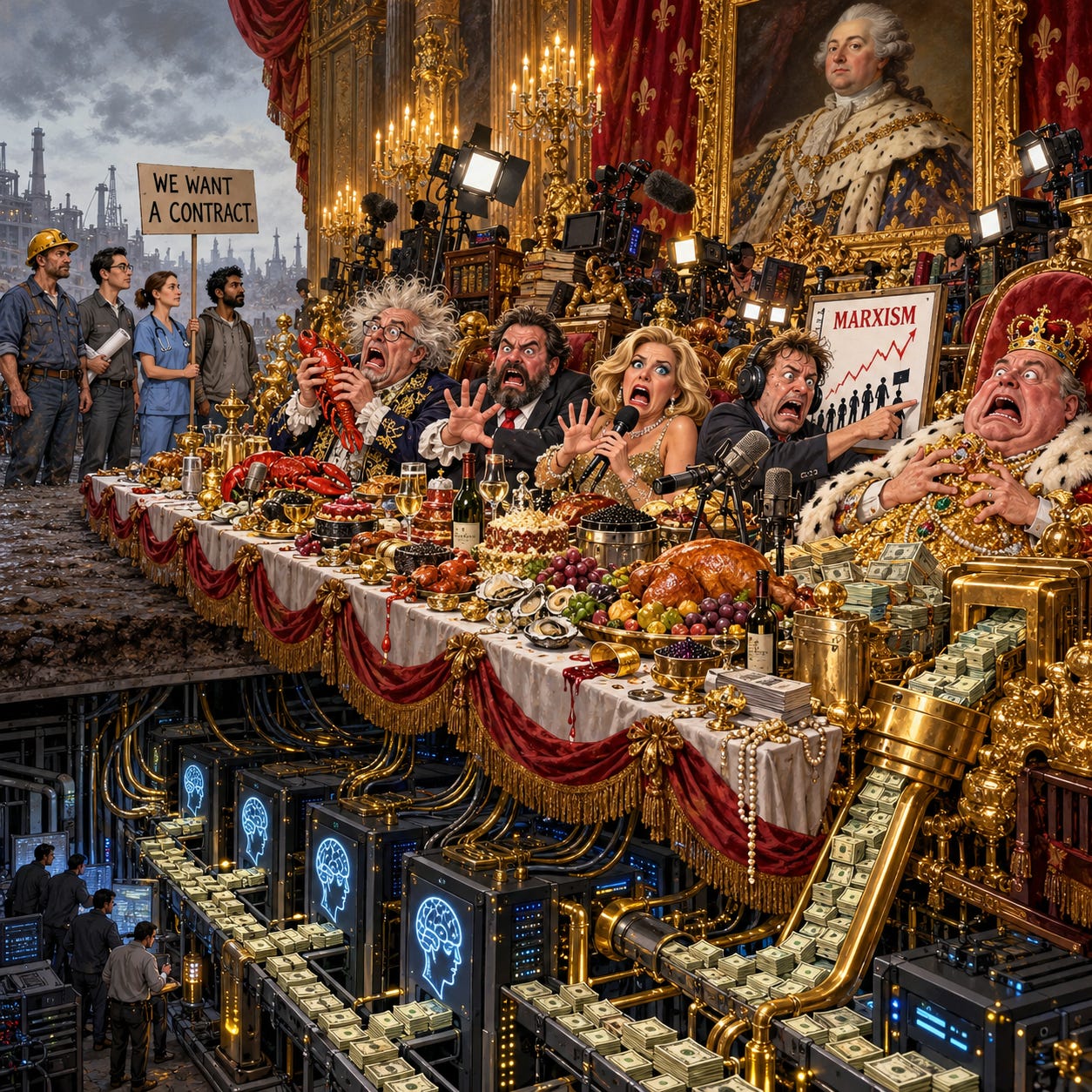
I. The Emergency Committee for the Preservation of Everything
The emergency meeting began at nine in the morning, which Professor Bartholomew Grievance considered an act of Marxist aggression.
He had spent the previous evening recording a three-hour podcast explaining why civilization was collapsing because a university librarian in Vermont had suggested renaming the motherboard the parentboard. He had connected this development to Carl Jung, the Babylonian captivity, the castration of Uranus, and something he called the Postmodern Neo-Marxist Feminization of Electrical Components.
The episode had received fourteen million views.
The librarian, who was sixty-three, had made the suggestion as a joke.
Nobody had asked her.
The professor entered the conference room carrying a leather briefcase containing a Bible, three unread books by Nietzsche, and a collection of newspaper clippings about women who had refused to marry him.
Seated around the enormous mahogany table were Benedict Shrapnel, founder of The Daily Detonation; Gideon Thistlebeard, the world’s leading authority on other people’s genitals; Portia Alarmbell, an investigative journalist who had never investigated anything she hadn’t already decided was true; and Savannah Bellweather, the platinum-blonde host of America at the Precipice.
Savannah was applying lipstick.
“Is this about the homosexual penguins again?” she asked.
“No,” said Benedict. “Those were last Thursday.”
“Thank God. We did penguins for six hours.”
“We have a more serious problem,” announced Augustus P. Vault.
Vault owned the studio, the building, the broadcasting network, three private prisons, two defense contractors, a pharmaceutical distributor, and forty-seven percent of a corporation manufacturing autonomous weapons systems. He was seventy-four years old and had spent most of his life warning the public about the dangers of government intervention while receiving approximately eight billion dollars in government contracts.
He placed a document on the table.
“Our employees want to unionize.”
Nobody spoke.
Then Gideon crossed himself.
“Dear God.”
“Precisely,” said Vault.
Bartholomew adjusted his glasses.
“Well, you see, Augustus, this is precisely what happens when you abandon the archetypal structure of the masculine household. The father, you understand, represents the ordering principle, whereas the union represents the primordial chaos of the devouring feminine—”
“They want health insurance,” said Vault.
“Exactly. The maternal archetype.”
Benedict leaned forward.
“Actually, if you look at the statistics, unionized workers have a statistically significant tendency toward collectivist arrangements, which historically correlate with communist atrocities, and if you disagree with that, you’re disagreeing with mathematics.”
“What statistics?” asked Savannah.
“All of them.”
Vault rubbed his temples.
“The employees at CrownMind are discussing collective bargaining. They’re asking whether replacing half the workforce with artificial intelligence should entitle them to some share of the productivity gains.”
The committee considered this extraordinary proposition.
“That’s theft,” said Benedict.
“They haven’t stolen anything,” said Vault.
“They’re proposing to.”
“How?”
“By asking.”
Portia opened her laptop.
“I’ve found something.”
She turned the screen toward the others.
A twenty-one-year-old anthropology student at a small college in Oregon had posted a video suggesting that competitive chess reinforced patriarchal assumptions about kings and queens.
The video had seventeen views.
“This,” Portia announced, “is the face of the modern left.”
Gideon stared at the screen.
“Is that a man?”
“Doesn’t matter,” said Portia. “I’ll say it is.”
Savannah immediately began rehearsing her opening monologue.
“Tonight, Americans are asking a simple question: Has the radical left declared war on chess?”
“Excellent,” said Vault.
“Perhaps we can connect chess to the union situation,” offered Bartholomew. “You see, the board itself is a metaphor for the distribution of labor within a hierarchical society. The king occupies—”
“Bartholomew,” interrupted Vault. “We don’t want to connect them.”
“Ah.”
“We want people to forget the unions exist.”
The professor looked relieved.
“Oh. Well, that’s considerably easier.”
Portia had already found a second video, this one featuring an obscure activist who claimed that sandwiches were colonial constructs.
“She has eleven followers,” Portia said triumphantly.
“How many Americans does she represent?” Savannah asked.
Benedict opened a spreadsheet.
“Approximately ninety-four million.”
“How do you know?”
“I multiplied.”
“By what?”
“A number.”
The committee was making excellent progress.
By eleven, it had identified twelve existential threats to Western civilization, including gender-neutral potatoes, a vegan children’s puppet theater in Massachusetts, and an unpublished doctoral dissertation on the semiotics of shoelaces.
Nobody had mentioned wages.
Then an assistant entered carrying coffee.
“Excuse me,” she said. “The production crew wanted to know whether the company has responded to their request for paid sick leave.”
Vault reached beneath the table and rang a little silver bell.
Ding.
“CULTURE,” he announced.
Savannah snapped her fingers.
“Can we say paid sick leave is a Chinese concept?”
“Possibly,” said Benedict. “Let me check.”
Bartholomew was already speaking.
“The very notion of sickness, you understand, when placed within the broader context of post-Enlightenment materialism—”
The assistant quietly left.
She earned eighteen dollars an hour.
The discussion continued until lunchtime, when Vault’s private chef served a selection of ethically sourced vegetables accompanied by beef flown in from Argentina.
Gideon refused the vegetables on principle.
“I believe in natural hierarchies,” he explained.
“Of course,” said Savannah.
“The lion does not negotiate with the gazelle.”
“Beautiful.”
“The wolf does not ask permission of the sheep.”
“Powerful.”
“The masculine lobster establishes dominance through ritual combat.”
Bartholomew looked up.
“Actually, that’s my department.”
At three, Vault rose to conclude the meeting.
“Gentlemen. Ladies. We have a civilization to defend.”
Savannah smiled.
“Western civilization.”
“Precisely.”
“Against the Marxists.”
“Certainly.”
“And the chess people.”
“Especially the chess people.”
Vault walked toward the windows overlooking Manhattan.
Far below, delivery workers hurried between cars, nurses entered crowded subway stations, construction workers crossed dangerous scaffolding, and a man with two jobs slept sitting upright on a public bench.
None of them had heard of the anthropology student in Oregon.
None of them had read the doctoral dissertation about shoelaces.
Most were concerned about rent.
Vault regarded the city affectionately.
“Look at them,” he said. “Our people.”
“Indeed,” said Bartholomew.
“Everything we do, we do for them.”
Savannah checked her reflection in the window.
“Augustus, darling, what exactly are we defending?”
Vault appeared momentarily confused.
Then he laughed.
“Western civilization, of course.”
“But what is Western civilization?”
He thought about this.
“Well,” he said, “at the moment, it’s mostly mine.”
II. The Day God Invented the Right
Versailles, September 11, 1789.
Étienne Bric-à-Brac had been employed by the French National Assembly to manage ink, chairs, documents, and the occasional aristocrat who had fainted upon discovering that peasants possessed opinions.
He was twenty-seven, badly paid, and afflicted with the unfortunate habit of noticing things.
On the morning of September 11, his principal concern was a shortage of writing paper.
France, meanwhile, was undergoing a revolution.
The Bastille had fallen. Feudal privileges had been formally abolished in the decrees of August. The Declaration of the Rights of Man and of the Citizen had been adopted. The ancient political order was being dismantled with terrifying speed.
The deputies were gathered in the Salle des Menus-Plaisirs, where they had occupied themselves for months with the delicate business of determining h…